War Preparation as a Societal Project
Here is a version of about 20 minutes without restrictions – our OVALmedia subscribers can enjoy the full programme.
Watch the full film with OVAL Abo
Above you can watch a short version.
from €7 / month · cancel anytime · this and all other films, shows and articles
Already a subscriber? Log in
War Preparation as a Societal Project
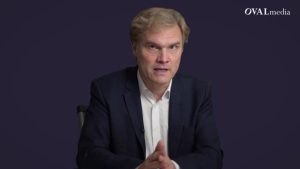
– Lecture by Wolfgang Effenberger
In his lecture, Wolfgang Effenberger draws a broad historical line: wars do not arise suddenly but are prepared systematically – politically, economically and psychosocially. From the Peloponnesian War and the Roman–Carthaginian conflicts to US propaganda in the Spanish–American War of 1898, he shows how images of the enemy, media manipulation and social mobilisation have always gone hand in hand. This dynamic continues to this day.
The conceptual core is the US strategy document TRADOC 525-3-1 “Win in a Complex World” (2014–2040), which plans war no longer as a state of exception but as a permanent condition – across all domains: land, air, sea, cyberspace and, increasingly, the human mind. This is complemented by the concept of the so-called “Omniwar” (David A. Hughes): an invisible, omnipresent war that steers the population through smart technologies, biodigital systems and cognitive warfare and reduces democratic structures to a mere backdrop of legitimacy.
Effenberger sees Germany in the thick of it: for him, the Bundeswehr’s “Operationsplan Deutschland” (Operation Plan Germany), the Bundestag’s multi-billion debt package of March 2025 and the mobilisation of society for the “case of defence” do not mark security policy but an anti-Russian escalation strategy in the service of American hegemonic interests. The biggest errors, he says, are the belief that deterrence automatically secures peace and the illusion that modern wars are controllable.
His conclusion: war preparation today is a transformation project for society as a whole. The necessary counter-project – peace research, media pluralism, democratic control – is the real defence of democracy.
See also:
War Concepts – Wolfgang Effenberger | NARRATIVE #223
Wolfgang EffenbergerWar preparation as a societal project: interests, ideologies and errors. Wars do not break out suddenly, but since antiquity have generally been prepared carefully and systematically. The historical causes of war often lay in tensions arising when a rising power challenges an established one. As in the example of Athens and Sparta. Graham Allison popularized this as the Thucydides Trap in his 2017 book "Destined for War: Can America and China Escape Thucydides's Trap?" In Allison's study, 12 of 16 rivalries over the past 500 years ended in war. Thucydides, an ancient Greek historian and strategist from Athens, emphasizes in his History of the Peloponnesian War that the real reason for the war was not only military in nature, but above all lay in the political fear of Athens, a superior naval power with Greece's strongest fleet, of the rising land power Sparta, in which the declining power's readiness for war gains momentum.
The connection between comprehensive preparations for war and society, mobilization, training, social disciplining and moral legitimization lies in the deep political, social and cultural interconnectedness. Thucydides achieved a reflection on the philosophy of history that, in its essential features, explains the actions of great powers today. For him, the mechanisms of war are rooted in human nature and in political laws, then as now. And Thucydides' doubt about humanity's capacity for moral development has still not been dispelled. Political tensions lead to social disciplining and comprehensively mobilize resources and the will to wage war, so that the Thucydides Trap today, too, manifests itself as a complex interplay between political fears of power and social as well as cultural factors.
The three wars of Rome against Carthage may also serve as an example, from 264 to 146 BC. After defeating Carthage, Rome controlled large territories in Spain and North Africa, which let Rome rise to become the dominant power in the Mediterranean. This brought a lot of money and slaves to Rome. Rich senators became even richer, large estates emerged, while small farmers lost their land. This also greatly changed Roman society. There was political instability, conflicts between rich and poor, and attempts at reform, for example by the Gracchi brothers. These tensions later destabilized the Republic. The new wars gave rise to large standing armies, in which soldiers were often more loyal to their generals than to the state.
This led to power struggles between generals such as Julius Caesar and Pompey. War seems to be a fundamental cultural phenomenon of human history that accompanied the development of complex societies. Preparing for wars involved planning, mobilizing society, strategic deception and enlisting allies in order to maximize the chances of victory. The examples show that warring powers often developed tactics years in advance, forged alliances and created the political as well as economic conditions needed to begin a war to their advantage. The principle that war goes hand in hand with extensive physical and psychological preparation is consistently documented throughout history.
From early city-states to modern conflicts, whose propagandistic preparation has gained new momentum since the US attack on the then great power Spain in 1898. The yellow press played a decisive role in the warmongering back then, stirring up public opinion against Spain with sensationalist reports. Newspapers such as William Randolph Hearst's New York Journal and Joseph Pulitzer's New York World reported exaggeratedly on Spanish atrocities in Cuba, invented stories about torture and concentration camps, and used dramatic headlines like "Remember the Maine" after the ship explosion in late February 1898.
Through comic elements and false reports, circulation soared. Hearst is said to have said: "You furnish the pictures, I'll furnish the war." This fueled feelings of revenge and chauvinism. Thus the press turned the conflict into the top national issue, put pressure on President McKinley and made the war politically unavoidable. In the night leading up to May 1, 1898, the US war fleet steamed into Manila Bay and at around 5 a.m. opened fire on the Spanish fleet anchored there. The Spanish recognized this attack too late. All Spanish ships sank, while the US Navy suffered no losses. The late 19th century was marked by the efforts of the European and North American powers to expand their colonial empires.
The Spanish-American War marked the starting point of American imperialism, which constantly sought new spheres of influence, manifested in the takeover of the Philippines, Cuba and other states, and which today shows itself in the strategy paper TRADOC 525-3-1 titled "Win in a Complex World 2020 to 2040". The global context since 1898 is marked by a continuous series of warlike conflicts deeply rooted in geopolitical, economic and social dynamics. So too the Second Boer War of 1899, Alfred Milner. Milner was the right-hand man of Cecil Rhodes, First War, with British historians also calling World War I Milner's Second War.
These wars are exemplary of the expansion and militarization of Western powers. The Boer War in South Africa was a struggle for control of territory and of resource-rich regions, I remind you of gold and diamonds, which underscored the great powers' influence over global resources. Since 1898, wars and conflicts have not been exceptional events, but the expression of a continuously intensifying dynamic of economic interests, political power projection and psychological mobilization. These factors added up to a global tendency to resolve conflicts by force in order to increase resources and influence.
A development that forms the key to the emergence of large-scale, catastrophic wars. International stability was increasingly clouded by these conflicts, and the ever-growing militarization of states paved the way to World War I. Within the respective states, military mobilization led to extreme social tensions, nationalism and the marginalization of opposition groups. The principles of Manifest Destiny and Lebensraum ideology drove the USA, Britain, Germany and other powers to assert their geopolitical interests aggressively. Wars were also fueled by collective fears, national identity and enemy images.
Through propaganda, controlled media and social mobilization, war preparation was given a social existence, a dynamic still found today in the militarization of social discourse. Media and the public played a central and multifaceted role in US war policy, especially since the late 19th century and during the wars of the 20th century. The main aspects are mobilization and opinion control. The US government used the media strategically to win the public over to military deployments and to promote national cohesion. Coverage was often supportive, especially in the early phases of conflicts.
The media served as an essential instrument of propaganda and opinion-forming, with the aim of presenting wars as necessary and justified. The press often exercised voluntary restraint so as not to endanger the war effort. At the same time, critical or oppositional reporting was sometimes suppressed or marginalized. From the Vietnam War on, television became the most important medium. The visual and immediate depiction of war fundamentally changed public perception. At least back then. Images of the wounded, war destruction and civilian casualties led to a shift in public opinion, which shook political support for the war.
Investigative reporters occasionally exposed government deception, as with the Pentagon Papers during the Vietnam War, which shook trust in government and the military and radically changed the social discourse on war policy. In 1973, two years before the official end of the Vietnam War, when defeat in Vietnam became apparent and tensions at home became visible, the US Army founded a new command. The Training and Doctrine Command, abbreviated TRADOC. Officially, it was meant to draw lessons from a lost war, modernize training and doctrine, consolidate combat development and prepare the army for future conflicts.
Unofficially, TRADOC marks the beginning of a new phase. War becomes the subject of a thoroughly rationalized, permanently institutionalized production of knowledge, of a technocratic war administration. From the start, TRADOC was more than just a training agency. It is training, scenario development, systems analysis and long-term planning for the future in one. The army's own center of knowledge and control, designing the army of the future. The military becomes a place where data, models, simulations and expert panels decide how war is planned, practiced, waged and legitimized. As early as 1970, the Polish political scientist Zbigniew Brzezinski presented a diagnosis in "Between Two Ages" that can be read as the ideological framework for this development.
In it he describes the transition from the industrial to the technetronic society, in which electronics, communication technologies and theoretical knowledge become the central driving forces of political and social order. Since the 1991 Iraq War, media have increasingly been used as a weapon of war to support psychological warfare and to influence one's own population as well as the enemy. At the same time, thanks to social media and 24-hour news cycles, narratives about wars are today more complex and often polarized. In summary, since the late 19th century, media and the public have been for the USA both a means of war mobilization and a space of social debate and control.
Both sides influence each other in complex ways between propaganda, enlightenment and criticism. In World War I, the US government used a targeted and comprehensive propaganda strategy to prepare the public to support the war and to legitimize entering it in 1917. They created a clearly polarized enemy image shaped by emotion, stereotypes and moral superiority, in order to present the war as justified and to mobilize their own society against the others. Depictions of racist prejudice served to intensify social and ethnic tension and to secure support for the war.
Many members of marginalized groups withdrew from public discussions or political engagement in the face of hostile, defamatory portrayals. The constant attacks on identity and belonging led to fear, shame and insecurity. Minorities in particular suffered under these emotional burdens, which made their social integration more difficult. The propaganda-built enemy images contributed to long-term prejudice and discrimination that remained in social consciousness even after the war ended. Overall, the affected communities behaved somewhere between resistance, adaptation and withdrawal, depending on social opportunities and the degree of social marginalization.
These reactions were part of a complex process of dealing with propaganda and social exclusion. Overall, US propaganda in World War I showed how ethnic prejudice and aggressive enemy images contributed to a social consensus for war and the waging of war, by dehumanizing social groups and portraying them as a threat. The First World War, and no end in sight. A look at the globe shows that all the fault lines that led to the First World War have reopened. An end is only possible through a genuine reckoning with the past. With the founding of the Fed in December 1913, US capital was already intervening in the war in 1914.
The Entente received extensive loans from the very beginning. The goal of the money elite in the USA and Great Britain was to destroy the continental dynasties in Europe and, in line with Halford Mackinder's Heartland Theory of 1904, to prevent any dominant power from emerging in Eurasia.. In mid-November 2022, the Congressional Research Service of the US Congress highlighted this connection in its briefing materials for the Senate and House of Representatives. To prevent regional hegemony in Eurasia, many US military operations in the First World War and the Second World War, numerous military deployments and everyday operations of the USA since the Second World War appear to have been carried out, to no small degree, in support of this goal.
Three months later, General Keith Kellogg spoke in similar terms in a Senate hearing when he gushed to Senator Rick Scott. Mind you, General Kellogg is now the coordinator for Ukraine and Russia. I quote him: If you can defeat a strategic adversary without deploying US troops, you are at the pinnacle of professionalism. Because if you let the Ukrainians win, a strategic adversary is off the table and we can focus on what we should be doing about our main adversary. And that is China right now. And if we fail at that, we may have to fight another European war.
That would be the third time. End of quote. Well, the odds are not bad. With the US document 525-3-1, Win in a Complex World, 2020 to 2040, adopted back in September 2014, the West is sliding down the slippery slope into the Third World War. When I asked artificial intelligence what relevance the long-term US strategy paper Win in a Complex World has today, the answer was, and I quote: It has great relevance today for the orientation and development of the US Army and its operational concepts. According to section 2, point 4, Future Conflicts, and key sections of the US strategy paper, the explicit goal of the US armed forces is, together with allied and multinational forces, to actively counter the threats posed by Russia and China, to reduce them and, if it comes to it, to win militarily.
The document sets out a clear security-policy orientation toward the possibility of large-scale conflicts and wars against technologically and militarily equal or nearly equal adversaries such as Russia and China and, as we now see, perhaps Iran as well. In October last year, the US command Training and Doctrine Command was merged with the Army Futures Command under a single command, the new United States Army Transformation and Training Command, abbreviated T2COM. The merger took place under similar circumstances as in 1973: defeat in Ukraine is visible and the USA faces a severe test.
Now the task was to pool forces for all-encompassing war, the Omni-War. The omnipresent war, from the cell nucleus to the stratosphere. In David Hughes's Omni-War concept, smart technologies and biodigital systems serve as central weapons that permeate the human body, mind and everyday life in order to establish control. Hughes introduced the concept in his works published in 2024 and developed it there as an analytical model of a covert, omnipresent war. In his book Covid-19, he argues that since 2020 the pandemic has initiated the Omni-War as the Third World War, a total conflict over technocracy that permeates cognition, society and biology.
In his book Wall Street – The Nazis and the Crime of the Deep State, 2024, he places the Omni-War context in a historical framework, namely eugenics and National Socialism. In lectures and Substack articles, Hughes further developed the term Omni-War and used it as a tool to explain global technocracy offensives, closely related to cognitive warfare and the T2COM transformation logic. In Omni-Wars, according to Hughes, invisibility is the greatest weapon. The public realizes neither the enemy nor the attacks, because everyday systems are being targeted, namely food, technology and health. The goal is a technocracy under elite control with complete biodigital convergence.
With his Omni-War model, Hughes seeks to describe the covert World War III waged by a transnational elite against humanity and sees in the attacks of Covid, 5G and AI a coordinated elite offensive to establish technocracy. By means of a communication platform linking the human body to future 6G networks, the Internet of Bio-Nano-Things, Neuralink and neurotech, World War III is already underway, asymptotically and irreversibly. A biodigital control network is being built that steers thoughts, behavior and mortality and will enslave people. Within this overall complex, cognitive warfare is then used as a nuclear weapon.
According to Hughes, the existing control system, namely capitalism and the surveillance state, fell into crisis in 2019. In 2020, the "plandemic" was used as a trigger for a revolution from above. Technocracy as a successor model, with central planned economy via smart technology, makes the Omni-War operational. In the order of the Omni-War, democracy is less a form of government than a language in which we promise ourselves freedom. Participation, equality at the ballot box, public debate. Yet the more the procedures remain intact, elections, parliaments, talk shows, participation formats, the more easily we overlook that the real levers of power have gradually shifted.
Into committees, agencies, central banks, security apparatuses, technical infrastructures and algorithms. The instruments of administration lead us step by step out of a political existence and into a technical one. What formally appears as an expression of the popular will is in fact often the retroactive legitimation of decisions that were long since made in expert groups, committees, platform governance boards, rating agencies and rational regimes.. Where the room for maneuver of these bodies is coded as a practical necessity, the democratic ritual becomes a soft-power technology. It generates consent to processes that are largely beyond the citizens' reach.
Democracy as the Omni-War's cloak of invisibility stabilizes the fiction that we decide together, while the war inscribes itself into administrative logic as permanent optimization, surveillance and risk management. The expansion of security, health, climate and financial regimes is then experienced as a democratically legitimized necessity. Dissent appears as a problem that the system has to manage. In this constellation, democracy is functionally recoded. It serves to give the Omni-War the signature of free consent. The actual disempowerment takes place where citizens are no longer addressed as political subjects but as a population to be steered.
As consumers, users, risks, data points. The task of critical theory is then to look behind the democratic surface and to make visible the places where the language of freedom has become the infrastructure of a cold technocratic war against the political self. In the political vocabulary of recent years, transformation has condensed into a guiding formula and becomes the central technique of the Omni-War. War turns from an extraordinary event into a structure of the world order. A state in which rule is organized as a permanent operation over bodies, data, infrastructures and consciousness.
It is about the deep patterns of a system that integrates conflict, control and crisis management into the normal state of affairs. Technocracy grows out of democracy. Step by step, decision-making centers shift from parliaments to expert panels, standard-setters and regulatory bodies. Precisely their apparent gentleness, the absence of open terror, the language of efficiency, evidence and responsibility, proves deadly to the political, namely to dispute, uncertainty and genuine alternatives. At its core, an anthropological question arises. What remains of the human being when the cold spirit of war colonizes the key concepts of our time?
Namely security, health, sustainability, responsibility. When these concepts no longer open up spaces for shared reflection but serve as levers to steer behavior, pathologize deviation and optimize systems? In the Omni-War, classical hard power, that is, open repression and visible violence, is used only where soft power fails. The preferred aim is to lead people toward desired options by designing default options, information or presentations so that the desired behavior becomes more likely, without coercion or prohibitions. Conformist behavior is also to be generated through threat scenarios in security discourse as well as in health and climate policy.
Outwardly, self-determination dominates, while the decision parameters are set by technocratic regimes. Those who comply are considered responsible, those who deviate are seen as threats. The Omni-War aims at transforming the human being from a political being into a managed, optimized, calculable data carrier. Technocratic instruments, biometrics and AI-supported surveillance intrude into existential areas. Body, mobility, communication, financial participation. Democratic rhetoric conceals that central life decisions are no longer made politically but technically and administratively. Under Omni-War conditions, democracy becomes a soft-power brand that labels interventionist policy, regime-change operations, sanction regimes and information warfare as the promotion of freedom.
The actual function is the integration of states and populations into technocratic control laws. Domestically, the permanent state of emergency legitimizes itself, namely security, pandemic, climate and financial crises, with the promise of protecting the democratic order. In fact, the relationship is reversed. Democracy now protects the system from the population, not the other way around. And to this end, the strategic chain from transformation to T2COM was forged. We have transformation, that is artificial intelligence and nanotechnology, transhumanism, which wants to create a new upgrade of the human being, cognitive warfare, which is the manipulation of the mind, and the Omni-War as the total conflict, and then T2COM as the command center that steers truth and perception.
Transformation is not a political process but a military-inspired operational plan. In the political vocabulary of recent years, transformation has condensed into a guiding formula and left no field untouched. Digital transformation of administration and the economy, green transformation of energy, mobility and production systems, security transformation of the police, military and intelligence services, and soon the transformation of health care, education or finance. Transformation never appears as an option, but always as a necessity, as a time-critical task that is scientifically mandated, without alternative, system-relevant, and whoever hesitates supposedly endangers prosperity, security, the climate or health.
This rhetoric reveals the technocratic core of the present. One defines a target vision: climate-neutral, resilient, digitally sovereign. It then sets out a schedule and a roadmap and assigns responsibilities. In this grid, people and society appear as systems that are to be optimized, hardened, made more efficient, not as historically grown, contradictory, conflict-ridden entities that must be understood, questioned, criticized. Military terms thus dominate the language of transformation. Situational picture, threat analysis, goal definition, resource allocation, execution, monitoring. What in the military context related to the enemy and the battlefield is now aimed at infrastructures, patterns of behavior, norms and consciousness.
Whoever evades the transformation plan is a disruptive factor in the system. The logic of war – identify, rationalize, neutralize – penetrates the heart of society, albeit in the language of efficiency, sustainability and security. In this way, transformation and technocracy become intertwined. The operation plan replaces debate, the target vision replaces the dispute over goals, the project replaces politics. The public may only talk about the pace, but no longer about the direction. Expert panels define what counts as realistic, responsible, scientifically sound. In this configuration, transformation becomes the central technique of Omni-War.
It turns war into modernization and discipline into progress. The gradual submission to technocratic protocols is interpreted as rescue and necessity. Consequences of current war preparations with regard to TRADOC 525-3-1, Omni-War and T2COM In an unknown, unpredictable, constantly changing world, the US Army is to offer multiple options and be deployable across all domains – land, air, sea, space and cyber – and partners. Adversaries are to be confronted with multiple dilemmas, that is, permanently overwhelmed. Win is defined as a strategic victory for society as a whole, not just as a military battle.
Social consequences are the lasting alignment of research, economy, diplomacy and media to a permanent state of emergency. Militarization of everyday infrastructures, networks, data, logistics as a civil-military economy. Omni-War is extended into all areas of life and especially into the human mind. The goal is thus superiority in the cognitive domain by means of psychological operations, disinformation, algorithm-assisted influencing of perception and decisions in peace as in war. The dissolving of the boundary between information, propaganda and war triggers an erosion of trust in the media, science and institutions.
T2COM aims to reinforce an organizational logic geared toward permanent war and permanent transformation, with a pull effect on allies. When societies in peacetime steer toward war, a dynamic arises that drives technical innovation, political mobilization and collective emotions in a common direction, into a spiral of raging destruction. Raging destruction can thus be read as a metaphor for the acceleration and unbounding of destructive potentials, economic, technological, cultural. War preparation means not only rearmament, but also propaganda, production of enemy images, resource steering and the militarization of science, education and thought.
Above it all, the military-industrial complex seems to reign, accelerating military innovation with the aim of alienating actors from the real effects of violence. At the same time, power projection serves imperial strategies and sees the war economy as a political steering instrument. The people delivered up in this scenario are inescapably bound in by enemy images, collective identity, militarization of thinking, society's habituation to the logic of violence, and fear. This leads to the merging of civilian and military economy, national economies or economic sectors in which goods, technologies and services have both civilian and military applications, and thus to the tying up of resources, social inequality and the restriction of democratic control, surveillance, states of emergency.
Largely invisible beyond that follow traumatization, militarization of everyday culture and erosion of civil society values. Ladies and gentlemen, war preparation today is no longer a purely military matter, but a comprehensive societal project that bundles political, economic and social interests. The current security situation, above all in the context of the Russia conflict, has led Germany to massive rearmament and societal mobilization for possible armed conflicts. This rearmament is accompanied by certain ideologies that equate military strength with security and is based on assumptions that in part foster irrational fears and misjudgments.
In the wake of the argumentative war preparation, errors lurk. For instance, the notion that deterrence always secures peace. But that would presuppose rational action. Yet history teaches us that misunderstandings, misjudgments and escalation dynamics in particular can have fatal consequences. The massive rearmament and the reduction to black-and-white thinking, friend or foe, attack or defense, stoke fears and create enemy images. A fragile security situation arises, in which peace stands on shaky ground. And further, that wars are technically controllable or clean. Reality shows: hybrid warfare, cyberattacks, disinformation – all this reaches deep into our social life and increases the risk of escalation.
The militarization of society goes far beyond the military. It affects civil infrastructure, companies and citizens, who are to be involved in a wide variety of ways. The Bundeswehr demands that our society as a whole become resilient and fit for war. War preparation thus becomes a whole-of-society project with far-reaching implications for democracy and freedom. What is certain is only that a development toward war entails risks for democracy, social cohesion and ultimately for peace itself. The security situation in Europe has changed drastically in recent years.
With the war in Ukraine, the growing confrontation between NATO and Russia and the conflict in Iran, the perception of a direct threat to Germany has become reality again. War preparation as a societal project is not a neutral process, but permeated by interests, ideologies and errors. It is necessary to question these critically, so that together we can create real security for all people. Through peace and not through weapons. With the Operation Plan Germany, Germany's Bundeswehr has launched a comprehensive societal mobilization that prepares not only military forces but the whole of society for possible crises and armed conflicts.
Cities and municipalities must adapt their infrastructure, companies are being included in the planning, and broad civil society support is considered necessary. This shows the societal scope of the rearmament strategy. From the Bundestag comes the Green Paper ZMZ, that is, Civil-Military Cooperation 4.0, a script for war, end of May 2030. The Bundestag's decision in March 2025 on billion-euro loans for the rearmament of the Bundeswehr reflects a political and economic interest that goes beyond mere defense needs and also includes ideological components of a policy of anti-Russian escalation.
The notion that deterrence alone guarantees peace and that war becomes controllable is criticized by numerous experts as an error, since history and current conflict dynamics often show irrational conflict behavior that does not rule out escalation. Together, these indications prove that war preparation is indeed a multilayered societal project with far-reaching political, economic and ideological dimensions. Germany and Europe de facto accept a readiness for annihilation as part of the current geopolitical strategy. This is no longer a theoretical danger, but becomes practically visible in the rearmament, which accepts escalation with unimaginable destruction.
A turning point in Europe's peace. We must not forget what Thomas Mann already warned in 1953: the danger of a nuclear crusade that would completely ruin Russia. This warning is more relevant today than ever, because the nuclear option hovers as a shadow over all military planning, illustrates the intensity of the existential threat and puts central societal and moral questions at the center. War preparation is a bundle of interests – arms industry, geopolitics, loyalty to alliances – ideologies, narratives of security, enemies and progress, and errors: the illusion of controllability, blindness to escalation.
The threshold of what counts as normal keeps shifting. War preparation becomes part of ordinary politics. Hegemonic interests of the USA and NATO. TRADOC documents such as 525-3-1 – formulate a claim to operate in unknown, constantly changing environments worldwide and to be able to project power. Internal rearmament through Omni-War logic. Merging of external and internal security. Surveillance, information and opinion wars against one's own population. The great error: that conflicts could be managed and tightly contained, although doctrines explicitly anticipate incalculable complexity. And finally, four theses.
Thesis 1. War preparation in the 21st century is a whole-of-society transformation project that bundles economic, political and psychosocial processes and is no longer a purely military question. Thesis 2. Doctrines like TRADOC 525-3-1 and structures like T2COM institutionalize the permanent state of emergency. They make permanent uncertainty the basis of planning and permanent war an option of normal politics. Thesis 3. Omni-War and cognitive warfare shift the theater of war into minds and communications. Democratic dispute is thereby easily reinterpreted as a security risk. Thesis 4. The great errors are illusions of controllability of escalating conflicts and the belief that technological superiority automatically ensures stability.
Here it is time that we remember the warnings of Bertolt Brecht from 1951. I quote him: The great Carthage waged three wars. After the first, it was still powerful. After the second one, it was still habitable. And after the third, it could no longer be found. And now, the positive thesis. Societal counter-projects, peace research, transparency, democratic oversight of security apparatuses, media pluralism are not naivety, but a necessary defense of democracy against the logic of the Omni-War. If preparing for war is a societal project, what counter-project do we, as a society, want to set against it?
Thank you very much.
Wolfgang EffenbergerKriegsvorbereitung als gesellschaftliches Projekt: Interessen, Ideologien und Irrtümer. Kriege brechen nicht plötzlich aus, sondern werden seit der Antike im Regelfall vorsichtig und systematisch vorbereitet. Die historischen Ursachen für Krieg lagen häufig in den Spannungen, weil eine aufstrebende Macht eine etablierte herausfordert. Wie beim Beispiel Athen und Sparta. Graham Allison popularisierte dies als Thukydides-Falle in seinem 2017 erschienenen Buch „Bestimmt für den Krieg. Können Amerika und China der Thukydides-Falle entkommen?“ In Allisons Studie endeten 12 von 16 Rivalitäten der letzten 500 Jahre mit Krieg. Thukydides, antiker griechischer Historiker und Stratege aus Athen, hebt in seiner Geschichte des Peloponnesischen Krieges hervor, dass der eigentliche Grund für den Krieg nicht nur militärischer Natur war, sondern vor allem in der politischen Angst Athens als überlegene Seemacht mit der stärksten Flotte Griechenlands vor der aufkommenden Landmacht Sparta lag, in der die Kriegsbereitschaft der absteigenden Macht an Dynamik gewinnt.
Der Zusammenhang zwischen den umfassenden Kriegs- und Gesellschaftsvorbereitungen, Mobilisierung, Ausbildung, soziale Disziplinierung, moralische Legitimation liegt in der tiefgreifenden politischen, sozialen und kulturellen Verflochtenheit. Thukydides gelang eine geschichtsphilosophische Reflexion, die in ihren wesentlichen Zügen das heutige Handeln von Großmächten erklärt. Für ihn gründen sich in der menschlichen Natur und den politischen Gesetzmäßigkeiten die Mechanismen des Krieges, damals wie heute. Und der Zweifel des Thukydides an der sittlichen Entwicklungsfähigkeit des Menschen ist immer noch nicht ausgeräumt. Politische Spannungen führen zur sozialen Disziplinierung und mobilisieren umfassend die Ressourcen und den Willen zum Krieg, wodurch sich die Thukydides-Falle auch heute als eine komplexe Wechselwirkung zwischen politischen Machtängsten und sozialen sowie kulturellen Faktoren manifestiert.
Als Beispiel mögen auch die drei Kriege Roms gegen Karthago gelten, von 264 bis 146 vor Christus. Nach dem Sieg über Karthago kontrollierte Rom große Gebiete in Spanien und Nordafrika, was Rom zur dominierenden Macht im Mittelmeer emporsteigen ließ. Das brachte viel Geld und Sklaven nach Rom. Reiche Senatoren wurden noch reicher, große Landgüter entstanden, kleine Bauern verloren dagegen ihr Land. Das veränderte auch die römische Gesellschaft stark. Es kam zu politischer Instabilität, Konflikten zwischen Arm und Reich, sowie Reformversuchen, zum Beispiel der Gebrüder Gracchus. Diese Spannungen destabilisierten später die Republik. Durch die neuen Kriege entstanden große stehende Heere, in denen die Soldaten häufiger loyaler zu ihren Generälen als zum Staat standen.
Das führte zu Machtkämpfen zwischen Generälen wie Julius Cäsar und Pompejus. Der Krieg scheint ein kulturelles Grundphänomen der Menschheitsgeschichte zu sein, welches mit der Entwicklung komplexer Gesellschaften einherging. Die Vorbereitung auf Kriege umfasste Planung, Mobilisierung der Gesellschaft, strategische Täuschung und die Einbindung von Verbündeten, um die Chancen auf den Sieg zu maximieren. Die Beispiele zeigen, als kriegführende Mächte oft Jahre im Voraus Taktiken entwickelten, Allianzen schmiedeten und politische sowie wirtschaftliche Voraussetzungen schufen, um einen Krieg vorteilhaft beginnen zu können. Das Prinzip, dass Krieg mit umfassenden physischen und psychischen Vorbereitungen einhergeht, ist durchgängig historisch belegt.
Von frühen Stadtstaaten bis zu modernen Konflikten, deren propagandistische Vorbereitung seit dem Angriff der USA auf die damalige Großmacht Spanien 1898 eine neue Dynamik entfaltet. Die Yellow Press spielte damals eine entscheidende Rolle bei der Kriegshetze, indem sie die öffentliche Meinung durch Sensationsberichte gegen Spanien aufhetzte. Zeitungen wie William Randolph Hearst, New York Journal und Joseph Pulitzers New York World berichteten übertrieben von spanischen Gräueltaten auf Kuba, erfanden Geschichten über Folter- und Konzentrationslagern und nutzten dramatische Schlagzeilen wie „Remember the Maine“ nach der Schiffsexplosion Ende Februar 1898.
Durch Comic-Elemente und Falschmeldungen stiegen die Auflagen enorm. Hearst soll gesagt haben: „Ihr liefert die Bilder, ich liefere den Krieg.“ Das schürte Rachegefühle und Chauvinismus. So stilisierte die Presse den Konflikt zum nationalen Top-Thema, übte Druck auf Präsident McKinley aus und machte den Krieg politisch unvermeidbar. In der Nacht zum 1. Mai 1898 dampfte die US-Kriegsflotte in die Bucht von Manila ein, eröffnete morgens gegen 5 Uhr auf die dort ankernde spanische Kriegsflotte das Feuer. Die Spanier erkannten diesen Angriff zu spät. Alle spanischen Schiffe sanken, während die US-Marine keine Verluste hatte. Das späte 19. Jahrhundert war durch das Bestreben der europäischen und nordamerikanischen Mächte geprägt, ihre Kolonialreiche auszubauen.
Der spanisch-amerikanische Krieg markierte den Anfangspunkt für den amerikanischen Imperialismus, der permanent nach neuen Einflussgebieten suchte, was sich in der Übernahme der Philippinen, Kubas und anderer Staaten manifestierte und sich heute in dem Strategiepapier TRADOC 525-3-1 überschrieben »Win in a Complex World 2020 bis 2040« zeigt. Der weltweite Kontext seit 1898 ist geprägt von einer kontinuierlichen Serie kriegerischer Konflikte, die tief in geopolitische, wirtschaftlichen und sozialen Dynamiken verwurzelt sind. So auch der Zweite Burenkrieg von 1899, Alfred Milner, Milner war die rechte Hand von Cecil Rhodes, First War, wobei britische Historiker den Ersten Weltkrieg auch als Milners Second War bezeichnen.
Diese Kriege stehen exemplarisch für die Expansion und Militarisierung westlicher Mächte. Der Burenkrieg in Südafrika war ein Kampf um die Kontrolle des Raumes und über rohstoffreiche Gebiete, ich erinnere hier Gold und Diamanten, was den Einfluss der Großmächte auf globale Ressourcen unterstrich. Seit 1898 sind Kriege und Konflikte nicht nur Ausnahmeereignisse, sondern Ausdruck einer sich kontinuierlich verstärkenden Dynamik aus wirtschaftlichen Interessen und politischen Machtprojektionen und psychologischen Mobilisierung. Diese Faktoren summierten sich zu einer globalen Tendenz, Konflikte zum Zwecke der Ressourcen- und Einflusssteigerung gewaltsam zu lösen.
Eine Entwicklung, die den Schlüssel zur Entstehung umfangreicher katastrophale Kriege bildet. Die internationale Stabilität wurde durch diese Konflikte zunehmend getrübt, wobei die ständig wachsende Militarisierung der Staaten den Weg in den Ersten Weltkrieg ebnete. Innerhalb der jeweiligen Staaten führte die Militärmobilisierung zu extremen gesellschaftlichen Spannungen, zum Nationalismus und zur Marginalisierung oppositioneller Gruppen. Das Prinzip des Manifest Destiny und der Lebensraumideologie trieben die USA, Großbritannien, Deutschland und andere Mächte an, ihre geopolitischen Interessen aggressiv durchzusetzen. Kriege wurden auch durch kollektive Ängste, nationale Identität und Feindbilder genährt.
Durch Propaganda, gesteuerte Medien und gesellschaftliche Mobilisierung wurden die Kriegsvorbereitung eine gesellschaftliche Existenz verschafft, eine Dynamik, die sich bis heute in der Militarisierung gesellschaftlicher Diskurse wiederfindet. Medien und Öffentlichkeit spielten in der Kriegspolitik der USA eine zentrale und vielschichtige Rolle, besonders seit dem späten 19. Jahrhundert und während der Kriege des 20. Jahrhunderts. Die wichtigsten Aspekte sind Mobilisierung und Meinungssteuerung. Die US-Regierung nutzte die Medien strategisch, um die Öffentlichkeit für Kriegseinsätze zu gewinnen und nationalen Zusammenhalt zu fördern. Die Berichterstattung war häufig unterstützend, besonders in den Anfangsphasen von Konflikten.
Die Medien dienten als ein wesentliches Instrument der Propaganda und Meinungsbildung, mit dem Ziel, Kriege als notwendig und gerechtfertigt darzustellen. Die Presse unterzog sich oft einer freiwilligen Zurückhaltung, um die Kriegsanstrengungen nicht zu gefährden. Zugleich wurde kritische oder oppositionelle Berichterstattung manchmal unterdrückt oder marginalisiert. Ab dem Vietnamkrieg wurde das Fernsehen zum wichtigsten Medium. Die visuelle und unmittelbare Darstellung des Krieges veränderte die Wahrnehmung in der Öffentlichkeit grundlegend. Zumindest damals. Bilder von Verwundeten, Kriegszerstörung und zivilen Opfern führten zu einem Wandel in der öffentlichen Meinung, was die politische Unterstützung für den Krieg erschütterte.
Investigative Reporter deckten mitunter staatliche Täuschung auf, wie bei den Pentagon Papers während des Vietnamkrieges, was das Vertrauen in Regierung und Militär erschütterte und den gesellschaftlichen Diskurs über Kriegspolitik radikal veränderte. 1973, zwei Jahre vor dem offiziellen Ende des Vietnamkriegs, als die Niederlage in Vietnam erkennbar und die Spannungen im Land sichtbar wurden, gründete die US-Armee ein neues Kommando. Das Training and Doctrine Command, abgekürzt TRADOC. Offiziell sollte es die Lehren aus einem verlorenen Krieg ziehen, Ausbildung und Doktrin modernisieren, die Kampfentwicklung bündeln und die Armee auf künftige Konflikte vorbereiten.
Inoffiziell markiert TRADOC den Beginn einer neuen Phase. Krieg wird zum Gegenstand einer durchrationalisierten, dauerhaft institutionalisierten Wissensproduktion einer technokratischen Kriegsverwaltung. TRADOC war von Anfang an mehr als nur eine Schulungsbehörde. Es ist Ausbildung, Szenarienentwicklung, Systemanalyse und langfristige Zukunftsplanung in einem. Ein eigenes Wissens- und Steuerungszentrum der Armee, das das Heer der Zukunft entwirft. Das Militär wird zu einem Ort, an dem Daten, Modelle, Simulationen und Expertengremien darüber entscheiden, wie Krieg geplant, geübt, geführt und legitimiert wird. Schon 1970 hat der polnische Politikwissenschaftler Zbigniew Brzezinski mit „Between Two Ages“ eine Diagnose vorgelegt, die man als ideologischen Rahmen für diese Entwicklung lesen kann.
Er beschreibt darin den Übergang von der industriellen zur technetronischen Gesellschaft, in der Elektronik, Kommunikationstechnologien und theoretisches Wissen zu den zentralen Triebkräften der politischen und sozialen Ordnung werden. Seit dem Irakkrieg 1991 werden Medien verstärkt als Kriegswaffe eingesetzt, um psychologische Kriegsführung zu unterstützen und die eigene Bevölkerung sowie den Gegner zu beeinflussen. Gleichzeitig sind heute durch soziale Medien und 24-Stunden-Nachrichten-Zyklen der Narrationen um Kriege komplexer und oft polarisiert. Zusammenfassend waren Medien und Öffentlichkeit für die USA seit dem späten 19. Jahrhundert sowohl ein Mittel der Kriegsmobilisierung als auch ein Raum gesellschaftlicher Auseinandersetzung und Kontrolle.
Beide Seiten beeinflussen sich wechselseitig in komplexer Weise zwischen Propaganda, Aufklärung und Kritik. Im Ersten Weltkrieg nutzte die US-Regierung eine gezielte und umfassende Propagandastrategie, um die Öffentlichkeit zur Unterstützung des Krieges einzustimmen und den Kriegseintritt 1917 zu legitimieren. Sie schufen ein klar polarisiertes Feindbild, das durch Affekte, Stereotype und moralische Überlegenheit geprägt war, um den Krieg als gerechtfertigt darzustellen und die eigene Gesellschaft gegen die anderen zu mobilisieren. Die Darstellungen von rassistischen Vorurteilen dienten dazu, soziale und ethnische Spannung zu verstärken und die Unterstützung für den Krieg zu sichern.
Viele Angehörige marginalisierter Gruppen zogen sich angesichts der feindseligen, diffamierenden Darstellung aus öffentlichen Diskussionen oder politischem Engagement zurück. Die ständigen Angriffe auf Identität und Zugehörigkeit führten zu Angst, Scham und Verunsicherung. Besonders Minderheiten litten unter diesen emotionalen Belastungen, was ihre gesellschaftliche Integration erschwerte. Die propagandistisch aufgebauten Feindbilder trugen zu längerfristigen Vorurteilen und Diskriminierung bei, die auch nach Kriegsende im gesellschaftlichen Bewusstsein blieben. Insgesamt zeigten sich betroffene Communities in Verhalten zwischen Widerstand, Anpassung und Rückzug, je nach sozialen Möglichkeiten und dem Grad der gesellschaftlichen Marginalisierung.
Diese Reaktionen waren Teil eines komplexen Prozesses von Auseinandersetzung mit Propaganda und gesellschaftlicher Exklusion. Insgesamt zeigte die US-Propaganda im Ersten Weltkrieg, wie ethnische Vorurteile und aggressive Feindbilder zu einem gesellschaftlichen Konsens für Krieg und Kriegführung beitrugen, indem sie gesellschaftlichen Gruppen entmenschlichten und als Bedrohung stilisierten. Der Erste Weltkrieg und kein Ende. Ein Blick auf den Globus zeigt, alle Verwerfungslinien, die in den Ersten Weltkrieg führten, sind wieder aufgebrochen. Ein Ende ist nur über eine wahrhafte Aufarbeitung möglich. Durch Gründung der FED im Dezember 1913 griffen bereits 1914 das US-Kapital in den Krieg ein.
Die Entente erhielt von Beginn an umfangreiche Kredite. Ziel der Geldelite der USA und Großbritannien war es, die kontinentalen Dynastien in Europa zu vernichten und gemäß Halford Mackinders Herzland-Theorie von 1904 in Eurasien keine dominierende Macht aufkommen zu lassen. Diesen Zusammenhang hat Mitte November 2022 der wissenschaftliche Dienst des US-Kongresses in den Handreichungen für Senat und Repräsentantenhaus herausgestellt. Um regionale Hegemonie in Eurasien zu verhindern, sind anscheinend viele militärische Operationen der USA im Ersten Weltkrieg und im Zweiten Weltkrieg, zahlreiche militärische Kriegseinsätze und alltägliche Operationen in der USA seit dem Zweiten Weltkrieg zu einem nicht geringen Teil zur Unterstützung dieses Ziels durchgeführt worden.
Drei Monate später äußert sich General Keith Kellogg in einer Senatsanhörung ähnlich, als er dem Senator Rick Scott vorschwärmte. Wohlgemerkt, General Kellogg ist heute der Koordinator für die Ukraine und Russland. Ich zitiere ihn: Wenn man einen strategischen Gegner besiegen kann und dabei keine US-Truppen einsetzt, ist man auf dem Gipfel der Professionalität. Denn wenn man die Ukrainer siegen lässt, ist ein strategischer Gegner vom Tisch und wir können uns auf das konzentrieren, was wir gegen unseren Hauptgegner tun sollten. Und das ist im Moment China. Und wenn wir dabei scheitern, müssen wir vielleicht einen weiteren europäischen Krieg führen.
Das wäre dann das dritte Mal. Zitat Ende. Nun, die Chancen stehen nicht schlecht. Mit dem bereits im September 2014 verabschiedeten US-Dokument 525-3-1 Win in a Complex World 2020 bis 2040 schlittert der Westen auf der abschüssigen Bahn in den Dritten Weltkrieg. Die Frage, welche Relevanz hat heute das US-Langzeitstrategiepapier Win in a Complex World, fragte ich die künstliche Intelligenz, als Antwort kam. Es hat, zitiere, es hat heute große Relevanz für die Ausrichtung und Entwicklung der US-Armee und ihre operationellen Konzepte nach Punkt 2, Punkt 4, zukünftige Konflikte und Kernabschnitten des US-Strategiepapiers, ist das explizite Ziel der US-Streitkräfte, im Verbund mit alliierten und multinationalen Kräften den von Russland und China ausgehenden Bedrohungen aktiv zu begegnen, sie abzubauen und im Ernstfall militärisch zu siegen.
Das Dokument nimmt dabei eine klare sicherheitspolitische Ausrichtung auf die Möglichkeit auch groß angelegter Konflikte und Kriege gegen technologische und militärisch gleiche oder annähernd gleichwertige eben wie Russland und China und wie wir jetzt sehen auch noch vielleicht in der Iran. Im Oktober letzten Jahres wurde der US-Befehlsbereich Training and Doctrine Command mit dem Army Futures Command unter einem einheitlichen Kommando zusammengeführt, dem neuen Befehlsbereich United States Army Transformation and Training Command, abgekürzt T2COM. Die Zusammenlegung erfolgte unter ähnlichen Umständen wie 1973, die Niederlage in der Ukraine ist sichtbar und die USA stehen vor einer Zerreißprobe.
Jetzt galt es, die Kräfte für den allumfassenden Krieg zu bündeln, dem Omni-War. Der allgegenwärtige Krieg vom Zellkern bis zur Stratosphäre. Im Omni-War-Konzept von David Hughes dienen Smart-Technologien und biodigitale Systeme als zentrale Waffen, die den menschlichen Körper, Geist und Alltag durchdringen, um Kontrolle zu etablieren. Hughes führt das Konzept in seinen 2024 erschienenen Werken ein und entwickelte es dort als analytisches Modell eines verdeckten allgegenwärtigen Krieges. In seinem Buch Covid-19 argumentiert er, dass die Pandemie seit 2020 den Omni-War als dritten Weltkrieg einleitete, einen totalen Konflikt um Technokratie, der Kognition, Gesellschaft und Biologie durchdringt.
In seinem Buch Wall Street – The Nazis and the Crime of the Deep State 2024 stellt er den Omni-War-Kontext in einen historischen Rahmen, nämlich Eugenik und den Nationalsozialismus. In Vorträgen und Substack-Artikeln prägte Hughes den Begriff Omni-War weiter und nutzte ihn als Werkzeug zur Erklärung globaler Technokratieoffensiven, eng verwandt mit kognitiver Kriegführung und T2COM-Transformationslogik. In Omni-Wars ist laut Hughes die Unsichtbarkeit die größte Waffe. Die Öffentlichkeit realisiert weder Feind noch Angriffe, da auf alltägliche Systeme, nämlich Nahrung, Technik, Gesundheit, eingewirkt wird. Ziel ist eine unter Elite-Kontrolle stehende Technokratie mit vollständiger biodigitaler Konvergenz.
Hughes will mit seinem Omni-War-Modell den verdeckten Weltkrieg III einer transnationalen Elite gegen die Menschheit beschreiben und sieht in den Angriffen Covid, 5G, KI eine koordinierte Elite-Offensive zur Technokratieetablierung. Mittels einer Kommunikationsplattform zur Verbindung des menschlichen Körpers mit zukünftigen 6G-Netzen, dem Internet of Bio-Nano-Things, Neuralink und Neurotech läuft bereits der Weltkrieg III asymptotisch und irreversibel. Ein biodigitales Kontrollnetz wird errichtet, das Gedanken-, Verhalten- und Sterblichkeit steuert und die Menschen versklaven wird. In diesem Gesamtkomplex wird dann die kognitive Kriegführung als Kernwaffe benutzt.
Laut Hughes geriet das bestehende Kontrollsystem, nämlich Kapitalismus und Überwachungsstaat, 2019 in eine Krise. 2020 wurde die Plandemie als Trigger für Revolution von oben benutzt. Technokratie als Nachfolgemodell mit zentraler Planwirtschaft via Smart-Technik machen den Omni-War operationalisierbar. Demokratie ist in der Ordnung des Omni-War weniger eine Regierungsform als eine Sprache, in der wir uns Freiheit versprechen. Beteiligung, Gleichheit an der Urne, öffentliche Debatte. Doch je mehr die Verfahren intakt bleiben, Wahlen, Parlamente, Talkshows, Beteiligungsformate, desto leichter übersehen wir, dass die wirklichen Hebel der Macht sich schrittweise verlagert haben.
In Gremien, Agenturen, Zentralbanken, Sicherheitsapparate, in technische Infrastrukturen und Algorithmen. Die Instrumente der Verwaltung führen uns Schritt für Schritt aus der politischen in eine technische Existenz. Was formal als Ausdruck des Volkswillens erscheint, ist faktisch häufig die nachträgliche Legitimation von Entscheidungen, die längst in Expertengruppen, Ausschüssen, Plattform-Governance-Boards, Rating-Agenturen und rationalen Regimen gefällt wurden. Wo der Handlungsspielraum dieser Instanzen als Sachzwang kodiert ist, wird das demokratische Ritual zur Soft-Power-Technologie. Es erzeugt Zustimmung zu Prozessen, die dem Zugriff der Bürger weitgehend entzogen sind.
Demokratie als Tarnkappe des Omni-Wars stabilisiert die Fiktion, dass wir gemeinsam entscheiden, während sich der Krieg als permanente Optimierung, Überwachung, Risikosteuerung in die Verwaltungslogik einschreibt. Die Ausweitung von Sicherheits-, Gesundheits-, Klima- und Finanzregimen wird dann als demokratisch legitimierte Notwendigkeit erlebt. Widerspruch erscheint als Problem, das das System zu managen hat. In dieser Konstellation ist die Demokratie funktional umkodiert. Sie dient dazu, den Omni-War mit der Signatur freier Zustimmung zu versehen. Die eigentliche Entmachtung vollzieht sich dort, wo Bürger nicht mehr als politische Subjekte adressiert werden, sondern als zu steuernde Population.
Als Konsumenten, Nutzer, Risiken, Datenpunkte. Die Aufgabe kritischer Theorie besteht dann darin, hinter die demokratische Oberfläche zu blicken und die Stellen sichtbar zu machen, an denen die Sprache der Freiheit zur Infrastruktur eines kalten technokratischen Kriegs gegen das politische Selbst geworden ist. Transformation hat sich im politischen Vokabular der letzten Jahre zu einer Leitformel verdichtet und wird zur zentralen Technik des Omni-War. Der Krieg wandelt sich von einem außergewöhnlichen Ereignis zu einer Struktur der Weltordnung. Einem Zustand, in dem Herrschaft als permanente Operation über Körper, Daten, Infrastrukturen und Bewusstsein organisiert ist.
Es geht um die tiefen Muster eines Systems, das Konflikt, Kontrolle und Krisenmanagement in den Normalzustand integriert. Technokratie wächst aus der Demokratie heraus. Schritt für Schritt verschieben sich Entscheidungszentren von Parlamenten zu Expertengremien, Standardsetzern und Regulierungsgremien. Gerade ihre scheinbare Sanftheit, die Abwesenheit von offenem Terror, die Sprache von Effizienz, Evidenz und Verantwortung, erweist sich als tödlich für das Politische, nämlich für Streit, Ungewissheit und echte Alternativen. Im Kern stellt sich eine anthropologische Frage. Was bleibt vom Menschen, wenn der kalte Geist des Krieges die Schlüsselbegriffe unserer Gegenwart kolonisiert?
Nämlich Sicherheit, Gesundheit, Nachhaltigkeit, Verantwortung. Wenn diese Begriffe nicht mehr Räume des gemeinsamen Nachdenkens eröffnen, sondern als Hebel dienen, um Verhalten zu steuern, Abweichungen zu pathologisieren und Systeme zu optimieren? Im Omni-War wird klassische Hardpower, also offene Repression, sichtbare Gewalt, nur dort eingesetzt, wo Softpower versagt. Das bevorzugte Ziel ist es, Menschen zu erwünschten Optionen zu führen, indem Standardoptionen, Informationen oder Präsentationen so gestaltet werden, dass das gewünschte Verhalten wahrscheinlicher wird, ohne Zwang oder Verbote. Angepasstes Verhalten soll auch mittels Bedrohlichkeitsszenarien im Sicherheitsdiskurs sowie Gesundheits- und Klimapolitik erzeugt werden.
Äußerlich dominiert Selbstbestimmung, während die Entscheidungsparameter durch technokratische Regime vorgegeben werden. Wer sich fügt, gilt als verantwortungsbewusst, wer abweicht als Gefährder. Omni-War zielt auf die Transformation des Menschen vom politischen Wesen zum verwalteten, optimierten, berechenbaren Datenträger. Technokratische Instrumente, Biometrie und KI-gestützte Überwachung greifen in existenzielle Bereiche ein. Körper, Mobilität, Kommunikation, finanzielle Teilhabe. Demokratie-Rhetorik kaschiert, dass zentrale Lebensentscheidungen nicht mehr politisch, sondern technisch-administrativ getroffen werden. Unter Omni-War-Bedingungen wird Demokratie zur Soft-Power-Marke, die Interventionspolitik, Regime-Change-Operationen, Sanktionsregime und Informationskrieg als Förderung von Freiheit etikettiert.
Die eigentliche Funktion ist die Integration von Staaten und Bevölkerung in technokratische Steuerungsgesetze. Im Inneren legitimiert sich der permanente Ausnahmezustand, nämlich Sicherheits-, Pandemie-, Klima-, Finanzkrise, mit dem Versprechen, demokratische Ordnung zu schützen. Faktisch verkehrt sich das Verhältnis. Die Demokratie schützt nun das System vor der Bevölkerung und nicht umgekehrt. Und dazu wurde die strategische Kette von der Transformation zur T2COM geschmiedet. Wir haben die Transformation, das ist die Künstliche Intelligenz und die Nanotechnik, der Transhumanismus, der ein neues Upgrade vom Menschen erstellen will, die kognitive Kriegsführung, das ist die Manipulation des Geistes und Omni-War als der totale Konflikt und dann T2COM als die Kommandozentrale, die die Wahrheit und Wahrnehmung steuert.
Transformation ist kein politischer Prozess, sondern militärisch inspirierter Operationsplan. Transformation hat sich im politischen Vokabular der letzten Jahre zu einer Leitformel verdichtet und kein Feld ausgelassen. Digitale Transformation der Verwaltung und Wirtschaft, grüne Transformation von Energie, Mobilitäts- und Produktionssystemen, Sicherheitstransformation von Polizei, Militär und Nachrichtendiensten und demnächst die Transformation des Gesundheits-, Bildungs- oder Finanzwesens. Transformation erscheint dabei nie als Option, sondern immer als Notwendigkeit als zeitkritische Aufgabe, die wissenschaftlich geboten, alternativlos, systemrelevant ist und wer zögert, gefährdet angeblich Wohlstand, Sicherheit, Klima oder Gesundheit.
In dieser Rhetorik zeigt sich der technokratische Kern der Gegenwart. Man definiert ein Zielbild, klimaneutral, resilient, digital souverän. Er stellt dazu Fahrplan und Straßenkarte und legt die Verantwortlichkeiten fest. Mensch und Gesellschaft erscheinen in diesem Raster als Systeme, die optimiert, gehärtet, effizienter gemacht werden sollen, nicht als historisch gewachsene, widersprüchliche, konflikthafte Gebilde, die verstanden, befragt, kritisiert werden müssen. So dominieren militärische Begriffe die Sprache der Transformation. Lagebild, Bedrohungsanalyse, Zieldefinition, Ressourcenzuteilung, Exekution, Monitoring. Was im militärischen Kontext auf Feind und Schlachtfeld bezogen war, richtet sich nun auf Infrastrukturen, Verhaltensweisen, Normen und Bewusstsein.
Wer sich dem Transformationsplan entzieht, ist ein Störfaktor im System. Die Logik des Krieges – identifizieren, rationalisieren, neutralisieren – dringt in das Herz der Gesellschaft vor, allerdings in der Sprache von Effizienz, Nachhaltigkeit und Sicherheit. So verschränken sich Transformation und Technokratie. Der Operationsplan ersetzt die Debatte, das Zielbild ersetzt den Streit um Ziele, das Projekt ersetzt die Politik. Öffentlichkeit darf nur noch über Tempo, nicht mehr aber über die Richtung reden. Expertengremien definieren, was als realistisch, verantwortbar, wissenschaftlich fundiert gilt. In dieser Konfiguration wird Transformation zur zentralen Technik des Omni-Wars.
Sie verwandelt Krieg in Modernisierung und Disziplinierung in Fortschritt. Die schrittweise Unterwerfung unter technokratische Protokolle wird interpretiert als Rettung und Notwendigkeit. Folgen der aktuellen Kriegsvorbereitung im Hinblick auf TRADOC 525-3-1, Omni-War und T2COM In einer unbekannten, nicht vorhersagbaren, sich ständig wandelnden Welt soll die US-Armee multiple Optionen bieten, über alle Domänen, Land, Luft, See, Weltraum und Cyber und Partner hinweg eingesetzt werden können. Gegner sollen vor multiple Dilemmas gestellt werden, also permanent überfordert. Win ist als strategischer, gesamtgesellschaftlicher Sieg definiert, nicht nur als militärische Schlacht.
Gesellschaftliche Folgen sind dauerhafte Ausrichtung von Forschung, Wirtschaft, Diplomatie und Medien auf einen permanenten Ausnahmezustand. Militarisierung von Alltagsinfrastrukturen, Netze, Daten, Logistik als zivil-militärische Ökonomie. Omni-War wird in alle Lebensbereiche und insbesondere in dem menschlichen Geist ausgedehnt. Ziel ist also Überlegenheit im kognitiven Bereich mittels psychologischen Operationen, Desinformationen, algorithmisch gestützte Beeinflussung von Wahrnehmung und Entscheidung im Frieden wie im Krieg. Die Auflösung der Grenze zwischen Information, Propaganda und Krieg löst die Erosion von Vertrauen in Medien, Wissenschaft und Institutionen aus.
T2COM zielt auf Verstärkung einer auf Dauerkrieg und Dauertransformation ausgelegten Organisationslogik ab, mit Sogwirkung auf Verbündete. Wenn Gesellschaften in Frieden auf den Krieg zusteuern, entsteht eine Dynamik, die technische Innovation, politische Mobilisierung und kollektive Emotionen in eine gemeinsame Richtung treibt, in eine Spirale rasender Zerstörung. So kann rasende Zerstörung als Metapher gelesen werden für die Beschleunigung und Entgrenzung zerstörerischer Potenziale, ökonomisch und technologisch, kulturell. Kriegsvorbereitung meint nicht nur Aufrüstung, sondern auch Propaganda, Feindbildproduktion, Ressourcenlenkung und Militarisierung von Wissenschaft, Bildung und Denken.
Über allem scheint der militärisch-industrielle Komplex zu thronen, der militärische Innovation beschleunigt, mit dem Ziel der Entfremdung der Akteure von der realen Gewaltwirkung. Gleichzeitig bedient der Machtprojektion imperiale Strategien und sieht die Kriegswirtschaft als politisches Steuerungsinstrument. Die in diesem Szenario ausgelieferten Menschen werden mittels Feindbilder, kollektiver Identität, Militarisierung des Denkens, gesellschaftliche Gewöhnung an Gewaltlogik und der Angst unentrinnbar eingebunden. Das führt zur Verschmelzung von ziviler und militärischer Ökonomie, Volkswirtschaften oder Wirtschaftssektoren, in denen Güter, Technologien und Dienstleistungen sowohl zivile als auch militärische Anwendungen haben und damit zur Ressourcenbindung, soziale Ungleichheit und die Einschränkung demokratischer Kontrolle, Überwachung, Ausnahmezustände.
Weitgehend unsichtbar darüber folgen Traumatisierung, Militarisierung der Alltagskultur und Erosion zivilgesellschaftlicher Werte. Sehr geehrte Damen und Herren, Kriegsvorbereitung ist heute keine rein militärische Angelegenheit mehr, sondern ein umfassendes gesellschaftliches Projekt, das politische, wirtschaftliche und soziale Interessen bündelt. Die aktuelle sicherheitspolitische Lage, vor allem im Kontext des Russlandkonflikts, hat Deutschland zu einer massiven Aufrüstung und gesellschaftlichen Mobilisierung für mögliche kriegerische Auseinandersetzungen geführt. Diese Aufrüstung wird begleitet von bestimmten Ideologien, die militärische Stärke mit Sicherheit gleichsetzen und basiert auf der Annahme, die teils irrationale Ängste und Fehleinschätzungen fördern.
Im Gefolge der argumentativen Kriegsvorbereitung lauern die Irrtümer. Etwa die Vorstellung, dass Abschreckung immer Frieden sichert. Das würde aber rationales Handeln voraussetzen. Doch die Geschichte lehrt uns, dass gerade Missverständnisse, Fehleinschätzungen und Eskalationsdynamiken fatale Folgen haben können. Die massive Aufrüstung und das Herunterfahren auf eine Schwarz-Weiß-Denke, Freund oder Feind, Angriff oder Verteidigung, schüren Ängste und erzeugen Feindbilder. Es entsteht eine brüchige Sicherheitslage, in der der Frieden auf wackeligen Füßen steht. Und weiter, dass Kriege technisch beherrschbar oder sauber seien. Die Realität zeigt, hybride Kriegführung, Cyberangriffen, Desinformation, All das greift tief in unser gesellschaftliches Leben ein und erhöht das Risiko von Eskalation.
Die Militarisierung der Gesellschaft geht weit über das Militär hinaus. Sie betrifft zivile Infrastruktur, Unternehmen und Bürger, die in unterschiedlichster Weise eingebunden werden sollen. Die Bundeswehr fordert, dass unsere Gesellschaft insgesamt widerstandsfähig und kriegstauglich wird. So wird Kriegsvorbereitung zum gesamtgesellschaftlichen Projekt mit tiefgreifenden Implikationen für Demokratie und Freiheit. Sicher ist nur, dass eine kriegerische Entwicklung Risiken für die Demokratie, den gesellschaftlichen Zusammenhalt und letztlich für den Frieden selbst in sich bringt. Die sicherheitspolitische Lage in Europa hat sich in den letzten Jahren drastisch verändert.
Mit dem Krieg in der Ukraine und der zunehmenden Konfrontation zwischen NATO und Russland und dem Konflikt im Iran ist die Wahrnehmung einer direkten Bedrohung für Deutschland wieder Realität geworden. Kriegsvorbereitung als gesellschaftliches Projekt ist kein neutraler Prozess, sondern von Interessen, Ideologien und Irrtümern durchdrungen. Es gilt, diese kritisch zu hinterfragen, damit wir gemeinsam echte Sicherheit für alle Menschen schaffen. Durch Frieden und nicht durch Waffen. Deutschlands Bundeswehr hat mit dem Operationsplan Deutschland eine umfassende gesellschaftliche Mobilisierung gestartet, die nicht nur militärische Kräfte, sondern die gesamte Gesellschaft auf mögliche Krisen und kriegerische Auseinandersetzungen vorbereitet.
Städte und Gemeinden müssen ihre Infrastruktur anpassen, Unternehmen werden in die Planung einbezogen und eine breite zivilgesellschaftliche Unterstützung wird als notwendig betrachtet. Dies zeigt den gesellschaftlichen Umfang der Aufrüstungsstrategie. Aus dem Bundestag kommt dazu das Grünbuch ZMZ, also Zivil-Militärische Zusammenarbeit 4.0, ein Drehbuch in den Krieg Ende Mai 2030. Die Entscheidung des Bundestags im März 2025 über milliardenschwere Kredite zur Aufrüstung der Bundeswehr spiegelt ein politisches und wirtschaftliches Interesse wider, das über reine Verteidigungsnotwendigkeiten hinausgeht und auch ideologische Komponenten einer antirussischen Eskalationspolitik beinhaltet.
Die Vorstellung, dass Abschreckung allein Frieden garantiert und Krieg beherrschbar wird, wird durch zahlreiche Experten als Irrtum kritisiert, da Geschichte und aktuelle Konfliktdynamiken oft irrationales Konfliktverhalten zeigen, das eine Eskalation nicht ausschließt. Diese Hinweise belegen zusammen, dass Kriegsvorbereitung tatsächlich ein vielschichtiges gesellschaftliches Projekt mit weitreichenden politischen, wirtschaftlichen und ideologischen Dimensionen ist. Deutschland und Europa akzeptieren de facto die Bereitschaft zur Vernichtung als Teil der aktuellen geopolitischen Strategie. Dies ist keine theoretische Gefahr mehr, sondern wird praktisch in der Aufrüstung sichtbar, die eine Eskalation mit unvorstellbaren Zerstörungen in Kauf nimmt.
Eine Zäsur im Frieden Europas. Dabei darf nicht vergessen werden, was Thomas Mann schon 1953 warnend aussprach. Die Gefahr eines atomaren Kreuzzugs, der Russland vollständig ruinieren würde. Diese Warnung ist heute aktueller denn je, denn die nukleare Option schwebt als Schatten über allen militärischen Planungen und verdeutlicht die existenzielle Bedrohungsintensität und stellt zentrale gesellschaftliche und moralische Fragen in den Mittelpunkt. Kriegsvorbereitung ist ein Bündel aus Interessen, Rüstungsindustrie, Geopolitik, Bündnistreue, Ideologien, Sicherheits-, Feind- und Fortschrittsnarrative und Irrtümern, Illusion der Kontrollierbarkeit, Eskalationsblindheit.
Die Schwelle, was als normal gilt, verschiebt sich ständig. Kriegsvorbereitung wird Teil gewöhnlicher Politik. Hegemoniale Interessen der USA und NATO. TRADOC-Dokumente wie 525-3-1 ein. Formulieren einen Anspruch weltweit unbekannten sich ständig verändernden Umgebungen zu operieren und Macht projizieren zu können. Innere Aufrüstung durch Omni-War-Logik. Verschmelzung von äußerer und innerer Sicherheit. Überwachung, Informations- und Meinungskriege gegen die eigene Bevölkerung. Der große Irrtum. Man könnte Konflikte managen und eng begrenzen, obwohl Doktrinen explizit mit unkalkulierbarer Komplexität rechnen. Und zum Schluss vier Thesen. These 1.
Kriegsvorbereitung im 21. Jahrhundert ist ein gesamtgesellschaftliches Transformationsprojekt, das ökonomische, politische und psychosoziale Prozesse bündelt und keine reine militärische Frage mehr. These 2. Doktrinen wie TRADOC 525-3-1 und Strukturen wie T2COM institutionalisieren den Dauerausnahmezustand. Sie machen permanente Unsicherheit zur Planungsgrundlage und Dauerkrieg zur Option der Normalpolitik. These 3. Omni-War und Cognitive Warfare verschieben den Kriegsschauplatz in Köpfe und Kommunikationen. Damit wird demokratischer Streit leicht als Sicherheitsrisiko umgedeutet. These 4. Die großen Irrtümer sind Illusionen der Kontrollierbarkeit eskalierender Konflikte und der Glaube technologischer Überlegenheit sicherer automatisch Stabilität.
Hier wird es Zeit, dass wir uns an die Warnungen von Bertolt Brecht aus dem Jahr 1951 erinnern. Zitiere ihn. Das große Karthago führte drei Kriege. Nach dem ersten war es noch mächtig. Nach dem zweiten war es noch bewohnbar. Und nach dem dritten war es nicht mehr auffindbar. Und anschließend die positive These. Gesellschaftliche Gegenprojekte, Friedensforschung, Transparenz, demokratische Kontrolle von Sicherheitsapparaten, Medienpluralismus sind keine Naivität, sondern notwendige Verteidigung der Demokratie gegen die Logik des Omni-Wars. Wenn Kriegsvorbereitung ein gesellschaftliches Projekt ist, welches Gegenprojekt wollen wir als Gesellschaft setzen?
Vielen Dank.
Wolfgang EffenbergerWar preparation as a societal project: interests, ideologies and errors. Wars do not break out suddenly, but since antiquity have generally been prepared carefully and systematically. The historical causes of war often lay in tensions arising when a rising power challenges an established one. As in the example of Athens and Sparta. Graham Allison popularized this as the Thucydides Trap in his 2017 book "Destined for War: Can America and China Escape Thucydides's Trap?" In Allison's study, 12 of 16 rivalries over the past 500 years ended in war. Thucydides, an ancient Greek historian and strategist from Athens, emphasizes in his History of the Peloponnesian War that the real reason for the war was not only military in nature, but above all lay in the political fear of Athens, a superior naval power with Greece's strongest fleet, of the rising land power Sparta, in which the declining power's readiness for war gains momentum.
Wolfgang EffenbergerKriegsvorbereitung als gesellschaftliches Projekt: Interessen, Ideologien und Irrtümer. Kriege brechen nicht plötzlich aus, sondern werden seit der Antike im Regelfall vorsichtig und systematisch vorbereitet. Die historischen Ursachen für Krieg lagen häufig in den Spannungen, weil eine aufstrebende Macht eine etablierte herausfordert. Wie beim Beispiel Athen und Sparta. Graham Allison popularisierte dies als Thukydides-Falle in seinem 2017 erschienenen Buch „Bestimmt für den Krieg. Können Amerika und China der Thukydides-Falle entkommen?“ In Allisons Studie endeten 12 von 16 Rivalitäten der letzten 500 Jahre mit Krieg. Thukydides, antiker griechischer Historiker und Stratege aus Athen, hebt in seiner Geschichte des Peloponnesischen Krieges hervor, dass der eigentliche Grund für den Krieg nicht nur militärischer Natur war, sondern vor allem in der politischen Angst Athens als überlegene Seemacht mit der stärksten Flotte Griechenlands vor der aufkommenden Landmacht Sparta lag, in der die Kriegsbereitschaft der absteigenden Macht an Dynamik gewinnt.
The connection between comprehensive preparations for war and society, mobilization, training, social disciplining and moral legitimization lies in the deep political, social and cultural interconnectedness. Thucydides achieved a reflection on the philosophy of history that, in its essential features, explains the actions of great powers today. For him, the mechanisms of war are rooted in human nature and in political laws, then as now. And Thucydides' doubt about humanity's capacity for moral development has still not been dispelled. Political tensions lead to social disciplining and comprehensively mobilize resources and the will to wage war, so that the Thucydides Trap today, too, manifests itself as a complex interplay between political fears of power and social as well as cultural factors.
Der Zusammenhang zwischen den umfassenden Kriegs- und Gesellschaftsvorbereitungen, Mobilisierung, Ausbildung, soziale Disziplinierung, moralische Legitimation liegt in der tiefgreifenden politischen, sozialen und kulturellen Verflochtenheit. Thukydides gelang eine geschichtsphilosophische Reflexion, die in ihren wesentlichen Zügen das heutige Handeln von Großmächten erklärt. Für ihn gründen sich in der menschlichen Natur und den politischen Gesetzmäßigkeiten die Mechanismen des Krieges, damals wie heute. Und der Zweifel des Thukydides an der sittlichen Entwicklungsfähigkeit des Menschen ist immer noch nicht ausgeräumt. Politische Spannungen führen zur sozialen Disziplinierung und mobilisieren umfassend die Ressourcen und den Willen zum Krieg, wodurch sich die Thukydides-Falle auch heute als eine komplexe Wechselwirkung zwischen politischen Machtängsten und sozialen sowie kulturellen Faktoren manifestiert.
The three wars of Rome against Carthage may also serve as an example, from 264 to 146 BC. After defeating Carthage, Rome controlled large territories in Spain and North Africa, which let Rome rise to become the dominant power in the Mediterranean. This brought a lot of money and slaves to Rome. Rich senators became even richer, large estates emerged, while small farmers lost their land. This also greatly changed Roman society. There was political instability, conflicts between rich and poor, and attempts at reform, for example by the Gracchi brothers. These tensions later destabilized the Republic. The new wars gave rise to large standing armies, in which soldiers were often more loyal to their generals than to the state.
Als Beispiel mögen auch die drei Kriege Roms gegen Karthago gelten, von 264 bis 146 vor Christus. Nach dem Sieg über Karthago kontrollierte Rom große Gebiete in Spanien und Nordafrika, was Rom zur dominierenden Macht im Mittelmeer emporsteigen ließ. Das brachte viel Geld und Sklaven nach Rom. Reiche Senatoren wurden noch reicher, große Landgüter entstanden, kleine Bauern verloren dagegen ihr Land. Das veränderte auch die römische Gesellschaft stark. Es kam zu politischer Instabilität, Konflikten zwischen Arm und Reich, sowie Reformversuchen, zum Beispiel der Gebrüder Gracchus. Diese Spannungen destabilisierten später die Republik. Durch die neuen Kriege entstanden große stehende Heere, in denen die Soldaten häufiger loyaler zu ihren Generälen als zum Staat standen.
This led to power struggles between generals such as Julius Caesar and Pompey. War seems to be a fundamental cultural phenomenon of human history that accompanied the development of complex societies. Preparing for wars involved planning, mobilizing society, strategic deception and enlisting allies in order to maximize the chances of victory. The examples show that warring powers often developed tactics years in advance, forged alliances and created the political as well as economic conditions needed to begin a war to their advantage. The principle that war goes hand in hand with extensive physical and psychological preparation is consistently documented throughout history.
Das führte zu Machtkämpfen zwischen Generälen wie Julius Cäsar und Pompejus. Der Krieg scheint ein kulturelles Grundphänomen der Menschheitsgeschichte zu sein, welches mit der Entwicklung komplexer Gesellschaften einherging. Die Vorbereitung auf Kriege umfasste Planung, Mobilisierung der Gesellschaft, strategische Täuschung und die Einbindung von Verbündeten, um die Chancen auf den Sieg zu maximieren. Die Beispiele zeigen, als kriegführende Mächte oft Jahre im Voraus Taktiken entwickelten, Allianzen schmiedeten und politische sowie wirtschaftliche Voraussetzungen schufen, um einen Krieg vorteilhaft beginnen zu können. Das Prinzip, dass Krieg mit umfassenden physischen und psychischen Vorbereitungen einhergeht, ist durchgängig historisch belegt.
From early city-states to modern conflicts, whose propagandistic preparation has gained new momentum since the US attack on the then great power Spain in 1898. The yellow press played a decisive role in the warmongering back then, stirring up public opinion against Spain with sensationalist reports. Newspapers such as William Randolph Hearst's New York Journal and Joseph Pulitzer's New York World reported exaggeratedly on Spanish atrocities in Cuba, invented stories about torture and concentration camps, and used dramatic headlines like "Remember the Maine" after the ship explosion in late February 1898.
Von frühen Stadtstaaten bis zu modernen Konflikten, deren propagandistische Vorbereitung seit dem Angriff der USA auf die damalige Großmacht Spanien 1898 eine neue Dynamik entfaltet. Die Yellow Press spielte damals eine entscheidende Rolle bei der Kriegshetze, indem sie die öffentliche Meinung durch Sensationsberichte gegen Spanien aufhetzte. Zeitungen wie William Randolph Hearst, New York Journal und Joseph Pulitzers New York World berichteten übertrieben von spanischen Gräueltaten auf Kuba, erfanden Geschichten über Folter- und Konzentrationslagern und nutzten dramatische Schlagzeilen wie „Remember the Maine“ nach der Schiffsexplosion Ende Februar 1898.
Through comic elements and false reports, circulation soared. Hearst is said to have said: "You furnish the pictures, I'll furnish the war." This fueled feelings of revenge and chauvinism. Thus the press turned the conflict into the top national issue, put pressure on President McKinley and made the war politically unavoidable. In the night leading up to May 1, 1898, the US war fleet steamed into Manila Bay and at around 5 a.m. opened fire on the Spanish fleet anchored there. The Spanish recognized this attack too late. All Spanish ships sank, while the US Navy suffered no losses. The late 19th century was marked by the efforts of the European and North American powers to expand their colonial empires.
Durch Comic-Elemente und Falschmeldungen stiegen die Auflagen enorm. Hearst soll gesagt haben: „Ihr liefert die Bilder, ich liefere den Krieg.“ Das schürte Rachegefühle und Chauvinismus. So stilisierte die Presse den Konflikt zum nationalen Top-Thema, übte Druck auf Präsident McKinley aus und machte den Krieg politisch unvermeidbar. In der Nacht zum 1. Mai 1898 dampfte die US-Kriegsflotte in die Bucht von Manila ein, eröffnete morgens gegen 5 Uhr auf die dort ankernde spanische Kriegsflotte das Feuer. Die Spanier erkannten diesen Angriff zu spät. Alle spanischen Schiffe sanken, während die US-Marine keine Verluste hatte. Das späte 19. Jahrhundert war durch das Bestreben der europäischen und nordamerikanischen Mächte geprägt, ihre Kolonialreiche auszubauen.
The Spanish-American War marked the starting point of American imperialism, which constantly sought new spheres of influence, manifested in the takeover of the Philippines, Cuba and other states, and which today shows itself in the strategy paper TRADOC 525-3-1 titled "Win in a Complex World 2020 to 2040". The global context since 1898 is marked by a continuous series of warlike conflicts deeply rooted in geopolitical, economic and social dynamics. So too the Second Boer War of 1899, Alfred Milner. Milner was the right-hand man of Cecil Rhodes, First War, with British historians also calling World War I Milner's Second War.
Der spanisch-amerikanische Krieg markierte den Anfangspunkt für den amerikanischen Imperialismus, der permanent nach neuen Einflussgebieten suchte, was sich in der Übernahme der Philippinen, Kubas und anderer Staaten manifestierte und sich heute in dem Strategiepapier TRADOC 525-3-1 überschrieben »Win in a Complex World 2020 bis 2040« zeigt. Der weltweite Kontext seit 1898 ist geprägt von einer kontinuierlichen Serie kriegerischer Konflikte, die tief in geopolitische, wirtschaftlichen und sozialen Dynamiken verwurzelt sind. So auch der Zweite Burenkrieg von 1899, Alfred Milner, Milner war die rechte Hand von Cecil Rhodes, First War, wobei britische Historiker den Ersten Weltkrieg auch als Milners Second War bezeichnen.
These wars are exemplary of the expansion and militarization of Western powers. The Boer War in South Africa was a struggle for control of territory and of resource-rich regions, I remind you of gold and diamonds, which underscored the great powers' influence over global resources. Since 1898, wars and conflicts have not been exceptional events, but the expression of a continuously intensifying dynamic of economic interests, political power projection and psychological mobilization. These factors added up to a global tendency to resolve conflicts by force in order to increase resources and influence.
Diese Kriege stehen exemplarisch für die Expansion und Militarisierung westlicher Mächte. Der Burenkrieg in Südafrika war ein Kampf um die Kontrolle des Raumes und über rohstoffreiche Gebiete, ich erinnere hier Gold und Diamanten, was den Einfluss der Großmächte auf globale Ressourcen unterstrich. Seit 1898 sind Kriege und Konflikte nicht nur Ausnahmeereignisse, sondern Ausdruck einer sich kontinuierlich verstärkenden Dynamik aus wirtschaftlichen Interessen und politischen Machtprojektionen und psychologischen Mobilisierung. Diese Faktoren summierten sich zu einer globalen Tendenz, Konflikte zum Zwecke der Ressourcen- und Einflusssteigerung gewaltsam zu lösen.
A development that forms the key to the emergence of large-scale, catastrophic wars. International stability was increasingly clouded by these conflicts, and the ever-growing militarization of states paved the way to World War I. Within the respective states, military mobilization led to extreme social tensions, nationalism and the marginalization of opposition groups. The principles of Manifest Destiny and Lebensraum ideology drove the USA, Britain, Germany and other powers to assert their geopolitical interests aggressively. Wars were also fueled by collective fears, national identity and enemy images.
Eine Entwicklung, die den Schlüssel zur Entstehung umfangreicher katastrophale Kriege bildet. Die internationale Stabilität wurde durch diese Konflikte zunehmend getrübt, wobei die ständig wachsende Militarisierung der Staaten den Weg in den Ersten Weltkrieg ebnete. Innerhalb der jeweiligen Staaten führte die Militärmobilisierung zu extremen gesellschaftlichen Spannungen, zum Nationalismus und zur Marginalisierung oppositioneller Gruppen. Das Prinzip des Manifest Destiny und der Lebensraumideologie trieben die USA, Großbritannien, Deutschland und andere Mächte an, ihre geopolitischen Interessen aggressiv durchzusetzen. Kriege wurden auch durch kollektive Ängste, nationale Identität und Feindbilder genährt.
Through propaganda, controlled media and social mobilization, war preparation was given a social existence, a dynamic still found today in the militarization of social discourse. Media and the public played a central and multifaceted role in US war policy, especially since the late 19th century and during the wars of the 20th century. The main aspects are mobilization and opinion control. The US government used the media strategically to win the public over to military deployments and to promote national cohesion. Coverage was often supportive, especially in the early phases of conflicts.
Durch Propaganda, gesteuerte Medien und gesellschaftliche Mobilisierung wurden die Kriegsvorbereitung eine gesellschaftliche Existenz verschafft, eine Dynamik, die sich bis heute in der Militarisierung gesellschaftlicher Diskurse wiederfindet. Medien und Öffentlichkeit spielten in der Kriegspolitik der USA eine zentrale und vielschichtige Rolle, besonders seit dem späten 19. Jahrhundert und während der Kriege des 20. Jahrhunderts. Die wichtigsten Aspekte sind Mobilisierung und Meinungssteuerung. Die US-Regierung nutzte die Medien strategisch, um die Öffentlichkeit für Kriegseinsätze zu gewinnen und nationalen Zusammenhalt zu fördern. Die Berichterstattung war häufig unterstützend, besonders in den Anfangsphasen von Konflikten.
The media served as an essential instrument of propaganda and opinion-forming, with the aim of presenting wars as necessary and justified. The press often exercised voluntary restraint so as not to endanger the war effort. At the same time, critical or oppositional reporting was sometimes suppressed or marginalized. From the Vietnam War on, television became the most important medium. The visual and immediate depiction of war fundamentally changed public perception. At least back then. Images of the wounded, war destruction and civilian casualties led to a shift in public opinion, which shook political support for the war.
Die Medien dienten als ein wesentliches Instrument der Propaganda und Meinungsbildung, mit dem Ziel, Kriege als notwendig und gerechtfertigt darzustellen. Die Presse unterzog sich oft einer freiwilligen Zurückhaltung, um die Kriegsanstrengungen nicht zu gefährden. Zugleich wurde kritische oder oppositionelle Berichterstattung manchmal unterdrückt oder marginalisiert. Ab dem Vietnamkrieg wurde das Fernsehen zum wichtigsten Medium. Die visuelle und unmittelbare Darstellung des Krieges veränderte die Wahrnehmung in der Öffentlichkeit grundlegend. Zumindest damals. Bilder von Verwundeten, Kriegszerstörung und zivilen Opfern führten zu einem Wandel in der öffentlichen Meinung, was die politische Unterstützung für den Krieg erschütterte.
Investigative reporters occasionally exposed government deception, as with the Pentagon Papers during the Vietnam War, which shook trust in government and the military and radically changed the social discourse on war policy. In 1973, two years before the official end of the Vietnam War, when defeat in Vietnam became apparent and tensions at home became visible, the US Army founded a new command. The Training and Doctrine Command, abbreviated TRADOC. Officially, it was meant to draw lessons from a lost war, modernize training and doctrine, consolidate combat development and prepare the army for future conflicts.
Investigative Reporter deckten mitunter staatliche Täuschung auf, wie bei den Pentagon Papers während des Vietnamkrieges, was das Vertrauen in Regierung und Militär erschütterte und den gesellschaftlichen Diskurs über Kriegspolitik radikal veränderte. 1973, zwei Jahre vor dem offiziellen Ende des Vietnamkriegs, als die Niederlage in Vietnam erkennbar und die Spannungen im Land sichtbar wurden, gründete die US-Armee ein neues Kommando. Das Training and Doctrine Command, abgekürzt TRADOC. Offiziell sollte es die Lehren aus einem verlorenen Krieg ziehen, Ausbildung und Doktrin modernisieren, die Kampfentwicklung bündeln und die Armee auf künftige Konflikte vorbereiten.
Unofficially, TRADOC marks the beginning of a new phase. War becomes the subject of a thoroughly rationalized, permanently institutionalized production of knowledge, of a technocratic war administration. From the start, TRADOC was more than just a training agency. It is training, scenario development, systems analysis and long-term planning for the future in one. The army's own center of knowledge and control, designing the army of the future. The military becomes a place where data, models, simulations and expert panels decide how war is planned, practiced, waged and legitimized. As early as 1970, the Polish political scientist Zbigniew Brzezinski presented a diagnosis in "Between Two Ages" that can be read as the ideological framework for this development.
Inoffiziell markiert TRADOC den Beginn einer neuen Phase. Krieg wird zum Gegenstand einer durchrationalisierten, dauerhaft institutionalisierten Wissensproduktion einer technokratischen Kriegsverwaltung. TRADOC war von Anfang an mehr als nur eine Schulungsbehörde. Es ist Ausbildung, Szenarienentwicklung, Systemanalyse und langfristige Zukunftsplanung in einem. Ein eigenes Wissens- und Steuerungszentrum der Armee, das das Heer der Zukunft entwirft. Das Militär wird zu einem Ort, an dem Daten, Modelle, Simulationen und Expertengremien darüber entscheiden, wie Krieg geplant, geübt, geführt und legitimiert wird. Schon 1970 hat der polnische Politikwissenschaftler Zbigniew Brzezinski mit „Between Two Ages“ eine Diagnose vorgelegt, die man als ideologischen Rahmen für diese Entwicklung lesen kann.
In it he describes the transition from the industrial to the technetronic society, in which electronics, communication technologies and theoretical knowledge become the central driving forces of political and social order. Since the 1991 Iraq War, media have increasingly been used as a weapon of war to support psychological warfare and to influence one's own population as well as the enemy. At the same time, thanks to social media and 24-hour news cycles, narratives about wars are today more complex and often polarized. In summary, since the late 19th century, media and the public have been for the USA both a means of war mobilization and a space of social debate and control.
Er beschreibt darin den Übergang von der industriellen zur technetronischen Gesellschaft, in der Elektronik, Kommunikationstechnologien und theoretisches Wissen zu den zentralen Triebkräften der politischen und sozialen Ordnung werden. Seit dem Irakkrieg 1991 werden Medien verstärkt als Kriegswaffe eingesetzt, um psychologische Kriegsführung zu unterstützen und die eigene Bevölkerung sowie den Gegner zu beeinflussen. Gleichzeitig sind heute durch soziale Medien und 24-Stunden-Nachrichten-Zyklen der Narrationen um Kriege komplexer und oft polarisiert. Zusammenfassend waren Medien und Öffentlichkeit für die USA seit dem späten 19. Jahrhundert sowohl ein Mittel der Kriegsmobilisierung als auch ein Raum gesellschaftlicher Auseinandersetzung und Kontrolle.
Both sides influence each other in complex ways between propaganda, enlightenment and criticism. In World War I, the US government used a targeted and comprehensive propaganda strategy to prepare the public to support the war and to legitimize entering it in 1917. They created a clearly polarized enemy image shaped by emotion, stereotypes and moral superiority, in order to present the war as justified and to mobilize their own society against the others. Depictions of racist prejudice served to intensify social and ethnic tension and to secure support for the war.
Beide Seiten beeinflussen sich wechselseitig in komplexer Weise zwischen Propaganda, Aufklärung und Kritik. Im Ersten Weltkrieg nutzte die US-Regierung eine gezielte und umfassende Propagandastrategie, um die Öffentlichkeit zur Unterstützung des Krieges einzustimmen und den Kriegseintritt 1917 zu legitimieren. Sie schufen ein klar polarisiertes Feindbild, das durch Affekte, Stereotype und moralische Überlegenheit geprägt war, um den Krieg als gerechtfertigt darzustellen und die eigene Gesellschaft gegen die anderen zu mobilisieren. Die Darstellungen von rassistischen Vorurteilen dienten dazu, soziale und ethnische Spannung zu verstärken und die Unterstützung für den Krieg zu sichern.
Many members of marginalized groups withdrew from public discussions or political engagement in the face of hostile, defamatory portrayals. The constant attacks on identity and belonging led to fear, shame and insecurity. Minorities in particular suffered under these emotional burdens, which made their social integration more difficult. The propaganda-built enemy images contributed to long-term prejudice and discrimination that remained in social consciousness even after the war ended. Overall, the affected communities behaved somewhere between resistance, adaptation and withdrawal, depending on social opportunities and the degree of social marginalization.
Viele Angehörige marginalisierter Gruppen zogen sich angesichts der feindseligen, diffamierenden Darstellung aus öffentlichen Diskussionen oder politischem Engagement zurück. Die ständigen Angriffe auf Identität und Zugehörigkeit führten zu Angst, Scham und Verunsicherung. Besonders Minderheiten litten unter diesen emotionalen Belastungen, was ihre gesellschaftliche Integration erschwerte. Die propagandistisch aufgebauten Feindbilder trugen zu längerfristigen Vorurteilen und Diskriminierung bei, die auch nach Kriegsende im gesellschaftlichen Bewusstsein blieben. Insgesamt zeigten sich betroffene Communities in Verhalten zwischen Widerstand, Anpassung und Rückzug, je nach sozialen Möglichkeiten und dem Grad der gesellschaftlichen Marginalisierung.
These reactions were part of a complex process of dealing with propaganda and social exclusion. Overall, US propaganda in World War I showed how ethnic prejudice and aggressive enemy images contributed to a social consensus for war and the waging of war, by dehumanizing social groups and portraying them as a threat. The First World War, and no end in sight. A look at the globe shows that all the fault lines that led to the First World War have reopened. An end is only possible through a genuine reckoning with the past. With the founding of the Fed in December 1913, US capital was already intervening in the war in 1914.
Diese Reaktionen waren Teil eines komplexen Prozesses von Auseinandersetzung mit Propaganda und gesellschaftlicher Exklusion. Insgesamt zeigte die US-Propaganda im Ersten Weltkrieg, wie ethnische Vorurteile und aggressive Feindbilder zu einem gesellschaftlichen Konsens für Krieg und Kriegführung beitrugen, indem sie gesellschaftlichen Gruppen entmenschlichten und als Bedrohung stilisierten. Der Erste Weltkrieg und kein Ende. Ein Blick auf den Globus zeigt, alle Verwerfungslinien, die in den Ersten Weltkrieg führten, sind wieder aufgebrochen. Ein Ende ist nur über eine wahrhafte Aufarbeitung möglich. Durch Gründung der FED im Dezember 1913 griffen bereits 1914 das US-Kapital in den Krieg ein.
The Entente received extensive loans from the very beginning. The goal of the money elite in the USA and Great Britain was to destroy the continental dynasties in Europe and, in line with Halford Mackinder's Heartland Theory of 1904, to prevent any dominant power from emerging in Eurasia.. In mid-November 2022, the Congressional Research Service of the US Congress highlighted this connection in its briefing materials for the Senate and House of Representatives. To prevent regional hegemony in Eurasia, many US military operations in the First World War and the Second World War, numerous military deployments and everyday operations of the USA since the Second World War appear to have been carried out, to no small degree, in support of this goal.
Die Entente erhielt von Beginn an umfangreiche Kredite. Ziel der Geldelite der USA und Großbritannien war es, die kontinentalen Dynastien in Europa zu vernichten und gemäß Halford Mackinders Herzland-Theorie von 1904 in Eurasien keine dominierende Macht aufkommen zu lassen. Diesen Zusammenhang hat Mitte November 2022 der wissenschaftliche Dienst des US-Kongresses in den Handreichungen für Senat und Repräsentantenhaus herausgestellt. Um regionale Hegemonie in Eurasien zu verhindern, sind anscheinend viele militärische Operationen der USA im Ersten Weltkrieg und im Zweiten Weltkrieg, zahlreiche militärische Kriegseinsätze und alltägliche Operationen in der USA seit dem Zweiten Weltkrieg zu einem nicht geringen Teil zur Unterstützung dieses Ziels durchgeführt worden.
Three months later, General Keith Kellogg spoke in similar terms in a Senate hearing when he gushed to Senator Rick Scott. Mind you, General Kellogg is now the coordinator for Ukraine and Russia. I quote him: If you can defeat a strategic adversary without deploying US troops, you are at the pinnacle of professionalism. Because if you let the Ukrainians win, a strategic adversary is off the table and we can focus on what we should be doing about our main adversary. And that is China right now. And if we fail at that, we may have to fight another European war.
Drei Monate später äußert sich General Keith Kellogg in einer Senatsanhörung ähnlich, als er dem Senator Rick Scott vorschwärmte. Wohlgemerkt, General Kellogg ist heute der Koordinator für die Ukraine und Russland. Ich zitiere ihn: Wenn man einen strategischen Gegner besiegen kann und dabei keine US-Truppen einsetzt, ist man auf dem Gipfel der Professionalität. Denn wenn man die Ukrainer siegen lässt, ist ein strategischer Gegner vom Tisch und wir können uns auf das konzentrieren, was wir gegen unseren Hauptgegner tun sollten. Und das ist im Moment China. Und wenn wir dabei scheitern, müssen wir vielleicht einen weiteren europäischen Krieg führen.
That would be the third time. End of quote. Well, the odds are not bad. With the US document 525-3-1, Win in a Complex World, 2020 to 2040, adopted back in September 2014, the West is sliding down the slippery slope into the Third World War. When I asked artificial intelligence what relevance the long-term US strategy paper Win in a Complex World has today, the answer was, and I quote: It has great relevance today for the orientation and development of the US Army and its operational concepts. According to section 2, point 4, Future Conflicts, and key sections of the US strategy paper, the explicit goal of the US armed forces is, together with allied and multinational forces, to actively counter the threats posed by Russia and China, to reduce them and, if it comes to it, to win militarily.
Das wäre dann das dritte Mal. Zitat Ende. Nun, die Chancen stehen nicht schlecht. Mit dem bereits im September 2014 verabschiedeten US-Dokument 525-3-1 Win in a Complex World 2020 bis 2040 schlittert der Westen auf der abschüssigen Bahn in den Dritten Weltkrieg. Die Frage, welche Relevanz hat heute das US-Langzeitstrategiepapier Win in a Complex World, fragte ich die künstliche Intelligenz, als Antwort kam. Es hat, zitiere, es hat heute große Relevanz für die Ausrichtung und Entwicklung der US-Armee und ihre operationellen Konzepte nach Punkt 2, Punkt 4, zukünftige Konflikte und Kernabschnitten des US-Strategiepapiers, ist das explizite Ziel der US-Streitkräfte, im Verbund mit alliierten und multinationalen Kräften den von Russland und China ausgehenden Bedrohungen aktiv zu begegnen, sie abzubauen und im Ernstfall militärisch zu siegen.
The document sets out a clear security-policy orientation toward the possibility of large-scale conflicts and wars against technologically and militarily equal or nearly equal adversaries such as Russia and China and, as we now see, perhaps Iran as well. In October last year, the US command Training and Doctrine Command was merged with the Army Futures Command under a single command, the new United States Army Transformation and Training Command, abbreviated T2COM. The merger took place under similar circumstances as in 1973: defeat in Ukraine is visible and the USA faces a severe test.
Das Dokument nimmt dabei eine klare sicherheitspolitische Ausrichtung auf die Möglichkeit auch groß angelegter Konflikte und Kriege gegen technologische und militärisch gleiche oder annähernd gleichwertige eben wie Russland und China und wie wir jetzt sehen auch noch vielleicht in der Iran. Im Oktober letzten Jahres wurde der US-Befehlsbereich Training and Doctrine Command mit dem Army Futures Command unter einem einheitlichen Kommando zusammengeführt, dem neuen Befehlsbereich United States Army Transformation and Training Command, abgekürzt T2COM. Die Zusammenlegung erfolgte unter ähnlichen Umständen wie 1973, die Niederlage in der Ukraine ist sichtbar und die USA stehen vor einer Zerreißprobe.
Now the task was to pool forces for all-encompassing war, the Omni-War. The omnipresent war, from the cell nucleus to the stratosphere. In David Hughes's Omni-War concept, smart technologies and biodigital systems serve as central weapons that permeate the human body, mind and everyday life in order to establish control. Hughes introduced the concept in his works published in 2024 and developed it there as an analytical model of a covert, omnipresent war. In his book Covid-19, he argues that since 2020 the pandemic has initiated the Omni-War as the Third World War, a total conflict over technocracy that permeates cognition, society and biology.
Jetzt galt es, die Kräfte für den allumfassenden Krieg zu bündeln, dem Omni-War. Der allgegenwärtige Krieg vom Zellkern bis zur Stratosphäre. Im Omni-War-Konzept von David Hughes dienen Smart-Technologien und biodigitale Systeme als zentrale Waffen, die den menschlichen Körper, Geist und Alltag durchdringen, um Kontrolle zu etablieren. Hughes führt das Konzept in seinen 2024 erschienenen Werken ein und entwickelte es dort als analytisches Modell eines verdeckten allgegenwärtigen Krieges. In seinem Buch Covid-19 argumentiert er, dass die Pandemie seit 2020 den Omni-War als dritten Weltkrieg einleitete, einen totalen Konflikt um Technokratie, der Kognition, Gesellschaft und Biologie durchdringt.
In his book Wall Street – The Nazis and the Crime of the Deep State, 2024, he places the Omni-War context in a historical framework, namely eugenics and National Socialism. In lectures and Substack articles, Hughes further developed the term Omni-War and used it as a tool to explain global technocracy offensives, closely related to cognitive warfare and the T2COM transformation logic. In Omni-Wars, according to Hughes, invisibility is the greatest weapon. The public realizes neither the enemy nor the attacks, because everyday systems are being targeted, namely food, technology and health. The goal is a technocracy under elite control with complete biodigital convergence.
In seinem Buch Wall Street – The Nazis and the Crime of the Deep State 2024 stellt er den Omni-War-Kontext in einen historischen Rahmen, nämlich Eugenik und den Nationalsozialismus. In Vorträgen und Substack-Artikeln prägte Hughes den Begriff Omni-War weiter und nutzte ihn als Werkzeug zur Erklärung globaler Technokratieoffensiven, eng verwandt mit kognitiver Kriegführung und T2COM-Transformationslogik. In Omni-Wars ist laut Hughes die Unsichtbarkeit die größte Waffe. Die Öffentlichkeit realisiert weder Feind noch Angriffe, da auf alltägliche Systeme, nämlich Nahrung, Technik, Gesundheit, eingewirkt wird. Ziel ist eine unter Elite-Kontrolle stehende Technokratie mit vollständiger biodigitaler Konvergenz.
With his Omni-War model, Hughes seeks to describe the covert World War III waged by a transnational elite against humanity and sees in the attacks of Covid, 5G and AI a coordinated elite offensive to establish technocracy. By means of a communication platform linking the human body to future 6G networks, the Internet of Bio-Nano-Things, Neuralink and neurotech, World War III is already underway, asymptotically and irreversibly. A biodigital control network is being built that steers thoughts, behavior and mortality and will enslave people. Within this overall complex, cognitive warfare is then used as a nuclear weapon.
Hughes will mit seinem Omni-War-Modell den verdeckten Weltkrieg III einer transnationalen Elite gegen die Menschheit beschreiben und sieht in den Angriffen Covid, 5G, KI eine koordinierte Elite-Offensive zur Technokratieetablierung. Mittels einer Kommunikationsplattform zur Verbindung des menschlichen Körpers mit zukünftigen 6G-Netzen, dem Internet of Bio-Nano-Things, Neuralink und Neurotech läuft bereits der Weltkrieg III asymptotisch und irreversibel. Ein biodigitales Kontrollnetz wird errichtet, das Gedanken-, Verhalten- und Sterblichkeit steuert und die Menschen versklaven wird. In diesem Gesamtkomplex wird dann die kognitive Kriegführung als Kernwaffe benutzt.
According to Hughes, the existing control system, namely capitalism and the surveillance state, fell into crisis in 2019. In 2020, the "plandemic" was used as a trigger for a revolution from above. Technocracy as a successor model, with central planned economy via smart technology, makes the Omni-War operational. In the order of the Omni-War, democracy is less a form of government than a language in which we promise ourselves freedom. Participation, equality at the ballot box, public debate. Yet the more the procedures remain intact, elections, parliaments, talk shows, participation formats, the more easily we overlook that the real levers of power have gradually shifted.
Laut Hughes geriet das bestehende Kontrollsystem, nämlich Kapitalismus und Überwachungsstaat, 2019 in eine Krise. 2020 wurde die Plandemie als Trigger für Revolution von oben benutzt. Technokratie als Nachfolgemodell mit zentraler Planwirtschaft via Smart-Technik machen den Omni-War operationalisierbar. Demokratie ist in der Ordnung des Omni-War weniger eine Regierungsform als eine Sprache, in der wir uns Freiheit versprechen. Beteiligung, Gleichheit an der Urne, öffentliche Debatte. Doch je mehr die Verfahren intakt bleiben, Wahlen, Parlamente, Talkshows, Beteiligungsformate, desto leichter übersehen wir, dass die wirklichen Hebel der Macht sich schrittweise verlagert haben.
Into committees, agencies, central banks, security apparatuses, technical infrastructures and algorithms. The instruments of administration lead us step by step out of a political existence and into a technical one. What formally appears as an expression of the popular will is in fact often the retroactive legitimation of decisions that were long since made in expert groups, committees, platform governance boards, rating agencies and rational regimes.. Where the room for maneuver of these bodies is coded as a practical necessity, the democratic ritual becomes a soft-power technology. It generates consent to processes that are largely beyond the citizens' reach.
In Gremien, Agenturen, Zentralbanken, Sicherheitsapparate, in technische Infrastrukturen und Algorithmen. Die Instrumente der Verwaltung führen uns Schritt für Schritt aus der politischen in eine technische Existenz. Was formal als Ausdruck des Volkswillens erscheint, ist faktisch häufig die nachträgliche Legitimation von Entscheidungen, die längst in Expertengruppen, Ausschüssen, Plattform-Governance-Boards, Rating-Agenturen und rationalen Regimen gefällt wurden. Wo der Handlungsspielraum dieser Instanzen als Sachzwang kodiert ist, wird das demokratische Ritual zur Soft-Power-Technologie. Es erzeugt Zustimmung zu Prozessen, die dem Zugriff der Bürger weitgehend entzogen sind.
Democracy as the Omni-War's cloak of invisibility stabilizes the fiction that we decide together, while the war inscribes itself into administrative logic as permanent optimization, surveillance and risk management. The expansion of security, health, climate and financial regimes is then experienced as a democratically legitimized necessity. Dissent appears as a problem that the system has to manage. In this constellation, democracy is functionally recoded. It serves to give the Omni-War the signature of free consent. The actual disempowerment takes place where citizens are no longer addressed as political subjects but as a population to be steered.
Demokratie als Tarnkappe des Omni-Wars stabilisiert die Fiktion, dass wir gemeinsam entscheiden, während sich der Krieg als permanente Optimierung, Überwachung, Risikosteuerung in die Verwaltungslogik einschreibt. Die Ausweitung von Sicherheits-, Gesundheits-, Klima- und Finanzregimen wird dann als demokratisch legitimierte Notwendigkeit erlebt. Widerspruch erscheint als Problem, das das System zu managen hat. In dieser Konstellation ist die Demokratie funktional umkodiert. Sie dient dazu, den Omni-War mit der Signatur freier Zustimmung zu versehen. Die eigentliche Entmachtung vollzieht sich dort, wo Bürger nicht mehr als politische Subjekte adressiert werden, sondern als zu steuernde Population.
As consumers, users, risks, data points. The task of critical theory is then to look behind the democratic surface and to make visible the places where the language of freedom has become the infrastructure of a cold technocratic war against the political self. In the political vocabulary of recent years, transformation has condensed into a guiding formula and becomes the central technique of the Omni-War. War turns from an extraordinary event into a structure of the world order. A state in which rule is organized as a permanent operation over bodies, data, infrastructures and consciousness.
Als Konsumenten, Nutzer, Risiken, Datenpunkte. Die Aufgabe kritischer Theorie besteht dann darin, hinter die demokratische Oberfläche zu blicken und die Stellen sichtbar zu machen, an denen die Sprache der Freiheit zur Infrastruktur eines kalten technokratischen Kriegs gegen das politische Selbst geworden ist. Transformation hat sich im politischen Vokabular der letzten Jahre zu einer Leitformel verdichtet und wird zur zentralen Technik des Omni-War. Der Krieg wandelt sich von einem außergewöhnlichen Ereignis zu einer Struktur der Weltordnung. Einem Zustand, in dem Herrschaft als permanente Operation über Körper, Daten, Infrastrukturen und Bewusstsein organisiert ist.
It is about the deep patterns of a system that integrates conflict, control and crisis management into the normal state of affairs. Technocracy grows out of democracy. Step by step, decision-making centers shift from parliaments to expert panels, standard-setters and regulatory bodies. Precisely their apparent gentleness, the absence of open terror, the language of efficiency, evidence and responsibility, proves deadly to the political, namely to dispute, uncertainty and genuine alternatives. At its core, an anthropological question arises. What remains of the human being when the cold spirit of war colonizes the key concepts of our time?
Es geht um die tiefen Muster eines Systems, das Konflikt, Kontrolle und Krisenmanagement in den Normalzustand integriert. Technokratie wächst aus der Demokratie heraus. Schritt für Schritt verschieben sich Entscheidungszentren von Parlamenten zu Expertengremien, Standardsetzern und Regulierungsgremien. Gerade ihre scheinbare Sanftheit, die Abwesenheit von offenem Terror, die Sprache von Effizienz, Evidenz und Verantwortung, erweist sich als tödlich für das Politische, nämlich für Streit, Ungewissheit und echte Alternativen. Im Kern stellt sich eine anthropologische Frage. Was bleibt vom Menschen, wenn der kalte Geist des Krieges die Schlüsselbegriffe unserer Gegenwart kolonisiert?
Namely security, health, sustainability, responsibility. When these concepts no longer open up spaces for shared reflection but serve as levers to steer behavior, pathologize deviation and optimize systems? In the Omni-War, classical hard power, that is, open repression and visible violence, is used only where soft power fails. The preferred aim is to lead people toward desired options by designing default options, information or presentations so that the desired behavior becomes more likely, without coercion or prohibitions. Conformist behavior is also to be generated through threat scenarios in security discourse as well as in health and climate policy.
Nämlich Sicherheit, Gesundheit, Nachhaltigkeit, Verantwortung. Wenn diese Begriffe nicht mehr Räume des gemeinsamen Nachdenkens eröffnen, sondern als Hebel dienen, um Verhalten zu steuern, Abweichungen zu pathologisieren und Systeme zu optimieren? Im Omni-War wird klassische Hardpower, also offene Repression, sichtbare Gewalt, nur dort eingesetzt, wo Softpower versagt. Das bevorzugte Ziel ist es, Menschen zu erwünschten Optionen zu führen, indem Standardoptionen, Informationen oder Präsentationen so gestaltet werden, dass das gewünschte Verhalten wahrscheinlicher wird, ohne Zwang oder Verbote. Angepasstes Verhalten soll auch mittels Bedrohlichkeitsszenarien im Sicherheitsdiskurs sowie Gesundheits- und Klimapolitik erzeugt werden.
Outwardly, self-determination dominates, while the decision parameters are set by technocratic regimes. Those who comply are considered responsible, those who deviate are seen as threats. The Omni-War aims at transforming the human being from a political being into a managed, optimized, calculable data carrier. Technocratic instruments, biometrics and AI-supported surveillance intrude into existential areas. Body, mobility, communication, financial participation. Democratic rhetoric conceals that central life decisions are no longer made politically but technically and administratively. Under Omni-War conditions, democracy becomes a soft-power brand that labels interventionist policy, regime-change operations, sanction regimes and information warfare as the promotion of freedom.
Äußerlich dominiert Selbstbestimmung, während die Entscheidungsparameter durch technokratische Regime vorgegeben werden. Wer sich fügt, gilt als verantwortungsbewusst, wer abweicht als Gefährder. Omni-War zielt auf die Transformation des Menschen vom politischen Wesen zum verwalteten, optimierten, berechenbaren Datenträger. Technokratische Instrumente, Biometrie und KI-gestützte Überwachung greifen in existenzielle Bereiche ein. Körper, Mobilität, Kommunikation, finanzielle Teilhabe. Demokratie-Rhetorik kaschiert, dass zentrale Lebensentscheidungen nicht mehr politisch, sondern technisch-administrativ getroffen werden. Unter Omni-War-Bedingungen wird Demokratie zur Soft-Power-Marke, die Interventionspolitik, Regime-Change-Operationen, Sanktionsregime und Informationskrieg als Förderung von Freiheit etikettiert.
The actual function is the integration of states and populations into technocratic control laws. Domestically, the permanent state of emergency legitimizes itself, namely security, pandemic, climate and financial crises, with the promise of protecting the democratic order. In fact, the relationship is reversed. Democracy now protects the system from the population, not the other way around. And to this end, the strategic chain from transformation to T2COM was forged. We have transformation, that is artificial intelligence and nanotechnology, transhumanism, which wants to create a new upgrade of the human being, cognitive warfare, which is the manipulation of the mind, and the Omni-War as the total conflict, and then T2COM as the command center that steers truth and perception.
Die eigentliche Funktion ist die Integration von Staaten und Bevölkerung in technokratische Steuerungsgesetze. Im Inneren legitimiert sich der permanente Ausnahmezustand, nämlich Sicherheits-, Pandemie-, Klima-, Finanzkrise, mit dem Versprechen, demokratische Ordnung zu schützen. Faktisch verkehrt sich das Verhältnis. Die Demokratie schützt nun das System vor der Bevölkerung und nicht umgekehrt. Und dazu wurde die strategische Kette von der Transformation zur T2COM geschmiedet. Wir haben die Transformation, das ist die Künstliche Intelligenz und die Nanotechnik, der Transhumanismus, der ein neues Upgrade vom Menschen erstellen will, die kognitive Kriegsführung, das ist die Manipulation des Geistes und Omni-War als der totale Konflikt und dann T2COM als die Kommandozentrale, die die Wahrheit und Wahrnehmung steuert.
Transformation is not a political process but a military-inspired operational plan. In the political vocabulary of recent years, transformation has condensed into a guiding formula and left no field untouched. Digital transformation of administration and the economy, green transformation of energy, mobility and production systems, security transformation of the police, military and intelligence services, and soon the transformation of health care, education or finance. Transformation never appears as an option, but always as a necessity, as a time-critical task that is scientifically mandated, without alternative, system-relevant, and whoever hesitates supposedly endangers prosperity, security, the climate or health.
Transformation ist kein politischer Prozess, sondern militärisch inspirierter Operationsplan. Transformation hat sich im politischen Vokabular der letzten Jahre zu einer Leitformel verdichtet und kein Feld ausgelassen. Digitale Transformation der Verwaltung und Wirtschaft, grüne Transformation von Energie, Mobilitäts- und Produktionssystemen, Sicherheitstransformation von Polizei, Militär und Nachrichtendiensten und demnächst die Transformation des Gesundheits-, Bildungs- oder Finanzwesens. Transformation erscheint dabei nie als Option, sondern immer als Notwendigkeit als zeitkritische Aufgabe, die wissenschaftlich geboten, alternativlos, systemrelevant ist und wer zögert, gefährdet angeblich Wohlstand, Sicherheit, Klima oder Gesundheit.
This rhetoric reveals the technocratic core of the present. One defines a target vision: climate-neutral, resilient, digitally sovereign. It then sets out a schedule and a roadmap and assigns responsibilities. In this grid, people and society appear as systems that are to be optimized, hardened, made more efficient, not as historically grown, contradictory, conflict-ridden entities that must be understood, questioned, criticized. Military terms thus dominate the language of transformation. Situational picture, threat analysis, goal definition, resource allocation, execution, monitoring. What in the military context related to the enemy and the battlefield is now aimed at infrastructures, patterns of behavior, norms and consciousness.
In dieser Rhetorik zeigt sich der technokratische Kern der Gegenwart. Man definiert ein Zielbild, klimaneutral, resilient, digital souverän. Er stellt dazu Fahrplan und Straßenkarte und legt die Verantwortlichkeiten fest. Mensch und Gesellschaft erscheinen in diesem Raster als Systeme, die optimiert, gehärtet, effizienter gemacht werden sollen, nicht als historisch gewachsene, widersprüchliche, konflikthafte Gebilde, die verstanden, befragt, kritisiert werden müssen. So dominieren militärische Begriffe die Sprache der Transformation. Lagebild, Bedrohungsanalyse, Zieldefinition, Ressourcenzuteilung, Exekution, Monitoring. Was im militärischen Kontext auf Feind und Schlachtfeld bezogen war, richtet sich nun auf Infrastrukturen, Verhaltensweisen, Normen und Bewusstsein.
Whoever evades the transformation plan is a disruptive factor in the system. The logic of war – identify, rationalize, neutralize – penetrates the heart of society, albeit in the language of efficiency, sustainability and security. In this way, transformation and technocracy become intertwined. The operation plan replaces debate, the target vision replaces the dispute over goals, the project replaces politics. The public may only talk about the pace, but no longer about the direction. Expert panels define what counts as realistic, responsible, scientifically sound. In this configuration, transformation becomes the central technique of Omni-War.
Wer sich dem Transformationsplan entzieht, ist ein Störfaktor im System. Die Logik des Krieges – identifizieren, rationalisieren, neutralisieren – dringt in das Herz der Gesellschaft vor, allerdings in der Sprache von Effizienz, Nachhaltigkeit und Sicherheit. So verschränken sich Transformation und Technokratie. Der Operationsplan ersetzt die Debatte, das Zielbild ersetzt den Streit um Ziele, das Projekt ersetzt die Politik. Öffentlichkeit darf nur noch über Tempo, nicht mehr aber über die Richtung reden. Expertengremien definieren, was als realistisch, verantwortbar, wissenschaftlich fundiert gilt. In dieser Konfiguration wird Transformation zur zentralen Technik des Omni-Wars.
It turns war into modernization and discipline into progress. The gradual submission to technocratic protocols is interpreted as rescue and necessity. Consequences of current war preparations with regard to TRADOC 525-3-1, Omni-War and T2COM In an unknown, unpredictable, constantly changing world, the US Army is to offer multiple options and be deployable across all domains – land, air, sea, space and cyber – and partners. Adversaries are to be confronted with multiple dilemmas, that is, permanently overwhelmed. Win is defined as a strategic victory for society as a whole, not just as a military battle.
Sie verwandelt Krieg in Modernisierung und Disziplinierung in Fortschritt. Die schrittweise Unterwerfung unter technokratische Protokolle wird interpretiert als Rettung und Notwendigkeit. Folgen der aktuellen Kriegsvorbereitung im Hinblick auf TRADOC 525-3-1, Omni-War und T2COM In einer unbekannten, nicht vorhersagbaren, sich ständig wandelnden Welt soll die US-Armee multiple Optionen bieten, über alle Domänen, Land, Luft, See, Weltraum und Cyber und Partner hinweg eingesetzt werden können. Gegner sollen vor multiple Dilemmas gestellt werden, also permanent überfordert. Win ist als strategischer, gesamtgesellschaftlicher Sieg definiert, nicht nur als militärische Schlacht.
Social consequences are the lasting alignment of research, economy, diplomacy and media to a permanent state of emergency. Militarization of everyday infrastructures, networks, data, logistics as a civil-military economy. Omni-War is extended into all areas of life and especially into the human mind. The goal is thus superiority in the cognitive domain by means of psychological operations, disinformation, algorithm-assisted influencing of perception and decisions in peace as in war. The dissolving of the boundary between information, propaganda and war triggers an erosion of trust in the media, science and institutions.
Gesellschaftliche Folgen sind dauerhafte Ausrichtung von Forschung, Wirtschaft, Diplomatie und Medien auf einen permanenten Ausnahmezustand. Militarisierung von Alltagsinfrastrukturen, Netze, Daten, Logistik als zivil-militärische Ökonomie. Omni-War wird in alle Lebensbereiche und insbesondere in dem menschlichen Geist ausgedehnt. Ziel ist also Überlegenheit im kognitiven Bereich mittels psychologischen Operationen, Desinformationen, algorithmisch gestützte Beeinflussung von Wahrnehmung und Entscheidung im Frieden wie im Krieg. Die Auflösung der Grenze zwischen Information, Propaganda und Krieg löst die Erosion von Vertrauen in Medien, Wissenschaft und Institutionen aus.
T2COM aims to reinforce an organizational logic geared toward permanent war and permanent transformation, with a pull effect on allies. When societies in peacetime steer toward war, a dynamic arises that drives technical innovation, political mobilization and collective emotions in a common direction, into a spiral of raging destruction. Raging destruction can thus be read as a metaphor for the acceleration and unbounding of destructive potentials, economic, technological, cultural. War preparation means not only rearmament, but also propaganda, production of enemy images, resource steering and the militarization of science, education and thought.
T2COM zielt auf Verstärkung einer auf Dauerkrieg und Dauertransformation ausgelegten Organisationslogik ab, mit Sogwirkung auf Verbündete. Wenn Gesellschaften in Frieden auf den Krieg zusteuern, entsteht eine Dynamik, die technische Innovation, politische Mobilisierung und kollektive Emotionen in eine gemeinsame Richtung treibt, in eine Spirale rasender Zerstörung. So kann rasende Zerstörung als Metapher gelesen werden für die Beschleunigung und Entgrenzung zerstörerischer Potenziale, ökonomisch und technologisch, kulturell. Kriegsvorbereitung meint nicht nur Aufrüstung, sondern auch Propaganda, Feindbildproduktion, Ressourcenlenkung und Militarisierung von Wissenschaft, Bildung und Denken.
Above it all, the military-industrial complex seems to reign, accelerating military innovation with the aim of alienating actors from the real effects of violence. At the same time, power projection serves imperial strategies and sees the war economy as a political steering instrument. The people delivered up in this scenario are inescapably bound in by enemy images, collective identity, militarization of thinking, society's habituation to the logic of violence, and fear. This leads to the merging of civilian and military economy, national economies or economic sectors in which goods, technologies and services have both civilian and military applications, and thus to the tying up of resources, social inequality and the restriction of democratic control, surveillance, states of emergency.
Über allem scheint der militärisch-industrielle Komplex zu thronen, der militärische Innovation beschleunigt, mit dem Ziel der Entfremdung der Akteure von der realen Gewaltwirkung. Gleichzeitig bedient der Machtprojektion imperiale Strategien und sieht die Kriegswirtschaft als politisches Steuerungsinstrument. Die in diesem Szenario ausgelieferten Menschen werden mittels Feindbilder, kollektiver Identität, Militarisierung des Denkens, gesellschaftliche Gewöhnung an Gewaltlogik und der Angst unentrinnbar eingebunden. Das führt zur Verschmelzung von ziviler und militärischer Ökonomie, Volkswirtschaften oder Wirtschaftssektoren, in denen Güter, Technologien und Dienstleistungen sowohl zivile als auch militärische Anwendungen haben und damit zur Ressourcenbindung, soziale Ungleichheit und die Einschränkung demokratischer Kontrolle, Überwachung, Ausnahmezustände.
Largely invisible beyond that follow traumatization, militarization of everyday culture and erosion of civil society values. Ladies and gentlemen, war preparation today is no longer a purely military matter, but a comprehensive societal project that bundles political, economic and social interests. The current security situation, above all in the context of the Russia conflict, has led Germany to massive rearmament and societal mobilization for possible armed conflicts. This rearmament is accompanied by certain ideologies that equate military strength with security and is based on assumptions that in part foster irrational fears and misjudgments.
Weitgehend unsichtbar darüber folgen Traumatisierung, Militarisierung der Alltagskultur und Erosion zivilgesellschaftlicher Werte. Sehr geehrte Damen und Herren, Kriegsvorbereitung ist heute keine rein militärische Angelegenheit mehr, sondern ein umfassendes gesellschaftliches Projekt, das politische, wirtschaftliche und soziale Interessen bündelt. Die aktuelle sicherheitspolitische Lage, vor allem im Kontext des Russlandkonflikts, hat Deutschland zu einer massiven Aufrüstung und gesellschaftlichen Mobilisierung für mögliche kriegerische Auseinandersetzungen geführt. Diese Aufrüstung wird begleitet von bestimmten Ideologien, die militärische Stärke mit Sicherheit gleichsetzen und basiert auf der Annahme, die teils irrationale Ängste und Fehleinschätzungen fördern.
In the wake of the argumentative war preparation, errors lurk. For instance, the notion that deterrence always secures peace. But that would presuppose rational action. Yet history teaches us that misunderstandings, misjudgments and escalation dynamics in particular can have fatal consequences. The massive rearmament and the reduction to black-and-white thinking, friend or foe, attack or defense, stoke fears and create enemy images. A fragile security situation arises, in which peace stands on shaky ground. And further, that wars are technically controllable or clean. Reality shows: hybrid warfare, cyberattacks, disinformation – all this reaches deep into our social life and increases the risk of escalation.
Im Gefolge der argumentativen Kriegsvorbereitung lauern die Irrtümer. Etwa die Vorstellung, dass Abschreckung immer Frieden sichert. Das würde aber rationales Handeln voraussetzen. Doch die Geschichte lehrt uns, dass gerade Missverständnisse, Fehleinschätzungen und Eskalationsdynamiken fatale Folgen haben können. Die massive Aufrüstung und das Herunterfahren auf eine Schwarz-Weiß-Denke, Freund oder Feind, Angriff oder Verteidigung, schüren Ängste und erzeugen Feindbilder. Es entsteht eine brüchige Sicherheitslage, in der der Frieden auf wackeligen Füßen steht. Und weiter, dass Kriege technisch beherrschbar oder sauber seien. Die Realität zeigt, hybride Kriegführung, Cyberangriffen, Desinformation, All das greift tief in unser gesellschaftliches Leben ein und erhöht das Risiko von Eskalation.
The militarization of society goes far beyond the military. It affects civil infrastructure, companies and citizens, who are to be involved in a wide variety of ways. The Bundeswehr demands that our society as a whole become resilient and fit for war. War preparation thus becomes a whole-of-society project with far-reaching implications for democracy and freedom. What is certain is only that a development toward war entails risks for democracy, social cohesion and ultimately for peace itself. The security situation in Europe has changed drastically in recent years.
Die Militarisierung der Gesellschaft geht weit über das Militär hinaus. Sie betrifft zivile Infrastruktur, Unternehmen und Bürger, die in unterschiedlichster Weise eingebunden werden sollen. Die Bundeswehr fordert, dass unsere Gesellschaft insgesamt widerstandsfähig und kriegstauglich wird. So wird Kriegsvorbereitung zum gesamtgesellschaftlichen Projekt mit tiefgreifenden Implikationen für Demokratie und Freiheit. Sicher ist nur, dass eine kriegerische Entwicklung Risiken für die Demokratie, den gesellschaftlichen Zusammenhalt und letztlich für den Frieden selbst in sich bringt. Die sicherheitspolitische Lage in Europa hat sich in den letzten Jahren drastisch verändert.
With the war in Ukraine, the growing confrontation between NATO and Russia and the conflict in Iran, the perception of a direct threat to Germany has become reality again. War preparation as a societal project is not a neutral process, but permeated by interests, ideologies and errors. It is necessary to question these critically, so that together we can create real security for all people. Through peace and not through weapons. With the Operation Plan Germany, Germany's Bundeswehr has launched a comprehensive societal mobilization that prepares not only military forces but the whole of society for possible crises and armed conflicts.
Mit dem Krieg in der Ukraine und der zunehmenden Konfrontation zwischen NATO und Russland und dem Konflikt im Iran ist die Wahrnehmung einer direkten Bedrohung für Deutschland wieder Realität geworden. Kriegsvorbereitung als gesellschaftliches Projekt ist kein neutraler Prozess, sondern von Interessen, Ideologien und Irrtümern durchdrungen. Es gilt, diese kritisch zu hinterfragen, damit wir gemeinsam echte Sicherheit für alle Menschen schaffen. Durch Frieden und nicht durch Waffen. Deutschlands Bundeswehr hat mit dem Operationsplan Deutschland eine umfassende gesellschaftliche Mobilisierung gestartet, die nicht nur militärische Kräfte, sondern die gesamte Gesellschaft auf mögliche Krisen und kriegerische Auseinandersetzungen vorbereitet.
Cities and municipalities must adapt their infrastructure, companies are being included in the planning, and broad civil society support is considered necessary. This shows the societal scope of the rearmament strategy. From the Bundestag comes the Green Paper ZMZ, that is, Civil-Military Cooperation 4.0, a script for war, end of May 2030. The Bundestag's decision in March 2025 on billion-euro loans for the rearmament of the Bundeswehr reflects a political and economic interest that goes beyond mere defense needs and also includes ideological components of a policy of anti-Russian escalation.
Städte und Gemeinden müssen ihre Infrastruktur anpassen, Unternehmen werden in die Planung einbezogen und eine breite zivilgesellschaftliche Unterstützung wird als notwendig betrachtet. Dies zeigt den gesellschaftlichen Umfang der Aufrüstungsstrategie. Aus dem Bundestag kommt dazu das Grünbuch ZMZ, also Zivil-Militärische Zusammenarbeit 4.0, ein Drehbuch in den Krieg Ende Mai 2030. Die Entscheidung des Bundestags im März 2025 über milliardenschwere Kredite zur Aufrüstung der Bundeswehr spiegelt ein politisches und wirtschaftliches Interesse wider, das über reine Verteidigungsnotwendigkeiten hinausgeht und auch ideologische Komponenten einer antirussischen Eskalationspolitik beinhaltet.
The notion that deterrence alone guarantees peace and that war becomes controllable is criticized by numerous experts as an error, since history and current conflict dynamics often show irrational conflict behavior that does not rule out escalation. Together, these indications prove that war preparation is indeed a multilayered societal project with far-reaching political, economic and ideological dimensions. Germany and Europe de facto accept a readiness for annihilation as part of the current geopolitical strategy. This is no longer a theoretical danger, but becomes practically visible in the rearmament, which accepts escalation with unimaginable destruction.
Die Vorstellung, dass Abschreckung allein Frieden garantiert und Krieg beherrschbar wird, wird durch zahlreiche Experten als Irrtum kritisiert, da Geschichte und aktuelle Konfliktdynamiken oft irrationales Konfliktverhalten zeigen, das eine Eskalation nicht ausschließt. Diese Hinweise belegen zusammen, dass Kriegsvorbereitung tatsächlich ein vielschichtiges gesellschaftliches Projekt mit weitreichenden politischen, wirtschaftlichen und ideologischen Dimensionen ist. Deutschland und Europa akzeptieren de facto die Bereitschaft zur Vernichtung als Teil der aktuellen geopolitischen Strategie. Dies ist keine theoretische Gefahr mehr, sondern wird praktisch in der Aufrüstung sichtbar, die eine Eskalation mit unvorstellbaren Zerstörungen in Kauf nimmt.
A turning point in Europe's peace. We must not forget what Thomas Mann already warned in 1953: the danger of a nuclear crusade that would completely ruin Russia. This warning is more relevant today than ever, because the nuclear option hovers as a shadow over all military planning, illustrates the intensity of the existential threat and puts central societal and moral questions at the center. War preparation is a bundle of interests – arms industry, geopolitics, loyalty to alliances – ideologies, narratives of security, enemies and progress, and errors: the illusion of controllability, blindness to escalation.
Eine Zäsur im Frieden Europas. Dabei darf nicht vergessen werden, was Thomas Mann schon 1953 warnend aussprach. Die Gefahr eines atomaren Kreuzzugs, der Russland vollständig ruinieren würde. Diese Warnung ist heute aktueller denn je, denn die nukleare Option schwebt als Schatten über allen militärischen Planungen und verdeutlicht die existenzielle Bedrohungsintensität und stellt zentrale gesellschaftliche und moralische Fragen in den Mittelpunkt. Kriegsvorbereitung ist ein Bündel aus Interessen, Rüstungsindustrie, Geopolitik, Bündnistreue, Ideologien, Sicherheits-, Feind- und Fortschrittsnarrative und Irrtümern, Illusion der Kontrollierbarkeit, Eskalationsblindheit.
The threshold of what counts as normal keeps shifting. War preparation becomes part of ordinary politics. Hegemonic interests of the USA and NATO. TRADOC documents such as 525-3-1 – formulate a claim to operate in unknown, constantly changing environments worldwide and to be able to project power. Internal rearmament through Omni-War logic. Merging of external and internal security. Surveillance, information and opinion wars against one's own population. The great error: that conflicts could be managed and tightly contained, although doctrines explicitly anticipate incalculable complexity. And finally, four theses.
Die Schwelle, was als normal gilt, verschiebt sich ständig. Kriegsvorbereitung wird Teil gewöhnlicher Politik. Hegemoniale Interessen der USA und NATO. TRADOC-Dokumente wie 525-3-1 ein. Formulieren einen Anspruch weltweit unbekannten sich ständig verändernden Umgebungen zu operieren und Macht projizieren zu können. Innere Aufrüstung durch Omni-War-Logik. Verschmelzung von äußerer und innerer Sicherheit. Überwachung, Informations- und Meinungskriege gegen die eigene Bevölkerung. Der große Irrtum. Man könnte Konflikte managen und eng begrenzen, obwohl Doktrinen explizit mit unkalkulierbarer Komplexität rechnen. Und zum Schluss vier Thesen. These 1.
Thesis 1. War preparation in the 21st century is a whole-of-society transformation project that bundles economic, political and psychosocial processes and is no longer a purely military question. Thesis 2. Doctrines like TRADOC 525-3-1 and structures like T2COM institutionalize the permanent state of emergency. They make permanent uncertainty the basis of planning and permanent war an option of normal politics. Thesis 3. Omni-War and cognitive warfare shift the theater of war into minds and communications. Democratic dispute is thereby easily reinterpreted as a security risk. Thesis 4. The great errors are illusions of controllability of escalating conflicts and the belief that technological superiority automatically ensures stability.
Kriegsvorbereitung im 21. Jahrhundert ist ein gesamtgesellschaftliches Transformationsprojekt, das ökonomische, politische und psychosoziale Prozesse bündelt und keine reine militärische Frage mehr. These 2. Doktrinen wie TRADOC 525-3-1 und Strukturen wie T2COM institutionalisieren den Dauerausnahmezustand. Sie machen permanente Unsicherheit zur Planungsgrundlage und Dauerkrieg zur Option der Normalpolitik. These 3. Omni-War und Cognitive Warfare verschieben den Kriegsschauplatz in Köpfe und Kommunikationen. Damit wird demokratischer Streit leicht als Sicherheitsrisiko umgedeutet. These 4. Die großen Irrtümer sind Illusionen der Kontrollierbarkeit eskalierender Konflikte und der Glaube technologischer Überlegenheit sicherer automatisch Stabilität.
Here it is time that we remember the warnings of Bertolt Brecht from 1951. I quote him: The great Carthage waged three wars. After the first, it was still powerful. After the second one, it was still habitable. And after the third, it could no longer be found. And now, the positive thesis. Societal counter-projects, peace research, transparency, democratic oversight of security apparatuses, media pluralism are not naivety, but a necessary defense of democracy against the logic of the Omni-War. If preparing for war is a societal project, what counter-project do we, as a society, want to set against it?
Hier wird es Zeit, dass wir uns an die Warnungen von Bertolt Brecht aus dem Jahr 1951 erinnern. Zitiere ihn. Das große Karthago führte drei Kriege. Nach dem ersten war es noch mächtig. Nach dem zweiten war es noch bewohnbar. Und nach dem dritten war es nicht mehr auffindbar. Und anschließend die positive These. Gesellschaftliche Gegenprojekte, Friedensforschung, Transparenz, demokratische Kontrolle von Sicherheitsapparaten, Medienpluralismus sind keine Naivität, sondern notwendige Verteidigung der Demokratie gegen die Logik des Omni-Wars. Wenn Kriegsvorbereitung ein gesellschaftliches Projekt ist, welches Gegenprojekt wollen wir als Gesellschaft setzen?
Thank you very much.
Vielen Dank.
Anyone with an OVALmedia account can rate – including the free one.
Never miss a show
New films, shows and articles by email – free, unsubscribe anytime.