Amitav Banerjee | NARRATIVE #109 by Robert Cibis
Il terzo occhio
Amitav Banerjee è attualmente professore e direttore del dipartimento di medicina di comunità al Dr. D. Y. Patil Medical College di Pune. Specializzato in sanità pubblica, è epidemiologo con dottorato e oltre 20 anni di esperienza come epidemiologo nelle forze armate indiane.
Robert Cibis discute con lui degli effetti delle iniezioni anti-COVID-19 sul numero di contagi. Per Paesi come lo Sri Lanka o l’Indonesia ne emergono risultati fortemente negativi, come il professore illustra nel suo ultimo studio. Questa impressione è rafforzata dal fatto che prima delle iniezioni non c’erano quasi contagiati. È una bomba per la narrazione dominante. Che cosa ne facciamo?
Il libro «The Third Eye» del Prof. Dr. Amitav Banerjee
L’ultimo studio del Prof. Dr. Amitav Banerjee
Amitav BanerjeeSalve, mi chiamo Robert Cibis e sono molto orgoglioso di essere qui con il Prof. Dr. Amitav Banerjee. Insieme a lui metteremo in discussione la prospettiva delle narrazioni dominanti in materia di salute pubblica, perché il Prof. Banerjee è professore di medicina di comunità e si è naturalmente specializzato in epidemiologia. E ha lavorato in diversi ambiti. Conosce i processi epidemici, la prevenzione. Sa leggere numeri e statistiche e può portare un po' di ragione in queste narrazioni della paura. È quello che vogliamo fare a OVALmedia. Vogliamo aiutare le persone a capire il mondo.
Robert CibisPuò spiegarci come ha visto la crisi del coronavirus,
Amitav Banerjeecome l'ha vista all'inizio, e qual è stata la sua prima impressione, come si è sviluppata?
Robert CibisGrazie, Robert. Ricordo ancora l'inizio. Ma prima vorrei dire che sono molto felice di poter collaborare qui con OVAL dalla Germania e di dare il mio contributo. Per me la pandemia è iniziata nel dicembre 2019.
Amitav BanerjeePoco prima avevo tenuto una lezione come ospite all'università in Malesia sulle tendenze attuali della salute pubblica. E lì ho detto: ora abbiamo le malattie infettive sotto controllo e possiamo dedicarci alle malattie non trasmissibili. Ma poi a dicembre sono arrivate le notizie sul virus di Wuhan.
Robert CibisE a gennaio c'erano molte immagini da Wuhan in Cina, lockdown, il caos, il panico. E noi eravamo lontani da tutto questo, in India, e non avremmo mai pensato che si sarebbe diffuso così in fretta.
Amitav BanerjeeE poi è passato dalla Cina alla Thailandia. Il paese successivo, la Thailandia, non ha avuto grossi problemi, ma poi è arrivato in Italia. Poi ci sono state queste morti di massa e questo ha scatenato il panico, credo. Come misura draconiana, la Cina ha poi isolato il distretto di Hubei. Molte persone erano rinchiuse. Una cosa così non si era mai vista nella storia della sanità. E i media di tutto il mondo hanno criticato la Cina per il lockdown. Hanno detto: è antiscientifico, è draconiano. Persino l'OMS se ne è scandalizzata. Ma quando è arrivato in Italia, i media l'hanno adottato. E lì ha colpito le case di riposo, le persone anziane. E a causa del gran numero di vittime, l'Italia è stata il secondo paese a imporre i lockdown. E poi si è esteso anche ad altri paesi europei. Uno dopo l'altro hanno applicato queste misure draconiane come unica misura. E le altre misure, che poi sono diventate note come misure Covid, mascherine, distanziamento.
È molto interessante da vedere. Ho letto da qualche parte che queste misure non avevano alcuna base fondata sulle prove. L'unica base era un lavoro universitario di una studentessa del 2015. Aveva fatto un progetto informatico per capire che cosa succede quando c'è un'epidemia di influenza. Aveva quindi usato un modello informatico simulato. Ed era figlia di uno scienziato degli Stati Uniti. E proprio questo modello è stato poi usato per spiegare le misure. Qui in India? Non in India, è stato in America. Le mando volentieri il link. È folle. Sì, le mando il link. E poi è andata avanti paese per paese. A marzo la Cina ha dichiarato la pandemia una pandemia globale. E un paese dopo l'altro si è superato con le misure. L'India ha imposto i lockdown più grandi. Quasi 140 milioni di persone senza preavviso, o con solo quattro ore.
Questo ha causato molti danni collaterali. Le persone hanno perso il lavoro. Le persone hanno dovuto tornare a casa a piedi per chilometri a marzo. Ed è stato da marzo, aprile, maggio. E credo che sia stato un approccio molto dilettantesco nella metodologia che è stata applicata qui. All'inizio si parlava di due settimane di lockdown. La maggior parte dei paesi voleva fare due settimane di lockdown perché gli ospedali non fossero sovraccarichi. E poi è stato prolungato ancora e ancora. E poi è arrivata la promessa del vaccino. E si diceva, dicevano: quando arriverà il vaccino, andrà tutto bene. Quindi lei è stato molto critico fin dall'inizio. Sì, lo sono stato. Un'altra cosa che mi è sembrata strana in questa vicenda, come epidemiologo, sono stati quei casi asintomatici, che sono stati propagati solo sulla base di un test. È un test molto, molto sensibile che rintraccia e rileva perfino particelle morte. Il virus c'era e se n'è andato. E la persona è contagiosa o no.
Normalmente in medicina prima ci sono i sintomi, poi si fa un test e poi si fa una diagnosi. E qui c'era solo il test e questo bastava per fare un caso. Quindi le misure sono un ottimo punto di partenza all'inizio di una pandemia. Ma quando la pandemia si è diffusa globalmente nei diversi paesi, nella popolazione, allora queste misure non sono affatto convenienti. Richiedono moltissime risorse. Sono costose. Generano panico e aumentano soltanto i numeri dei casi. E tra l'altro tutto questo è partito da un unico caso pubblicato sul New England Journal of Medicine. Era una donna cinese che aveva viaggiato dalla Cina in Germania o negli Stati Uniti. E si diceva che fosse asintomatica. Sì, è molto interessante. Conosco questo studio, viene dalla Charité di Berlino. Ed è davvero uno studio interessante, perché innanzitutto è sbagliato. La signora aveva forti sintomi e prendeva molti farmaci. Sì, è emerso più tardi. Sì, e in secondo luogo è sorprendente che un'équipe di ricercatori di Berlino venga a Monaco per testare una donna di Wuhan che aveva il raffreddore, mentre lo stesso giorno circa 100.000 persone in Germania avevano il raffreddore.
E perché fare un test, un test che non era mai stato fatto, e su una donna che si trova a 800 chilometri, in una città molto più piccola di Berlino? È uno studio sorprendente. Perché si ha la sensazione che si volesse un determinato risultato. Come se si fosse deciso che questa donna di qui, visto che era asintomatica, almeno quando è stato pubblicato si diceva che non avesse sintomi. E allora bisogna occuparsi anche degli asintomatici. E allora bisogna infilare qui nel naso e nella gola. Ed è qualcosa che non era mai esistito nella salute pubblica. E più tardi è emerso che aveva sintomi e che prendeva farmaci, ma la pubblicità iniziale è bastata a mettere le persone nella paura. E questo studio è stato quindi persino un riferimento in India e in Malesia? Sì, come dice l'OMS, o dicono i CDC: c'è una diffusione asintomatica. In India, Sri Lanka, Malesia, in tutti i paesi hanno seguito le linee guida dell'OMS senza fare studi propri.
E hanno semplicemente seguito le linee guida dell'OMS. E qualunque cosa succeda, anche questo è qualcosa di molto evidente in questa pandemia: normalmente le cosiddette misure di quarantena si applicano alle persone malate. Qui sono state messe in quarantena persone sane, giovani, persone sane. All'inizio la paura era forse giustificata, questo lo direi. Nei primi mesi, quando si avevano i dati dall'Italia, e poi c'è stata una pubblicazione su The Lancet che stimava un tasso di mortalità del 20%. Il 20% è da prendere sul serio. Voglio dire, chiunque andrebbe nel panico. Ma più tardi ci sono stati i casi ospedalieri, e quelli erano casi gravi di persone con un'età media alta di 80 anni. E sulla base di questi dati falsi si è fatto ricorso a certi modelli di Neil Ferguson e di altri, e si è previsto che ci sarebbero stati milioni di morti in Inghilterra e in altri paesi. E questo panico che è stato creato non si è mai placato. E uno dei principi della gestione di una pandemia nella salute pubblica è che bisogna attenuare il panico.
Qui è successo esattamente il contrario. Tutti non hanno fatto che alimentare il panico. Più tardi, nei primi tre, quattro mesi, l'università californiana di Stanford ha condotto degli studi. Era John Ioannidis. E hanno scoperto che c'era molta diffusione asintomatica nella popolazione, ma che il tasso di letalità dell'infezione era solo dello 0,3 per cento o dello 0,27 per cento. E la maggior parte erano asintomatici. E anche quello era tutto basato sui test, che comprendevano i test anticorpali. Sì, era quel test anticorpale, con cui si rilevano le infezioni passate. La RT-PCR dovrebbe rilevare l'infezione in corso, ma è sempre artificiale, perché da qualche parte c'è sempre una particella di acido nucleico che si può trovare. Questo è stato quindi fortemente criticato, anche nella scienza. Ma già molto presto nella pandemia sapevamo che la mortalità non sarebbe stata così alta come si era
ipotizzato all'inizio. E in secondo luogo c'erano anche dati dalla Cina e da altri paesi che hanno rilevato una differenza di rischio di quasi mille volte a seconda dell'età.
Robert CibisIl rischio dei bambini è trascurabile e gli ottanta- enni hanno un rischio mille volte più alto. Sì, capisco. Quindi fin dall'inizio lei ha proceduto in modo molto metodico. Cerca di mettere i numeri in un contesto. E vorrebbe forse mostrare alcuni dei suoi lavori? Apro ora il computer per farlo. Sì, come dicevo, un'altra cosa era che all'inizio avevamo registrato i dati solo verso maggio 2020.
Amitav BanerjeeE quando lavoriamo a una cosa del genere, abbiamo pensato che ogni paese avrebbe avuto una mortalità diversa. Abbiamo preso la mortalità da Covid come endpoint, perché naturalmente questo dipende anche un po' dalla politica dei test dei diversi paesi. Abbiamo quindi ipotizzato che i paesi con un'età media più alta avranno anche una mortalità più alta. Ed è esattamente quello che abbiamo poi
Robert Cibisriscontrato. A maggio 2020 c'erano, per milione, decessi, decessi Covid negli Stati Uniti, in Inghilterra. Tutto ciò che era a tre cifre. È iniziato con una mortalità più bassa, ma poi gli altri paesi hanno recuperato. In Africa la mortalità era la più bassa. Quindi all'inizio abbiamo pensato che fosse l'età. E più tardi abbiamo anche ipotizzato che l'obesità potesse avere un ruolo e abbiamo preso l'indice di massa corporea dal sito dell'OMS. L'età mediana, questa qui è l'età mediana. Nell'emisfero settentrionale è intorno ai 40 anni, tranne in Brasile, dove è intorno ai 30. Tranne il Giappone. Il Giappone è un'eccezione, con un'età mediana di 48 anni. È più che per i caucasici del nord. Quindi avevano più agenti patogeni, ma tassi di mortalità bassissimi, per cominciare con tre paesi che avevano un'età mediana
Amitav Banerjeesimile. Sì, voglio dire, bisogna considerare che una persona con il Covid che è morta di Covid è una persona che ha un test Covid positivo. Quindi se si muore di infarto e poi viene fatto questo test, si finisce nelle statistiche. Sì, anche questo non era mai successo nella salute pubblica. Sì, e se non si fa il test, non si finisce nelle statistiche dei test, anche se si muore di una malattia respiratoria, ma in un paese dove si testa meno, naturalmente si hanno anche meno casi. Quello che voglio dire è: quanto sono affidabili questi numeri? Ebbene, a quali numeri si può credere? Per questo non ho guardato i casi. Quello che possiamo prendere sono i morti. E come ha detto lei, qualcuno muore magari di infarto o di un'altra comorbidità e per caso ha un test PCR positivo. E poi viene registrato come morto di Covid. Negli Stati Uniti sono state uccise a colpi d'arma da fuoco persone che avevano un test PCR positivo e sono comunque state indicate come morti di Covid.
Robert CibisCi sono stati perfino servizi su questo. E vediamo migliaia di batteri e virus.
Amitav BanerjeePosso estrarre streptococchi da qualsiasi naso, per così dire. E quindi posso dire: perché non sono gli streptococchi ad aver causato la morte? Sì, esatto. Se si testa solo una cosa, anche se la persona con una malattia respiratoria ha forse l'influenza B o qualcosa del genere. Semplicemente sono morte più persone con il Covid che di Covid. C'è stato anche un lavoro su questo, che poi è stato ritirato. Il 6% delle persone è direttamente riconducibile al virus. Il 96% ha qualche altra comorbidità. Questa è una cosa. E per questo c'è molta confusione in questa faccenda, se sono anziani, se hanno il diabete, se hanno malattie cardiache. John Ioannidis ha perfino riferito in un lavoro che per una persona anziana, fragile, magari allettata, anche se è infettata da un virus del raffreddore, il tasso di mortalità è dell'8%. Un normale virus del raffreddore può uccidere qualsiasi … persona. Quindi il virus qui non è diverso da tutti gli altri virus.
Robert CibisE quello che abbiamo visto qui è questo rischio di mortalità nettamente aumentato, mille volte più alto negli ottantenni. Si tratta quindi di dover valutare i rischi. Le persone ad alto rischio devono essere protette. E chi non è ad alto rischio può continuare a vivere normalmente. Un'altra cosa che abbiamo visto è il sovrappeso. Nell'emisfero settentrionale vediamo che il sovrappeso è intorno al 60%. Ci sono due eccezioni. Una è il Giappone, con un'età molto alta ma poco sovrappeso. E i paesi africani, tranne il Sudafrica, con una percentuale di quasi il 53%, il Sudafrica ha registrato anche il tasso di mortalità più alto. I paesi occidentali; anche il Giappone ha un basso tasso di mortalità, e poi abbiamo
Amitav Banerjeecontinuato a seguirlo. Nei paesi occidentali abbiamo visto un tasso di sovrappeso più alto, un'età più alta e una mortalità più alta. Anche dal Brasile possiamo imparare qualcosa. Il Brasile ha una popolazione giovane, ma l'obesità è comunque alta, a causa dell'economia. E da questo si può concludere che l'obesità è un fattore di rischio maggiore, quasi quanto l'età. E naturalmente questo incide anche sulle funzioni respiratorie. In secondo luogo, può essere un marcatore surrogato di diabete e ipertensione.
Robert CibisPerché questi sono i dati che abbiamo qui, a livello di popolazione. Possono sollevare alcune domande, ma qui nell' ultima riga vediamo ancora qualcosa che riguarda il continente
Amitav Banerjeeafricano. Lì non c'è quasi nessun luogo con un alto tasso di vaccinazione, ma dove è più alto, ci sono i tassi di mortalità più alti. E di che mese sono questi numeri? Febbraio 2020. Sì, numeri relativamente recenti.
Robert CibisQuindi la vaccinazione non è la panacea. Vede, in epidemiologia è come negli scacchi. Bisogna vedere tutti i pezzi che ci sono sulla scacchiera. E ogni partita è un po' diversa. Nei singoli paesi ci sono fattori di rischio diversi. Ed è per questo che queste politiche e queste direttive, valide ovunque, non vanno bene. L'India, per esempio, è un paese molto grande, e lì la dinamica ha un ruolo diverso. E questo significa che le direttive devono essere elaborate localmente, e non, come propone l'OMS, a livello globale. Credo che l'OMS stia da qualche parte e noi siamo dall'altra parte del mondo. La pandemia ha mostrato che le differenze sono di 10 e 20 volte, nonostante i lockdown e altre misure. Nella diapositiva successiva vediamo che, per esempio, paesi come la Svezia, gli svedesi, che non hanno avuto alcun lockdown, non erano simili, forse sono andati perfino meglio.
Anche la Bielorussia ha evidentemente mostrato che le misure non hanno alcuna influenza. Quindi nessuna mortalità alta in generale.
Amitav BanerjeeSì, anche qui direi che forse in Bielorussia testano meno che in altri paesi. Quindi non è che, voglio dire, quanto è chiaro che si possano davvero confrontare i numeri? I tassi di test naturalmente contano. In Svezia si è testato tanto quanto in tutti gli altri paesi. Per questo non ho preso questi numeri. Abbiamo anche rilevato i tassi di test per milione di persone. Questo non è in questa diapositiva. Tranne il Giappone.
Robert CibisIl Giappone ha testato meno, ma qualcuno che muore di Covid è un dato più definitivo dei casi testati. Quindi qui vediamo i paesi europei e gli Stati Uniti e poi i paesi asiatici. Vede qui per esempio lo Sri Lanka con un tasso di vaccinazione molto alto. È interessante che paesi come l'India, che hanno un tasso di vaccinazione del 56 per cento, abbiano una mortalità più alta, mentre il Pakistan ne ha meno. E lo vede anche in Bangladesh. Lì abbiamo probabilmente solo un tasso di vaccinazione del 37 per cento e il tasso di mortalità lì è molto più basso. Sì, 173 rispetto a 164. Quindi qui vediamo a livello di popolazione che il tasso di vaccinazione non ha molto effetto, la vaccinazione non ha molto effetto.
Amitav BanerjeeBeh, qui non c'è correlazione, forse addirittura una correlazione negativa. Significa che forse a causa della vaccinazione si ha più Covid. Bisogna esaminarlo attentamente. Lo vediamo qui come un segnale, ma un segnale non deve portarci subito, o un indizio non deve portarci subito a una conclusione.
Robert CibisSarebbe un procedere alla cieca, prima di dire adesso: richiamo e ancora richiamo. Abbiamo alcune diapositive su come si comporta con e senza vaccinazione. Questo vuol dire che qui si può dire: va bene, prima si diceva che non impedisce la trasmissione, ma che riduce i decorsi gravi della malattia e così via.
Amitav BanerjeePerché se qui si pensa al pubblico, alla salute, alla salute pubblica, si spendono molti soldi e naturalmente bisogna anche ottenere un ritorno da questi soldi, se li si toglie ad altre malattie che hanno tassi di mortalità più alti. E questo vale soprattutto per paesi poveri come il Pakistan, l'India, i paesi asiatici, dove abbiamo persone che muoiono ogni giorno di tubercolosi. 2000 bambini muoiono ogni giorno in India per cause evitabili. Qui non muoiono nemmeno due bambini di Covid, e abbiamo la dengue, per la quale non ci sono nemmeno dati affidabili. Abbiamo il tifo, con una mortalità, anche se trattato,
Robert Cibisdel 3%. Abbiamo persone di 69 anni che sono state tutte curate. E nell'emisfero occidentale il tasso di mortalità è dello 0,3%. Abbiamo fatto alcune indagini su questo, alla facoltà di medicina dove lavoro; abbiamo visto che 30 milioni, abbiamo esaminato 30 milioni di abitanti. Era dopo la prima ondata, che è finita a ottobre 2020; abbiamo constatato che il 35% della popolazione di quella zona aveva anticorpi. Avevano quindi avuto un'infezione, il 90% di loro in modo asintomatico, e c'era anche una differenza di classe. Cioè, le persone povere che vivono in case sovraffollate, negli slum, nei casermoni, avevano l'80, 90% di positività, e nei ceti benestanti avevano circa il 10, 15, 5%. Cioè il 70% delle persone che erano molto esposte. Quando è arrivata la seconda ondata, abbiamo chiesto di nuovo. E abbiamo scoperto che le zone che avevano l'80, 90% di infezioni non sono state toccate affatto dalla seconda
ondata. E gli altri, i benestanti, che pensavano che la pandemia si fosse fermata.
Amitav BanerjeeLe classi inferiori, il 70%, quelli che lavoravano a casa erano protetti, e poi sono scesi in strada dopo aver pensato che la pandemia fosse finita. E loro, allora, erano immuni. La seconda ondata ha quindi colpito di più la classe superiore. Ed era la stessa cosa, per così dire, al contrario. Nella prima ondata è stata colpita la classe inferiore, nella seconda la classe superiore. È stato a ottobre che l'abbiamo rilevato. La seconda ondata è arrivata nell'aprile del '21. Come, ad aprile? Eh, a quel punto la maggior parte era già vaccinata, no? Sì, la vaccinazione è iniziata a gennaio e a marzo, quando è arrivata la seconda ondata, meno del 7% della popolazione era vaccinato. Ma era piuttosto la classe superiore, no, o chi? Il 7% in generale, credo. So cosa vuole dire. Ma partiamo semplicemente dal peggio. È un esperimento mentale importante: quando si conduce un'indagine, devo chiedermi qual è lo scenario migliore e quello peggiore.
E dobbiamo semplicemente guardare la cosa dal lato peggiore. Quindi pensiamo allo scenario peggiore. Molti professori dicono che il vaccino può avere l'effetto opposto. Che può amplificare gli effetti del virus. Può amplificare l'azione del virus. Può scatenare una reazione autoimmune. Sì, il potenziamento anticorpo-dipendente è una cosa. L'altra è che naturalmente, se non si procede in modo coerente, si favoriscono le mutazioni. Sì, esatto, si sa che nel registro ufficiale VAERS l'elenco dei possibili effetti collaterali è piuttosto lungo. Sono in tutto 64.000 effetti collaterali diversi. Quindi questo elenco è piuttosto lungo, di quelli già noti. E poi molti di essi hanno sintomi molto simili. E c'era anche la narrazione che tutto questo è Covid. Per questo sono molto critico quando parliamo di Covid nel 2021, quando solo il 7% della popolazione era vaccinato; chissà di quali numeri stiamo parlando.
Qui si tratta di valori per milione; se parliamo del 7% e uno su cinque ha un problema, questo può naturalmente avere effetti su questi numeri. Allora, come la vede? È legato alla vaccinazione o non si può dire così? L'India è naturalmente un paese molto grande, e su questo ha ragione. Un altro problema è che in India forse tutti sono vaccinati meglio di altri. Ma ho osservato questo fenomeno dell'aumento dei casi e dei decessi anche in paesi più piccoli, come lo Sri Lanka. Ho seguito lo Sri Lanka molto da vicino. Sì, mi racconti qualcosa. Vorrei saperne di più. Qual era la situazione in Sri Lanka? Lo Sri Lanka aveva meno casi per milione e pochissimi decessi, molto meno che in India, dieci volte meno. L'ho esaminato attentamente, esamino attentamente tutti i nostri paesi vicini, e la demografia dei vicini dell'India come Bangladesh, Pakistan, Sri Lanka è più confrontabile che con l'Europa, perché la maggior parte delle persone qui ha semplicemente adottato i modelli occidentali. Quindi l'ho esaminato per diversi motivi. Uno è l'età e l'obesità, e poi la densità di popolazione.
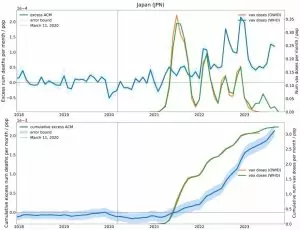
Paesi come India, Bangladesh, Sri Lanka sono dieci volte più densamente popolati dei paesi occidentali. Quindi quando si diffonde un'infezione naturale, cosa che ho visto spesso nel mio lavoro, dove l'80% delle persone ha già anticorpi, un'infezione naturale. L'ho visto in Sri Lanka, era quasi al livello di base. E dopo l'introduzione del vaccino, nel '21, i casi segnalati e i decessi sono aumentati. Ho osservato un fenomeno simile in Malesia. Dopo l'introduzione del vaccino; questo ci ha preoccupato: o è dovuto al calo dell'efficacia del vaccino o al fatto che le persone dopo la vaccinazione diventano imprudenti. Può essere. Ma il Giappone, per esempio, non ha avuto lockdown. E anche lì era meno che in India. Vuole mostrare adesso qualche grafico? Sì, posso mostrare i grafici qui. Anche in Giappone dopo la vaccinazione non è andata così bene. No, lo ingrandisco un po'. È l'argomento sbagliato. Scusi. Sì,
ne avevo un PDF. Un momento. Scusi. Questo è sicuramente sbagliato. Questo è probabilmente in Giappone. No. Yes. Cari spettatori, OVALmedia cresce e abbiamo ancora molti progetti. Per voi questo video è gratuito. Ma la produzione a noi costa denaro. Il nostro progetto si regge sul vostro sostegno. Un modo per sostenerci è una donazione o una donazione mensile. Diventate membri su oval.media. Così potremo continuare a produrre interviste e video come questo. Ma offriamo anche libri e molto altro, come potete vedere qui in sovrimpressione. Lo ingrandisco ancora un po'.
Prima di marzo 2021 i casi erano quasi normali. E poi marzo, aprile, maggio; a maggio è stato distribuito il vaccino. E ora il Giappone ha uno dei tassi di vaccinazione più alti, il 79 per cento, pur non avendo, per esempio, l'obbligo vaccinale. Non c'è stato lockdown. E qui si vede che i casi aumentano. O l'immunità cala; quindi prima della vaccinazione, qui dopo la vaccinazione. E questi sono i decessi in Giappone. Avevano alti tassi di mortalità, ma dopo la vaccinazione sono rimasti quasi uguali. Ci si aspetterebbe che i decessi calino, se si afferma che la vaccinazione aiuta. Quindi il quadro generale qui evidentemente non torna da qualche parte. E ora c'è perfino un picco verso l'alto. Questo non lo capisco del tutto. Lei dice che la vaccinazione è stata somministrata solo ad aprile. In Germania è iniziata già a dicembre 2020. Sì, in Germania; il primo paese è stato l'Inghilterra. Lo vediamo anche lì. In Inghilterra abbiamo un quadro simile. Singapore,
anche lì è così. Va bene, ecco Singapore. Allora, cosa facciamo per primo? La Gran Bretagna, faccio adesso la Gran Bretagna. Questa ora è l'Inghilterra, la Gran Bretagna. Lì è arrivato il vaccino e dopo c'è stato un aumento più alto del picco di prima della vaccinazione. Ma questi sono di nuovo numeri che sono anche falsati. No, qui bisogna guardare. Non crediamo a questi numeri e non crediamo nemmeno agli altri. Quindi allora è uguale. Questo possiamo senz'altro confrontarlo. Naturalmente, come epidemiologo, a volte bisogna improvvisare. Per questo questi confronti vanno sempre presi con cautela. Quindi qui cerco sempre di confrontare la stessa cosa. È il prima e il dopo in uno stesso paese. Qui confronto la Gran Bretagna con la Gran Bretagna con gli stessi procedimenti. E qui si vede prima e dopo la vaccinazione che cosa è successo: chi fa parte dei gruppi a rischio può morire una volta sola. Cioè dopo dovrebbe instaurarsi un'immunità e allora i decessi dovrebbero
scendere. Lo si vede anche in altri paesi. Singapore ha lo stesso problema, lo si vede qui. Vede, questa è la campagna vaccinale. Ah sì, va bene. 64 per cento. No, questi qui sono gli Stati Uniti. Gli Stati Uniti hanno lo stesso problema. Ho avuto una tavola rotonda con Wittkowski negli Stati Uniti e ha detto che i vaccini non
Robert Cibisfunzionano. Chi lo dice? Wittkowski. Ho partecipato ad alcune tavole rotonde con lui. Dov'era? Philipp Macmillan. È del Rockefeller Institute di New York. Sì, è del Rockefeller Institute di New York. Siamo in contatto. Abbiamo parlato insieme in alcune tavole rotonde. Lo conosco. Posso mandarle i link. Sì, parla sempre senza peli sulla lingua. Sì, beh, è molto impressionante. Quindi prima nessun caso e poi all'improvviso tantissimi casi. Ecco di nuovo Singapore. Allora come si giustificano queste vaccinazioni di massa, quando qualsiasi matricola universitaria può capire questi dati? E questo è solo il quadro che viene dal dominio pubblico. Questo è il mondo e questi sono i tracker delle vaccinazioni. Entrambi sono accessibili al pubblico. Sì. E a Singapore c'è l'obbligo vaccinale, no? Tranne in Giappone. Lì non è così, ma evidentemente ci credono
e basta. Sì, si fidano semplicemente delle autorità. E allora non serve l'obbligo vaccinale. Va bene, capisco. Wow, è davvero impressionante. È impressionante nel complesso, qui. Qui si vedono altri paesi, non importa quale paese abbia guardato. Perché qui è così, siamo ad alcuni Stati. Ecco i casi negli Stati
Amitav BanerjeeUniti. Devo rimpicciolire un po' perché si veda meglio. Quindi qui, anche questo si vede bene. Israele, davvero sorprendente. Ecco Israele, lo Sri Lanka; lo Sri Lanka lo seguo sempre. Molto da vicino. Qui si vede che i casi erano in realtà del tutto normali, al livello di base. E dopo la vaccinazione sono schizzati in alto. E lo confronto con l'India. Allora, qual è l'influenza: di Covid, dopo la vaccinazione, sono semplicemente morte più persone. Qui vediamo i decessi in Sri Lanka dopo la vaccinazione. Beh, direi che la cosa migliore è confrontare tra loro i decessi. Perché la morte non si può simulare, non così facilmente comunque. Naturalmente la qualità dei dati qui ha qualche limite. Dipende anche un po' dalla politica.
Robert CibisEcco i test. Si cercano i test e i casi. Adesso vediamo sempre di più che non testano più. Forse è per questo che vogliono evitare così tanti decessi. Quindi, quando si sente questa storia, si rischia semplicemente di più.
Amitav BanerjeeSì, beh, qui non riesco a vedere che la salute migliori dopo la vaccinazione. Se guardo il quadro generale, allora... Ma nel quadro più ampio bisogna anche vedere che complessivamente muoiono più persone, si può dire così? Può dire se muoiono più persone? Sì, forse perché le altre patologie preesistenti sono state trascurate. Sì, perché il professor Kuhbandner, dalla Germania, ha pubblicato uno studio sulla mortalità per tutte le cause. E ha preso i numeri del professor Fenton a Londra e li ha poi trasferiti ai numeri tedeschi. E ha scoperto che dopo la distribuzione dei vaccini, in particolare dei richiami, nella regione in cui i richiami sono stati distribuiti, la mortalità per tutte le cause... E precisamente a seconda di quando è stato introdotto il richiamo. Quindi a Berlino e Monaco la mortalità sale a seconda di quando viene introdotto il richiamo. Quindi c'è una correlazione molto forte, e non solo a livello nazionale, ma davvero circoscrivibile a livello regionale.
E qualche settimana fa abbiamo già avuto un Narrative su questo. E l'ho trovato molto impressionante. E a quanto pare ha impressionato anche il Parlamento, il Bundestag. Perché di recente ha votato sull'obbligo vaccinale. E mi chiedo quali conseguenze avrà. Ci sono molte persone che temono che tramite l'UE l'obbligo vaccinale venga comunque introdotto in Europa. Vedremo che cosa succede. Sì, si vede chiaramente. Basta mettere insieme le posizioni. Sì, esatto. E che cosa ci dice questo? Che cosa dice della nostra società?
Robert CibisCredo che quello che succede qui sia che stiamo semplicemente perdendo le capacità mediche. Adesso qui ognuno guarda il virus. I clinici lo vedono da lontano. E tutto questo non torna da nessuna parte. Quando devo spiegare qui qualcosa che non si può spiegare, deve sempre sembrare tutto scientifico. Ma lì dentro ci sono moltissime varianti e variabili. Un'altra cosa che trovo ancora molto sbagliata in questa pandemia è che una simile vaccinazione di massa non è mai stata fatta per una malattia con una mortalità del genere. Ma è sempre così: bisogna avere una mortalità superiore al 5 o al 10 per cento. La cosa successiva è che si tratta ancora di un uso sperimentale.
Amitav BanerjeeGli esperimenti devono sempre avere un gruppo di controllo. Non si può fare una vaccinazione di massa del genere senza una vaccinazione di controllo. Anche uno studio del genere va fatto come studio randomizzato. Adesso è molto, molto difficile trarne conclusioni. Rispetto ad altre malattie. Molte persone avevano malattie già prima. Ed è quello che cerchiamo di fare qui. Ma se si ha un gruppo di controllo, per esempio, si può constatare: alcune coorti vengono vaccinate, altre no. Allora si può confrontare. E siccome qui siamo in un esperimento, dovremmo anche avere un gruppo di controllo. E qui ci sono forti indizi che i dati siano stati manipolati. Sì, ma questo suona un po' come se fosse stato pianificato.
Robert CibisSì, qualunque cosa sia, è stato fatto in modo molto, molto dilettantesco … Guardiamo le prime due settimane con i lockdown, perché gli ospedali non fossero sovraccarichi. Va bene, poi si è detto: arriva il vaccino. E ora estendiamo i lockdown, poi avremo il vaccino e poi la gente uscirà. E ora il vaccino c'è. Abbiamo avuto due anni di lockdown. Le scuole erano chiuse. E ora abbiamo perso tutto. Neanche il vaccino è quello che dovrebbe essere. E spendiamo soldi per i richiami. E in India si sono spese, credo, centinaia di migliaia di rupie. E i bambini muoiono. Nessun bambino è morto di Covid. Ma allo stesso tempo di altre malattie. Quindi i soldi andrebbero spesi per queste altre malattie. Un'altra cosa molto importante: a settembre c'è stato a Delhi uno studio che ha scoperto che l'82% dei minori di 18 anni aveva già anticorpi.
Amitav BanerjeePerché avevano già preso il virus da bambini. E ora, dopo due anni, i CDC hanno controvoglia … e constatato che l'immunità naturale è robusta quanto quella prodotta dal vaccino. Com'era, 27 volte più robusta? Sì, se qualcuno ha superato l'infezione, è come se avesse ricevuto 35 richiami. E questo fa le prime due dosi e poi 25 richiami. Adesso, dal punto di vista scientifico. È qualcosa che qui... Sì, lei è uno scienziato con molta esperienza. Perché? Si è già occupato di molte altre malattie infettive. Sì,
Robert Cibisho lavorato molto in questo campo. Ho studiato diversi focolai di morbillo e di tifo. So come funziona. E a livello globale, devo dire, è in qualche modo... Mi sembra di essere nel film sbagliato quando vedo come viene gestito a livello globale. Sì, voglio dire, per il profano dev'essere stata una terapia d'urto, ma poi ci sono anche gli esperti. Sono molto sorpreso di come alcuni dei miei colleghi lo affrontano. O non ne parlano affatto o sono sorpresi. Alcune istituzioni dell'OMS o dei CDC emanano linee guida, e ora tutti sono esperti. Tutti i miei colleghi, che uno sia chirurgo o cardiologo, adesso mi spiegano come funziona la salute pubblica. E non sappiamo con chi dovremmo parlare.
Amitav BanerjeeSì, gli specialisti più affermati al mondo, sì, all'improvviso hanno pubblicato la Dichiarazione di Great Barrington. Sì, si diceva che con questo eravamo, per così dire, ai margini. Sì, adesso all'improvviso sono loro ai margini. Quindi chi è adesso al centro, questa è la domanda. Credo che le persone, una volta c'era un video, Contagion, sì, Contagion 2014, esatto. Ma era interessante, a quanto pare era il primo film, il primo film catastrofico su un virus in cui, beh, probabilmente era il primo film in assoluto in cui persone senza sintomi sono pericolose.
Robert CibisQuindi abbiamo questa narrazione di una persona sana che è pericolosa. Sì, ed è una psicosi di massa molto pericolosa quella su cui si lavora. Qui la si glorifica, il sistema sanitario viene glorificato. E credo che questo non abbia nulla a che fare con la realtà. Le persone ne ricavano una paura eccessiva. Come ha detto lei, la maggior parte dei medici che non sono nella sanità, in senso pubblico, vengono anche glorificati e probabilmente hanno visto questi film per scegliere tali istruzioni. Voglio dire, non se ne può ricavare davvero nulla di pratico.
Amitav BanerjeeVoglio dire, non è davvero una sanità pratica. Per me, come regista, è una storia molto affascinante, perché ci si sente del tutto sani, si è del tutto sani, e poi si può fare un test e sentirsi malati, e allora bisogna avere paura, preoccuparsi per la propria vita. E ho solo detto: va bene, non era solo il film Contagion, era così anche con l'AIDS. Forse ricorda che la narrazione era che chiunque nella stanza poteva avere l'AIDS. Semplicemente non si sa, ma se si fa un test PCR e si è positivi, si morirà presto. È anche certo che si morirà presto. E bisogna semplicemente preoccuparsi, bisogna stare attenti e così via e così via. Quindi mi chiedo se l'AIDS sia stato importante perché il pubblico capisse che una persona sana in realtà può non essere sana. Lei come la vede? Con l'AIDS era un po' diverso, perché l'AIDS richiede un contatto intimo perché il virus si diffonda. Con le malattie respiratorie è diverso. Sì, va bene, quindi è ancora più preoccupante. Sì, esatto. E un'altra cosa: in questo contesto abbiamo esaminato i diversi paesi che sono molto densamente popolati.
Robert CibisUn altro approccio non scientifico è stato l'isolamento, i lockdown. In India, Pakistan, Bangladesh le persone erano rinchiuse. Ma noi viviamo molto stretti; quando lavorano, lavorano all'aperto, lavorano come venditori ambulanti. E lì la trasmissione è trascurabile.
Amitav BanerjeeSe si rinchiudono dieci persone in una stanza che forse non ha nemmeno finestre, e che condividono un solo bagno, allora si ha un problema. Quindi, e la politica era di non uscire. Le persone dovevano restare dentro, dove il rischio di contagio è più alto. Quindi, tanti approcci non scientifici. Sembra anche un po' come se le idee venissero da alcune persone potenti in Occidente, e fossero poi state attuate nella società indiana.
Robert CibisSì, sembra che qui le idee venissero dalle autorità e dal governo. Ho parlato con altri esperti. Una mattina sono andato a passeggio e ho incontrato un vecchio collega, un microbiologo, la mattina presto alle sette, e lui va in giro con la mascherina fino agli occhi.
Amitav BanerjeeE gli ho chiesto: perché uno come te porta la mascherina? E allora mi ha parlato di goccioline e così via. E allora gli ho detto: tu sei molto più alto di me. Quindi se qui qualcuno sparge goccioline, sei tu. Allora perché ce l'hai? Perché porti la mascherina? E allora ha detto: perché l'ha prescritto il governo. E allora gli ho detto: ma come esperto dovresti mettere in discussione il governo. E credo che questo sia il problema della nostra società, che non mettiamo in discussione il nostro governo. Il governo è l'autorità e noi gli obbediamo. E questo succede anche in molte società asiatiche, dove il capofamiglia dice cosa succede, e basta. E non lo si mette in discussione. Ma questa è naturalmente la mia opinione personale. Da questo punto di vista non sono stato un bravo bambino. Ho sempre messo in discussione mio padre. E adesso considero un dovere mettere in discussione il mio governo. Sì, per me è una questione della società in cui voglio vivere. Lei come la vedrebbe?
Viviamo in una democrazia? Sì, almeno sulla carta.
Robert CibisMa ho l'impressione che la democrazia debba partire dalla famiglia. Si dà ai membri della famiglia la libertà, ai figli la libertà di parlare con loro, di lasciar sviluppare le loro idee. Se come capofamiglia si è autoritari, è come se, se c'è un motivo, per esempio, che come capofamiglia si impongono delle cose al proprio figlio, e si può cambiare idea se il figlio ci convince del contrario, allora si può diventare un cittadino migliore per una democrazia. Sì, penso anch'io che se non si possono sfidare le autorità, se non c'è dibattito, allora c'è il rischio di non prendere le decisioni migliori.
Amitav BanerjeePerché non si tengono in considerazione tutte le prospettive. Sì, ho sempre sulla mia scrivania una citazione di Napoleone Bonaparte. Ha detto che non bisogna temere le persone che sono di un'altra opinione, ma quelle che sono di un'altra opinione e hanno paura di dirlo. Sì, e purtroppo molti dirigenti sono cresciuti con questo tipo di autorità, tanto che interpretano il disaccordo come mancanza di rispetto. E credo, mi chiedo, voglio dire, sul nostro sito abbiamo un video intitolato Monopoly, che descrive a chi appartiene quale azienda, e mostra che grandi società d'investimento possiedono la maggioranza delle quote della maggior parte delle grandi aziende, così che in realtà tutte le aziende più grandi appartengono alle stesse persone, o almeno le decisioni d'investimento della maggior parte delle aziende vengono prese da pochissime persone.
Per me è stato molto impressionante da vedere, perché mostra così chiaramente come tutto sia collegato. E questo mi ha anche aiutato a capire come azioni assurde possano essere portate avanti contemporaneamente in tutto il mondo. Ho pensato: se tutti nel mondo fanno qualcosa, si pensa che debba essere giusto. Sì, direi che le persone che pensano poco con la propria testa, che hanno poca fiducia in sé. L'ho osservato anche nel mio istituto. Per due anni non ho portato la mascherina. Tutti avevano semplicemente la mascherina, anche se adesso non più. Sì, va bene. Ma nell'istituto accanto tutti portavano la mascherina.
Robert CibisQuindi da me sembrava essere così: va bene, è da tanto che non porto la mascherina, sono ancora vivo, non sembra così grave. E l'ho fatto con i miei colleghi e studenti. Loro lo analizzano. E penso che abbiano uno sguardo completamente diverso. Quindi forse qui è pensiero di gruppo, pressione del gruppo. Qui sono il direttore dell'istituto. Ho evidentemente l'autorità. Va bene, sì, ma come si può incoraggiare il pensiero critico? Dico sempre: abbiamo questa abitudine verso gli insegnanti di toccare i piedi a un insegnante. Io lo vieto sempre. Dico: fatemi delle domande. Non toccatemi i piedi, perché non voglio che mi seguiate ciecamente. Il vero rispetto verso un insegnante è pensare con la propria testa e fare domande. Naturalmente anche le influenze sociali hanno un ruolo. Ed è questo il motivo per cui ha scritto questo libro.
Credo che si intitoli Covid-19 Pandemic, A Third Eye. Perché un terzo occhio? Nella mitologia indiana gli dei hanno un terzo occhio con cui possono vedere cose che gli uomini non vedono. Io stesso non sono religioso. So poco della mitologia indiana. So solo che c'è un dio che ha un terzo occhio. Era il dio Vishnu. Vishnu Bhagwan, lui aveva il terzo occhio. E Brahma, anche Brahma, è un dio che aveva capacità particolari. E il terzo occhio gli è stato conferito. È qualcosa che, qualcuno me l'ha suggerito. Mi ha anche aiutato. A quel tempo avevo proprio problemi con i miei due occhi. Ho avuto un distacco della retina. E ho dovuto fare un'operazione. Così ho pensato: va bene, forse adesso devo attivare il mio terzo occhio. Il terzo occhio rappresenta l'illuminazione che viene dal terzo occhio di Dio. E l'ho preso anche come … per osservare le cose con distacco, senza conflitto di interessi, senza interessi di carriera.
E come ha detto lei, tutti si chiedono perché gli scienziati non lo mettano in discussione.
Amitav BanerjeeQuando uno scienziato ha un conflitto di interessi, non è necessariamente solo economico, ma può anche essere un conflitto di carriera: se ricevo un finanziamento per la cura del Covid e posso fare progressi lì, allora lo faccio. Ma in questi casi non si può usare il proprio terzo occhio. Di solito questo terzo occhio è associato all'età, quando non devo più fare carriera, quando posso guardare le cose con distacco. Va bene, sì, un po' di distanza aiuta. Se si è troppo coinvolti, non ci si riesce a staccare. Sì, e non rimprovero i miei colleghi che non riescono a vederlo. Sono semplicemente ancora troppo in basso per capire che cosa succede ai livelli più alti. Anche per me è stato
Robert Cibiscosì. Ho cominciato a sospettare che qualcosa non andasse quando si è detto che l'immunità naturale veniva negata dalle autorità, le autorità, nell'OMS. Non è stata negata direttamente, ma in qualche modo si diceva che due settimane dopo l'infezione naturale bisognava comunque vaccinarsi. Perché vaccinarsi se si è già superata la malattia? Questo mi è sembrato strano. E poi c'era, lasciamo perdere per un momento gli effetti collaterali.
Amitav BanerjeeChe cosa si studia lì, se l'80% del paese ha già avuto un'infezione naturale? Perché sprecare ancora soldi per le vaccinazioni? In un paese dove le persone muoiono di tante altre malattie, questi soldi potrebbero essere impiegati in modo molto più utile. Sì, e questo libro si rivolge alle persone comuni?
Robert CibisSì, ho cominciato con una rubrica. Ho ricevuto l'offerta di scrivere una rubrica settimanale per un quotidiano nazionale, il National Herald. E usciva ogni settimana, e poi ho ricevuto buoni riscontri e anche molti riscontri negativi.
Amitav BanerjeeIl tema è semplicemente polarizzato. L'India è molto divisa su questo tema? Sì, direi nel senso di 70-30. Il 30% delle persone non crede alla narrazione principale. Il 70% ci crede. Credo che sia il 70% della classe superiore. Il 30% l'ha vissuto. Devono lavorare con le mani. Sono i tassisti. E credo che abbiano l'orecchio teso su quello che succede. Ho ottenuto il permesso del National Herald perché ho ricevuto soprattutto buoni riscontri, e per questo ho detto: facciamo qualcosa. E ho pubblicato le rubriche come raccolta. È supportato il più possibile da numeri e fatti.
Robert CibisSì, probabilmente lo pubblicheremo anche nella nostra libreria. I disegni sono del professor Rahman. Sì, con lui abbiamo già fatto anche un Narrative. Sì, ha fatto lui questi disegni, e sì. Bene, ma parliamo del futuro. Se pensiamo a dove porta
Amitav Banerjeetutto questo? La cosa buona per me, vengo dalla Germania, è che la situazione qui adesso è completamente diversa, perché la narrazione è dominata dalla paura della Russia. È di questo che si tratta. Dalla guerra calda nell'est dell'Ucraina, i media sono passati completamente dal corona all'Ucraina. Qui in India naturalmente si parla della guerra, ma probabilmente non in modo così intenso e polemico come da noi. È vero.
Robert CibisCredo che la guerra non sia ancora abbastanza vicina. Penso che sia piuttosto una crisi economica quella che abbiamo davanti. La preoccupazione è che dobbiamo tenere conto dei danni collaterali. Molte persone sono rimaste senza lavoro e questo mi preoccupa. La malnutrizione infantile continuerà ad aumentare. In India i tassi sono già tra i più alti al mondo. 2000 bambini muoiono ogni giorno, e c'erano previsioni che da 3.000 a 4.000 bambini potessero morirne. E naturalmente le persone devono superare questa paura, perché temo che il terreno sia stato preparato per futuri falsi allarmi, che sia stato preparato qui, e che qui si usino anche altre malattie. Ci sono tante malattie diverse: tifo, tubercolosi, dengue. Che cosa succede se già ora trattiamo in questo modo una malattia che ha poco
Amitav Banerjeeimpatto? Questo mi preoccupa. Dobbiamo informare le persone. Dobbiamo fare in modo che la prossima volta, nel senso che ci rimandino di nuovo a casa, non lo facciamo, ma mettiamo in discussione il governo. Il suo lavoro per l'esercito l'ha aiutata ad analizzare la situazione attuale? Fino a un certo punto,
Robert Cibissì. Non così tanto. Nell'esercito abbiamo anche una popolazione molto limitata, molto ben delimitata. C'erano focolai occasionali. Naturalmente mi ha aiutato a capire l'immunologia nel suo insieme e a capire le scale più piccole. Ma quando ora si guarda qualcosa da una prospettiva globale, l'esercito mi ha aiutato anche in questo. Qui vediamo un focolaio con i diversi ambiti. Ambiti. È la componente globale, quella politica. Va bene. Forse se ne può tenere conto già dall'inizio. Si vedono gli schemi. Può spiegarlo ancora, per favore? Sì, vediamo come sono gli schemi. In Occidente ci sono stati tassi più alti all'inizio e un anno e mezzo dopo l'inizio della pandemia. Cioè, ci sono state le diverse misure, che hanno avuto effetti diversi, forse solo moderati, ma la pandemia è la prima volta nella storia dell'umanità che l'uomo cerca di controllare le forze naturali perché la pandemia si esaurisca.
Amitav BanerjeeE alla fine hanno dovuto ammettere che è l'immunità acquisita naturalmente a spegnere la pandemia, non i vaccini. I dati sui vaccini sono molto deludenti, se li si guarda a livello di popolazione. Bene, che cosa consiglierebbe dunque di fare a un cittadino comune in questi giorni? Come dovrebbe orientarsi? In India, il cittadino medio, sono abbastanza sicuro che l'80, 90 per cento dei giovani, perché vivono, che escono comunque anche se le scuole erano chiuse, dovrebbero continuare a vivere normalmente, svolgere i propri doveri, fin dall'inizio, proprio come fanno adesso. E gli anziani, le persone fragili, dovrebbero prendere precauzioni aggiuntive. Forse si possono anche vaccinare su consiglio del loro medico di famiglia. Possono anche fare un richiamo se il medico di famiglia glielo consiglia. Ma non si può generalizzare. Le persone a rischio più alto possono anche avere un beneficio maggiore, se
… morire di Covid. Ogni bambino che muore è naturalmente uno di troppo. Sì, certo, ma se il vaccino protegge solo per otto settimane, allora si presume che anche l'immunità cali. Quindi le persone devono poter prendere una decisione informata. Gli studi si possono fare solo su piccoli gruppi. E come ho anche mostrato nei grafici, le persone qui, questi studi devono semplicemente essere interrotti a causa dei dati. Ci sono regole per interrompere gli studi. E se non funziona, lo studio deve essere interrotto. Punto. L'opinione generale sulle vaccinazioni in India è molto positiva?
Robert CibisNel complesso, poche persone sono favorevoli alle vaccinazioni. Indirettamente non è possibile viaggiare senza vaccinazione, e molti datori di lavoro spingono i loro dipendenti a vaccinarsi. Il governo centrale ha rilasciato una dichiarazione giurata secondo cui la vaccinazione …
Amitav BanerjeeFaccio lo stesso anche io. Qui cerco di promuovere il mio libro e dico ai miei studenti: non dovete comprare questo libro se venite da me. Ma naturalmente è volontario, ed è anche bene se lo comprate, e se ne comprate uno, ve lo firmo. Incentivi …
Robert Cibisle persone che lavorano nell'industria del software vengono spinte a comprare certe cose. Sì, certo, molto interessante. Allora, che cosa prevede per il futuro? Può dire se presto ci sarà di nuovo un virus molto pericoloso, o le persone sono stanche dei discorsi sul Covid? Quindi la domanda è questa: in India vivremo uno stato d'emergenza permanente?
Amitav BanerjeeNon credo. La gente è di nuovo in strada. Quando sono venuto qui, sono rimasto imbottigliato nel traffico. Prima il traffico mi dava fastidio, ora ne sono contento, perché significa che … E grazie anche agli ascoltatori per il loro tempo. OVALmedia ha bisogno del suo pubblico, perché viviamo esclusivamente delle donazioni degli ascoltatori, di nessun altro, nessun partner privato, nessun fondo pubblico, e così via, nessun sostegno di alcun tipo. È davvero molto importante per noi che continuiate a sostenerci, perché possiamo continuare ad aiutare a capire meglio il mondo. Ed è stato un grande onore per me fare questa conversazione con lei. Grazie mille. Grazie mille, Robert. Ancora una cosa. Sì, grazie mille e buona giornata. Ciao.
Amitav BanerjeeHello, my name is Robert Cibis and I am very proud to be here with Prof. Dr. Amitav Banerjee. Together with him we will question the perspective of the prevailing narratives regarding public health, because Prof. Banerjee is a professor of community medicine and has of course specialised in epidemiology. And he has worked in various fields. He knows about epidemic processes, about prevention. He knows how to read numbers and statistics, and he can bring a little reason into these narratives of fear. That is what we want to do at OVALmedia. We want to help people understand the world.
Robert CibisCan you please explain to us how you saw the corona crisis,
Amitav Banerjeehow you saw it at the beginning, and what was your first impression, how did it develop?
Robert CibisThank you, Robert. I can still remember the beginning. But first I would like to say that I am very happy to be able to work here with OVAL from Germany and to contribute my part. For me the pandemic began in December 2019.
Amitav BanerjeeShortly before that I gave a guest lecture at the university in Malaysia on current trends in public health. And I said there, now we have infectious diseases under control and can turn to the non-communicable diseases. But then in December came the news about the Wuhan virus.
Robert CibisAnd in January there were many pictures from Wuhan in China, lockdown, the chaos, panic. And we were far away from it, in India, and never thought that it would spread so quickly. And then it jumped from China
Amitav Banerjeeto Thailand. The next country, Thailand, did not have a big problem, but then it came to Italy. Then there were these mass deaths and that triggered the panic, I think. As a draconian measure, China then sealed off the Hubei district. Many people were locked in. That had never happened before in the history of health. And the world media criticised China for the lockdown. They said, this is unscientific, this is draconian. Even the WHO took offence at it. But then when they came to Italy, the media adopted it. And there it hit the nursing homes, the older people. And because of the large number of victims, Italy was then the second country that imposed lockdowns. And then it also spread to other European countries. One after the other applied these draconian measures as the only measure. And the other measures that then became known as Covid measures, masks, keeping distance.
That is very interesting to see. I read somewhere that these measures had no evidence-based foundation at all. The only foundation was a university paper by a student from 2015. She once did a computer project to find out what happens when there is a flu outbreak. So she used a simulated computer model. And she was the daughter of a scientist from the USA. And of all things, this model was then used to explain the measures. Here in India? Not in India, that was in America. I am happy to send you the link to it. That is crazy. Yes, I will send you the link. And then it went on country by country. In March, China declared the pandemic a global pandemic. And one country after another then outdid itself with the measures. India imposed the biggest lockdowns. Almost 140 million people without prior notice, or only four hours. That caused a lot of collateral damage.
People lost their jobs. People had to walk home for miles in March. And that was from March, April, May. And I think that was a very amateurish approach in the methodology that was applied here. At the beginning it was said two weeks of lockdown. Most countries wanted to do two weeks of lockdown so that the hospitals would not be overrun. And after that it was extended further and further and extended. And then there was the promise of the vaccine. And it was said, they said, when the vaccine is here, then everything will be fine. So you were very critical from the start. Yes, I was. What also struck me as strange in this matter as an epidemiologist were these asymptomatic cases, which were propagated only on the basis of a test. It is a very, very sensitive test that even tracks down and detects dead particles. The virus was there and is gone again. And the person is infectious or not.
Normally in medicine there are first symptoms and then a test is done and then a diagnosis is made. And here there was only the test and that was enough to make a case. So the measures are a very good start at the beginning of a pandemic. But once the pandemic has spread globally in the different countries, in the population, then these measures are not cost-effective at all. They are very resource-intensive. They are costly. They create panic and simply increase the case numbers. And by the way, all of this started from a single case that was published in the New England Journal of Medicine. And that was a woman from China who travelled from China to Germany or to the USA. And it was said that she was asymptomatic. Yes, that is very interesting. I know this study, it comes from the Charité in Berlin. And it really is an interesting study, because first of all it is wrong. The lady had strong symptoms and was taking a lot of medication. Yes, that turned out later. Yes, and secondly it is surprising that a team of researchers from Berlin comes to Munich to test a woman from Wuhan who had a cold, while on the same day about 100,000 people in Germany had a cold. And why would you carry out a test,
a test that had never been carried out before, and on a woman who is 800 kilometres away, in a much smaller city than Berlin? That is a surprising study. Because you get the feeling that they wanted a certain result. As if they had decided that this woman from here, since she was asymptomatic, at least when it was published, it said she had no symptoms. And then you also have to take care of the asymptomatic. And then you have to poke into the nose and the throat here. And that is something that had never existed in public health before. And later it came out that she had symptoms and that she was taking medication, but the initial publicity was enough to put people in fear. And so this study was even a reference in India and in Malaysia? Yes, as the WHO says, or the CDC says, there is asymptomatic spread. In India, Sri Lanka, Malaysia, in all countries they followed the WHO guidelines without doing their own studies.
And they simply followed the WHO guidelines. And no matter what happens there, that is also something very striking in this pandemic: normally so-called quarantine measures are applied to people who are sick. Here healthy, young people, healthy people were put in quarantine. At the beginning the fear was possibly justified, I would say that. In the first months, when we had the data from Italy, and then there was a publication in the Lancet that estimated a mortality rate of 20%. 20% is to be taken seriously. I mean, anyone would panic then. But later there were the hospital cases, and those were severe cases for people with a high average age of 80 years. And on the basis of this false data, certain models by Neil Ferguson and others were drawn on, and it was predicted that there would be millions of deaths in England and in other countries. And this panic that was created never subsided. And one of the principles of pandemic management in public health is that you should mitigate panic.
Here exactly the opposite happened. Everyone only fuelled the panic. Later, in the first three, four months, the Californian Stanford University carried out studies. That was John Ioannidis. And they found that there was a lot of asymptomatic spread in the population, but the infection fatality rate was only 0.3 percent or 0.27 percent. And most of them were asymptomatic. And even that was all built on the tests, which included the antibody tests. Yes, it was this antibody test, which captures past infections. RT-PCR is supposed to capture the current infection, but that is always artificial, because there is always a nucleic acid particle somewhere that you can find there. So that has been strongly criticised, also in science. But very early in the pandemic we already knew that the mortality would not be as high as originally assumed.
And secondly, there was also data from China and other countries that found an almost thousandfold difference in risk, depending on age.
Robert CibisChildren's risk is negligible, and the 80 -year-olds have a thousandfold higher risk. Yes, I understand. So from the start you really proceeded very methodically. You try to put the numbers into context. And would you perhaps like to show some of your work? I will open the computer for that now. Yes, as I said, another thing was that we originally only recorded the data somewhere around May 2020.
Amitav BanerjeeAnd when we work on something like this, we thought, every country will have a different mortality. We took Covid mortality as the end point, because of course that also depends a little on the testing policy of the different countries. So we postulated that countries with a higher average age will also have a higher mortality. And that is exactly what we then found.
Robert CibisIn May 2020 there were, per million, deaths, Covid deaths in the USA, in England. Everything that was three digits. It started with lower mortality, but later the other countries caught up. In Africa mortality was lowest. So at first we thought it was age. And later we also suspected that obesity could play a role and then took the body mass index from the WHO website. The median age, this here is the median age. In the northern hemisphere it is around 40, except in Brazil, where it is around 30. Except Japan. Japan is an outlier with a median age of 48 years. That is more than for the Caucasians in the north. So they had the most pathogens, but very low death rates, to start with three countries that had a similar median age.
Amitav BanerjeeYes, I mean, you have to bear in mind that a person with Covid who died of Covid is a person who has a positive Covid test. So if you die of a heart attack and then this test is carried out, then you are in the statistics. Yes, that had never happened before in public health either. Yes, and if you don't do the test, then you are not in the test statistics, even if you die of a respiratory disease, but in a country where less testing is done, you of course have fewer cases. So what I want to say is, how reliable are these numbers? Well, which numbers can you believe? That is why I did not look at the cases. What we can take are the deaths. And as you said, someone may die of a heart attack or another comorbidity and happens to have a positive PCR test. And then it is recorded as a Covid death. In the USA, people were shot who had a positive PCR test and were still described as Covid deaths.
Robert CibisThere were even reports about it. And we see thousands of bacteria and viruses.
Amitav BanerjeeI can pull streptococci out of any nose, so to speak. And so I can say, why is it not the streptococci that caused death? Yes, exactly. If you only test for one thing, even if the person with a respiratory disease perhaps has influenza B or something like that. Simply more people died with Covid than of Covid. There was also a paper on that, which was then withdrawn. 6% of people are directly attributable to the virus. 96% have some other comorbidity. That is one thing. And that is why there is a lot of confusion in this matter, if they are old, if they have diabetes, if they have heart disease. John Ioannidis even reported in a paper that for a person who is older, who is frail, who is perhaps bedridden, even if they are infected with a cold virus, the mortality rate is 8%. A normal cold virus can kill any … person. So the virus here is no different from all other viruses.
Robert CibisAnd what we have seen here is this markedly increased, thousandfold increased mortality risk in 80-year-olds. So it is about the fact that we have to assess the risks. People who are at high risk must be protected. And those who are not at high risk can continue to live their lives normally. What we also saw was overweight. In the northern hemisphere we see that overweight is around 60%. There are two outliers. One is Japan with a very high age, but little overweight. And the African countries, except South Africa, with a percentage of almost 53%, South Africa also showed the highest mortality rate. The Western countries, Japan also has a low mortality rate, and then we followed it further. In the Western countries we saw a higher overweight rate,
Amitav Banerjeehigher age and higher mortality. We can also learn something in Brazil. Brazil has a low age, but obesity is still high, because of the economy. And from this you can conclude that obesity is a higher risk factor, almost the same as age. And of course that also affects respiratory functions. Secondly, it can be a surrogate marker for diabetes and high blood pressure.
Robert CibisBecause this is the data we have here, at population level. It can raise some questions, but here in the last row we see something else that relates to the African continent.
Amitav BanerjeeThere is hardly any place there with a high vaccination rate, but where it is highest, there are the highest mortality rates. And from which month are these figures? February 2020. Yes, relatively new figures.
Robert CibisSo vaccination is not the cure-all. You see here, in epidemiology it is like a game of chess. You have to see all the pieces that are on the board. And every game is a little different. In the individual countries there are different risk factors. And that is why these policies and these directives, which are universally applicable, do not fit. India is a very large country, for example, and there the dynamics play a different role. And that means that the directives have to be worked out locally, and not, as the WHO proposes, globally. I think the WHO sits somewhere and we sit at the other end of the world. The pandemic has shown that the differences are 10- and 20-fold, despite lockdowns and other measures. On the next slide we see that, for example, countries like Sweden, the Swedes, who had no lockdown at all, were not similar, perhaps even better.
Belarus has also obviously shown that there is no influence of the measures. So no high mortality in general.
Amitav BanerjeeYes, I would say again that perhaps they test less in Belarus than in other countries. So it is not like, I mean, how clear is it that you can really compare the numbers? Testing rates of course play a role. In Sweden there was just as much testing as in all other countries. That is why I did not take these numbers. We also collected the testing rates per million people. That is not in this slide here. Except Japan. Japan tested less, but someone who dies of
Robert CibisCovid, that is a more definitive statement than the test cases. That means here we see the European countries and the USA and then the Asian countries. You see here, for example, Sri Lanka with a very high vaccination rate. It is interesting that countries like India, which have a vaccination rate of 56 percent, have a higher mortality, while Pakistan has less. And you see that in Bangladesh too. There we probably only have a vaccination rate of 37 percent, and the mortality rate there is much lower. Yes, 173 compared to 164. So, here we see at population level that the vaccination rate does not have much effect, vaccination does not have much effect.
Amitav BanerjeeWell, there is no correlation here, perhaps even a negative correlation. That means that perhaps because of vaccination you have more Covid. That has to be examined carefully. We see this here as a signal, but a signal must not immediately, or an indication must not immediately lead us to a conclusion.
Robert CibisThat would be a blind approach, before we now say boost and boost. We have some slides on how this behaves with and without vaccination. So this means, here you can say, okay, first it was said that it does not prevent transmission, but severe courses of illness are reduced and so on.
Amitav BanerjeeBecause if you think about the public, health, public health here, a lot of money is spent and of course you also have to get a return on this money if you take the money away from other diseases that have higher mortality rates. And that applies especially to poor countries like Pakistan, India, Asian countries, where we have people who die every day of tuberculosis. 2000 children die every day in India of preventable causes. Here not even two children die of Covid, and we have dengue fever, where there is no proper data either. We have typhoid with a mortality, even when treated, of 3%. We have people at 69
Robert Cibisyears who have all been treated. And in the Western hemisphere the mortality rate is 0.3%. We carried out some surveys on this, at the medical faculty where I work, we saw that 30 million, we surveyed 30 million inhabitants. That was after the first wave, which ended in October 2020, we found that 35% of the population in this area had antibodies. So they had had an infection, 90% of them asymptomatic, and there was also a class difference. That means the poor people who live in overcrowded houses, in slums, in tenements, they had 80, 90% positivity, and in the affluent classes they had about 10, 15, 5%. That means 70% of the people who were highly exposed. When the second wave came, we asked again. There we found that the areas that had 80, 90% infections were not affected at all by the second wave.
And the others, the affluent, who thought the pandemic had come to a standstill. The lower classes, 70%, who
Amitav Banerjeeworked at home were protected, and they then went out on the streets after they thought the pandemic was over. And they then, they were immune. So the second wave had more of an effect on the upper class. And that was the same, so to speak, in reverse. In the first wave the lower class was hit, in the second wave the upper class. It was in October that we surveyed this. The second wave came in April '21. What, in April, uh, most people had already been vaccinated by then, hadn't they? Yes, vaccination began in January, and in March, when the second wave came, less than 7% of the population was vaccinated. But it was more the upper class, wasn't it, or who? 7% overall, I think. I know what you are trying to say. But let us simply assume the worst. It is an important thought experiment: when you carry out an investigation, I have to consider what is the best scenario, the worst
scenario. And we simply have to look at the matter from the worst side. So let us think it through in the worst scenario. Many professors say that the vaccine can have the opposite effect. That it can intensify the effects of the virus. It can intensify the effect of the virus. It can trigger an autoimmune reaction. Yes, antibody-dependent enhancement is one thing. The other is that of course, if you do not proceed consistently, you promote mutations. Yes, exactly, we know that in the official VAERS register the list of possible side effects is quite long. That is a total of 64,000 different side effects. So this list is quite long, of those that are already known. And then many of them are very similar in symptoms. And there was also the narrative that all of this is Covid. So that is why I am very critical when we talk about Covid in 2021, when only 7% of the population was vaccinated, who knows which figures, which figures
we are talking about. It is per million here, so if we talk about 7%, then if every fifth person has a problem, that can of course also have an effect on these figures. So how do you see that? Is it connected with vaccination, or can you not say that? India is of course a very large country, and you are right about that. Another problem is that in India perhaps everyone is better vaccinated than others. But I have observed this phenomenon of rising cases and deaths in smaller countries too, such as Sri Lanka. I followed Sri Lanka very closely. Yes, tell me something about that. I would like to know more. What was the situation in Sri Lanka? Sri Lanka had fewer cases per million and very few deaths, far fewer than in India, ten times fewer. I looked at it closely, I look closely at all our neighbouring countries, and the demography of India's neighbours such as Bangladesh, Pakistan, Sri Lanka is more comparable than with Europe, because most people here simply adopted the Western models. So I looked at it for various reasons. One is age and obesity and then population density.
Countries like India, Bangladesh, Sri Lanka are ten times more densely populated than the Western countries. So when a natural infection spreads, which I have often seen in my work, where 80% of people already have antibodies, a natural infection. I saw that in Sri Lanka, it was almost at the baseline. And after the introduction of the vaccine, in '21, the reported cases and the deaths rose. I observed a similar phenomenon in Malaysia. After the introduction of the vaccine, so that did worry us, that it is either due to the waning effect of the vaccine or that people become careless after vaccination. That may be. But Japan, for example, had no lockdown. And there it was also less than in India. Would you like to show a few graphs now? Yes, I can show the graphs here. Japan did not go so well after vaccination either. No, let me make this a bit bigger. That is the wrong argument. Sorry. Yes, I had a PDF of it.
Just a moment. Sorry. That is surely wrong. That is probably in Japan. No. Yes. Dear viewers, OVALmedia is growing and we still have a lot planned. This video is free for you. But the production costs us money. Our concept stands and falls with your support. One way to support us is a donation or a monthly donation. Become a member at oval.media. So that we can keep producing interviews and videos like this one. But we also offer books and much more, as you can see displayed here now. I will make it a bit bigger.
Before March 2021 the cases were almost normal. And then March, April, May, in May the vaccine was rolled out. And now it has one of the highest vaccination rates, 79 percent, in Japan, where there is no vaccine mandate, for example. There was no lockdown. And here you can see that the cases are rising. Either immunity is waning, so before vaccination, here after vaccination. And these are the deaths in Japan. They had high death rates, but after vaccination it stayed almost the same. You would expect deaths to go down if you claim that vaccination helps. And so the overall picture here is obviously not right somewhere. And now there is even a spike upwards. I don't quite understand that. You say that the vaccination was only administered in April. In Germany it already started in December 2020. Yes, in Germany, the first country was England. We see that there too. In England we have a similar picture. Singapore, it is the same there.
Okay, here is Singapore. So what should we do first? Great Britain, I will do Great Britain now. This is England now, Great Britain. There was the vaccine and after that there was a rise that was higher than the spike before vaccination. But those are again the figures that are also distorted. No, here you have to look. We don't believe these figures, and we don't believe the other figures either. So it is the same then. We can certainly compare that. Of course, as an epidemiologist you sometimes have to improvise. That is why these comparisons should always be taken with caution. So here I always try to compare like with like. That is before and after in one country. Here I compare Great Britain with Great Britain using the same procedures. And here you can see before and after vaccination what happened: those who are in the risk groups can only die once. That means immunity should set in afterwards, and then deaths should go down.
You can see that in other countries too. Singapore has the same problem, you can see that here. You see, this here is the vaccination campaign. Ah yes, okay. 64 percent. No, this here is the USA. The USA has the same problem. I had a panel discussion with Wittkowski in the USA and he said the vaccines don't work.
Robert CibisWho says that? Wittkowski. I have sat on a few panel discussions with him. Where was that? Philipp Macmillan. He is from the Rockefeller Institute in New York City. He is from the Rockefeller Institute in New York City. We are in contact. We have spoken together on a few panel discussions. I know him. I can send you the links. Yes, he always speaks straight out. Yes, well, that is very impressive. So no cases before and then suddenly a lot of cases. Here is Singapore again. So how do you justify these mass vaccinations when any first-year student can understand this data? And that is only the picture from the public domain. That is the world and those are the vaccine trackers. Both are publicly accessible. Yes. And in Singapore there is a vaccine mandate, isn't there? Except in Japan. It is not like that there, but they obviously simply believe
in it. Yes, they simply trust the authorities. And then you don't need a vaccine mandate. Okay, I see. Wow, that is really impressive. It is impressive altogether here. You can see other countries here, no matter which country I looked at. Because here it is like this, we are at some states. Here are the cases in the USA.
Amitav BanerjeeI have to make it a bit smaller so that you can see it better. So here, that is also easy to see. Israel, really astonishing. Here is Israel, Sri Lanka, I always follow Sri Lanka. Very closely. Here you can see the cases were actually quite normal at the baseline. And after vaccination they shot up. And I compare that with India. So, what is the influence: of Covid after vaccination, simply more people died. Here we see the deaths in Sri Lanka after vaccination. Well, I would say it is best to compare the deaths with each other. Because death cannot be faked, not so easily anyway. Of course the data quality here has one or two limitations. That also depends a little on the policy.
Robert CibisHere are the tests. You look for tests and for cases. Now we see more and more that they are no longer testing. Perhaps that is why they want to avoid so many deaths. So when you hear this story, you simply take more risks.
Amitav BanerjeeYes, well, I cannot see here that health improves after vaccination. When I look at the big picture, then... But in the bigger picture you also have to see that more people are dying overall, can one say that? Can you say whether more people are dying? Yes, perhaps because the other pre-existing conditions were neglected. Yes, because Professor Kuhbandner from Germany published a study on all-cause mortality. And he took the figures from Professor Fenton in London and then applied them to the German figures. And he found that after the rollout of the vaccines, especially the boosters, in the region where the boosters were rolled out, all-cause mortality... And depending on when the booster was introduced. So in Berlin and Munich mortality rises depending on when the booster is introduced. So there is a very strong correlation there, and not only nationally, but really traceable regionally.
And a few weeks ago we already had a Narrative on this. And I found that very impressive. And it apparently also impressed parliament, the Bundestag. Because it recently voted on the vaccine mandate. And I wonder what consequences that will have. There are many people who fear that via the EU the vaccine mandate will be introduced in Europe after all. We will see what happens there. Yes, that is clear to see. You only have to put the positions together. Yes, exactly. And what does that tell us? What does it say about our society?
Robert CibisI think what is happening here is that we are simply losing our medical skills. Now everyone here looks at the virus. The clinicians see it from a distance. And somehow none of it fits together. When I am supposed to explain something here that cannot be explained, it is always supposed to sound scientific. But there are very many variants and variables in it. What I also still find very wrong in this pandemic is that such a mass vaccination has never been carried out for a disease with such a mortality. Rather, it is always, well, you need more than 5 or 10 percent mortality. The next thing is that it is still an experimental use.
Amitav BanerjeeExperiments should always have a control group. You cannot carry out such a mass vaccination without a control vaccination. Even such a study must be carried out as a randomised study. It is very, very difficult now to draw conclusions from it. Compared with other diseases. Many people had diseases before. And that is what we are trying here. But if you have a control group, for example, then you can establish: some cohorts are vaccinated, others are not. Then you can compare that. And because we are in an experiment here, we should also have a control group. And there are strong indications here that the data has been manipulated. Yes, but that sounds a bit as if it had been planned.
Robert CibisYes, whatever it is, it has been very, very amateurishly … Let's look at the first two weeks with the lockdowns, so that the hospitals are not overloaded. Okay, then it was said the vaccine is coming. And now we extend the lockdowns, then we will have the vaccine and then people will come out. And now the vaccine is here. We have had two years of lockdown. The schools were closed. And now we have lost everything. The vaccine is not what it is supposed to be either. And we are spending money on boosters. And in India, I think, hundreds of thousands of rupees have been spent. And the children are dying. Not one child has died of Covid. But at the same time of other diseases. So the money should be spent on these other diseases. Something else that is very important: in September 2021 there was a study in Delhi which found that 82% of under-18s already had antibodies. Because they had already caught the virus
Amitav Banerjeeas children. And now, after two years, the CDC has reluctantly … and established that natural immunity is just as robust as that produced by the vaccine. What was it, 27 times more robust? Yes, if someone has been through the infection, it is the same as if they had been boosted 35 times. And that makes the first two doses and then 25 boosters. Now, looked at scientifically. That is something that here... Yes, you are a scientist with a lot of experience. Why? You have already dealt with many other infectious diseases. Yes, I have done a lot of work in this field.
Robert CibisI have investigated various measles and typhoid outbreaks. I know how it works. And globally, I have to say, it is somehow... I feel like I am in the wrong film when I look at how it is handled globally. Yes, I mean, for the layperson it must have been shock therapy, but then you also have the experts. I am very surprised how some of my colleagues deal with it. Either they don't talk about it at all or they are surprised. Some of the WHO or CDC institutions issue guidelines, and now everyone is an expert. So all my colleagues, whether someone is a surgeon or a heart specialist, now explain to me how public health works. And we don't know who we should talk to.
Amitav BanerjeeYes, the most established specialists worldwide, yes, suddenly they issued the Great Barrington Declaration. Yes, it was said that we are on the fringe with it, so to speak. Yes, now they are suddenly on the fringe. So who is in the middle now, that is the question. I think people, there was once a video, Contagion, yes, Contagion 2014, exactly. But it was interesting, that was apparently the first film, the first virus disaster film in which, well, it was probably the first film ever in which people without symptoms are dangerous.
Robert CibisSo we have this narrative of a healthy person who is dangerous. Yes, and that is a very dangerous mass psychosis that is being worked on. It is glorified here, the health system is glorified. And I think that has nothing to do with reality. People get excessive fear from it. As you said, most doctors who are not in health care, in the public sense, are also glorified, and they have probably seen these films to choose such instructions. I mean, you cannot really derive anything practical from it.
Amitav BanerjeeI mean, it is not really practical health care. For me as a filmmaker it is a very fascinating story, because you feel completely healthy, you are completely healthy, and then you can take a test and feel sick, and then you have to fear, worry about your life. And I only said, okay, that was not only the film Contagion, it was also like that with AIDS. Perhaps you remember that the narrative was that anyone in the room could have AIDS. You simply don't know, but if you take a PCR test and are positive, then you will soon die. It is also certain that you will soon die. And you simply have to worry, you have to be careful, and so on and so forth. So I wonder whether AIDS was important for the public to understand that a healthy person may in fact not be healthy. How do you see that? With AIDS it was somewhat different, because AIDS requires intimate contact for the virus to spread. With respiratory diseases it is different. Yes, okay, so that is even more worrying. Yes, exactly. And something else: in this context we looked at the various countries that are very densely populated.
Robert CibisAnother unscientific approach was the sealing off, the lockdowns. In India, Pakistan, Bangladesh people were locked in. But we are very crowded; when they work, they work outdoors, they work as street vendors. And there transmission is negligible.
Amitav BanerjeeIf you lock ten people in a room that probably doesn't even have windows, and they share one toilet, then you have a problem. So, and the policy was not to go out. People had to stay indoors, where the risk of infection is highest. So, so many unscientific approaches. That also looks a bit as if ideas came from some powerful people in the West, which were then implemented in Indian society.
Robert CibisYes, it sounds as if the ideas here came from the authorities and the government. I have spoken to other experts. I once went for a walk in the morning and met an old colleague, a microbiologist, early in the morning at seven, and he is walking around with a mask up to his eyes.
Amitav BanerjeeAnd I asked, why does someone like you wear a mask? And then he said something about droplets and so on. And then I said, you are so much taller than me. So if anyone is spreading droplets here, it is you. So why do you have that? Why are you wearing the mask? And then he said, because the government has prescribed it. And then I said, but as an expert you should question the government. And I think that is the problem of our society, that we do not question our government. The government is the authority and we are obedient to it. And that also happens in many Asian societies, where the head of the family says what happens, and that's it. And you don't question that. But that is of course my personal view. In that respect I was not a good child. I always questioned my father. And I now see it as a duty to question my government. Yes, for me it is a question of the society I want to live in. How would you see it? Do we live in a democracy?
Yes, on paper at least.
Robert CibisBut I have the impression that democracy has to start from the family. You give family members freedom, children the freedom to talk to them, to let them develop their ideas. If you are authoritarian as head of the family, then it is as if, if there a reason, for example, that as head of the family you prescribe things to your child, and you can change your mind if the child convinces you otherwise, then you can become a better citizen for a democracy. Yes, I also think that if you cannot challenge the authorities, if there is no debate, then there is the risk that you do not make the best decisions.
Amitav BanerjeeBecause not all perspectives are taken into account. Yes, I always have a quote from Napoleon Bonaparte on my desk. He said that you need not fear the people who are of a different opinion, but those who are of a different opinion and are afraid to say it. Yes, and unfortunately many leaders grew up with this kind of authority, so that they interpret disagreement as disrespect. And I think, I wonder, I mean, we have a video on our website called Monopoly, which describes who owns which company, and it shows that large investment companies own the majority of shares in most large companies, so that in reality all the larger companies belong to the same people, or at least the investment decisions for most companies are made by very few people.
That was very impressive for me to see, because it shows so clearly how everything is connected. And that also helped me understand how absurd actions can be carried out simultaneously around the globe. I thought, if everyone in the world is doing something, then you think it must be right. Yes, I would say that people who think little for themselves, who have little self-confidence. I also observed that in my institute. I did not wear a mask for two years. Everyone simply had a mask, even if you don't any more now. Yes, okay. But in the neighbouring institute everyone wore a mask.
Robert CibisSo for me it seemed to have been like this: okay, I have not worn a mask for a long time, I am still alive, it does not seem to be so bad. And I did that with my colleagues and students. They analyse it. And I think they have a completely different view. So perhaps it is groupthink here, group pressure. I am head of the institute here. I obviously have the authority. Okay, yes, but how can you encourage critical thinking? I always say, we have this behaviour towards teachers that you touch a teacher's feet. I always forbid that. I say, ask me questions. Don't touch my feet, because I don't want you to follow me blindly. That is actually respect towards a teacher, that you think for yourself and ask questions. Social influences of course also play a role. And that is the reason why you wrote this book.
I think it is called Covid-19 Pandemic, A Third Eye. Why a third eye? In Indian mythology the gods have a third eye with which they can see things that people cannot see. I myself am not religious. I know little about Indian mythology. I only know there is a god who has a third eye. That was the god Vishnu. Vishnu Bhagwan, he had the third eye. And Brahma, Brahma too, is also a god who had special abilities. And the third eye was bestowed on him. It is something, someone suggested it to me. It also helped me. At that time I happened to have problems with my own two eyes. I had a retinal detachment. And I had to have an operation. So I thought, okay, maybe now I have to activate my third eye. The third eye stands for enlightenment that comes from the third eye of God. And I also took it as … in order to observe things in a detached way, without a conflict of interest, without career interest.
And as you said, everyone wonders why the scientists do not question this. When a scientist has a conflict of interest,
Amitav Banerjeeit is not necessarily only financial, it can also be a career conflict, where I get a grant for Covid treatment and can make progress there, then I do it. But in these cases you cannot use your third eye. Normally this third eye is associated with age, when I no longer have to make a career, when I can look at things in a detached way. Okay, yes, a bit of distance helps there. If you are too deeply entangled, you cannot free yourself from it. Yes, and I don't blame my colleagues who cannot see it. They are simply still too low down to understand what is happening at the higher levels. It was the same for me.
Robert CibisI first suspected that something was not right when it was said that natural immunity was being denied by the authorities, the authorities, in the WHO. It was not denied directly, but somehow it was said that two weeks after natural infection you should still get vaccinated. Why should you get vaccinated if you have already survived the disease? That struck me as strange. And then there was, let's forget the side effects for now.
Amitav BanerjeeHow much is being studied there when 80% of the country has already been through a natural infection? Why should you then still waste money on vaccinations? In a country where people die of many other diseases, this money could be used much more helpfully. Yes, and this book is aimed at ordinary people?
Robert CibisYes, I started it as a column. I received an offer to write a weekly column for a national daily newspaper, the National Herald. And that ran weekly, and then I got good feedback and also a lot of bad feedback.
Amitav BanerjeeThe topic is simply polarised. Is India very divided on this topic? Yes, I would say in the sense of 70-30. 30% of people do not believe in the main narrative. 70% believe in it. I think it is 70% of the upper class. 30% have lived through it. They have to work with their hands. They are the taxi drivers. And I think they have an ear for what is happening. I got permission from the National Herald because I mostly got good feedback, and that is why I said, let's do something. And I published the columns as a collection. It is backed up with figures and facts as far as possible.
Robert CibisYes, we will probably publish it in our bookshop too. The drawings are by Professor Rahman. Yes, we have already done a Narrative with him too. Yes, he made these drawings, and yes. Well, but let's talk about the future. When we think about where all this is leading?
Amitav BanerjeeThe good thing for me, I come from Germany, is that the situation here is now completely different, because the narrative is dominated by fear of Russia. That is what it is about. So since the hot war in the east of Ukraine, the media have completely switched from corona to Ukraine. Here in India the war is of course reported on, but it is probably not reported on as intensively and polemically as with us. That is right. I think the
Robert Cibiswar is not close enough yet. I think it is more an economic crisis that we are facing. The worry is that we have to consider the collateral damage. Many people have become unemployed and that worries me. Malnutrition among children will continue to increase. In India the rates are already among the highest in the world. 2000 children die every day, and there were predictions that 3,000 to 4,000 children could die of it. And of course people have to overcome this fear, because I am worried that the ground has been laid for future false alarms, has been prepared here, and that other diseases will also be used here. There are so many different diseases, typhoid, tuberculosis, dengue. What happens if we already handle a disease here that has little impact in such a way?
Amitav BanerjeeI am worried about that. We have to educate people. We have to make sure that next time, in the sense that we are sent back into our houses again, we should not do that, but should question the government. Did your work for the army help you analyse the current situation? To a certain extent, yes.
Robert CibisNot so much. In the army we also have a very limited population, very well defined. There were occasional outbreaks. It of course helped me to understand immunology as a whole and to understand the smaller scales. But when you now see something from the global perspective, the army also helped me with that. Here we see an outbreak with the different areas. Areas. That is the global, the political component. Okay. Perhaps you can consider that right from the start. You can see the patterns. Can you explain that again, please? Yes, we see what the patterns are. In the West there were higher rates at the beginning and one and a half years into the pandemic. That means there were the various measures that had various effects, perhaps only moderate, but the pandemic is the first time in the history of mankind that man has tried to control the natural forces so that the pandemic runs out.
Amitav BanerjeeAnd in the end they had to admit that it is naturally acquired immunity that extinguishes the pandemic, not the vaccines. The data on the vaccines are very disappointing, when you look at it at population level. Well, what would you recommend an ordinary citizen to do these days? How should he or she orient themselves? In India, the average citizen, I am quite sure that 80, 90 percent of young people, because they live, who go out anyway even though the schools were closed, should continue to live their normal lives, go about their duties, from the beginning, just as they are doing now. And the elderly, the frail, should take additional precautions. Perhaps they can also be vaccinated on the advice of their family doctor. They can also get a booster if the family doctor advises them to. But you cannot generalise that. People at higher risk can also have a greater benefit, if
… dying of Covid. Every child that dies is of course one too many. Yes, of course, but if the vaccine only protects for eight weeks, then one assumes that immunity also declines. So people have to be able to make an informed decision. Studies can only be carried out in small groups. And as I have also shown in the charts, the people here, these studies simply have to be stopped because of the data. There are rules for stopping studies. And if it does not work, then the study must be stopped. Full stop. Is the general opinion on vaccinations in India very positive?
Robert CibisBy and large, few people are positive about vaccinations. Indirectly it is not possible to travel without vaccination, and many employers push their employees to get vaccinated. The central government has given an affidavit that the vaccination …
Amitav BanerjeeI do the same with myself. I am trying to promote my book here, and I tell my students you don't have to buy this book if you come to me. But of course it is voluntary, and it is also quite good if you buy it, and if you buy one, I will sign it for you. Incentives …
Robert Cibispeople who work in the software industry are urged to buy certain things. Yes, of course, very interesting. So what do you predict for the future? Can you say whether there will soon be a very dangerous virus again, or are people tired of the Covid talk? So the question is this: will we experience a permanent state of emergency in India?
Amitav BanerjeeI don't think so. People are back on the streets. When I came here, I was stuck in a traffic jam. Traffic jams used to annoy me, now I am glad about them, because it means that … And also thanks to the listeners for their time. OVALmedia needs its audience, because we live exclusively on donations from listeners, from no one else, no private partners, no public funds and so on, no support of any kind. It is really very important for us that you continue to support us so that we can keep helping to understand the world better. And it was a great honour for me to have this conversation with you. Thank you very much. Thank you very much, Robert. One more point. Yes, thank you very much and have a nice day. Bye.
Amitav BanerjeeSalve, mi chiamo Robert Cibis e sono molto orgoglioso di essere qui con il Prof. Dr. Amitav Banerjee. Insieme a lui metteremo in discussione la prospettiva delle narrazioni dominanti in materia di salute pubblica, perché il Prof. Banerjee è professore di medicina di comunità e si è naturalmente specializzato in epidemiologia. E ha lavorato in diversi ambiti. Conosce i processi epidemici, la prevenzione. Sa leggere numeri e statistiche e può portare un po' di ragione in queste narrazioni della paura. È quello che vogliamo fare a OVALmedia. Vogliamo aiutare le persone a capire il mondo.
Amitav BanerjeeHello, my name is Robert Cibis and I am very proud to be here with Prof. Dr. Amitav Banerjee. Together with him we will question the perspective of the prevailing narratives regarding public health, because Prof. Banerjee is a professor of community medicine and has of course specialised in epidemiology. And he has worked in various fields. He knows about epidemic processes, about prevention. He knows how to read numbers and statistics, and he can bring a little reason into these narratives of fear. That is what we want to do at OVALmedia. We want to help people understand the world.
Robert CibisPuò spiegarci come ha visto la crisi del coronavirus,
Robert CibisCan you please explain to us how you saw the corona crisis,
Amitav Banerjeecome l'ha vista all'inizio, e qual è stata la sua prima impressione, come si è sviluppata?
Amitav Banerjeehow you saw it at the beginning, and what was your first impression, how did it develop?
Robert CibisGrazie, Robert. Ricordo ancora l'inizio. Ma prima vorrei dire che sono molto felice di poter collaborare qui con OVAL dalla Germania e di dare il mio contributo. Per me la pandemia è iniziata nel dicembre 2019.
Robert CibisThank you, Robert. I can still remember the beginning. But first I would like to say that I am very happy to be able to work here with OVAL from Germany and to contribute my part. For me the pandemic began in December 2019.
Amitav BanerjeePoco prima avevo tenuto una lezione come ospite all'università in Malesia sulle tendenze attuali della salute pubblica. E lì ho detto: ora abbiamo le malattie infettive sotto controllo e possiamo dedicarci alle malattie non trasmissibili. Ma poi a dicembre sono arrivate le notizie sul virus di Wuhan.
Amitav BanerjeeShortly before that I gave a guest lecture at the university in Malaysia on current trends in public health. And I said there, now we have infectious diseases under control and can turn to the non-communicable diseases. But then in December came the news about the Wuhan virus.
Robert CibisE a gennaio c'erano molte immagini da Wuhan in Cina, lockdown, il caos, il panico. E noi eravamo lontani da tutto questo, in India, e non avremmo mai pensato che si sarebbe diffuso così in fretta.
Robert CibisAnd in January there were many pictures from Wuhan in China, lockdown, the chaos, panic. And we were far away from it, in India, and never thought that it would spread so quickly. And then it jumped from China
Amitav BanerjeeE poi è passato dalla Cina alla Thailandia. Il paese successivo, la Thailandia, non ha avuto grossi problemi, ma poi è arrivato in Italia. Poi ci sono state queste morti di massa e questo ha scatenato il panico, credo. Come misura draconiana, la Cina ha poi isolato il distretto di Hubei. Molte persone erano rinchiuse. Una cosa così non si era mai vista nella storia della sanità. E i media di tutto il mondo hanno criticato la Cina per il lockdown. Hanno detto: è antiscientifico, è draconiano. Persino l'OMS se ne è scandalizzata. Ma quando è arrivato in Italia, i media l'hanno adottato. E lì ha colpito le case di riposo, le persone anziane. E a causa del gran numero di vittime, l'Italia è stata il secondo paese a imporre i lockdown. E poi si è esteso anche ad altri paesi europei. Uno dopo l'altro hanno applicato queste misure draconiane come unica misura. E le altre misure, che poi sono diventate note come misure Covid, mascherine, distanziamento.
Amitav Banerjeeto Thailand. The next country, Thailand, did not have a big problem, but then it came to Italy. Then there were these mass deaths and that triggered the panic, I think. As a draconian measure, China then sealed off the Hubei district. Many people were locked in. That had never happened before in the history of health. And the world media criticised China for the lockdown. They said, this is unscientific, this is draconian. Even the WHO took offence at it. But then when they came to Italy, the media adopted it. And there it hit the nursing homes, the older people. And because of the large number of victims, Italy was then the second country that imposed lockdowns. And then it also spread to other European countries. One after the other applied these draconian measures as the only measure. And the other measures that then became known as Covid measures, masks, keeping distance.
È molto interessante da vedere. Ho letto da qualche parte che queste misure non avevano alcuna base fondata sulle prove. L'unica base era un lavoro universitario di una studentessa del 2015. Aveva fatto un progetto informatico per capire che cosa succede quando c'è un'epidemia di influenza. Aveva quindi usato un modello informatico simulato. Ed era figlia di uno scienziato degli Stati Uniti. E proprio questo modello è stato poi usato per spiegare le misure. Qui in India? Non in India, è stato in America. Le mando volentieri il link. È folle. Sì, le mando il link. E poi è andata avanti paese per paese. A marzo la Cina ha dichiarato la pandemia una pandemia globale. E un paese dopo l'altro si è superato con le misure. L'India ha imposto i lockdown più grandi. Quasi 140 milioni di persone senza preavviso, o con solo quattro ore.
That is very interesting to see. I read somewhere that these measures had no evidence-based foundation at all. The only foundation was a university paper by a student from 2015. She once did a computer project to find out what happens when there is a flu outbreak. So she used a simulated computer model. And she was the daughter of a scientist from the USA. And of all things, this model was then used to explain the measures. Here in India? Not in India, that was in America. I am happy to send you the link to it. That is crazy. Yes, I will send you the link. And then it went on country by country. In March, China declared the pandemic a global pandemic. And one country after another then outdid itself with the measures. India imposed the biggest lockdowns. Almost 140 million people without prior notice, or only four hours. That caused a lot of collateral damage.
Questo ha causato molti danni collaterali. Le persone hanno perso il lavoro. Le persone hanno dovuto tornare a casa a piedi per chilometri a marzo. Ed è stato da marzo, aprile, maggio. E credo che sia stato un approccio molto dilettantesco nella metodologia che è stata applicata qui. All'inizio si parlava di due settimane di lockdown. La maggior parte dei paesi voleva fare due settimane di lockdown perché gli ospedali non fossero sovraccarichi. E poi è stato prolungato ancora e ancora. E poi è arrivata la promessa del vaccino. E si diceva, dicevano: quando arriverà il vaccino, andrà tutto bene. Quindi lei è stato molto critico fin dall'inizio. Sì, lo sono stato. Un'altra cosa che mi è sembrata strana in questa vicenda, come epidemiologo, sono stati quei casi asintomatici, che sono stati propagati solo sulla base di un test. È un test molto, molto sensibile che rintraccia e rileva perfino particelle morte. Il virus c'era e se n'è andato. E la persona è contagiosa o no.
People lost their jobs. People had to walk home for miles in March. And that was from March, April, May. And I think that was a very amateurish approach in the methodology that was applied here. At the beginning it was said two weeks of lockdown. Most countries wanted to do two weeks of lockdown so that the hospitals would not be overrun. And after that it was extended further and further and extended. And then there was the promise of the vaccine. And it was said, they said, when the vaccine is here, then everything will be fine. So you were very critical from the start. Yes, I was. What also struck me as strange in this matter as an epidemiologist were these asymptomatic cases, which were propagated only on the basis of a test. It is a very, very sensitive test that even tracks down and detects dead particles. The virus was there and is gone again. And the person is infectious or not.
Normalmente in medicina prima ci sono i sintomi, poi si fa un test e poi si fa una diagnosi. E qui c'era solo il test e questo bastava per fare un caso. Quindi le misure sono un ottimo punto di partenza all'inizio di una pandemia. Ma quando la pandemia si è diffusa globalmente nei diversi paesi, nella popolazione, allora queste misure non sono affatto convenienti. Richiedono moltissime risorse. Sono costose. Generano panico e aumentano soltanto i numeri dei casi. E tra l'altro tutto questo è partito da un unico caso pubblicato sul New England Journal of Medicine. Era una donna cinese che aveva viaggiato dalla Cina in Germania o negli Stati Uniti. E si diceva che fosse asintomatica. Sì, è molto interessante. Conosco questo studio, viene dalla Charité di Berlino. Ed è davvero uno studio interessante, perché innanzitutto è sbagliato. La signora aveva forti sintomi e prendeva molti farmaci. Sì, è emerso più tardi. Sì, e in secondo luogo è sorprendente che un'équipe di ricercatori di Berlino venga a Monaco per testare una donna di Wuhan che aveva il raffreddore, mentre lo stesso giorno circa 100.000 persone in Germania avevano il raffreddore.
Normally in medicine there are first symptoms and then a test is done and then a diagnosis is made. And here there was only the test and that was enough to make a case. So the measures are a very good start at the beginning of a pandemic. But once the pandemic has spread globally in the different countries, in the population, then these measures are not cost-effective at all. They are very resource-intensive. They are costly. They create panic and simply increase the case numbers. And by the way, all of this started from a single case that was published in the New England Journal of Medicine. And that was a woman from China who travelled from China to Germany or to the USA. And it was said that she was asymptomatic. Yes, that is very interesting. I know this study, it comes from the Charité in Berlin. And it really is an interesting study, because first of all it is wrong. The lady had strong symptoms and was taking a lot of medication. Yes, that turned out later. Yes, and secondly it is surprising that a team of researchers from Berlin comes to Munich to test a woman from Wuhan who had a cold, while on the same day about 100,000 people in Germany had a cold. And why would you carry out a test,
E perché fare un test, un test che non era mai stato fatto, e su una donna che si trova a 800 chilometri, in una città molto più piccola di Berlino? È uno studio sorprendente. Perché si ha la sensazione che si volesse un determinato risultato. Come se si fosse deciso che questa donna di qui, visto che era asintomatica, almeno quando è stato pubblicato si diceva che non avesse sintomi. E allora bisogna occuparsi anche degli asintomatici. E allora bisogna infilare qui nel naso e nella gola. Ed è qualcosa che non era mai esistito nella salute pubblica. E più tardi è emerso che aveva sintomi e che prendeva farmaci, ma la pubblicità iniziale è bastata a mettere le persone nella paura. E questo studio è stato quindi persino un riferimento in India e in Malesia? Sì, come dice l'OMS, o dicono i CDC: c'è una diffusione asintomatica. In India, Sri Lanka, Malesia, in tutti i paesi hanno seguito le linee guida dell'OMS senza fare studi propri.
a test that had never been carried out before, and on a woman who is 800 kilometres away, in a much smaller city than Berlin? That is a surprising study. Because you get the feeling that they wanted a certain result. As if they had decided that this woman from here, since she was asymptomatic, at least when it was published, it said she had no symptoms. And then you also have to take care of the asymptomatic. And then you have to poke into the nose and the throat here. And that is something that had never existed in public health before. And later it came out that she had symptoms and that she was taking medication, but the initial publicity was enough to put people in fear. And so this study was even a reference in India and in Malaysia? Yes, as the WHO says, or the CDC says, there is asymptomatic spread. In India, Sri Lanka, Malaysia, in all countries they followed the WHO guidelines without doing their own studies.
E hanno semplicemente seguito le linee guida dell'OMS. E qualunque cosa succeda, anche questo è qualcosa di molto evidente in questa pandemia: normalmente le cosiddette misure di quarantena si applicano alle persone malate. Qui sono state messe in quarantena persone sane, giovani, persone sane. All'inizio la paura era forse giustificata, questo lo direi. Nei primi mesi, quando si avevano i dati dall'Italia, e poi c'è stata una pubblicazione su The Lancet che stimava un tasso di mortalità del 20%. Il 20% è da prendere sul serio. Voglio dire, chiunque andrebbe nel panico. Ma più tardi ci sono stati i casi ospedalieri, e quelli erano casi gravi di persone con un'età media alta di 80 anni. E sulla base di questi dati falsi si è fatto ricorso a certi modelli di Neil Ferguson e di altri, e si è previsto che ci sarebbero stati milioni di morti in Inghilterra e in altri paesi. E questo panico che è stato creato non si è mai placato. E uno dei principi della gestione di una pandemia nella salute pubblica è che bisogna attenuare il panico.
And they simply followed the WHO guidelines. And no matter what happens there, that is also something very striking in this pandemic: normally so-called quarantine measures are applied to people who are sick. Here healthy, young people, healthy people were put in quarantine. At the beginning the fear was possibly justified, I would say that. In the first months, when we had the data from Italy, and then there was a publication in the Lancet that estimated a mortality rate of 20%. 20% is to be taken seriously. I mean, anyone would panic then. But later there were the hospital cases, and those were severe cases for people with a high average age of 80 years. And on the basis of this false data, certain models by Neil Ferguson and others were drawn on, and it was predicted that there would be millions of deaths in England and in other countries. And this panic that was created never subsided. And one of the principles of pandemic management in public health is that you should mitigate panic.
Qui è successo esattamente il contrario. Tutti non hanno fatto che alimentare il panico. Più tardi, nei primi tre, quattro mesi, l'università californiana di Stanford ha condotto degli studi. Era John Ioannidis. E hanno scoperto che c'era molta diffusione asintomatica nella popolazione, ma che il tasso di letalità dell'infezione era solo dello 0,3 per cento o dello 0,27 per cento. E la maggior parte erano asintomatici. E anche quello era tutto basato sui test, che comprendevano i test anticorpali. Sì, era quel test anticorpale, con cui si rilevano le infezioni passate. La RT-PCR dovrebbe rilevare l'infezione in corso, ma è sempre artificiale, perché da qualche parte c'è sempre una particella di acido nucleico che si può trovare. Questo è stato quindi fortemente criticato, anche nella scienza. Ma già molto presto nella pandemia sapevamo che la mortalità non sarebbe stata così alta come si era
Here exactly the opposite happened. Everyone only fuelled the panic. Later, in the first three, four months, the Californian Stanford University carried out studies. That was John Ioannidis. And they found that there was a lot of asymptomatic spread in the population, but the infection fatality rate was only 0.3 percent or 0.27 percent. And most of them were asymptomatic. And even that was all built on the tests, which included the antibody tests. Yes, it was this antibody test, which captures past infections. RT-PCR is supposed to capture the current infection, but that is always artificial, because there is always a nucleic acid particle somewhere that you can find there. So that has been strongly criticised, also in science. But very early in the pandemic we already knew that the mortality would not be as high as originally assumed.
ipotizzato all'inizio. E in secondo luogo c'erano anche dati dalla Cina e da altri paesi che hanno rilevato una differenza di rischio di quasi mille volte a seconda dell'età.
And secondly, there was also data from China and other countries that found an almost thousandfold difference in risk, depending on age.
Robert CibisIl rischio dei bambini è trascurabile e gli ottanta- enni hanno un rischio mille volte più alto. Sì, capisco. Quindi fin dall'inizio lei ha proceduto in modo molto metodico. Cerca di mettere i numeri in un contesto. E vorrebbe forse mostrare alcuni dei suoi lavori? Apro ora il computer per farlo. Sì, come dicevo, un'altra cosa era che all'inizio avevamo registrato i dati solo verso maggio 2020.
Robert CibisChildren's risk is negligible, and the 80 -year-olds have a thousandfold higher risk. Yes, I understand. So from the start you really proceeded very methodically. You try to put the numbers into context. And would you perhaps like to show some of your work? I will open the computer for that now. Yes, as I said, another thing was that we originally only recorded the data somewhere around May 2020.
Amitav BanerjeeE quando lavoriamo a una cosa del genere, abbiamo pensato che ogni paese avrebbe avuto una mortalità diversa. Abbiamo preso la mortalità da Covid come endpoint, perché naturalmente questo dipende anche un po' dalla politica dei test dei diversi paesi. Abbiamo quindi ipotizzato che i paesi con un'età media più alta avranno anche una mortalità più alta. Ed è esattamente quello che abbiamo poi
Amitav BanerjeeAnd when we work on something like this, we thought, every country will have a different mortality. We took Covid mortality as the end point, because of course that also depends a little on the testing policy of the different countries. So we postulated that countries with a higher average age will also have a higher mortality. And that is exactly what we then found.
Robert Cibisriscontrato. A maggio 2020 c'erano, per milione, decessi, decessi Covid negli Stati Uniti, in Inghilterra. Tutto ciò che era a tre cifre. È iniziato con una mortalità più bassa, ma poi gli altri paesi hanno recuperato. In Africa la mortalità era la più bassa. Quindi all'inizio abbiamo pensato che fosse l'età. E più tardi abbiamo anche ipotizzato che l'obesità potesse avere un ruolo e abbiamo preso l'indice di massa corporea dal sito dell'OMS. L'età mediana, questa qui è l'età mediana. Nell'emisfero settentrionale è intorno ai 40 anni, tranne in Brasile, dove è intorno ai 30. Tranne il Giappone. Il Giappone è un'eccezione, con un'età mediana di 48 anni. È più che per i caucasici del nord. Quindi avevano più agenti patogeni, ma tassi di mortalità bassissimi, per cominciare con tre paesi che avevano un'età mediana
Robert CibisIn May 2020 there were, per million, deaths, Covid deaths in the USA, in England. Everything that was three digits. It started with lower mortality, but later the other countries caught up. In Africa mortality was lowest. So at first we thought it was age. And later we also suspected that obesity could play a role and then took the body mass index from the WHO website. The median age, this here is the median age. In the northern hemisphere it is around 40, except in Brazil, where it is around 30. Except Japan. Japan is an outlier with a median age of 48 years. That is more than for the Caucasians in the north. So they had the most pathogens, but very low death rates, to start with three countries that had a similar median age.
Amitav Banerjeesimile. Sì, voglio dire, bisogna considerare che una persona con il Covid che è morta di Covid è una persona che ha un test Covid positivo. Quindi se si muore di infarto e poi viene fatto questo test, si finisce nelle statistiche. Sì, anche questo non era mai successo nella salute pubblica. Sì, e se non si fa il test, non si finisce nelle statistiche dei test, anche se si muore di una malattia respiratoria, ma in un paese dove si testa meno, naturalmente si hanno anche meno casi. Quello che voglio dire è: quanto sono affidabili questi numeri? Ebbene, a quali numeri si può credere? Per questo non ho guardato i casi. Quello che possiamo prendere sono i morti. E come ha detto lei, qualcuno muore magari di infarto o di un'altra comorbidità e per caso ha un test PCR positivo. E poi viene registrato come morto di Covid. Negli Stati Uniti sono state uccise a colpi d'arma da fuoco persone che avevano un test PCR positivo e sono comunque state indicate come morti di Covid.
Amitav BanerjeeYes, I mean, you have to bear in mind that a person with Covid who died of Covid is a person who has a positive Covid test. So if you die of a heart attack and then this test is carried out, then you are in the statistics. Yes, that had never happened before in public health either. Yes, and if you don't do the test, then you are not in the test statistics, even if you die of a respiratory disease, but in a country where less testing is done, you of course have fewer cases. So what I want to say is, how reliable are these numbers? Well, which numbers can you believe? That is why I did not look at the cases. What we can take are the deaths. And as you said, someone may die of a heart attack or another comorbidity and happens to have a positive PCR test. And then it is recorded as a Covid death. In the USA, people were shot who had a positive PCR test and were still described as Covid deaths.
Robert CibisCi sono stati perfino servizi su questo. E vediamo migliaia di batteri e virus.
Robert CibisThere were even reports about it. And we see thousands of bacteria and viruses.
Amitav BanerjeePosso estrarre streptococchi da qualsiasi naso, per così dire. E quindi posso dire: perché non sono gli streptococchi ad aver causato la morte? Sì, esatto. Se si testa solo una cosa, anche se la persona con una malattia respiratoria ha forse l'influenza B o qualcosa del genere. Semplicemente sono morte più persone con il Covid che di Covid. C'è stato anche un lavoro su questo, che poi è stato ritirato. Il 6% delle persone è direttamente riconducibile al virus. Il 96% ha qualche altra comorbidità. Questa è una cosa. E per questo c'è molta confusione in questa faccenda, se sono anziani, se hanno il diabete, se hanno malattie cardiache. John Ioannidis ha perfino riferito in un lavoro che per una persona anziana, fragile, magari allettata, anche se è infettata da un virus del raffreddore, il tasso di mortalità è dell'8%. Un normale virus del raffreddore può uccidere qualsiasi … persona. Quindi il virus qui non è diverso da tutti gli altri virus.
Amitav BanerjeeI can pull streptococci out of any nose, so to speak. And so I can say, why is it not the streptococci that caused death? Yes, exactly. If you only test for one thing, even if the person with a respiratory disease perhaps has influenza B or something like that. Simply more people died with Covid than of Covid. There was also a paper on that, which was then withdrawn. 6% of people are directly attributable to the virus. 96% have some other comorbidity. That is one thing. And that is why there is a lot of confusion in this matter, if they are old, if they have diabetes, if they have heart disease. John Ioannidis even reported in a paper that for a person who is older, who is frail, who is perhaps bedridden, even if they are infected with a cold virus, the mortality rate is 8%. A normal cold virus can kill any … person. So the virus here is no different from all other viruses.
Robert CibisE quello che abbiamo visto qui è questo rischio di mortalità nettamente aumentato, mille volte più alto negli ottantenni. Si tratta quindi di dover valutare i rischi. Le persone ad alto rischio devono essere protette. E chi non è ad alto rischio può continuare a vivere normalmente. Un'altra cosa che abbiamo visto è il sovrappeso. Nell'emisfero settentrionale vediamo che il sovrappeso è intorno al 60%. Ci sono due eccezioni. Una è il Giappone, con un'età molto alta ma poco sovrappeso. E i paesi africani, tranne il Sudafrica, con una percentuale di quasi il 53%, il Sudafrica ha registrato anche il tasso di mortalità più alto. I paesi occidentali; anche il Giappone ha un basso tasso di mortalità, e poi abbiamo
Robert CibisAnd what we have seen here is this markedly increased, thousandfold increased mortality risk in 80-year-olds. So it is about the fact that we have to assess the risks. People who are at high risk must be protected. And those who are not at high risk can continue to live their lives normally. What we also saw was overweight. In the northern hemisphere we see that overweight is around 60%. There are two outliers. One is Japan with a very high age, but little overweight. And the African countries, except South Africa, with a percentage of almost 53%, South Africa also showed the highest mortality rate. The Western countries, Japan also has a low mortality rate, and then we followed it further. In the Western countries we saw a higher overweight rate,
Amitav Banerjeecontinuato a seguirlo. Nei paesi occidentali abbiamo visto un tasso di sovrappeso più alto, un'età più alta e una mortalità più alta. Anche dal Brasile possiamo imparare qualcosa. Il Brasile ha una popolazione giovane, ma l'obesità è comunque alta, a causa dell'economia. E da questo si può concludere che l'obesità è un fattore di rischio maggiore, quasi quanto l'età. E naturalmente questo incide anche sulle funzioni respiratorie. In secondo luogo, può essere un marcatore surrogato di diabete e ipertensione.
Amitav Banerjeehigher age and higher mortality. We can also learn something in Brazil. Brazil has a low age, but obesity is still high, because of the economy. And from this you can conclude that obesity is a higher risk factor, almost the same as age. And of course that also affects respiratory functions. Secondly, it can be a surrogate marker for diabetes and high blood pressure.
Robert CibisPerché questi sono i dati che abbiamo qui, a livello di popolazione. Possono sollevare alcune domande, ma qui nell' ultima riga vediamo ancora qualcosa che riguarda il continente
Robert CibisBecause this is the data we have here, at population level. It can raise some questions, but here in the last row we see something else that relates to the African continent.
Amitav Banerjeeafricano. Lì non c'è quasi nessun luogo con un alto tasso di vaccinazione, ma dove è più alto, ci sono i tassi di mortalità più alti. E di che mese sono questi numeri? Febbraio 2020. Sì, numeri relativamente recenti.
Amitav BanerjeeThere is hardly any place there with a high vaccination rate, but where it is highest, there are the highest mortality rates. And from which month are these figures? February 2020. Yes, relatively new figures.
Robert CibisQuindi la vaccinazione non è la panacea. Vede, in epidemiologia è come negli scacchi. Bisogna vedere tutti i pezzi che ci sono sulla scacchiera. E ogni partita è un po' diversa. Nei singoli paesi ci sono fattori di rischio diversi. Ed è per questo che queste politiche e queste direttive, valide ovunque, non vanno bene. L'India, per esempio, è un paese molto grande, e lì la dinamica ha un ruolo diverso. E questo significa che le direttive devono essere elaborate localmente, e non, come propone l'OMS, a livello globale. Credo che l'OMS stia da qualche parte e noi siamo dall'altra parte del mondo. La pandemia ha mostrato che le differenze sono di 10 e 20 volte, nonostante i lockdown e altre misure. Nella diapositiva successiva vediamo che, per esempio, paesi come la Svezia, gli svedesi, che non hanno avuto alcun lockdown, non erano simili, forse sono andati perfino meglio.
Robert CibisSo vaccination is not the cure-all. You see here, in epidemiology it is like a game of chess. You have to see all the pieces that are on the board. And every game is a little different. In the individual countries there are different risk factors. And that is why these policies and these directives, which are universally applicable, do not fit. India is a very large country, for example, and there the dynamics play a different role. And that means that the directives have to be worked out locally, and not, as the WHO proposes, globally. I think the WHO sits somewhere and we sit at the other end of the world. The pandemic has shown that the differences are 10- and 20-fold, despite lockdowns and other measures. On the next slide we see that, for example, countries like Sweden, the Swedes, who had no lockdown at all, were not similar, perhaps even better.
Anche la Bielorussia ha evidentemente mostrato che le misure non hanno alcuna influenza. Quindi nessuna mortalità alta in generale.
Belarus has also obviously shown that there is no influence of the measures. So no high mortality in general.
Amitav BanerjeeSì, anche qui direi che forse in Bielorussia testano meno che in altri paesi. Quindi non è che, voglio dire, quanto è chiaro che si possano davvero confrontare i numeri? I tassi di test naturalmente contano. In Svezia si è testato tanto quanto in tutti gli altri paesi. Per questo non ho preso questi numeri. Abbiamo anche rilevato i tassi di test per milione di persone. Questo non è in questa diapositiva. Tranne il Giappone.
Amitav BanerjeeYes, I would say again that perhaps they test less in Belarus than in other countries. So it is not like, I mean, how clear is it that you can really compare the numbers? Testing rates of course play a role. In Sweden there was just as much testing as in all other countries. That is why I did not take these numbers. We also collected the testing rates per million people. That is not in this slide here. Except Japan. Japan tested less, but someone who dies of
Robert CibisIl Giappone ha testato meno, ma qualcuno che muore di Covid è un dato più definitivo dei casi testati. Quindi qui vediamo i paesi europei e gli Stati Uniti e poi i paesi asiatici. Vede qui per esempio lo Sri Lanka con un tasso di vaccinazione molto alto. È interessante che paesi come l'India, che hanno un tasso di vaccinazione del 56 per cento, abbiano una mortalità più alta, mentre il Pakistan ne ha meno. E lo vede anche in Bangladesh. Lì abbiamo probabilmente solo un tasso di vaccinazione del 37 per cento e il tasso di mortalità lì è molto più basso. Sì, 173 rispetto a 164. Quindi qui vediamo a livello di popolazione che il tasso di vaccinazione non ha molto effetto, la vaccinazione non ha molto effetto.
Robert CibisCovid, that is a more definitive statement than the test cases. That means here we see the European countries and the USA and then the Asian countries. You see here, for example, Sri Lanka with a very high vaccination rate. It is interesting that countries like India, which have a vaccination rate of 56 percent, have a higher mortality, while Pakistan has less. And you see that in Bangladesh too. There we probably only have a vaccination rate of 37 percent, and the mortality rate there is much lower. Yes, 173 compared to 164. So, here we see at population level that the vaccination rate does not have much effect, vaccination does not have much effect.
Amitav BanerjeeBeh, qui non c'è correlazione, forse addirittura una correlazione negativa. Significa che forse a causa della vaccinazione si ha più Covid. Bisogna esaminarlo attentamente. Lo vediamo qui come un segnale, ma un segnale non deve portarci subito, o un indizio non deve portarci subito a una conclusione.
Amitav BanerjeeWell, there is no correlation here, perhaps even a negative correlation. That means that perhaps because of vaccination you have more Covid. That has to be examined carefully. We see this here as a signal, but a signal must not immediately, or an indication must not immediately lead us to a conclusion.
Robert CibisSarebbe un procedere alla cieca, prima di dire adesso: richiamo e ancora richiamo. Abbiamo alcune diapositive su come si comporta con e senza vaccinazione. Questo vuol dire che qui si può dire: va bene, prima si diceva che non impedisce la trasmissione, ma che riduce i decorsi gravi della malattia e così via.
Robert CibisThat would be a blind approach, before we now say boost and boost. We have some slides on how this behaves with and without vaccination. So this means, here you can say, okay, first it was said that it does not prevent transmission, but severe courses of illness are reduced and so on.
Amitav BanerjeePerché se qui si pensa al pubblico, alla salute, alla salute pubblica, si spendono molti soldi e naturalmente bisogna anche ottenere un ritorno da questi soldi, se li si toglie ad altre malattie che hanno tassi di mortalità più alti. E questo vale soprattutto per paesi poveri come il Pakistan, l'India, i paesi asiatici, dove abbiamo persone che muoiono ogni giorno di tubercolosi. 2000 bambini muoiono ogni giorno in India per cause evitabili. Qui non muoiono nemmeno due bambini di Covid, e abbiamo la dengue, per la quale non ci sono nemmeno dati affidabili. Abbiamo il tifo, con una mortalità, anche se trattato,
Amitav BanerjeeBecause if you think about the public, health, public health here, a lot of money is spent and of course you also have to get a return on this money if you take the money away from other diseases that have higher mortality rates. And that applies especially to poor countries like Pakistan, India, Asian countries, where we have people who die every day of tuberculosis. 2000 children die every day in India of preventable causes. Here not even two children die of Covid, and we have dengue fever, where there is no proper data either. We have typhoid with a mortality, even when treated, of 3%. We have people at 69
Robert Cibisdel 3%. Abbiamo persone di 69 anni che sono state tutte curate. E nell'emisfero occidentale il tasso di mortalità è dello 0,3%. Abbiamo fatto alcune indagini su questo, alla facoltà di medicina dove lavoro; abbiamo visto che 30 milioni, abbiamo esaminato 30 milioni di abitanti. Era dopo la prima ondata, che è finita a ottobre 2020; abbiamo constatato che il 35% della popolazione di quella zona aveva anticorpi. Avevano quindi avuto un'infezione, il 90% di loro in modo asintomatico, e c'era anche una differenza di classe. Cioè, le persone povere che vivono in case sovraffollate, negli slum, nei casermoni, avevano l'80, 90% di positività, e nei ceti benestanti avevano circa il 10, 15, 5%. Cioè il 70% delle persone che erano molto esposte. Quando è arrivata la seconda ondata, abbiamo chiesto di nuovo. E abbiamo scoperto che le zone che avevano l'80, 90% di infezioni non sono state toccate affatto dalla seconda
Robert Cibisyears who have all been treated. And in the Western hemisphere the mortality rate is 0.3%. We carried out some surveys on this, at the medical faculty where I work, we saw that 30 million, we surveyed 30 million inhabitants. That was after the first wave, which ended in October 2020, we found that 35% of the population in this area had antibodies. So they had had an infection, 90% of them asymptomatic, and there was also a class difference. That means the poor people who live in overcrowded houses, in slums, in tenements, they had 80, 90% positivity, and in the affluent classes they had about 10, 15, 5%. That means 70% of the people who were highly exposed. When the second wave came, we asked again. There we found that the areas that had 80, 90% infections were not affected at all by the second wave.
ondata. E gli altri, i benestanti, che pensavano che la pandemia si fosse fermata.
And the others, the affluent, who thought the pandemic had come to a standstill. The lower classes, 70%, who
Amitav BanerjeeLe classi inferiori, il 70%, quelli che lavoravano a casa erano protetti, e poi sono scesi in strada dopo aver pensato che la pandemia fosse finita. E loro, allora, erano immuni. La seconda ondata ha quindi colpito di più la classe superiore. Ed era la stessa cosa, per così dire, al contrario. Nella prima ondata è stata colpita la classe inferiore, nella seconda la classe superiore. È stato a ottobre che l'abbiamo rilevato. La seconda ondata è arrivata nell'aprile del '21. Come, ad aprile? Eh, a quel punto la maggior parte era già vaccinata, no? Sì, la vaccinazione è iniziata a gennaio e a marzo, quando è arrivata la seconda ondata, meno del 7% della popolazione era vaccinato. Ma era piuttosto la classe superiore, no, o chi? Il 7% in generale, credo. So cosa vuole dire. Ma partiamo semplicemente dal peggio. È un esperimento mentale importante: quando si conduce un'indagine, devo chiedermi qual è lo scenario migliore e quello peggiore.
Amitav Banerjeeworked at home were protected, and they then went out on the streets after they thought the pandemic was over. And they then, they were immune. So the second wave had more of an effect on the upper class. And that was the same, so to speak, in reverse. In the first wave the lower class was hit, in the second wave the upper class. It was in October that we surveyed this. The second wave came in April '21. What, in April, uh, most people had already been vaccinated by then, hadn't they? Yes, vaccination began in January, and in March, when the second wave came, less than 7% of the population was vaccinated. But it was more the upper class, wasn't it, or who? 7% overall, I think. I know what you are trying to say. But let us simply assume the worst. It is an important thought experiment: when you carry out an investigation, I have to consider what is the best scenario, the worst
E dobbiamo semplicemente guardare la cosa dal lato peggiore. Quindi pensiamo allo scenario peggiore. Molti professori dicono che il vaccino può avere l'effetto opposto. Che può amplificare gli effetti del virus. Può amplificare l'azione del virus. Può scatenare una reazione autoimmune. Sì, il potenziamento anticorpo-dipendente è una cosa. L'altra è che naturalmente, se non si procede in modo coerente, si favoriscono le mutazioni. Sì, esatto, si sa che nel registro ufficiale VAERS l'elenco dei possibili effetti collaterali è piuttosto lungo. Sono in tutto 64.000 effetti collaterali diversi. Quindi questo elenco è piuttosto lungo, di quelli già noti. E poi molti di essi hanno sintomi molto simili. E c'era anche la narrazione che tutto questo è Covid. Per questo sono molto critico quando parliamo di Covid nel 2021, quando solo il 7% della popolazione era vaccinato; chissà di quali numeri stiamo parlando.
scenario. And we simply have to look at the matter from the worst side. So let us think it through in the worst scenario. Many professors say that the vaccine can have the opposite effect. That it can intensify the effects of the virus. It can intensify the effect of the virus. It can trigger an autoimmune reaction. Yes, antibody-dependent enhancement is one thing. The other is that of course, if you do not proceed consistently, you promote mutations. Yes, exactly, we know that in the official VAERS register the list of possible side effects is quite long. That is a total of 64,000 different side effects. So this list is quite long, of those that are already known. And then many of them are very similar in symptoms. And there was also the narrative that all of this is Covid. So that is why I am very critical when we talk about Covid in 2021, when only 7% of the population was vaccinated, who knows which figures, which figures
Qui si tratta di valori per milione; se parliamo del 7% e uno su cinque ha un problema, questo può naturalmente avere effetti su questi numeri. Allora, come la vede? È legato alla vaccinazione o non si può dire così? L'India è naturalmente un paese molto grande, e su questo ha ragione. Un altro problema è che in India forse tutti sono vaccinati meglio di altri. Ma ho osservato questo fenomeno dell'aumento dei casi e dei decessi anche in paesi più piccoli, come lo Sri Lanka. Ho seguito lo Sri Lanka molto da vicino. Sì, mi racconti qualcosa. Vorrei saperne di più. Qual era la situazione in Sri Lanka? Lo Sri Lanka aveva meno casi per milione e pochissimi decessi, molto meno che in India, dieci volte meno. L'ho esaminato attentamente, esamino attentamente tutti i nostri paesi vicini, e la demografia dei vicini dell'India come Bangladesh, Pakistan, Sri Lanka è più confrontabile che con l'Europa, perché la maggior parte delle persone qui ha semplicemente adottato i modelli occidentali. Quindi l'ho esaminato per diversi motivi. Uno è l'età e l'obesità, e poi la densità di popolazione.
we are talking about. It is per million here, so if we talk about 7%, then if every fifth person has a problem, that can of course also have an effect on these figures. So how do you see that? Is it connected with vaccination, or can you not say that? India is of course a very large country, and you are right about that. Another problem is that in India perhaps everyone is better vaccinated than others. But I have observed this phenomenon of rising cases and deaths in smaller countries too, such as Sri Lanka. I followed Sri Lanka very closely. Yes, tell me something about that. I would like to know more. What was the situation in Sri Lanka? Sri Lanka had fewer cases per million and very few deaths, far fewer than in India, ten times fewer. I looked at it closely, I look closely at all our neighbouring countries, and the demography of India's neighbours such as Bangladesh, Pakistan, Sri Lanka is more comparable than with Europe, because most people here simply adopted the Western models. So I looked at it for various reasons. One is age and obesity and then population density.
Paesi come India, Bangladesh, Sri Lanka sono dieci volte più densamente popolati dei paesi occidentali. Quindi quando si diffonde un'infezione naturale, cosa che ho visto spesso nel mio lavoro, dove l'80% delle persone ha già anticorpi, un'infezione naturale. L'ho visto in Sri Lanka, era quasi al livello di base. E dopo l'introduzione del vaccino, nel '21, i casi segnalati e i decessi sono aumentati. Ho osservato un fenomeno simile in Malesia. Dopo l'introduzione del vaccino; questo ci ha preoccupato: o è dovuto al calo dell'efficacia del vaccino o al fatto che le persone dopo la vaccinazione diventano imprudenti. Può essere. Ma il Giappone, per esempio, non ha avuto lockdown. E anche lì era meno che in India. Vuole mostrare adesso qualche grafico? Sì, posso mostrare i grafici qui. Anche in Giappone dopo la vaccinazione non è andata così bene. No, lo ingrandisco un po'. È l'argomento sbagliato. Scusi. Sì,
Countries like India, Bangladesh, Sri Lanka are ten times more densely populated than the Western countries. So when a natural infection spreads, which I have often seen in my work, where 80% of people already have antibodies, a natural infection. I saw that in Sri Lanka, it was almost at the baseline. And after the introduction of the vaccine, in '21, the reported cases and the deaths rose. I observed a similar phenomenon in Malaysia. After the introduction of the vaccine, so that did worry us, that it is either due to the waning effect of the vaccine or that people become careless after vaccination. That may be. But Japan, for example, had no lockdown. And there it was also less than in India. Would you like to show a few graphs now? Yes, I can show the graphs here. Japan did not go so well after vaccination either. No, let me make this a bit bigger. That is the wrong argument. Sorry. Yes, I had a PDF of it.
ne avevo un PDF. Un momento. Scusi. Questo è sicuramente sbagliato. Questo è probabilmente in Giappone. No. Yes. Cari spettatori, OVALmedia cresce e abbiamo ancora molti progetti. Per voi questo video è gratuito. Ma la produzione a noi costa denaro. Il nostro progetto si regge sul vostro sostegno. Un modo per sostenerci è una donazione o una donazione mensile. Diventate membri su oval.media. Così potremo continuare a produrre interviste e video come questo. Ma offriamo anche libri e molto altro, come potete vedere qui in sovrimpressione. Lo ingrandisco ancora un po'.
Just a moment. Sorry. That is surely wrong. That is probably in Japan. No. Yes. Dear viewers, OVALmedia is growing and we still have a lot planned. This video is free for you. But the production costs us money. Our concept stands and falls with your support. One way to support us is a donation or a monthly donation. Become a member at oval.media. So that we can keep producing interviews and videos like this one. But we also offer books and much more, as you can see displayed here now. I will make it a bit bigger.
Prima di marzo 2021 i casi erano quasi normali. E poi marzo, aprile, maggio; a maggio è stato distribuito il vaccino. E ora il Giappone ha uno dei tassi di vaccinazione più alti, il 79 per cento, pur non avendo, per esempio, l'obbligo vaccinale. Non c'è stato lockdown. E qui si vede che i casi aumentano. O l'immunità cala; quindi prima della vaccinazione, qui dopo la vaccinazione. E questi sono i decessi in Giappone. Avevano alti tassi di mortalità, ma dopo la vaccinazione sono rimasti quasi uguali. Ci si aspetterebbe che i decessi calino, se si afferma che la vaccinazione aiuta. Quindi il quadro generale qui evidentemente non torna da qualche parte. E ora c'è perfino un picco verso l'alto. Questo non lo capisco del tutto. Lei dice che la vaccinazione è stata somministrata solo ad aprile. In Germania è iniziata già a dicembre 2020. Sì, in Germania; il primo paese è stato l'Inghilterra. Lo vediamo anche lì. In Inghilterra abbiamo un quadro simile. Singapore,
Before March 2021 the cases were almost normal. And then March, April, May, in May the vaccine was rolled out. And now it has one of the highest vaccination rates, 79 percent, in Japan, where there is no vaccine mandate, for example. There was no lockdown. And here you can see that the cases are rising. Either immunity is waning, so before vaccination, here after vaccination. And these are the deaths in Japan. They had high death rates, but after vaccination it stayed almost the same. You would expect deaths to go down if you claim that vaccination helps. And so the overall picture here is obviously not right somewhere. And now there is even a spike upwards. I don't quite understand that. You say that the vaccination was only administered in April. In Germany it already started in December 2020. Yes, in Germany, the first country was England. We see that there too. In England we have a similar picture. Singapore, it is the same there.
anche lì è così. Va bene, ecco Singapore. Allora, cosa facciamo per primo? La Gran Bretagna, faccio adesso la Gran Bretagna. Questa ora è l'Inghilterra, la Gran Bretagna. Lì è arrivato il vaccino e dopo c'è stato un aumento più alto del picco di prima della vaccinazione. Ma questi sono di nuovo numeri che sono anche falsati. No, qui bisogna guardare. Non crediamo a questi numeri e non crediamo nemmeno agli altri. Quindi allora è uguale. Questo possiamo senz'altro confrontarlo. Naturalmente, come epidemiologo, a volte bisogna improvvisare. Per questo questi confronti vanno sempre presi con cautela. Quindi qui cerco sempre di confrontare la stessa cosa. È il prima e il dopo in uno stesso paese. Qui confronto la Gran Bretagna con la Gran Bretagna con gli stessi procedimenti. E qui si vede prima e dopo la vaccinazione che cosa è successo: chi fa parte dei gruppi a rischio può morire una volta sola. Cioè dopo dovrebbe instaurarsi un'immunità e allora i decessi dovrebbero
Okay, here is Singapore. So what should we do first? Great Britain, I will do Great Britain now. This is England now, Great Britain. There was the vaccine and after that there was a rise that was higher than the spike before vaccination. But those are again the figures that are also distorted. No, here you have to look. We don't believe these figures, and we don't believe the other figures either. So it is the same then. We can certainly compare that. Of course, as an epidemiologist you sometimes have to improvise. That is why these comparisons should always be taken with caution. So here I always try to compare like with like. That is before and after in one country. Here I compare Great Britain with Great Britain using the same procedures. And here you can see before and after vaccination what happened: those who are in the risk groups can only die once. That means immunity should set in afterwards, and then deaths should go down.
scendere. Lo si vede anche in altri paesi. Singapore ha lo stesso problema, lo si vede qui. Vede, questa è la campagna vaccinale. Ah sì, va bene. 64 per cento. No, questi qui sono gli Stati Uniti. Gli Stati Uniti hanno lo stesso problema. Ho avuto una tavola rotonda con Wittkowski negli Stati Uniti e ha detto che i vaccini non
You can see that in other countries too. Singapore has the same problem, you can see that here. You see, this here is the vaccination campaign. Ah yes, okay. 64 percent. No, this here is the USA. The USA has the same problem. I had a panel discussion with Wittkowski in the USA and he said the vaccines don't work.
Robert Cibisfunzionano. Chi lo dice? Wittkowski. Ho partecipato ad alcune tavole rotonde con lui. Dov'era? Philipp Macmillan. È del Rockefeller Institute di New York. Sì, è del Rockefeller Institute di New York. Siamo in contatto. Abbiamo parlato insieme in alcune tavole rotonde. Lo conosco. Posso mandarle i link. Sì, parla sempre senza peli sulla lingua. Sì, beh, è molto impressionante. Quindi prima nessun caso e poi all'improvviso tantissimi casi. Ecco di nuovo Singapore. Allora come si giustificano queste vaccinazioni di massa, quando qualsiasi matricola universitaria può capire questi dati? E questo è solo il quadro che viene dal dominio pubblico. Questo è il mondo e questi sono i tracker delle vaccinazioni. Entrambi sono accessibili al pubblico. Sì. E a Singapore c'è l'obbligo vaccinale, no? Tranne in Giappone. Lì non è così, ma evidentemente ci credono
Robert CibisWho says that? Wittkowski. I have sat on a few panel discussions with him. Where was that? Philipp Macmillan. He is from the Rockefeller Institute in New York City. He is from the Rockefeller Institute in New York City. We are in contact. We have spoken together on a few panel discussions. I know him. I can send you the links. Yes, he always speaks straight out. Yes, well, that is very impressive. So no cases before and then suddenly a lot of cases. Here is Singapore again. So how do you justify these mass vaccinations when any first-year student can understand this data? And that is only the picture from the public domain. That is the world and those are the vaccine trackers. Both are publicly accessible. Yes. And in Singapore there is a vaccine mandate, isn't there? Except in Japan. It is not like that there, but they obviously simply believe
e basta. Sì, si fidano semplicemente delle autorità. E allora non serve l'obbligo vaccinale. Va bene, capisco. Wow, è davvero impressionante. È impressionante nel complesso, qui. Qui si vedono altri paesi, non importa quale paese abbia guardato. Perché qui è così, siamo ad alcuni Stati. Ecco i casi negli Stati
in it. Yes, they simply trust the authorities. And then you don't need a vaccine mandate. Okay, I see. Wow, that is really impressive. It is impressive altogether here. You can see other countries here, no matter which country I looked at. Because here it is like this, we are at some states. Here are the cases in the USA.
Amitav BanerjeeUniti. Devo rimpicciolire un po' perché si veda meglio. Quindi qui, anche questo si vede bene. Israele, davvero sorprendente. Ecco Israele, lo Sri Lanka; lo Sri Lanka lo seguo sempre. Molto da vicino. Qui si vede che i casi erano in realtà del tutto normali, al livello di base. E dopo la vaccinazione sono schizzati in alto. E lo confronto con l'India. Allora, qual è l'influenza: di Covid, dopo la vaccinazione, sono semplicemente morte più persone. Qui vediamo i decessi in Sri Lanka dopo la vaccinazione. Beh, direi che la cosa migliore è confrontare tra loro i decessi. Perché la morte non si può simulare, non così facilmente comunque. Naturalmente la qualità dei dati qui ha qualche limite. Dipende anche un po' dalla politica.
Amitav BanerjeeI have to make it a bit smaller so that you can see it better. So here, that is also easy to see. Israel, really astonishing. Here is Israel, Sri Lanka, I always follow Sri Lanka. Very closely. Here you can see the cases were actually quite normal at the baseline. And after vaccination they shot up. And I compare that with India. So, what is the influence: of Covid after vaccination, simply more people died. Here we see the deaths in Sri Lanka after vaccination. Well, I would say it is best to compare the deaths with each other. Because death cannot be faked, not so easily anyway. Of course the data quality here has one or two limitations. That also depends a little on the policy.
Robert CibisEcco i test. Si cercano i test e i casi. Adesso vediamo sempre di più che non testano più. Forse è per questo che vogliono evitare così tanti decessi. Quindi, quando si sente questa storia, si rischia semplicemente di più.
Robert CibisHere are the tests. You look for tests and for cases. Now we see more and more that they are no longer testing. Perhaps that is why they want to avoid so many deaths. So when you hear this story, you simply take more risks.
Amitav BanerjeeSì, beh, qui non riesco a vedere che la salute migliori dopo la vaccinazione. Se guardo il quadro generale, allora... Ma nel quadro più ampio bisogna anche vedere che complessivamente muoiono più persone, si può dire così? Può dire se muoiono più persone? Sì, forse perché le altre patologie preesistenti sono state trascurate. Sì, perché il professor Kuhbandner, dalla Germania, ha pubblicato uno studio sulla mortalità per tutte le cause. E ha preso i numeri del professor Fenton a Londra e li ha poi trasferiti ai numeri tedeschi. E ha scoperto che dopo la distribuzione dei vaccini, in particolare dei richiami, nella regione in cui i richiami sono stati distribuiti, la mortalità per tutte le cause... E precisamente a seconda di quando è stato introdotto il richiamo. Quindi a Berlino e Monaco la mortalità sale a seconda di quando viene introdotto il richiamo. Quindi c'è una correlazione molto forte, e non solo a livello nazionale, ma davvero circoscrivibile a livello regionale.
Amitav BanerjeeYes, well, I cannot see here that health improves after vaccination. When I look at the big picture, then... But in the bigger picture you also have to see that more people are dying overall, can one say that? Can you say whether more people are dying? Yes, perhaps because the other pre-existing conditions were neglected. Yes, because Professor Kuhbandner from Germany published a study on all-cause mortality. And he took the figures from Professor Fenton in London and then applied them to the German figures. And he found that after the rollout of the vaccines, especially the boosters, in the region where the boosters were rolled out, all-cause mortality... And depending on when the booster was introduced. So in Berlin and Munich mortality rises depending on when the booster is introduced. So there is a very strong correlation there, and not only nationally, but really traceable regionally.
E qualche settimana fa abbiamo già avuto un Narrative su questo. E l'ho trovato molto impressionante. E a quanto pare ha impressionato anche il Parlamento, il Bundestag. Perché di recente ha votato sull'obbligo vaccinale. E mi chiedo quali conseguenze avrà. Ci sono molte persone che temono che tramite l'UE l'obbligo vaccinale venga comunque introdotto in Europa. Vedremo che cosa succede. Sì, si vede chiaramente. Basta mettere insieme le posizioni. Sì, esatto. E che cosa ci dice questo? Che cosa dice della nostra società?
And a few weeks ago we already had a Narrative on this. And I found that very impressive. And it apparently also impressed parliament, the Bundestag. Because it recently voted on the vaccine mandate. And I wonder what consequences that will have. There are many people who fear that via the EU the vaccine mandate will be introduced in Europe after all. We will see what happens there. Yes, that is clear to see. You only have to put the positions together. Yes, exactly. And what does that tell us? What does it say about our society?
Robert CibisCredo che quello che succede qui sia che stiamo semplicemente perdendo le capacità mediche. Adesso qui ognuno guarda il virus. I clinici lo vedono da lontano. E tutto questo non torna da nessuna parte. Quando devo spiegare qui qualcosa che non si può spiegare, deve sempre sembrare tutto scientifico. Ma lì dentro ci sono moltissime varianti e variabili. Un'altra cosa che trovo ancora molto sbagliata in questa pandemia è che una simile vaccinazione di massa non è mai stata fatta per una malattia con una mortalità del genere. Ma è sempre così: bisogna avere una mortalità superiore al 5 o al 10 per cento. La cosa successiva è che si tratta ancora di un uso sperimentale.
Robert CibisI think what is happening here is that we are simply losing our medical skills. Now everyone here looks at the virus. The clinicians see it from a distance. And somehow none of it fits together. When I am supposed to explain something here that cannot be explained, it is always supposed to sound scientific. But there are very many variants and variables in it. What I also still find very wrong in this pandemic is that such a mass vaccination has never been carried out for a disease with such a mortality. Rather, it is always, well, you need more than 5 or 10 percent mortality. The next thing is that it is still an experimental use.
Amitav BanerjeeGli esperimenti devono sempre avere un gruppo di controllo. Non si può fare una vaccinazione di massa del genere senza una vaccinazione di controllo. Anche uno studio del genere va fatto come studio randomizzato. Adesso è molto, molto difficile trarne conclusioni. Rispetto ad altre malattie. Molte persone avevano malattie già prima. Ed è quello che cerchiamo di fare qui. Ma se si ha un gruppo di controllo, per esempio, si può constatare: alcune coorti vengono vaccinate, altre no. Allora si può confrontare. E siccome qui siamo in un esperimento, dovremmo anche avere un gruppo di controllo. E qui ci sono forti indizi che i dati siano stati manipolati. Sì, ma questo suona un po' come se fosse stato pianificato.
Amitav BanerjeeExperiments should always have a control group. You cannot carry out such a mass vaccination without a control vaccination. Even such a study must be carried out as a randomised study. It is very, very difficult now to draw conclusions from it. Compared with other diseases. Many people had diseases before. And that is what we are trying here. But if you have a control group, for example, then you can establish: some cohorts are vaccinated, others are not. Then you can compare that. And because we are in an experiment here, we should also have a control group. And there are strong indications here that the data has been manipulated. Yes, but that sounds a bit as if it had been planned.
Robert CibisSì, qualunque cosa sia, è stato fatto in modo molto, molto dilettantesco … Guardiamo le prime due settimane con i lockdown, perché gli ospedali non fossero sovraccarichi. Va bene, poi si è detto: arriva il vaccino. E ora estendiamo i lockdown, poi avremo il vaccino e poi la gente uscirà. E ora il vaccino c'è. Abbiamo avuto due anni di lockdown. Le scuole erano chiuse. E ora abbiamo perso tutto. Neanche il vaccino è quello che dovrebbe essere. E spendiamo soldi per i richiami. E in India si sono spese, credo, centinaia di migliaia di rupie. E i bambini muoiono. Nessun bambino è morto di Covid. Ma allo stesso tempo di altre malattie. Quindi i soldi andrebbero spesi per queste altre malattie. Un'altra cosa molto importante: a settembre c'è stato a Delhi uno studio che ha scoperto che l'82% dei minori di 18 anni aveva già anticorpi.
Robert CibisYes, whatever it is, it has been very, very amateurishly … Let's look at the first two weeks with the lockdowns, so that the hospitals are not overloaded. Okay, then it was said the vaccine is coming. And now we extend the lockdowns, then we will have the vaccine and then people will come out. And now the vaccine is here. We have had two years of lockdown. The schools were closed. And now we have lost everything. The vaccine is not what it is supposed to be either. And we are spending money on boosters. And in India, I think, hundreds of thousands of rupees have been spent. And the children are dying. Not one child has died of Covid. But at the same time of other diseases. So the money should be spent on these other diseases. Something else that is very important: in September 2021 there was a study in Delhi which found that 82% of under-18s already had antibodies. Because they had already caught the virus
Amitav BanerjeePerché avevano già preso il virus da bambini. E ora, dopo due anni, i CDC hanno controvoglia … e constatato che l'immunità naturale è robusta quanto quella prodotta dal vaccino. Com'era, 27 volte più robusta? Sì, se qualcuno ha superato l'infezione, è come se avesse ricevuto 35 richiami. E questo fa le prime due dosi e poi 25 richiami. Adesso, dal punto di vista scientifico. È qualcosa che qui... Sì, lei è uno scienziato con molta esperienza. Perché? Si è già occupato di molte altre malattie infettive. Sì,
Amitav Banerjeeas children. And now, after two years, the CDC has reluctantly … and established that natural immunity is just as robust as that produced by the vaccine. What was it, 27 times more robust? Yes, if someone has been through the infection, it is the same as if they had been boosted 35 times. And that makes the first two doses and then 25 boosters. Now, looked at scientifically. That is something that here... Yes, you are a scientist with a lot of experience. Why? You have already dealt with many other infectious diseases. Yes, I have done a lot of work in this field.
Robert Cibisho lavorato molto in questo campo. Ho studiato diversi focolai di morbillo e di tifo. So come funziona. E a livello globale, devo dire, è in qualche modo... Mi sembra di essere nel film sbagliato quando vedo come viene gestito a livello globale. Sì, voglio dire, per il profano dev'essere stata una terapia d'urto, ma poi ci sono anche gli esperti. Sono molto sorpreso di come alcuni dei miei colleghi lo affrontano. O non ne parlano affatto o sono sorpresi. Alcune istituzioni dell'OMS o dei CDC emanano linee guida, e ora tutti sono esperti. Tutti i miei colleghi, che uno sia chirurgo o cardiologo, adesso mi spiegano come funziona la salute pubblica. E non sappiamo con chi dovremmo parlare.
Robert CibisI have investigated various measles and typhoid outbreaks. I know how it works. And globally, I have to say, it is somehow... I feel like I am in the wrong film when I look at how it is handled globally. Yes, I mean, for the layperson it must have been shock therapy, but then you also have the experts. I am very surprised how some of my colleagues deal with it. Either they don't talk about it at all or they are surprised. Some of the WHO or CDC institutions issue guidelines, and now everyone is an expert. So all my colleagues, whether someone is a surgeon or a heart specialist, now explain to me how public health works. And we don't know who we should talk to.
Amitav BanerjeeSì, gli specialisti più affermati al mondo, sì, all'improvviso hanno pubblicato la Dichiarazione di Great Barrington. Sì, si diceva che con questo eravamo, per così dire, ai margini. Sì, adesso all'improvviso sono loro ai margini. Quindi chi è adesso al centro, questa è la domanda. Credo che le persone, una volta c'era un video, Contagion, sì, Contagion 2014, esatto. Ma era interessante, a quanto pare era il primo film, il primo film catastrofico su un virus in cui, beh, probabilmente era il primo film in assoluto in cui persone senza sintomi sono pericolose.
Amitav BanerjeeYes, the most established specialists worldwide, yes, suddenly they issued the Great Barrington Declaration. Yes, it was said that we are on the fringe with it, so to speak. Yes, now they are suddenly on the fringe. So who is in the middle now, that is the question. I think people, there was once a video, Contagion, yes, Contagion 2014, exactly. But it was interesting, that was apparently the first film, the first virus disaster film in which, well, it was probably the first film ever in which people without symptoms are dangerous.
Robert CibisQuindi abbiamo questa narrazione di una persona sana che è pericolosa. Sì, ed è una psicosi di massa molto pericolosa quella su cui si lavora. Qui la si glorifica, il sistema sanitario viene glorificato. E credo che questo non abbia nulla a che fare con la realtà. Le persone ne ricavano una paura eccessiva. Come ha detto lei, la maggior parte dei medici che non sono nella sanità, in senso pubblico, vengono anche glorificati e probabilmente hanno visto questi film per scegliere tali istruzioni. Voglio dire, non se ne può ricavare davvero nulla di pratico.
Robert CibisSo we have this narrative of a healthy person who is dangerous. Yes, and that is a very dangerous mass psychosis that is being worked on. It is glorified here, the health system is glorified. And I think that has nothing to do with reality. People get excessive fear from it. As you said, most doctors who are not in health care, in the public sense, are also glorified, and they have probably seen these films to choose such instructions. I mean, you cannot really derive anything practical from it.
Amitav BanerjeeVoglio dire, non è davvero una sanità pratica. Per me, come regista, è una storia molto affascinante, perché ci si sente del tutto sani, si è del tutto sani, e poi si può fare un test e sentirsi malati, e allora bisogna avere paura, preoccuparsi per la propria vita. E ho solo detto: va bene, non era solo il film Contagion, era così anche con l'AIDS. Forse ricorda che la narrazione era che chiunque nella stanza poteva avere l'AIDS. Semplicemente non si sa, ma se si fa un test PCR e si è positivi, si morirà presto. È anche certo che si morirà presto. E bisogna semplicemente preoccuparsi, bisogna stare attenti e così via e così via. Quindi mi chiedo se l'AIDS sia stato importante perché il pubblico capisse che una persona sana in realtà può non essere sana. Lei come la vede? Con l'AIDS era un po' diverso, perché l'AIDS richiede un contatto intimo perché il virus si diffonda. Con le malattie respiratorie è diverso. Sì, va bene, quindi è ancora più preoccupante. Sì, esatto. E un'altra cosa: in questo contesto abbiamo esaminato i diversi paesi che sono molto densamente popolati.
Amitav BanerjeeI mean, it is not really practical health care. For me as a filmmaker it is a very fascinating story, because you feel completely healthy, you are completely healthy, and then you can take a test and feel sick, and then you have to fear, worry about your life. And I only said, okay, that was not only the film Contagion, it was also like that with AIDS. Perhaps you remember that the narrative was that anyone in the room could have AIDS. You simply don't know, but if you take a PCR test and are positive, then you will soon die. It is also certain that you will soon die. And you simply have to worry, you have to be careful, and so on and so forth. So I wonder whether AIDS was important for the public to understand that a healthy person may in fact not be healthy. How do you see that? With AIDS it was somewhat different, because AIDS requires intimate contact for the virus to spread. With respiratory diseases it is different. Yes, okay, so that is even more worrying. Yes, exactly. And something else: in this context we looked at the various countries that are very densely populated.
Robert CibisUn altro approccio non scientifico è stato l'isolamento, i lockdown. In India, Pakistan, Bangladesh le persone erano rinchiuse. Ma noi viviamo molto stretti; quando lavorano, lavorano all'aperto, lavorano come venditori ambulanti. E lì la trasmissione è trascurabile.
Robert CibisAnother unscientific approach was the sealing off, the lockdowns. In India, Pakistan, Bangladesh people were locked in. But we are very crowded; when they work, they work outdoors, they work as street vendors. And there transmission is negligible.
Amitav BanerjeeSe si rinchiudono dieci persone in una stanza che forse non ha nemmeno finestre, e che condividono un solo bagno, allora si ha un problema. Quindi, e la politica era di non uscire. Le persone dovevano restare dentro, dove il rischio di contagio è più alto. Quindi, tanti approcci non scientifici. Sembra anche un po' come se le idee venissero da alcune persone potenti in Occidente, e fossero poi state attuate nella società indiana.
Amitav BanerjeeIf you lock ten people in a room that probably doesn't even have windows, and they share one toilet, then you have a problem. So, and the policy was not to go out. People had to stay indoors, where the risk of infection is highest. So, so many unscientific approaches. That also looks a bit as if ideas came from some powerful people in the West, which were then implemented in Indian society.
Robert CibisSì, sembra che qui le idee venissero dalle autorità e dal governo. Ho parlato con altri esperti. Una mattina sono andato a passeggio e ho incontrato un vecchio collega, un microbiologo, la mattina presto alle sette, e lui va in giro con la mascherina fino agli occhi.
Robert CibisYes, it sounds as if the ideas here came from the authorities and the government. I have spoken to other experts. I once went for a walk in the morning and met an old colleague, a microbiologist, early in the morning at seven, and he is walking around with a mask up to his eyes.
Amitav BanerjeeE gli ho chiesto: perché uno come te porta la mascherina? E allora mi ha parlato di goccioline e così via. E allora gli ho detto: tu sei molto più alto di me. Quindi se qui qualcuno sparge goccioline, sei tu. Allora perché ce l'hai? Perché porti la mascherina? E allora ha detto: perché l'ha prescritto il governo. E allora gli ho detto: ma come esperto dovresti mettere in discussione il governo. E credo che questo sia il problema della nostra società, che non mettiamo in discussione il nostro governo. Il governo è l'autorità e noi gli obbediamo. E questo succede anche in molte società asiatiche, dove il capofamiglia dice cosa succede, e basta. E non lo si mette in discussione. Ma questa è naturalmente la mia opinione personale. Da questo punto di vista non sono stato un bravo bambino. Ho sempre messo in discussione mio padre. E adesso considero un dovere mettere in discussione il mio governo. Sì, per me è una questione della società in cui voglio vivere. Lei come la vedrebbe?
Amitav BanerjeeAnd I asked, why does someone like you wear a mask? And then he said something about droplets and so on. And then I said, you are so much taller than me. So if anyone is spreading droplets here, it is you. So why do you have that? Why are you wearing the mask? And then he said, because the government has prescribed it. And then I said, but as an expert you should question the government. And I think that is the problem of our society, that we do not question our government. The government is the authority and we are obedient to it. And that also happens in many Asian societies, where the head of the family says what happens, and that's it. And you don't question that. But that is of course my personal view. In that respect I was not a good child. I always questioned my father. And I now see it as a duty to question my government. Yes, for me it is a question of the society I want to live in. How would you see it? Do we live in a democracy?
Viviamo in una democrazia? Sì, almeno sulla carta.
Yes, on paper at least.
Robert CibisMa ho l'impressione che la democrazia debba partire dalla famiglia. Si dà ai membri della famiglia la libertà, ai figli la libertà di parlare con loro, di lasciar sviluppare le loro idee. Se come capofamiglia si è autoritari, è come se, se c'è un motivo, per esempio, che come capofamiglia si impongono delle cose al proprio figlio, e si può cambiare idea se il figlio ci convince del contrario, allora si può diventare un cittadino migliore per una democrazia. Sì, penso anch'io che se non si possono sfidare le autorità, se non c'è dibattito, allora c'è il rischio di non prendere le decisioni migliori.
Robert CibisBut I have the impression that democracy has to start from the family. You give family members freedom, children the freedom to talk to them, to let them develop their ideas. If you are authoritarian as head of the family, then it is as if, if there a reason, for example, that as head of the family you prescribe things to your child, and you can change your mind if the child convinces you otherwise, then you can become a better citizen for a democracy. Yes, I also think that if you cannot challenge the authorities, if there is no debate, then there is the risk that you do not make the best decisions.
Amitav BanerjeePerché non si tengono in considerazione tutte le prospettive. Sì, ho sempre sulla mia scrivania una citazione di Napoleone Bonaparte. Ha detto che non bisogna temere le persone che sono di un'altra opinione, ma quelle che sono di un'altra opinione e hanno paura di dirlo. Sì, e purtroppo molti dirigenti sono cresciuti con questo tipo di autorità, tanto che interpretano il disaccordo come mancanza di rispetto. E credo, mi chiedo, voglio dire, sul nostro sito abbiamo un video intitolato Monopoly, che descrive a chi appartiene quale azienda, e mostra che grandi società d'investimento possiedono la maggioranza delle quote della maggior parte delle grandi aziende, così che in realtà tutte le aziende più grandi appartengono alle stesse persone, o almeno le decisioni d'investimento della maggior parte delle aziende vengono prese da pochissime persone.
Amitav BanerjeeBecause not all perspectives are taken into account. Yes, I always have a quote from Napoleon Bonaparte on my desk. He said that you need not fear the people who are of a different opinion, but those who are of a different opinion and are afraid to say it. Yes, and unfortunately many leaders grew up with this kind of authority, so that they interpret disagreement as disrespect. And I think, I wonder, I mean, we have a video on our website called Monopoly, which describes who owns which company, and it shows that large investment companies own the majority of shares in most large companies, so that in reality all the larger companies belong to the same people, or at least the investment decisions for most companies are made by very few people.
Per me è stato molto impressionante da vedere, perché mostra così chiaramente come tutto sia collegato. E questo mi ha anche aiutato a capire come azioni assurde possano essere portate avanti contemporaneamente in tutto il mondo. Ho pensato: se tutti nel mondo fanno qualcosa, si pensa che debba essere giusto. Sì, direi che le persone che pensano poco con la propria testa, che hanno poca fiducia in sé. L'ho osservato anche nel mio istituto. Per due anni non ho portato la mascherina. Tutti avevano semplicemente la mascherina, anche se adesso non più. Sì, va bene. Ma nell'istituto accanto tutti portavano la mascherina.
That was very impressive for me to see, because it shows so clearly how everything is connected. And that also helped me understand how absurd actions can be carried out simultaneously around the globe. I thought, if everyone in the world is doing something, then you think it must be right. Yes, I would say that people who think little for themselves, who have little self-confidence. I also observed that in my institute. I did not wear a mask for two years. Everyone simply had a mask, even if you don't any more now. Yes, okay. But in the neighbouring institute everyone wore a mask.
Robert CibisQuindi da me sembrava essere così: va bene, è da tanto che non porto la mascherina, sono ancora vivo, non sembra così grave. E l'ho fatto con i miei colleghi e studenti. Loro lo analizzano. E penso che abbiano uno sguardo completamente diverso. Quindi forse qui è pensiero di gruppo, pressione del gruppo. Qui sono il direttore dell'istituto. Ho evidentemente l'autorità. Va bene, sì, ma come si può incoraggiare il pensiero critico? Dico sempre: abbiamo questa abitudine verso gli insegnanti di toccare i piedi a un insegnante. Io lo vieto sempre. Dico: fatemi delle domande. Non toccatemi i piedi, perché non voglio che mi seguiate ciecamente. Il vero rispetto verso un insegnante è pensare con la propria testa e fare domande. Naturalmente anche le influenze sociali hanno un ruolo. Ed è questo il motivo per cui ha scritto questo libro.
Robert CibisSo for me it seemed to have been like this: okay, I have not worn a mask for a long time, I am still alive, it does not seem to be so bad. And I did that with my colleagues and students. They analyse it. And I think they have a completely different view. So perhaps it is groupthink here, group pressure. I am head of the institute here. I obviously have the authority. Okay, yes, but how can you encourage critical thinking? I always say, we have this behaviour towards teachers that you touch a teacher's feet. I always forbid that. I say, ask me questions. Don't touch my feet, because I don't want you to follow me blindly. That is actually respect towards a teacher, that you think for yourself and ask questions. Social influences of course also play a role. And that is the reason why you wrote this book.
Credo che si intitoli Covid-19 Pandemic, A Third Eye. Perché un terzo occhio? Nella mitologia indiana gli dei hanno un terzo occhio con cui possono vedere cose che gli uomini non vedono. Io stesso non sono religioso. So poco della mitologia indiana. So solo che c'è un dio che ha un terzo occhio. Era il dio Vishnu. Vishnu Bhagwan, lui aveva il terzo occhio. E Brahma, anche Brahma, è un dio che aveva capacità particolari. E il terzo occhio gli è stato conferito. È qualcosa che, qualcuno me l'ha suggerito. Mi ha anche aiutato. A quel tempo avevo proprio problemi con i miei due occhi. Ho avuto un distacco della retina. E ho dovuto fare un'operazione. Così ho pensato: va bene, forse adesso devo attivare il mio terzo occhio. Il terzo occhio rappresenta l'illuminazione che viene dal terzo occhio di Dio. E l'ho preso anche come … per osservare le cose con distacco, senza conflitto di interessi, senza interessi di carriera.
I think it is called Covid-19 Pandemic, A Third Eye. Why a third eye? In Indian mythology the gods have a third eye with which they can see things that people cannot see. I myself am not religious. I know little about Indian mythology. I only know there is a god who has a third eye. That was the god Vishnu. Vishnu Bhagwan, he had the third eye. And Brahma, Brahma too, is also a god who had special abilities. And the third eye was bestowed on him. It is something, someone suggested it to me. It also helped me. At that time I happened to have problems with my own two eyes. I had a retinal detachment. And I had to have an operation. So I thought, okay, maybe now I have to activate my third eye. The third eye stands for enlightenment that comes from the third eye of God. And I also took it as … in order to observe things in a detached way, without a conflict of interest, without career interest.
E come ha detto lei, tutti si chiedono perché gli scienziati non lo mettano in discussione.
And as you said, everyone wonders why the scientists do not question this. When a scientist has a conflict of interest,
Amitav BanerjeeQuando uno scienziato ha un conflitto di interessi, non è necessariamente solo economico, ma può anche essere un conflitto di carriera: se ricevo un finanziamento per la cura del Covid e posso fare progressi lì, allora lo faccio. Ma in questi casi non si può usare il proprio terzo occhio. Di solito questo terzo occhio è associato all'età, quando non devo più fare carriera, quando posso guardare le cose con distacco. Va bene, sì, un po' di distanza aiuta. Se si è troppo coinvolti, non ci si riesce a staccare. Sì, e non rimprovero i miei colleghi che non riescono a vederlo. Sono semplicemente ancora troppo in basso per capire che cosa succede ai livelli più alti. Anche per me è stato
Amitav Banerjeeit is not necessarily only financial, it can also be a career conflict, where I get a grant for Covid treatment and can make progress there, then I do it. But in these cases you cannot use your third eye. Normally this third eye is associated with age, when I no longer have to make a career, when I can look at things in a detached way. Okay, yes, a bit of distance helps there. If you are too deeply entangled, you cannot free yourself from it. Yes, and I don't blame my colleagues who cannot see it. They are simply still too low down to understand what is happening at the higher levels. It was the same for me.
Robert Cibiscosì. Ho cominciato a sospettare che qualcosa non andasse quando si è detto che l'immunità naturale veniva negata dalle autorità, le autorità, nell'OMS. Non è stata negata direttamente, ma in qualche modo si diceva che due settimane dopo l'infezione naturale bisognava comunque vaccinarsi. Perché vaccinarsi se si è già superata la malattia? Questo mi è sembrato strano. E poi c'era, lasciamo perdere per un momento gli effetti collaterali.
Robert CibisI first suspected that something was not right when it was said that natural immunity was being denied by the authorities, the authorities, in the WHO. It was not denied directly, but somehow it was said that two weeks after natural infection you should still get vaccinated. Why should you get vaccinated if you have already survived the disease? That struck me as strange. And then there was, let's forget the side effects for now.
Amitav BanerjeeChe cosa si studia lì, se l'80% del paese ha già avuto un'infezione naturale? Perché sprecare ancora soldi per le vaccinazioni? In un paese dove le persone muoiono di tante altre malattie, questi soldi potrebbero essere impiegati in modo molto più utile. Sì, e questo libro si rivolge alle persone comuni?
Amitav BanerjeeHow much is being studied there when 80% of the country has already been through a natural infection? Why should you then still waste money on vaccinations? In a country where people die of many other diseases, this money could be used much more helpfully. Yes, and this book is aimed at ordinary people?
Robert CibisSì, ho cominciato con una rubrica. Ho ricevuto l'offerta di scrivere una rubrica settimanale per un quotidiano nazionale, il National Herald. E usciva ogni settimana, e poi ho ricevuto buoni riscontri e anche molti riscontri negativi.
Robert CibisYes, I started it as a column. I received an offer to write a weekly column for a national daily newspaper, the National Herald. And that ran weekly, and then I got good feedback and also a lot of bad feedback.
Amitav BanerjeeIl tema è semplicemente polarizzato. L'India è molto divisa su questo tema? Sì, direi nel senso di 70-30. Il 30% delle persone non crede alla narrazione principale. Il 70% ci crede. Credo che sia il 70% della classe superiore. Il 30% l'ha vissuto. Devono lavorare con le mani. Sono i tassisti. E credo che abbiano l'orecchio teso su quello che succede. Ho ottenuto il permesso del National Herald perché ho ricevuto soprattutto buoni riscontri, e per questo ho detto: facciamo qualcosa. E ho pubblicato le rubriche come raccolta. È supportato il più possibile da numeri e fatti.
Amitav BanerjeeThe topic is simply polarised. Is India very divided on this topic? Yes, I would say in the sense of 70-30. 30% of people do not believe in the main narrative. 70% believe in it. I think it is 70% of the upper class. 30% have lived through it. They have to work with their hands. They are the taxi drivers. And I think they have an ear for what is happening. I got permission from the National Herald because I mostly got good feedback, and that is why I said, let's do something. And I published the columns as a collection. It is backed up with figures and facts as far as possible.
Robert CibisSì, probabilmente lo pubblicheremo anche nella nostra libreria. I disegni sono del professor Rahman. Sì, con lui abbiamo già fatto anche un Narrative. Sì, ha fatto lui questi disegni, e sì. Bene, ma parliamo del futuro. Se pensiamo a dove porta
Robert CibisYes, we will probably publish it in our bookshop too. The drawings are by Professor Rahman. Yes, we have already done a Narrative with him too. Yes, he made these drawings, and yes. Well, but let's talk about the future. When we think about where all this is leading?
Amitav Banerjeetutto questo? La cosa buona per me, vengo dalla Germania, è che la situazione qui adesso è completamente diversa, perché la narrazione è dominata dalla paura della Russia. È di questo che si tratta. Dalla guerra calda nell'est dell'Ucraina, i media sono passati completamente dal corona all'Ucraina. Qui in India naturalmente si parla della guerra, ma probabilmente non in modo così intenso e polemico come da noi. È vero.
Amitav BanerjeeThe good thing for me, I come from Germany, is that the situation here is now completely different, because the narrative is dominated by fear of Russia. That is what it is about. So since the hot war in the east of Ukraine, the media have completely switched from corona to Ukraine. Here in India the war is of course reported on, but it is probably not reported on as intensively and polemically as with us. That is right. I think the
Robert CibisCredo che la guerra non sia ancora abbastanza vicina. Penso che sia piuttosto una crisi economica quella che abbiamo davanti. La preoccupazione è che dobbiamo tenere conto dei danni collaterali. Molte persone sono rimaste senza lavoro e questo mi preoccupa. La malnutrizione infantile continuerà ad aumentare. In India i tassi sono già tra i più alti al mondo. 2000 bambini muoiono ogni giorno, e c'erano previsioni che da 3.000 a 4.000 bambini potessero morirne. E naturalmente le persone devono superare questa paura, perché temo che il terreno sia stato preparato per futuri falsi allarmi, che sia stato preparato qui, e che qui si usino anche altre malattie. Ci sono tante malattie diverse: tifo, tubercolosi, dengue. Che cosa succede se già ora trattiamo in questo modo una malattia che ha poco
Robert Cibiswar is not close enough yet. I think it is more an economic crisis that we are facing. The worry is that we have to consider the collateral damage. Many people have become unemployed and that worries me. Malnutrition among children will continue to increase. In India the rates are already among the highest in the world. 2000 children die every day, and there were predictions that 3,000 to 4,000 children could die of it. And of course people have to overcome this fear, because I am worried that the ground has been laid for future false alarms, has been prepared here, and that other diseases will also be used here. There are so many different diseases, typhoid, tuberculosis, dengue. What happens if we already handle a disease here that has little impact in such a way?
Amitav Banerjeeimpatto? Questo mi preoccupa. Dobbiamo informare le persone. Dobbiamo fare in modo che la prossima volta, nel senso che ci rimandino di nuovo a casa, non lo facciamo, ma mettiamo in discussione il governo. Il suo lavoro per l'esercito l'ha aiutata ad analizzare la situazione attuale? Fino a un certo punto,
Amitav BanerjeeI am worried about that. We have to educate people. We have to make sure that next time, in the sense that we are sent back into our houses again, we should not do that, but should question the government. Did your work for the army help you analyse the current situation? To a certain extent, yes.
Robert Cibissì. Non così tanto. Nell'esercito abbiamo anche una popolazione molto limitata, molto ben delimitata. C'erano focolai occasionali. Naturalmente mi ha aiutato a capire l'immunologia nel suo insieme e a capire le scale più piccole. Ma quando ora si guarda qualcosa da una prospettiva globale, l'esercito mi ha aiutato anche in questo. Qui vediamo un focolaio con i diversi ambiti. Ambiti. È la componente globale, quella politica. Va bene. Forse se ne può tenere conto già dall'inizio. Si vedono gli schemi. Può spiegarlo ancora, per favore? Sì, vediamo come sono gli schemi. In Occidente ci sono stati tassi più alti all'inizio e un anno e mezzo dopo l'inizio della pandemia. Cioè, ci sono state le diverse misure, che hanno avuto effetti diversi, forse solo moderati, ma la pandemia è la prima volta nella storia dell'umanità che l'uomo cerca di controllare le forze naturali perché la pandemia si esaurisca.
Robert CibisNot so much. In the army we also have a very limited population, very well defined. There were occasional outbreaks. It of course helped me to understand immunology as a whole and to understand the smaller scales. But when you now see something from the global perspective, the army also helped me with that. Here we see an outbreak with the different areas. Areas. That is the global, the political component. Okay. Perhaps you can consider that right from the start. You can see the patterns. Can you explain that again, please? Yes, we see what the patterns are. In the West there were higher rates at the beginning and one and a half years into the pandemic. That means there were the various measures that had various effects, perhaps only moderate, but the pandemic is the first time in the history of mankind that man has tried to control the natural forces so that the pandemic runs out.
Amitav BanerjeeE alla fine hanno dovuto ammettere che è l'immunità acquisita naturalmente a spegnere la pandemia, non i vaccini. I dati sui vaccini sono molto deludenti, se li si guarda a livello di popolazione. Bene, che cosa consiglierebbe dunque di fare a un cittadino comune in questi giorni? Come dovrebbe orientarsi? In India, il cittadino medio, sono abbastanza sicuro che l'80, 90 per cento dei giovani, perché vivono, che escono comunque anche se le scuole erano chiuse, dovrebbero continuare a vivere normalmente, svolgere i propri doveri, fin dall'inizio, proprio come fanno adesso. E gli anziani, le persone fragili, dovrebbero prendere precauzioni aggiuntive. Forse si possono anche vaccinare su consiglio del loro medico di famiglia. Possono anche fare un richiamo se il medico di famiglia glielo consiglia. Ma non si può generalizzare. Le persone a rischio più alto possono anche avere un beneficio maggiore, se
Amitav BanerjeeAnd in the end they had to admit that it is naturally acquired immunity that extinguishes the pandemic, not the vaccines. The data on the vaccines are very disappointing, when you look at it at population level. Well, what would you recommend an ordinary citizen to do these days? How should he or she orient themselves? In India, the average citizen, I am quite sure that 80, 90 percent of young people, because they live, who go out anyway even though the schools were closed, should continue to live their normal lives, go about their duties, from the beginning, just as they are doing now. And the elderly, the frail, should take additional precautions. Perhaps they can also be vaccinated on the advice of their family doctor. They can also get a booster if the family doctor advises them to. But you cannot generalise that. People at higher risk can also have a greater benefit, if
… morire di Covid. Ogni bambino che muore è naturalmente uno di troppo. Sì, certo, ma se il vaccino protegge solo per otto settimane, allora si presume che anche l'immunità cali. Quindi le persone devono poter prendere una decisione informata. Gli studi si possono fare solo su piccoli gruppi. E come ho anche mostrato nei grafici, le persone qui, questi studi devono semplicemente essere interrotti a causa dei dati. Ci sono regole per interrompere gli studi. E se non funziona, lo studio deve essere interrotto. Punto. L'opinione generale sulle vaccinazioni in India è molto positiva?
… dying of Covid. Every child that dies is of course one too many. Yes, of course, but if the vaccine only protects for eight weeks, then one assumes that immunity also declines. So people have to be able to make an informed decision. Studies can only be carried out in small groups. And as I have also shown in the charts, the people here, these studies simply have to be stopped because of the data. There are rules for stopping studies. And if it does not work, then the study must be stopped. Full stop. Is the general opinion on vaccinations in India very positive?
Robert CibisNel complesso, poche persone sono favorevoli alle vaccinazioni. Indirettamente non è possibile viaggiare senza vaccinazione, e molti datori di lavoro spingono i loro dipendenti a vaccinarsi. Il governo centrale ha rilasciato una dichiarazione giurata secondo cui la vaccinazione …
Robert CibisBy and large, few people are positive about vaccinations. Indirectly it is not possible to travel without vaccination, and many employers push their employees to get vaccinated. The central government has given an affidavit that the vaccination …
Amitav BanerjeeFaccio lo stesso anche io. Qui cerco di promuovere il mio libro e dico ai miei studenti: non dovete comprare questo libro se venite da me. Ma naturalmente è volontario, ed è anche bene se lo comprate, e se ne comprate uno, ve lo firmo. Incentivi …
Amitav BanerjeeI do the same with myself. I am trying to promote my book here, and I tell my students you don't have to buy this book if you come to me. But of course it is voluntary, and it is also quite good if you buy it, and if you buy one, I will sign it for you. Incentives …
Robert Cibisle persone che lavorano nell'industria del software vengono spinte a comprare certe cose. Sì, certo, molto interessante. Allora, che cosa prevede per il futuro? Può dire se presto ci sarà di nuovo un virus molto pericoloso, o le persone sono stanche dei discorsi sul Covid? Quindi la domanda è questa: in India vivremo uno stato d'emergenza permanente?
Robert Cibispeople who work in the software industry are urged to buy certain things. Yes, of course, very interesting. So what do you predict for the future? Can you say whether there will soon be a very dangerous virus again, or are people tired of the Covid talk? So the question is this: will we experience a permanent state of emergency in India?
Amitav BanerjeeNon credo. La gente è di nuovo in strada. Quando sono venuto qui, sono rimasto imbottigliato nel traffico. Prima il traffico mi dava fastidio, ora ne sono contento, perché significa che … E grazie anche agli ascoltatori per il loro tempo. OVALmedia ha bisogno del suo pubblico, perché viviamo esclusivamente delle donazioni degli ascoltatori, di nessun altro, nessun partner privato, nessun fondo pubblico, e così via, nessun sostegno di alcun tipo. È davvero molto importante per noi che continuiate a sostenerci, perché possiamo continuare ad aiutare a capire meglio il mondo. Ed è stato un grande onore per me fare questa conversazione con lei. Grazie mille. Grazie mille, Robert. Ancora una cosa. Sì, grazie mille e buona giornata. Ciao.
Amitav BanerjeeI don't think so. People are back on the streets. When I came here, I was stuck in a traffic jam. Traffic jams used to annoy me, now I am glad about them, because it means that … And also thanks to the listeners for their time. OVALmedia needs its audience, because we live exclusively on donations from listeners, from no one else, no private partners, no public funds and so on, no support of any kind. It is really very important for us that you continue to support us so that we can keep helping to understand the world better. And it was a great honour for me to have this conversation with you. Thank you very much. Thank you very much, Robert. One more point. Yes, thank you very much and have a nice day. Bye.
Non perdere nessun programma
Nuovi film, programmi e articoli via e-mail – gratis, disdici quando vuoi.