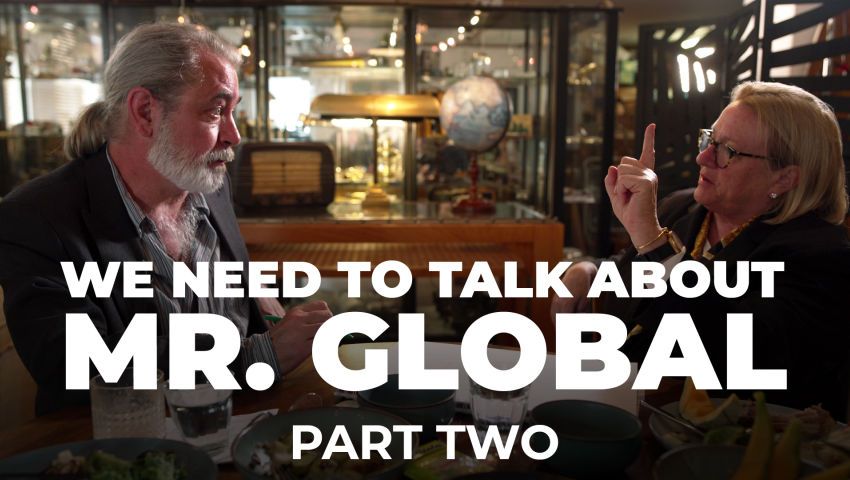
We Need to Talk About Mr. Global – Part Two
THE FINANCIAL COUP D’ETAT
In this PART TWO, we dive into the history of the multi-decade long financial coup and confront ourselves with lots of important questions:
What does it mean for us when 21 trillion US dollars disappear? Why do we urgently need to care about what is happening?
When two people from such completely different worlds come together, their approach is naturally creative and offers both, the necessary seriousness and a pinch of humor. A great mix for such important topics!
Trailer
TRIAL OFFER: OVAL Abo 24 Std. – only 3 € .
Overview:
Watch the full episode with OVAL Abo
Above you can watch a short version.
from €7 / month · cancel anytime · this and all other films, shows and articles
Already a subscriber? Log in
The topic today is an adversary that poses a threat, serious threat to the security of the United States of America. It's the Pentagon bureaucracy. Fiscal year 1999, $2.3 trillion missing. Fiscal year 2000, $1.1 trillion missing. According to some estimates, we cannot track $2.3 trillion in transactions. $2.3 trillion with a T. That's $8,000 for every man, woman, and child in America. Pentagon misplaced $8.5 trillion. Military leaders have also been found ordering subordinates to doctor books to hide the missing money. This is the conclusion of a special report by Reuters.
You are required when you play with other people's money to make things transparent. What does transparent mean? It means easy to understand what's going on. Capisce? You should be able to pick up the annual report of a company, and you should be able to understand what they're doing with your money. You should be able to pick up the federal budget, and you should be able to understand what's going on. Now, I was the Assistant Secretary of Housing, okay? And there are people who tell you the problem is I'm too smart. I picked up the HUD financial statements for the year 2000. I spent 15 hours trying to understand them. I couldn't understand. That's not transparent.
When they started the going direct and decided to print themselves $3 trillion to go on a shopping spree, they turned around and shut down Main Street. Yes. And put everybody on Main Street in a trap where they had to sell assets cheap. Here we have 20 small businesses in a shopping mall shut down, and everybody's got to go to Costco, which is publicly traded, and those guys are making a fortune. Right. And so now you can pick these guys off cheap. Exactly. Right. And that's, you know, it's one thing to print yourself money for free and go buy something. Right. It's another thing to put the guy who owns that thing you're going to buy in a corner, so he has to sell cheap. That's right. Right. And not only that guy who's running his business, but, you know, the people who can't pay their bills anymore.
Right. And then their house, you know. Right. And whoops, we'll come up, we'll buy your house. Right. And we'll rent it back to you. And we'll rent it back to you. Right. And you'll be happy. Right. And we'll sell your pension fund or REIT that finances this whole deal. Exactly. And at the end of the day, when you want to educate your kids, when you want to collect your pension, when you want the benefits of all of that stuff that you're working for and paying your taxes to the government for, sorry, we don't have anything left for you because the magic virus. Right. The magic virus. The magic virus stole all of our money. Right. One of the reasons that I really wanted to come up and talk to you about the new normal and, you know, Mr.
Global and Globocap and just the story of what's been happening over the last, you know, 30 years or however long it's been is because, you know, I focus mostly on propaganda and ideology and communications and all of that. And I really, you know, I really don't understand the money stuff. Mm-hmm. And you do. Mm-hmm. And I would love to be able to understand it in a simple way that, you know, that makes sense to somebody like me and to other people like me. And I just thought this would be a great chance to sit down with you and try. And I'm so glad you did. And try to do that, you know. Yeah. So what is the story? We talked about, you know, the new normal as the latest step, you know, in a process that's been happening, a process of really of transferring money and power out of the institutions and structures that at least theoretically should belong to us, the people. Right. You know, the people transferring that money and power out to this, you know, network of unaccountable global.
Yeah, secret global entities, which you call Mr. Global and I've been calling Global Cap. So, yeah, from, with all, with your knowledge and your experience, I mean, what is that story? You know, how does, how has this machine worked? You know, when did it start? So, well, you know, I always tell you this is the culmination of a 10,000-year-old war. Right. So, what is that war? It's been going on for a long, well, that's a spiritual war. But let me take it in, let me just bring it into the 20th and 21st century. So, the financial system is just a component part of the governance system. So, Mr. Global is my nickname for the top of the governance system because it's secret. And so, because we don't have a map or an organizational chart, I have a nickname for it, Mr.
Global. Right. Okay. So, the financial system is just part of how Mr. Global manages, manages the people, manages the resources. And you can't think of the financial system as separate. It's part of the hydraulic pumping system of governing and managing everything on the planet. Right. So, we've had for 500 years, A, what has been for the Western world, a phenomenally successful model called the central banking warfare model. Okay. The central bankers print money out of thin air. Right. And I'm exaggerating. Everything I'm going to say is a gross exaggeration just to make it simple. But the central bankers print money and then the military makes sure everybody takes it. Right. Right. So, it comes down to who can do the best financial engineering in terms of printing the money and who has the biggest gun.
Right. It's a promise. They literally create money by punching buttons. Right. Now, for many years, we had a gold standard. There was some real asset backing. Right. When we moved off, when the U.S. reserve currency moved, the dollar moved off the gold standard, we did go to an informal oil standard in a sense. But we've been pure, technically, we've been pure fiat currency, which means there's no real asset backing it. Right. Basically, the central bank will just create money saying, here's the money. And the reason that I can trust that or count on that is basically power. Yes. Right. Political and military power. That's what I'm trying to get at. You know, you're creating money out of thin air. I trust that money because you're the biggest badass on the playing field.
Right. So you're the one that I trust. That's where the money comes from. At the end of the day, it comes back to the military. It was interesting. When the first secretary of defense went through his congressional testimony during the Trump administration, he pointed out that the U.S. reserve currency was way too dependent on the military. Yeah. Thank you, General Mattis. You're right. Thank you for pointing that out. But it's right now, the reserve currency system is highly, highly dependent on the capacity and ability of the military to encourage everybody to stay in the system. Yeah. I mean, the way I understand it, okay, you're the U.S. government. Right. And you create money. Well, remember, the financial system has been a partnership between the central banks and the fiscal policy run by the legislatures.
Right. Okay. So you have the parliament or congress, and then you have the central banks. Now, the owners of the central bank also happen to run the bank accounts and financing for the governments. Yes. So their power and control is very significant on the fiscal side, but it's very quiet and invisible. And there has been this balance of power between the guys who can print money out of thin air and the people who have to earn money and then pay taxes. So you have this infrastructure of the fiscal policy and the monetary policy, and it's a balance of power between the electorate and the bankers. This is my next question, is what I wanted you to do is explain just very simply for me, how is it supposed to work?
How is it supposed to work? Well, how it's supposed to work is the electorate pays the taxes. Right. And congress, whether it's the tax money or the credit supported by the tax money, the congress basically determines the policies, and that congress is elected by the election process as opposed to the election computer fraud process. Exactly. Theoretically, we send them to congress. We send to congress, and our input into the policies is we can vote them in and out. Exactly. But we can vote them in and out based on transparency of how the money is spent. And what I refer to as the financial coup d'état for the last 20 or 30 years has been the process by which the central bankers have been sneaking in and taking complete control of the fiscal policy and delinking it from the electorate. Right. And I want to understand that.
Right. On the monetary side, what are they supposed to be doing to benefit democratic societies? How is that monetary side supposed to work? Oh, well, there's a big debate. I mean, they create money, basically. They're supposed to run a financial system that allows trade to happen. Okay. And allows financial liquidity to happen. And the liquidity is a big part. And to do it without inflation, which is why the more they print and the more it drives prices up through just printing more paper, they're considered to be violating their mandate. Right. But the useful function that they're supposed to be performing is creating enough liquidity and keeping the financial system stable so that businesses can… So here's the little secret.
The Treasury can do all of that. We don't need central banks. Okay. In other words, central banks are a very complicated machinery to do all of that, which drains money from the system, but it permits that whole operation to be secret. And see, this is what… If it was at the Treasury, if the Treasury did it, then it couldn't be secret. And this is what I'm trying to get at, just for people like me who don't understand all the nitty-gritty-its. You know, okay, there's all this machinery over there, and, you know, a lot of us don't even understand, you know, how it works, where the money is created, and what have you. But what it's supposed to be doing, this is the part of the machine that is supposed to print the money for us, keep the financial system, you know, stable enough so that businesses can trade and wealth can be created.
So it's supposed to run a sound, stable financial system. And the theory as to why we should let the private banks do it is they will keep it independent of government and dirty politics. Uh-huh, exactly. Okay, great. That's a function that needs to be done in order for people to be able to trade and businesses to grow and people to have jobs and wealth. You know, someone needs to do that function. What you're saying is the Treasury could do it. Treasury could do it. Right, but instead… But then it couldn't be secret. Yes, but instead… Right. Instead, we have this. Right. Right. Right. And different risk managers in the financial institutions would argue you can't trust Congress to do that, you know, because they're too, you know, they would want to print money and hand it out to their friends.
They're too corrupt. Right, right, right. But you can trust us. Right, exactly. The thing I did that caused so much offense in Washington is I started to create a software tool that would show you how all the federal government worked in the area that you lived in, walked around, and looked at. So, in other words, you pay your taxes. It's one of the biggest investments that a citizen makes is paying their taxes. You should get a financial statement that says, here's not only how all we spent all the money, all the tax money for the whole country, but here's how we spend it in your neighborhood, in your community, in your state, so that you can equate the expenditures and the usage to the jurisdictions for which you vote for political jurisdiction.
Absolutely. You know, just like a stock would give you a financial statement for the company, you should get a financial statement for your neighborhood or your county. Absolutely. Or for an old socialist like me. Right. That's my labor. You know, I've gone out and I've worked and I've created value with my labor, and I've given a portion of my labor, you know, to the government. Right. And they are going to use that value to do certain things, which hopefully I support, and that's why I voted them into office or what have you. But in any event, once they allocate all that money and use all of that money, they come back to me and say, here's how we used the money you gave us. Here's how we allocated the value you produced with your labor.
So here's the problem you have when you come into a county level in the United States. Right. When you come into a county level, you have the monetary policy happening and you have the fiscal policy happening, and both are happening behind tremendous walls of secrecy. So you don't have financial statements for your neighborhood, and you don't have anything that shows you how the monetary policy is interacting with your neighborhood. And behind those walls of secrecy, your neighborhood is getting drained. It's getting drained of human capital. It's getting drained of environmental capital. It's getting drained of financial capital. It's getting drained of legal capital. So, for example, if I'm in a community and I want to invest in a venture pool of all the small businesses in my community through my IRA, I can't do that. What I can do is I can buy the stocks that are traded on Wall Street that are very centrally owned and controlled.
Yes. So the idea is to channel all of my money back into a machinery that is controlling centrally. Yes. And that's one of the reasons. The greatest reason for environmental imbalance or human imbalance within a place is that centrally controlled secret financial system. And the little secret in all of this is if you could reverse that, if you could decentralize and have a healthy local financial system that was in balance with the environment and the people, the wealth potential is fantastic. But then you couldn't centrally control. Exactly.
Sacrifice is the folks who want to centrally control it have to give up central control. Right. So what happened starting, there are different ways of recording it, but at the end of World War II, we created two acts, the National Security Act of 1947 and the CIA Act of 1949. Yeah. And what we did with those two acts and then subsequent acts in executive order is we created a secrecy machinery. We said the most powerful financial interests in the world can keep a whole bunch of money secret. Okay. Okay. Where? So the National Security Act basically created the national security infrastructure. The 49 Act, the CIA Act, said that we could claw money out of other agencies' appropriations and put it in a black budget and keep it secret except for a small committee in Congress.
Okay. So you started to create a secret budget. Okay. That we can't look at. We don't know what's going on with it. We don't know how much is in there. Right. Now, what we do know is there were other funds in the government, like the Exchange Stabilization Fund, where secret activities went on. You know, sort of, you'll hear people saying they're rigging the markets. It's the Exchange Stabilization Fund. But on World War II, they were able to seize a huge amount of money and bring it back into the Exchange Stabilization Fund, which I call the mother of all slush funds. Okay. And sometimes I say American history since the 47 Act is the history of the mother of all slush funds getting replenished again and again.
It's like we need more secret money. And when you're talking about after World War II, you're talking about literally spoils of war. Yes. Yeah, that works. One of my favorite stories about the Exchange Stabilization Fund is they brought some of the booty back into the fund. And it was before they created the CIA. So you had the Dulles Brothers sitting at Sullivan and Cromwell in New York. And they were helping to run this. And the Vatican requested that the European elections be rigged in 1948. And so they financed the rigging of the European elections for the Vatican out of the Exchange Stabilization Fund. So think of it as your ultimate political kitty. And all of these acts and this slush fund and all of this was created on the grounds of- National security. National security.
We need to keep something secret. And if you look, one of the things we're watching, for many years, some of us called the world that was built up out of this growing secret black budget and related monies. We started to call it the breakaway civilization because essentially what was happening was a financial coup where the U.S. government or other governments would issue debt and then the money would disappear out the back door in through these secret mechanisms. Right. And so we started to call it breakaway civilization because they were literally building a whole new civilization. And what is happening now, the new normal, is the breakaway civilization is now breaking in. Uh-huh. Yeah. So- Breaking back in.
Right. Exactly. And just to make sure that I'm clear about this, what you're talking about is, you know, they issue debt. So they raise money. They raise money. You know, here's a note, a bond, what have you. You give me a bunch of money. And then I stick it over here in the slush fund and nobody knows what happens to it after that. Right. So this started in fiscal 1998, which begins on October 1st, 1997. Okay. Starting then, money started to disappear in huge amounts from the federal government. The federal government is required by law to produce audited financial statements. Yeah. To this date, they never have. What they have done is said each year that they couldn't and in some years admitted that there was a huge amount of undocumented adjustments.
Now, let me explain what an undocumented adjustment is. And before you do, I just want to make it clear, you know, they, according to the Constitution... They're required... To show us what they did with the money. Well, there are two rules in the Constitution. One is they can't spend money unless Congress has appropriated it. That's right. So it has to be approved before it's spent. Right. That's a power that Congress has. Right. And the second thing is you have to say what you did with it. Right. Okay. For many decades, but certainly from 1997 or fiscal 1998 on, they are in massive violation of both rules. They, you know, there's vast amounts of spending going on that's unknown to Congress and never approved.
Right. And thus unknown to us. Right. And there's absolutely no transparency. And what's interesting is I started a process in 1999 where I started warning people because we found, I and my team found it very early on. When Cuomo was running HUD, money started to go missing. And I had been, as Assistant Secretary, I had taken the initiative to significantly upgrade the accounting and information systems so that their books could be perfect. Right. So by fiscal 1999, when the money started going missing from HUD, it was impossible. They said they were missing $59 billion in one year, which is bigger than their entire budget. What we're talking about is literally HUD, for example, or whatever department, you know, they present their financial report and they say, we did all of our accounting and auditing.
And gosh, you know, we're missing $59 billion or whatever it is. Well, we have $59 billion of undocumented adjustments. I'm just saying, for example. And they insist those are accounting. And what I'm saying is what they're telling me, you know, Joe Public, what they're telling me is, gosh, that money disappeared and we don't know where it went. Right. Is what they're saying, which in and of itself just sounds completely crazy. Well, imagine just for a second if you said that to the IRS on your 1040. Yeah. Or if I said it to any, you know, creditor. It's like no one would accept that from me. Right. You know, it's like, oh, you know, I'm sorry, you know, I believe I paid you, you know, $100,000, you know, instead of the $10,000 that I actually, it just doesn't fly. Right.
Good. I just wanted to get clear on how absurd that really is. Well, but here's the thing. So they started a process. And the same time that they're saying, oops, $59 billion missing, the private equity firms in Washington were exploding with money going into the China and other funds to invest in the emerging markets. And these were people who had no capacity to raise this kind of money. And everyone was like, where did all this? Where did that $59 billion go? I call this the financial coup d'état. Right. We are now missing over $21 trillion that we can document with federal government documentation. And so those are undocumented transactions. They've announced another up to $96 trillion of, well, we don't know if they're undocumented or supported or what, but just adjustments. So let me explain what are undocumented adjustments.
Yeah, and then let me ask you a question. Go ahead. You have a checkbook, and it says you have $10,000 in your bank account. Right. Your bank sends you a statement, says, oops, you only have $1,000. Right. So you write undocumented adjustment $9,000, and now your checkbook balances. Okay. And your bank says, we promise never to do that again. Yeah. And you say, okay. That's the relationship we now have with the federal government. Anyway, in 2018, I worked with a professor from MSU, Michigan State University professor, Mark Skidmore, to do a complete survey of all the HUD and DOD financial statements from fiscal 1998 until 2015. What had happened was I was on a radio interview explaining that the U.S. government was missing $6.5 trillion in 2015, which I describe publicly as a cut and run.
Yeah. When you steal everything remaining, and then you get ready to run. Yeah, get out of town. Right. This professor heard me, and he said, she has to be mistaken. It's impossible to have more undocumented adjustments by a multiple of many, many factors than your entire budget. Yeah. So he got online and went and saw all the documents and realized, oh, she's right. Yeah. Anyway, so he agreed to do a survey. We did a survey. When we published his results, the total debt of the U.S. Treasury was the same amount as the money that had gone missing. Nice parallel. Anyway, so what we've seen is what I call a financial coup d'état. And the reason I kept warning everybody all along the way, I never set out in 1989 to spend 30 years of my life warning people about missing money. That was not my plan.
Right. But every year I found myself warning them because I knew, well, in 1997, the president of the largest pension fund in the country, I showed him my plan to sort of reinvigorate the U.S. economy. Yeah. And he looked at me, and, CJ, it was a magical moment. He looked at me and said, you don't understand. It's too late. I said, what do you mean it's too late? He said, they've given up on the country. They're moving all the money out starting in the fall, which was when it started to disappear. It was that October 1997. They literally decided, okay, this mechanism of the central banks and the treasury where the electorate votes in Congress and they run the tax money, and then we, the owners of the private banks, control the monetary policy, and it's a balance of power between those two.
Right. We give up. It won't work. We cannot get the electorate to be committed to financial responsibility. And so we're looking down the road, and in 20 to 30 years, the boomers are going to retire, and they're going to want all their money back. Right. And we don't want to give it back. Yeah. So we're just going to take it. Okay. So that's what they did. They moved all the money back out, and I kept warning people. I said, they're taking, they don't want to pay for nursing homes. They want to use that money for space. And if we don't stop this now, once we get to the time when everybody wants to retire, we're going to have a big problem. Because they've taken all the money. Exactly. Right. And so what do they do when everybody wants their retirement savings back? You know what they tell you?
Yeah. Oh, CJ, there's no money. We spend it on the magic virus. Yes. Exactly. That's the new normal. Right. That retirement that you were planning, well, maybe you need to rethink that. Right. Exactly. And, you know, not travel. And, you know, stay home. Right. And it's okay, because you can't go to a restaurant anyway. Right. Because you haven't had the latest booster shot. Right. And, you know, eat the bugs. Right. What they're trying to do is saying, oh, you know, we're bankrupt. There's no money for health care, et cetera. And we need to change the assumptions on your pension fund and, you know, blah, blah, blah. And it's all because of the magic virus. And what you're talking about is, you know, the going direct reset. You've covered this in your Solari Reports.
You've covered this a lot. And a lot of people don't know this. This came about, what was it, BlackRock that came into this meeting? So here's what happened. Yeah. The G7 central bankers go to Jackson Hole every year. That's right. It's a standard meeting run by the Kansas City Fed. Okay. So they show up in Jackson Hole in August. And a group of retired central bankers, very powerful central bankers, had been working through the BlackRock Investment Institute to put together a new plan for how you essentially consolidate the financial coup. Yeah. And it was called the going direct plan. They wrote it to, you know, they're remarkably honest about what they're up to. And anyway, so they gathered together and they had a vote and they voted to approve the going direct plan. And then as soon as they left, they went back to the market.
The Fed went into the market and started to institute going direct. And of course, by the time they got to March 2020, you needed a better cover story than, oh, we're having a coup. So now, interestingly enough, if you go back through history, there is a long, a long tradition of when you need to move the reserve currency, which it tends to move every 75 to 100 years of having a plague that allows you to consolidate control of human and financial capital. And then you move the reserve currency. So this appears to me, I'd love to have some history students go really research this. But I think there's a very old playbook of centralized control using the plague law to switch the reserve currency. And in fact, they are using the cover of the pandemic to globalize the military, globalize the, well, they're not globalizing the civil service, but they're moving all the power into the corporate contractors and banks.
And they will then globalize it all, which can be done with FASAB 56. So what the financial coup did was, as they were using digital systems, because digital systems have had a remarkable impact on the ability to centralize control. Because the question is, how can you centralize control and keep it quiet, keep it secret? And the digital systems have gone a long way to doing that. But what has happened over the last, since 1990, so it's fiscal 1998, when they started to pull all the money, we've watched the power of the electorate diminish steadily. Right. And the power of the Congress diminish steadily. And a lot of that relates to the ability to control the money centrally and control it secretly. And what we see in the last sort of two presidential cycles is a real de-linking of the fiscal policy from any influence by the electorate.
And now what we're watching with the going direct reset, which the central banks agreed to and voted on in 2019, is the central banks basically asserting control of fiscal policy. They're only part of the way there. This is a real financial coup. This is the consolidation of the financial coup. This is, you know, they've been, it's like a fire that's been burning under the grass. That's right. And now they're popping up and taking control. And they haven't finished. You know, they're, I would say they're probably about a third of the way there. Right. And they're doing very well. They've made a fortune. This has been, you know, the going direct reset and the pandemic psyop, is what I would call it, has been phenomenally successful.
Oh, yeah. And so they are very emboldened. It's working. And they're certainly making a tremendous amount of money. And now the question is, can they take it the next step? And the next step is essentially to destroy currency at the retail level as we know it and put into place a transaction system, which will be a complete financial control. Right. And I would describe it as slavery. It's everybody gets a credit at the company store and they have, you know, they either do exactly what they're told or they can't buy groceries. Right. And eliminating cash, eliminating any possibility of having a currency exchange outside of monitoring ability. No markets. Yeah. Everything is AI and software. This is a very high-tech dystopic view of the world.
Yeah. Can I take you back? Sure. Actually, just I wanted to try to make it simple for myself and, you know, and for a lot of people. I think a lot of people don't really even understand what the central bank system is. You know, they think, you know, not they, we, I say, you know, we think, oh, yeah, the central bank, that's a part of the government and that's where they make money. In every country, you know, there are different variations on the theme of how the central bank is structured. So in America, the Fed is run, it's basically 12 privately owned banks owned by their members. It's secret who they're, you know, how much, exactly how much the members own and who they are. It's also secret what the policies are with whether or not they share the data with their members.
So Nicholas Negroponte, when he ran the MIT Media Lab, said, in a digital age, data about money is worth more than money. And I once called all, or emailed and called all 12 banks and said, who manages your databases? You know, what corporations manage your database and do you share your data with your members? And they wrote back and said, that's a confidential policy of this bank. So if I am handling all the transactions in the economy, so for example, a wonderful reporter I used to work with was investigating the drug business and took a just-retired DEA agent out to lunch and he said, let's face it, sweetie, all the wires batch and go through the New York Fed. They know where every dime is. Because remember, if you're going to run, if Treasury did all of this, how would you run the narcotics trafficking and all the money laundering secretly and separately?
Okay, so- Because you'd have no way to hide it because you're supposed to account for it. Yeah, account for whatever you've done, yes. But I dare say, if you had no money to your name, but I could show you the data on how all the money in the economy worked daily, on a real-time basis, essentially. And I could tell you what's going to happen, you know, in the business cycles, because a lot of those cycles are being driven by the central banking policy. You know, it wouldn't take you long to end up a billionaire, right? Because you're talking about the ultimate in insider intelligence, right? Yeah. You know, and including some at the Treasury, too. So controlling and having access to the data on fiscal and monetary policy is the basis of huge, huge fortunes.
Yeah, I just think it's really important to understand, especially in the context of the story that I think we're chasing here, of power and money being sucked out of the democratic structures that should belong to us into these unaccountable structures that we can't even see what they're doing. There's an old saying that the Fed is about as federal as Federal Express.
Go, I want you to keep telling the story. I mean, I needed to really understand the basics of it. I need to add a couple things to the financial coup. Yeah, go. The financial coup, they decide, okay, we give up on trying to run the U.S. government on a fiscally responsible basis. We're going to pull all the money out, you know, wherever it goes. And that's part of the globalization move. We're shifting the money out and taking it. Can I stop you with a question? Why did they decide that? You know, what happened where they said, okay, we're giving up on the system? They don't think you can manage a complex society taking in or awarding power to the electorate. In other words, if you look at what it's going to take to do investment and risk management over the long term, they just think the electorate only votes for the people who hand out more money to them. And so you can never get to a fiscally responsible situation in a democracy. They would tell you, and what they told you after 1996 is democracy doesn't work. Right. People will vote for the guy who hands out the most money.
People are too stupid and greedy. No, not too stupid and too greedy. The structure is such that the criminal always wins. In other words, we have a systemically engineered structure that will always favor the criminal. And so it won't work. And I disagreed with him because I said if you decentralize the financial system and allow communities to optimize equity, private equity, publicly traded equity locally, and you bring transparency to the government money, then, in fact, you can create a constituency for financial responsibility and you can align the environment with the financial system. Forgive me if I'm making it too simplistic, but what I'm hearing basically is, you know, and maybe it's not they're too stupid and too greedy, but it's just democracy is too much of a mess.
It's a mess, and I'm talking from the voice of these guys. We're never going to get where we're trying to go, you know, with this, you know, democracy thing over here. And what we need to do is suck the power out of there and put it in our hands. So let me say it another way. We've built this huge national security state that's secret. Right. And we're half pregnant. We're still pretending we're a republic with the democratic process. Right. But we are, our economy all revolves around the secrecy. Right. And we can't figure out a way to end the secrecy. I've been told on more than a few occasions they've gotten together and tried to figure out how to reduce the secrecy. And the reality is, if you look at all the technology and assets that have been transferred by questionable means into private and corporate hands, the liability is too over the top.
So we're half pregnant. We can either go full on national security or, you know, go with chaos. This is exactly what I mean. And they're saying, OK, the only way we see forward is complete, total central control. Exactly. We can't let go of the secrecy and the national security, so the democracy has to go. Well, and here's the danger with this. The centralization continues to depend on lower and lower productivity. So you have more and more money that is less and less productive. It's an incredibly, you know, one of the interesting things in the Trump administration was Trump basically was a businessman who could add. And he would go in and say, $4 billion for that? Are you out of your mind? Right. And, you know, because the whole structure has become so political and unproductive. It's extraordinary.
Correct. Now, imagine just for a second, there is nothing to stop a neighborhood from starting its own central bank and having its own currency. And, in fact, if you look at real solutions, that is the real solution. We decentralize our money systems. You know, so we circulate equity locally. We circulate currency locally. We create ways of creating privacy locally. One of my favorite moments on the Solari Report was I was interviewing Bill Binney, and he said, he said, what we need to do is incorporate encryption into every home schooling curriculum in the world. He said, if all the kids are constantly making new grassroots encryption systems, he said, it'll drive them crazy. He said, I can't handle it. No, I love that one. I just, I love that one.
But, you know, it might sound like it's too much work to figure out how to do your own community currency. Right. But let me assure you, if we don't, you know, so it's either going to centralize further or we're going to decentralize it. There's no, you know, there's no middle of the road. It's what you wrote, you wrote recently, pick sides. Pick a side. Pick a side. There's no more middle of the road. Everybody's looking for the middle of the road. There is none. So you have to pick a side. And it's why I'm so obsessed, why I concentrate so much on trying to shine a light. A lot of what I've been chasing, you know, and I talk about the last 30 years a lot, but it actually does go back to the end of the Second World War.
It's kind of, I always felt, and this is weird coming from, you know, somebody who is on the left and which I definitely am. But basically, after the Second World War, I always felt it was just a matter of time until the Soviet Union was going to dissolve. And it was a fait accompli already. And what you're describing is, you know, what I call GloboCAP already transitioning into a global dominance structure. Sure. And the development of this, you know, secret national security apparatus, of course it developed. It started developing then and has just continued to develop, yeah. Okay. So we talked about why the U.S. governance or financial governance mechanism wasn't working in terms of the central. The central bankers were frustrated trying to deal with the fiscal and really want to take it over.
But there was another frustration going on at the same time, and it was related. And that frustration was the U.S. dollar reserve currency system globally had come out of the Bretton Woods decisions at the end of World War II. And there were many people in the emerging markets and in the economies that were growing fast that had grown uncomfortable with it. It wasn't working for them. And a decision was made, say, 10 or 20 years ago to use the reserve currency to impose financial control and sanctions globally and to globalize our legal and enforcement controls financially. And that has caused tremendous tension because there is a multiple personality disorder between using the reserve currency system as a, using it as a weapon to control versus people needing it to trade.
You know, it's very difficult to trade with tools that are being used as financial weapons. There's a multiple personality disorder. And the G7 nations, if you look when we published State of Our Currency, I did a timeline, the G7, the G20 nations are just in an uproar because they just need, you know, to trade fish for, you know, iron. And they can't because they're trying to trade in the middle of a financial war and it's driving them crazy. Right. And to make it just real and put it in real simplistic terms, you know, for myself and for other people, it's as if I need a wrench, you know, to fix my sink in the bathroom. And you say, oh, no, sorry, you know, you can't use the wrench because I'm beating this guy over the head with it.
Right. Right. So there has been more and more tension as the G20 and the emerging markets say, you know, we're going to start building alternatives to trade because the U.S. dollar system has been weaponized. That's right. So while you're the Federal Reserve and you're trying to deal with your various problems domestically, you're having to deal internationally with the fact that the world is changing and in a multipolar world, a lot of people don't like your system. And so there's tension internationally, there's tension domestic. It appears to me what they're trying to do is literally take the U.S. government regulatory structure, the Treasury and the military and de-link it from the U.S. and the U.S.
electorate and move it into global hands. Now, one of the things we have to bring up is something called, I call it FASB-56, the Federal Accounting Advisory Board Standards. Okay. In 2018, when you thought that the Senate and the House and the Republicans and the Democrats were all fighting about Kavanaugh and the Supreme Court. In fact, they were all gathering and writing a new accounting standard at an administrative level that said, oh, we can keep secret books. Not only can we keep secret books, but a group of people who are secret can decide what's secret. And they can decide what's secret by a process which is also secret. And then when it's over, the books are secret, but you can't know how much of the books are secret.
So when you're looking at the financial statements, you have no idea what they mean. Because arbitrarily, anything could be secret. Now, let me tell you what this means as a practical matter. What it means as a practical matter is that most of the companies and most of the banks traded in the U.S. stock market have secret books. So the government's secret, the big banks are secret, the corporations are secret, the whole thing's secret. Right. So now we're in Never Never Land because everything is a simulation. Well, you said it, and I think it's the story that we're trying to focus on here. What should be transparent to us is being increasingly walled off and removed and transferred out of our theoretical democratic society to this thing that you and I are calling Mr. Global and Globocap because we can't even see it clearly enough to understand what it is. Okay, so let's say it this way.
Our sovereign governments have become deeply indebted through this financial coup process. So now we're in a debt trap. They no longer have information sovereignty, and they no longer have financial sovereignty. Okay, but they still are our governments, and we still think they're running things, even though they're not. And what is now happening is they're in a position of constantly being extorted. Yeah, yeah. So let me say one more thing about FASB-56, and then I'm going to come back to the red button story that we talked about at breakfast. Yeah, yeah, yeah. Okay, so when FASB-56 happened, that was the last step in the financial coup they needed to do the pandemic. Okay. Okay, because once you have an infinite amount of secret money, you can do anything in that mechanism.
Sure. What was interesting is when there were a group of us who tried to warn people about FASB-56, and no one could connect the dots. There was an inability to understand what infinite amount of secret money combined with another precedent that happened during the financial crisis, which is the banks did not have to obey the law. So if you have a banking establishment, which is by policy free from the law, and they can borrow through the treasury mechanism an infinite amount, or print an infinite amount of money and spend it however they want, it's only a matter of time until you have a complete, you know, a consolidation of the code. Everything else has been tried. It's either cut retiree benefits or the plan will go belly up.
Right now the administration is clearly in denial about the inflation that's spinning out of control. Another disappointing report on inflation as prices unexpectedly rose in August and remain near a 40-year high. What worries people is we don't know where this ends. The typical American family has to spend $460 a month more than they spent last year to get the same stuff.
Never miss a show
New films, shows and articles by email – free, unsubscribe anytime.