Gottfried Meinhold | NARRATIVE #121 by Robert Cibis
The Copernican
Robert Cibis talks with Gottfried Meinhold about his book “Der Kopernikaner” (The Copernican), published by OVALmedia. This fascinatingly clairvoyant parable of an epidemic, which evokes medieval times of plague, reads like a Kafkaesque portrayal of the corona present: the Copernican is almost knocked off course by the turmoil of an epidemic spreading worldwide for which no pathogen can be found. He falls ill himself, and after his arduous recovery he ends up in the political underground.
A book that could not be more topical, and yet it was written forty years ago, in dark times, borne by premonitions. A parable of mankind of great import, valid to this day.
Limited edition published by OVALmedia, numbered and hand-signed by the author (in German)
Der Kopernikaner – special edition
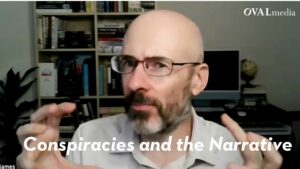
Robert CibisA warm welcome to a new episode of Narrative. I'm very proud, very honoured, to be here with Prof. Dr. Gottfried Meinhold. You're a linguist, but also a poet and novelist. And the conversation is also on our own behalf, because Ovalmedia is publishing the book Der Kopernikaner, The Copernican, very soon. There are only a few days left until it comes out. And I even have it in my hand already; it's already printed in a limited edition. It's called The Copernican. But we don't only have to talk on our own behalf; what's interesting is also the time in which the book was written and what it then means for us when we read it today, because the book was written around 1980, right? Written in 80, 81. Exactly. And that's a while ago, and yet in parts it reads as if one could have written it today. At least that's how I read it; of course I don't know whether you'd have written it like that today. That's a question we can discuss in a moment. Before I ask the first question, I wanted to briefly justify what I just said and read out a short paragraph. For example, I'll now say something very conspiracy-theory-like that's in your book. Book.
More inability than ability is needed to help people survive. It could go like this: trained germs nestle in certain nerve pathways, whole cell clusters, prevent certain connections or favour them by interrupting other, disruptive ones. They're directed into the relevant brain regions and create new abilities through negation, destruction, necrosis, a special new kind of pathophysiological intervention. Their toxins burn out certain cells; they bore and extirpate. Certain thoughts are then not even thinkable; the possibility of certain errors is extinguished. I'll skip a little. Of course, the disease that brought this about wouldn't be without risk, but after convalescence the patient would be a different person. The revolution of thinking and feeling would lie behind him. The newborn, changed, other human being: from him springs the other society. One must strike life if one wants to change it, at its innermost core, in heart and brain. So this is, I'm saying this now as a quotation, because these are, I'm not talking about facts now, I'm talking about narratives. I'm talking about what now, so to speak, well, these are perhaps facts, perhaps not; I know that, I don't want to discuss that now.
But there are already nano-devices that one, computers, nanorobots that one can inject, for example. I recently spoke to a researcher in this field, and much of what's currently being researched isn't known at all; it's not in the media at all. So this concept itself is very topical, and I'm surprised how you were able to write something like that, for example. And that's why I say I read it today with a view where I think: wow, this is quasi a science fiction novel, or a look into the future from today's point of view. Or perhaps into the present, depending on how you see it. So before I ask how you actually came to this text, or to this topic, I just wanted to ask what The Copernican actually means. What did it mean back then, in 1981, 80, or today?
Gottfried MeinholdYes, first of all it's about something very simple that we all know, namely the view that established itself from around 1500 onwards, the heliocentric world view, the sun as the centre of the solar system. That's the achievement of the Polish astronomer Kopernik, Latinised as Copernicus. And then this great upheaval, people even speak of a wound to mankind that this discovery is said to have caused, because before that there was the geocentric, the Ptolemaic world view with the earth as its centre. And that was a tremendous scientific revolution, one has to say. Such revolutions were later, several times in the sciences, also called Copernican turns. There was certainly a Copernican turn in medicine, for example through the discovery of the circulation of the blood. There may even be several Copernican turns in medicine, also brought about by microbiology, that is, when people finally knew what infections mean and what causes them.
The Copernican is actually someone who is naturally familiar with this world view, but that's not the most important thing. The most important thing in his mentality, I'd say, would be that he wants upheaval. The absolutely new, the subversive and the revolutionary, if you like. A radical upheaval: the transition from the Ptolemaic to the Copernican world view certainly was that. Yes, but in the sciences one is more modest. People also speak, in sciences whose developments are less conspicuous, in linguistics too, occasionally of a Copernican turn that has occurred there, for instance through generative grammar or innovations in grammatical theory.
Robert CibisOh really, I wasn't aware at all that language there had also undergone such a great turn. Yes, linguistics several times too, you know.
Gottfried MeinholdThrough modern structuralism; that's something different from the historical-linguistic orientation that prevailed before, with Grimm for example, Jacob Grimm, who wrote the first historical grammar of German, actually at the same time of the Germanic languages. So those are the essential moments of the Copernican mindset, I'd say. And the fact that I placed the Copernican, as a human type, in this way at the centre of a narrative, or also of a great reflection, a reflection that's partly somehow essayistic, does indeed have its cause in the fact that at that time, namely 1980, 1981 above all, but prepared since 1978 already by armed conflicts of tremendous force and above all of tremendous surprise, plus the intensification of the nuclear threat, worldwide, until well into the 1980s, this force with which developments were taking place in a dangerous, almost horrifying way, that there were of course considerations about what must happen to move forward here, to set off a development that leaves all this behind.
And that's what it was actually about.
Robert CibisVery briefly, I wanted to go back to the title, because I find that the book is astonishingly profound in making this title a theme at all and also in questioning it, because this upheaval is not just an upheaval, but really a new perspective in which man also makes himself an object, and mankind makes itself an object, and no longer places itself at the centre of the universe. And this objectification of man is also what causes a lot of trouble today. Or what, for example, fascism and the like are blamed for. People say: we can't simply treat people like animals or like things. That would take away people's dignity. And I find that fascinating in your novel, which basically reads like an essay when you read it. You've just said so yourself. Because one reflects a lot on what contradictions, what paradoxes there are. Because we make ourselves an object, but we must also remain a subject, otherwise it doesn't fit either. Because there's no object that's observed without an observer. So what's your view on that?
How Copernican was the world back then? And do you see the figure, and perhaps in what direction society has developed?
Gottfried MeinholdYes, in this book man actually recedes very much into the background compared with the event that takes place, actually without his ability to influence it and without his having anticipated it in thought. He is actually exposed, in this book, to an occurrence that also, as it were, overruns mankind. It's an epidemic that develops, and one that develops without a pathogen, strangely, but develops in the way intellectual epidemics have occurred in the course of history. And then he felt, as it were, set on track in this development. And he got involved in it. And yes, that's indeed a difficult question: how Copernican has society become?
That's the question. Yes, yes. How much have we become an object? The necessity of becoming an object is indeed given. Mankind must see itself as an object. Man must be seen as an object, in medicine for example. Isn't that so? Without this intensity of perceiving individual things, in the organ system, or in the interplay of psyche and body, there's a great deal that can be objectified. And at the same time he must again and again be aware of his subjectivity in this context. Context. That means his subjectivity is involved in the non-subjective, in what's to be objectified, apart from the fact that psychology of course also has to analyse his subjectivity in detail, namely the internal processes, cognition and emotion in detail, and has to objectify them again and again.
Again. So this possibility or necessity of objectification is permanent; there's no doubt about that. And man of course always lives in this contradiction.
Robert CibisContradiction. It's like in mathematics, where there are sometimes completely illogical situations. Situations. You mustn't divide by zero, but you'd have to. Or you can't define pi, and so on. There are such points where the tool of mathematics is at its limits, and I have the feeling we also have a limit here somewhere, because you can't calculate the subject out, but have to act as if it didn't exist at all if you want to work scientifically. Scientifically. And then you want to research subjectivity, take it as an object, and straight away you have a problem of perspective again. And that's why I also found the quotation I read out so telling, because if, for example, you really make man a complete object, then you'd think in such a way as to say: we treat man with a disease that changes this person, even changes him psychologically, and even changes him so that he thinks differently. And that sounds reasonable, sometimes, in that context in the text. And sometimes it also sounds
Gottfried Meinholdmonstrous. It is monstrous, already in Schiller, by the way. If you think that Schiller, with the Letters on the Aesthetic Education of Man, actually recommended, or wanted to recommend, a very benign prognosis for development. Development. And yet something finally comes about at the end, though it only flashes up, namely the aesthetic state, which is to achieve that something takes place which far at the front, right at the beginning of the letters, he demands, namely a total, he really says total, he uses this word, a total upheaval of man, basically an inner revolution. A total revolution of his inner condition. Without that, he believed, mankind would not move forward. He has a highly critical position. He sees the times and the destruction of human possibilities through the division of labour. He sees that just as Marx did later. Interesting. He virtually anticipates descriptions of alienation, without using the term, and then has a very clear opinion, a damning verdict on the present, his present.
And on what it does to man. But what he recommends as a possibility also almost looks like a dictatorship. The dictatorship of the artistic-aesthetic, one would almost have to say, although it of course becomes problematic when one forces people who actually have no artistic talent, well, or no affinity for art either, which is often the case, to submit to aesthetic education. To what extent, one then asks. And then this totality keeps playing a role, the total, the inner totality of man. And it doesn't exist. There's a reasonable particularism in human development, individually, and there's no totality of the kind Marx later also demanded. That's a utopia that leads astray. But back to the Copernican. He of course seeks the upheaval, this upheaval. And it's pretty daring to dream something up, if it really is his idea, to dream up that microbes might be able to rebuild, so to speak, in the human organism, those parts of the organs that are responsible for human behaviour.
That's very utopian thinking, and of course a...
Robert CibisHow did you come to write that in 1980, 1981?
Gottfried MeinholdYes, at the basis of it was, I've often asked myself; that's almost a question that overtaxes me. Because I no longer know exactly. I can no longer remember so well how this motivation to write came about. I simply started writing. I think a final impetus was given by Gottfried Benn's Ptolemäer, The Ptolemean. There's a great prose text by Gottfried Benn, The Ptolemean, and I thought: well, now, what is that? What does this backward turn in the direction of a Ptolemaic world view mean? And I thought one would actually have to make, out of everything the times offer, a Copernican, and with a view to a Copernican turn.
Robert CibisYes, well, that's really fascinating for me. And thank you very much too; you sent me excerpts from your diary, which I was allowed to read. And it was really impressive for me. I hadn't looked at that time like that at all. Of course I was a child then; I didn't experience it the way you did. But when I now see what political upheavals there actually already were back then, which perhaps already hinted at the collapse of the Soviet Union. Yes, none of that happens overnight, I see there, because this expansion too, this invasion of Afghanistan, for example, was, so to speak, probably already a flight forward, where people notice the system isn't working properly, because the citizens don't believe what the government tells them, and the government itself doesn't believe it, roughly. So one is quasi in a huge play, where one thinks: surely this must all collapse now. That's already a super-reality. And sometimes, I'm saying this because I read it with such wide eyes: you had hinted at it somewhat in the diary, but here in the novel the turn is
even much clearer. I'll briefly give an example; I want to let you have your say too, but I still found it, perhaps it's also interesting for you to see how I experience it. One second. Exactly. He, meaning the main character, was convinced that the turn was imminent. The declaration of zero hour, the complete new beginning, the hour of truth. The question asked several times a day: how much longer? He loved this question. Once this question of when the revolution would come was also called quasi the crucial question here. The question one can't ask. So was it really the case that, in general, back then, in 1980, 79, 81, a kind of revolution was in the air?
Gottfried MeinholdPerhaps rather the almost desperate hope for a fundamental upheaval. Not like this any more. There has to be a complete new beginning. That was a mood that was very stable, and over the years then, well, at least until, Gorbachev, that was from 85 onwards, the great hope that now really elements of an emerging upheaval could be seen or felt. And indeed it was obvious. Much was reduced to absurdity. And in a particularly grave or even shocking way. I'm thinking of all those moments of the Vietnamese intervention in Cambodia to eliminate Pol Pot. And the reaction of the Chinese, who liked Pol Pot, despite his genocidal acts of madness.
The Chinese then intervened, and there was a terrible war, which thank God lasted only a few weeks, but with many great losses, terrible losses, between China and Vietnam.
Robert CibisThat was also in 1979, right?
Gottfried MeinholdThat was 1979, well, it actually began as early as 1978; that was the Vietnamese intervention in Cambodia, and the elimination of Pol Pot too, if I'm not mistaken, had already progressed that far. And then came the reaction, and that had a colossal effect. I must say, in history people keep going back to the Lisbon earthquake and its effects, also with regard to religious affinities.
Robert CibisThat was about 500 years ago, wasn't it?
Gottfried MeinholdThat was, yes, not quite so long ago, the 18th century. Oh, I see, sorry. The early 18th century, as far as I know. And what took place here with these armed conflicts was actually a complete declaration of bankruptcy of an entire world view, namely of communism as such, wasn't it? Apart from the tensions that also existed between China and the Soviet Union back then. There were tensions with great readiness for destruction, or let's say what you see in Ukraine today, which dismays us so much, the unbridled will to destroy that prevails there, even among peoples who are closely related to each other. And where people actually know no mercy, no pity: there's a destruction of cities here, in a way that we could no longer imagine for many years, since the Second World War, actually.
Or where we hoped it wouldn't come to that again. But back to the Copernican. He seeks, he senses this turn, of course; he senses it, and it's in the air and it would have to come, and he longs for it, of course, with great intensity.
Robert CibisThat's an important motivation in this whole course of events. Dear viewers, OVALmedia is growing, and we still have a lot planned. This video is free for you. But production costs us money. Our concept stands or falls with your support. One way to support us is a donation or a monthly donation. Become a member at oval.media so that we can keep producing interviews and videos like this one. One. We also offer books and much more, which you can see displayed here now. When you listen to him, it feels as if the ground is giving way under your feet, because there's no orientation, nothing like: I can believe in this. And I'll tell you something; this is now also, we probably have a completely different perspective, and that's perhaps exactly why it's interesting if I say this.
Today I have the same feeling. I'm not yet 50; I'm 49 years old, and I have exactly the same feeling. My feeling is that Western capitalism has, as it were, declared its bankruptcy, in that in all sectors, purely economically speaking, but also politically and culturally too, in every respect I'd even say, economically monopolies or oligopolies are forming everywhere. That means the idea of the healthy, free market economy, which belongs to the ideology, is negated by everyone, and the ruling entrepreneurs even say: whoever is successful in his business has a monopoly on his service. Yes, like that. And the owning companies, which, so to speak, hold shares in companies, likewise have a massive concentration. That's only one point of the bankruptcy. Another point of the bankruptcy is this political superiority, these values that are often paraded around beforehand, where I see, I no longer see them. I no longer see that current politics really wants to implement the values it says it wants to implement.
I say this more because I have the feeling the discrepancy didn't use to be so great. Of course all rulers and politicians too always sell things as better than they then are, or have other interests in play. But there is a difference between one discrepancy and another. And there I have the feeling it's drifting further and further apart. And so on and so forth. So I have the same feeling; that's why I wanted to say it. Do you have that feeling for today too, or do you have the feeling that everything is much more settled
Gottfried Meinholdnow? No, the feeling is much more pessimistic than I let it resonate, say, in The Copernican. Copernican. There, optimism was actually even still a considerable ingredient of the whole. It's actually probably the case that we, and it's not my opinion alone, there are a whole number of people considering how much longer the earth will remain habitable. It's actually less about these economic problems, which are also devastating. Devastating. It's above all about what can no longer be saved. And when I see and hear the last climate conference, the assessments too that have just taken place, the disappointments, then I see there's obviously no longer the possibility of a highly developed rationality that allows something binding for all people to be envisaged, that allows a goal to be defined; rather, there's only a disintegration into individual interests, which then obviously offer no prospect of forming a general will.
It is of course always a question of the general will. I have to think of Rousseau. The volonté générale is something that was always considered dubious from the outset. But there's no other way when, with now eight billion people in the world, consensus has to be reached on crucial questions of life, such as the climatological question of survival. And there I see no possibilities at all; one can put it in a nutshell, I think: the overcomplexity of the circumstances, which mankind has also largely produced itself, is such that even the more complex mind is no longer equal to this overcomplexity. Overcomplexity. I think that's what we're experiencing now. That there is of course, if you like, a cognitive or intellectual
Robert Cibisdeficit. So you're also describing an end-times mood today, an end-times feeling or danger, and see it as almost inevitable. And yet that already existed back then, 40 years ago. My goodness. So what was it based on back then, I'd better ask?
Gottfried MeinholdWell, it existed back then. We weren't blind. At least since the first declaration of the Club of Rome, The Limits to Growth, it was clear things couldn't go on like this. And it always went on like this. There were interventions again and again; now and then something was changed a little, altered. There was steering, attempts were made to steer, but far too little. There was no consensus at all, back then either, to tackle goals consistently. I think the hope for political upheavals concealed a lot. What would have been more essential, let's say, global developments that affect the earth as a whole, with these climatological effects, that we, back then, also when events themselves at the end of the 80s went in a direction we had hoped for: collapses, upheavals, new beginnings and so on.
That was a hope that brought a great deal of radiance. And it outshone the threatening darkness on the horizon. A deception, if you like, an illusion, indeed. I'm inclined to admit that quite frankly. The disappointment only came when we saw, it began with the problems in the Balkans, the armed conflicts, which were also terrible, in the Balkans in the 90s. That was the first serious disillusionment that came. Less other things, which would have been at least as important. I'm prepared to say that we can't keep the entirety of a development in view, but that we then follow certain tracks in a large overall system and are therefore all the more susceptible to deception.
Robert CibisYes, that's an important point, the deception. At the beginning of the 80s, and I remember it very well, I learned at school from the teachers that we were heading for an ice age. And then at the end of the 80s, beginning of the 90s, it was acid rain. And the Süddeutsche Zeitung had published, for example, but all the big media had it, that in five years the German forest would quasi no longer exist at all. And now there's a Ministry for Climate and the Economy in Germany, and you notice it's very much in the foreground. And in the meantime, in the last 50 years, there are half as many species of plants and half as many species of animals in the world. So we've built up an incredible machinery of extermination. Most of the animals living in the world, the larger ones at least, are farm animals. And this nature hardly exists any more. To say what the priority actually is now, where one ought to act ethically and where not, I find that a complex question, as you said yourself. And one would have to face that complexity. I don't believe, and here I probably contradict you, I don't believe that climate is the biggest natural problem, so to speak.
And I also don't believe, from the conversations I've had, that we humans are mainly what influences it. I think there are many influencing factors. But of course one has to deal with that scientifically. I wouldn't trust myself to hold my own in a debate on that either. But I have a feeling that as a society we're always on one topic and then we're on another topic. The other topic, as you've just described, is then completely forgotten. And that's just crazy. Of course one has to deal with all important topics all the time, because life goes on everywhere, not only in the climate. There's also nature conservation, there's also education and so on. And that's a danger. And do you think society is now even more focused on a few topics and lets itself be distracted even more than back then?
Gottfried MeinholdThat's hard to say. I think we don't have as good an analysis of the present as was perhaps once attempted at the beginning of the 20th century. Back then people believed they were rather hot on the heels of certain problems and could also set them out properly and analyse them. I really do believe that these entanglements of different factors in an overall development can't be surveyed even by individual intellects anyway. Anyway. The competences are lacking. We always think of collective intelligences too. One always needs, even if it's a small appointments committee, a range of different expertise to come to a judgement.
Robert CibisThat's exactly an important point. I also had the feeling in recent years that the media always had one expert for one factual question and then another, as if one specialist could decide it. Of course every social decision has effects on all areas. And I mean, and I also found it fascinating, because one can also make use of it. I'm saying your book is also in a certain way about social upheaval, or pre-upheaval, or also how the disease leads to it or can also be exploited. Exploited. I also wanted to read something briefly on that. Perhaps you can comment on it, because I, it resonates a little with what people have experienced in the media today. But in order to make prophylaxis seem extremely urgent, a disease must be dangerous. Dangerous. And even if it doesn't lead to death, the physical strain would have to reach a degree of severity capable of frightening those in positions of responsibility. To me that sounds like: so that the medicines can be distributed, you have to provoke as much fear as possible.
So why was that, was it already like that back then, that in politics, here in the East too, you lived here in Jena probably, is that right? Yes, yes. Was it like that here too, that you had the feeling things were presented as a greater danger than they really were? Yes, that requires reflection. Yes, it says so here.
Gottfried MeinholdYes, I was surprised by many things when you read it. Yes, indeed. I was as taken aback as you probably were in some places.
Robert CibisSo I'm now going over to the people who said: well, sometimes it scares me, they make, it scares me. Yes, yes, of course. Why are they scaring me so much?
Gottfried MeinholdWhat do they want? To arrive at prophylaxis, at proper prophylaxis, one must, as it were, have developed a certain quality of awareness. Namely, one must say: careful, careful, mustn't one? And not rush towards it. And I know the attitude even in my own family, where it was then said: it's all exaggerated, it's theatre, a staging. Basically it means nothing. There were also many voices that expressed themselves in that direction. And we of course did the usual: washing hands several times and washing them properly, between the fingers too, for example, which one doesn't normally necessarily do. So there are many small things for proper prophylaxis, which then probably has to be practised above all conscientiously and really without gaps, so that one doesn't forget it at the decisive moment, in order to actually escape a possible infection. One must be able to recognise the danger. One must know that the danger has a certain magnitude that perhaps comes close to reality, and one mustn't go along with playing it down, for proper prophylaxis, which also needs
continuity. You can't practise prophylaxis for three hours a day and then not for the rest of the day. So that's a fairly elaborate or demanding behaviour that one needs there.
Robert CibisYou had, well, by the way, I'm one of those people who said the danger is exaggerated. And I think I've been proved right, because in 2020 just as many people fell ill or died as in 2019, or as was to be expected, as in 2018. That means there was of course a virus, and of course, as every year, there are viruses that are very nasty. Yes. But there was no state of emergency in terms of the population as a whole, given the fact that the virus demonstrably went through the entire population. That means it became endemic in 2020. That means, although it went through the population, there were actually as many, roughly as many people who died as would have been expected. That means we didn't have a real state of emergency. But nevertheless you, well, that's actually now also an epidemiologists' debate, but of course there's prophylaxis; of course it helps if one wants to protect oneself from germs. And you told me there was actually an epidemic in Jena in 1980.
And there the fear wasn't magnified by the media, quite the opposite, right? Would you like to tell us about that too?
Gottfried MeinholdYes, of course. That was the very last typhoid epidemic at all, which of all places took place in Jena. And it was ignored, or rather hushed up, including through press statements and so on. And it of course, simply through the fact that people knew something was being kept secret, and eventually people also knew it was typhoid, there were already fears, and people were careful, although on the other hand, in my own life, there had also been a very early familiarity with typhoid epidemics. I think I explained some details of that in the interview in the book too. Too. So it had almost become an attitude that had turned into normality. Also against that: what does one do for disinfection? My mother was precise there; she made sure every bread roll was held over the gas flame.
Oh really? Yes, so we really, against the microbes, worked, one has to say. And I thought about what else could be done against it.
Robert CibisTyphoid is a very harsh disease, but it really does have to do with hygiene in general; the poorer a region of the world is, the more often there's typhoid there. That's also, but my picture of Jena is of course not that it's a particularly
Gottfried Meinholdpoor little town. The bad thing was the rumour; it came through the barracks on the Forst. Those were Soviet barracks. The cesspits had obviously reached the drinking-water protection zone. Zone. The seepage water got into the groundwater. And that was the bad thing, also the bad thing about the basic attitude in this case. That is, the aversion to the Soviet occupation on that occasion.
Robert CibisSo there was the last typhoid epidemic in Germany, probably in Europe, in Jena, 1980, 1981. And you lived hygienically, thanks also to your mother, who treated everything. And of course medicine isn't just care of the body; it's also always somehow influenced by the overall social situation, or influences it too. And you describe that precisely in the book too. Why did the medical actually flow into these novels?
Gottfried MeinholdYes, the medical has played a big role in my life, in my professional life. For long stretches I worked together with medical institutions. Precisely in my professional field there was a strong connection with medicine. Doctors from the field of ENT, for example, or later plastic surgery too, always had an interest in the speech function, and the organic foundations of the speech function sometimes have to be, by medicine, in certain cases, with malformations for example in patients, they have to be optimised, as it were, as far as possible.
Robert CibisBecause as a linguist you're also specialised in pronunciation, right? As phonetics? Yes,
Gottfried Meinholdthat would concern the whole acoustic appearance of the human being, the speaking human being actually as a whole. That's your field too? That would be, so to speak, my special track.
Robert CibisYes, describe that. What did that do to you? Because you come from linguistics; that's not the first thing one associates with it.
Gottfried MeinholdYes, insofar as language, at most, in The Copernican itself, ultimately acts like a sheet anchor, at a time, or within circumstances, that are to a high degree destructive and actually aimed at disorder and turmoil. There precisely this man, who also has linguistic competence and knowledge of rare languages, translates from a language that doesn't exist. It's a language created by Christoph Martin Wieland, and I merely adopt it: Sheshianian, and Sheshianian culture. Yes, so language then ultimately plays an eminent role in this book, and it's, as it were, almost the last reliable thing, also in the declaration of the upheavals that are to be expected.
So it becomes something similar. I kept having to think of that speech when I found it again and had read the manuscript, especially at the end. I had to think of one of the shortest speeches in world history, which was, however, of tremendous consequence, namely Churchill's speech, the so-called "blood, toil, tears and sweat" speech, as it's called in all brevity, where in the end it was also language that brought about a great consistency of behaviour. And here it's ultimately about consistency of behaviour and also the admonition to hold language in correspondingly high esteem as a tool. So it's almost like an overestimation of the word and of words, but nevertheless a not unjustified, emphatic admonition to safeguard language as a phenomenon, to preserve and safeguard it, and to keep it, as it were, as the carrier of truth.
Yes, that would then be an important one at the end... What's the message of the novel? Ultimately it's the transformation that takes place. Why? Because politics gets in the way too much, I almost said.
Robert CibisAt that time there was also, and one can feel it too, this feeling that everything could be over very quickly. The world could be destroyed. In our preliminary conversation you told me about the NATO Double-Track Decision, which was taken in 1979. 1979. That means, on the one hand, medium-range missiles were to be stationed in Western Europe, including the Federal Republic, which would have been on the other side within seconds. And on the other hand, people wanted disarmament. But that's a bit contradictory, because of course the West probably mainly wanted disarmament from the East.
Gottfried MeinholdYes, well, with the balance of terror there was always the question of a balance that never existed. It was always the attempt to gain the advantage on one side. But that was, as it were, always also the case with the two main powers, the USA and the Soviet Union. So that was always possible, to a certain degree. And I don't know, to this day I don't know precisely enough whether the Soviet Union really collapsed because of this arms race, as is generally assumed. But back to the Copernican: this possibility of putting it in a nutshell. I would say it may well be a situation of awakening, perhaps even an awakening in the sense of the transformations that a thinker, not a philosopher, people always say, a thinker like Schiller imagined, wasn't it?
There it was ultimately about the inner proportioning of man, which above all keeps having an effect on the outer problems, or is able to shape outer circumstances differently.
Robert CibisFrom within, too. From within, too. That's basically a sort of overcoming of being human as it actually was. So would you say your novel is transhumanist? Yes, yes.
Gottfried MeinholdWould you say that? Yes, that's a very interesting version of understanding. I have nothing against it, or rather believe there are certainly several. Indeed, well, fine, I'll side with you.
Robert CibisIf one changes man from within, and preferably consciously. Yes, yes. There's another famous philosopher, Nietzsche, who also called for this overcoming of being human and sketched a kind of superman as the future of mankind. I have the feeling that this is also a very great force today. And what I also feel in the novel is that there are, well, I felt both. I read criticism of this transhumanism, and at the same time I also read something positive, or it says: one has to go this way, we somehow have to get out of here. And then the author speaks of Homo sapiens sapiens sapiens. I liked that: the one that could then be formed if one tinkers with people, roughly.
Gottfried MeinholdFine, yes, the third level of intensification. Yes,
Robert Cibisexactly. Yes, certainly. You can see that, and that's also interesting, because for many people transhumanism is a topic that would be completely new now. And it obviously wasn't. It was always there, already in Schiller. And then in others too. And basically it was also there in fascism. People also wanted to breed better human beings.
Gottfried MeinholdYes, of course. That was, if you like, indeed an attempt to surpass nature, as it was once put, by Goebbels I think, in terms of breeding and selection and higher development, and all this under the phantasm of the Nordic race. It all then became concrete once again, and yet, like the utopias that all tend in this direction, of course ultimately a disaster. Disaster. It can only end disastrously in this way when utopia enters into
Robert Cibisrealisation. Yes, man thereby places himself above nature. And perhaps this placing oneself above nature is also something fundamentally Copernican. Oh yes. Isn't it? Exactly, now I understand that too. So it's, so to speak, a tool for pulling oneself out and judging oneself from outside. Yes. A tool of understanding. But if it becomes the basic attitude to life, then it also has something uncanny about it. Then it can indeed end disastrously. And that's the paradox the narrator lives with here. Exactly, that's the third person. He's only ever referred to as "he". And which we live with today too. Because I see it in myself too. When I make myself an object, I also lose my dignity. And it's then often about dignity, in the text, but also in society. The question of dignity is often asked. So how much do you see human dignity respected today?
Gottfried MeinholdWell, we're always looking for areas, as for islands, the Isles of the Blessed, as it were, which don't exist or hardly exist, so as not to be hopeless in this matter. There's of course a tremendous preponderance of disregard for human dignity. Because in the decisive case, always actually, when certain emotions that are very old, probably very old in evolutionary terms, certain regions that we of course also carry within us as potential, suddenly get the upper hand. Every fit of rage is something like that, isn't it, ultimately. And the choleric is in this respect one of those most likely to disregard the respect for his person, which can only be maintained through self-discipline towards the other, and the consideration of the dignity of his person. Person.
So those are things we see with a great sigh, so to speak. We actually want an ideal of which we know that it's an ideal, something unattainable, namely in the sense of an ideal of unattainability. Unattainability. Well, I see, there are discussions again and again when someone, according to our constitution, refers to the inviolability of human dignity as a criterion for certain omissions, and of course also actions that have to take place; that's mostly where a debate begins that can't be settled, isn't it? One can then only collect findings and ultimately not get much further. Yes,
Robert Cibisbut I think the debate itself, that talking about it, already achieves something, because one at least becomes aware of the question. Yes, I see that the answer is hard to find, but the question has to be in the room; just as one has to objectify in order to think, one has to subjectify in order to feel dignity. And one needs both, so to speak, and one has a tension and a paradox, and yes, and all of this in between is also very often there in the text, to stay with it, and I also find that interesting from today's perspective. It says, for example: the pandemic, the disease that, so to speak, weakens everyone, is no virus, no bacterium, nor is it anything else measurable, but it's still inside people. So when you read that, it feels as if you're talking about a mass depression.
Gottfried MeinholdYes, at least in the sense of an intellectual epidemic, if you like. That's a term, but it's incomplete. One would have to say a mental epidemic, related to mass psychoses that are possible, or mass suggestions or whatever. But that's a whole range of different states. Yes, so here one should first hook in, in order first to get a bit further in the diagnosis. And I think the diagnostic weakness we currently have all round, whether it's outer circumstances or fatal events, terrible processes like wars, everywhere we always see the diagnostic deficits too, in every respect, too.
Schiller too always began with the diagnosis. A large part of his reflections on the aesthetic conditions of man concern the fatal circumstances in which he finds himself, actually through his own fault too, although the fault isn't seen individually, but as the fault of societies, if you like. And that would be, as it were, an analysis not necessarily far removed from what Marx gives as alienation, described and depicted.
Robert CibisAnd would you say that in 1980, 81 people were in a mass psychosis?
Gottfried MeinholdClose to it, I think so, yes. It had such features. I don't want to pathologise it, but from despair one very quickly gets into a state that's rather psychotic in nature, even if, strictly speaking, as a psychiatric clinical picture it isn't necessarily...
Robert CibisPsychosis means having a shift in perception that also makes everyday life somewhat harder, at least. That one really has a distortion. We talked at the beginning of the conversation about how most people already no longer believed what they themselves said. The government says something, but people say the economy is doing well, the war is being won, who knows what, and then. Actually everyone knows it isn't true, but they still say it when they have to say it, because it's politically correct. So perhaps describe it more concretely, because at that time I was a small child and don't know exactly what it was like for you. Besides, we lived in a different country. You were on the other side of the Wall.
Gottfried MeinholdYes, yes, I mean, it was right on our doorstep, even the hygiene; you may know it, or you may not: we had a missile regiment here, and that was also an elite regiment, on the Forst here in the woods, barracks equipped with nuclear missiles. The warheads were stored somewhat away, separately, but we knew. And those were very close-at-hand things, which one sometimes of course could only bear in a numbed state. State. At times, though, when there were phases of special inner mobilisation, and they came again and again in waves, so it was no continuum, but rather an undulating movement in the psychological states too, also between despair and agony, one could almost say. And in the last period of the GDR, in the 1980s, we measured, as it were, the increase of agony, generally. Strangely,
also in the second half, when new hope arose through Gorbachev. They were not inconsiderable as political up-, what should one call it, an illumination, virtually, of a politics that previously seemed like a concrete structure. Structure.
Robert CibisThen I'll briefly come back to that, because of course I found it very interesting how you describe it. I grew up on the other side of the Iron Curtain, also right next to barracks, also where such missiles were stationed. And I can see that it would have been a target, but my little town probably too. And back then, at the beginning of the 1980s, there were in Germany the biggest demonstrations ever, in the West at least, in Bonn above all. And apparently the polls also said that the majority of Germans were against the stationing of these medium-range missiles, the Pershing II and so on. And that the government had quite clearly decided against the will of the population. Population. And had carried out this stationing. Which in itself also becomes very interesting, because conceptually it's certainly not democratic, if one were to say that the people decide and the elected representatives decide as the people want. And that also caused a crisis for many politically active people, because they asked: can we actually achieve anything at all?
How much power do we actually have? And I see that in the Copernican too. And that's why I find him a very modern figure. Because there too there's this: on the one hand one sees through everything; on the other one notices that the machinery, the structure, the social structure, is so enormous that I as an individual achieve nothing anyway. There's this: do I get involved and try to nudge something in the right direction, or do I hold back and actually don't exist at all and am only a nomad who's just losing his roots? Those are of course also questions that, I think, very many people ask themselves today. How did you answer that for yourself back then, at the beginning of the 80s?
Gottfried MeinholdYes, well, what can probably also be seen in The Copernican, and what corresponds to it, is that in the changes that are aimed at, and where forces can become effective, effective, individual forces, that is, personal forces, just as much as forces of groups and whole populations, a big role is played by an unavoidable moment of destruction. That's already in the term that kept cropping up very closely back then in the political debate, at extreme points: concrete. The concrete-heads, and those who, where something has to be broken. Concrete can then only be either blasted or somehow else crushed, pressed to pieces with pressure, at any rate with force.
So there's undoubtedly a moment of violence here, and there's a conviction that it can't be done without destructive moments. Here something old has to be dismantled or broken in order to make room for something else. That's of course a very ambivalent attitude and again perhaps even paradoxical: one has to destroy in order to become creative. And that is undoubtedly the case in The Copernican too. In the book that isn't denied. In many places it comes down to hard confrontation. And one doesn't yet see the process of destruction itself, but it's hinted at. And that keeps happening today too, when one sees how now the Last Generation also tries to arrive at strong actions.
I say that deliberately, although there is indeed a moment of violence in it. Even if someone glues himself somewhere and can't be torn loose. That's a great investment of boldness and of an unconditionality, which, however, obviously has to be there in order to stimulate and mobilise anything that leads further at all. But that is the despair of the young people too, I think. Here in the actions I of course see great potentials of despair. Right now again, isn't it? The latest actions. And at first one is at a loss there, I'd say. And one would like to look for ways and means that are effective, effective, have force and yet don't represent a greater potential for destruction. Destruction.
Robert CibisI mean, there are of course the young people who are pushing the prevailing analysis, so to speak, to the extreme now. You've just told us about the G20 meeting, where the heads of state also consult on climate questions. That's, so to speak, a topic that's discussed, that's strongly present in the media, and they push it further. And then there are also associations that promote it, that, for example, pay these people who do it compensation or even pay their living costs. It then quasi becomes a profession, gluing oneself to the street. I'm only saying that because some of them say they actually get paid for it. For it. So one has the feeling: yes, that's basically a kind of extremism, that's a radicalisation. But at the same time it's embedded in something bigger that really has structure and belongs to the structure. And then there are of course people who say, I don't know, for example: we're against nuclear power. Or we're for unconditional peace. Weapons don't promote war. Weapons don't promote peace, but promote war.
Sorry, I mean it the other way round. Weapons promote war, and no weapons promote peace. So if someone said that today in Germany, he'd be, so to speak, swimming against the current, and I think he'd feel pretty lonely pretty quickly in various circumstances. But the founders of the Green Party would probably have said that already. So there I notice that one doesn't even know what's radical and what isn't radical, because even the radical is, so to speak, somewhere contained in the dominant perspective. Yes, yes. Yes, and for me that's one of the paradoxes we're also showing today. There's a whole series we've already talked about today. Yes, indeed. Yes. Yes. And now you, so to speak, see things darkly because of the climate. And the funny thing is, I see things darkly because of atomic bombs. I laugh about it a bit, because atomic bombs were so strongly in the minds of all people back then, in the 1980s. It was really the dominant topic. I studied film studies. There were lots of films about the end of the world because of atomic bombs.
At the end of the 1970s, beginning of the 80s. It was a genre of its own already. And today there are hardly any films about it. And yet there are still atomic bombs, and there are even more and more, and ever faster missiles. And this confrontation with Russia now, for example: there's a lot of talk about atomic bombs there too. And one thinks: oh God, oh God, oh God, what's going on there? And then it's said, I heard on a TV talk show recently, the journalist from the NZZ, the Neue Zürcher Zeitung, said that a war with atomic bombs was manageable, or something like that. I no longer remember the exact words. And my jaw dropped. And then General Kujat, who was also on the NATO committee, said in another programme that one can't win a war against a nuclear power at all. It's impossible, purely practically. How is one supposed to win? And there I notice that something has somehow shifted too. Basically one ought to look at these articles, these news reports and these reflections from the beginning of the 1980s, I tell myself today. Perhaps that would say more about today's times than one imagines.
Yes. Yes. And that's why I find this comparison we're making in the conversation today, between the time 40 years ago and today, really instructive too. Of course it's not the same, of course it's different, but it's still an interesting comparison. How did you get out of it? Was this end-times mood over at some point? Or was it particularly at the beginning of the 1980s? So 1985 was when Gorbachev became general secretary. Was it over with that?
Gottfried MeinholdNo, it was a gradual awakening of docta spes, Bloch would have said, of well-founded hope. But in small doses. Probably in a continuum; there was also an increase, a continuous increase. And the optimism that then, so to speak, outshone everything, it was like a cross-fading of things that later reawakened soon enough and that were there all the time somewhere, not only slumbering: that was the 1990s. The great illusion that the end of history might now really have been reached and that a glorious stasis, as it were, sets in: this illusion prevailed for a while. It was very nice to have it. Because it was something positive, yes. I think back on this illusion with nostalgia, at least after the 9th
of November. I had the good fortune, by the way, to experience the whole time in Heidelberg. Heidelberg. I had a visiting professorship in Heidelberg, which had come about in a very strange way, through a Heidelberg colleague, namely via the Ministry for Inner-German Relations. Ms Wilms was minister there, and the authorities here approved it, because of course they could pocket a C4 salary. That means I was only allowed to spend as much as I absolutely needed to live on and of course to pay for my accommodation in Schlierbach. And otherwise I had to hand it over. It never came to that, incidentally. This demand was gone with the collapse of the government when I came back in February. Nobody reminded me any more. I was now supposed to sacrifice the rest of the money too. Then you had something good out of it. That was settled; the case was settled. I was able to pay it into my own savings account. Yes, a little curiosity on the side.
So I tried to preserve this euphoria for as long as possible. And the euphoria was there every time, I say this quite openly, when we crossed borders. Whether it was only the Thuringian-Hessian one or the Thuringian-Bavarian one, those were the most frequent. Borders, border crossings, which we still today... Every border crossing is for us a matter of holding one's breath. Breathe in deeply, hold your breath, and what a glory. Something like that, a wonderful illusion, and it has remained. Such moments of illusion have certainly remained. All the more pitiful and horrifying is what nevertheless ultimately proves to be reality now and continues entirely in the spirit of the old atrocities.
Robert CibisThat border closures are becoming more and more frequent, you mean, don't you? Yes, yes, that freedom of movement is restricted, because I, this physical way of moving also gives one more freedom of thought. One has, when one also sees how other people live and think, then one always learns something. And it also has, one gets a perspective too; there's also a distance from the place where one otherwise is, and this distance can perhaps also tell one things, and I also think, I mean it did that; in the last two years I travelled relatively a lot, although there were many travel restrictions, and was able to see that much more had happened there, in the other countries, than was accessible in the German media, and also, interestingly, that much had happened in parallel, but then wasn't told in parallel. Parallel. One always had the feeling it was something quintessentially German that was happening in Germany. And for that alone it's already very important, because of course one can also, for example, recognise power structures when one sees that this company is now pushing through this product, for example, or this regulation is now being introduced everywhere.
Yes. So your view of the future, perhaps to conclude the conversation. You just made a pessimistic hint, but there's not only nature that needs protecting. Do you really see mankind at its end?
Gottfried MeinholdYes, if this continuation in the way it has occurred so far, that is, how this continuum of human development has occurred, if this goes on like this, then, I think, there's no hope. And not going on like this is doubtful, as we keep having proven to us. Not least through what has just happened again in connection with the climate and what is highly deserving of criticism. In other cases too it's obviously also the inability to influence in any way such barbaric, warlike acts as are currently taking place in Ukraine; that doesn't work. Disputes concerning arms deliveries: yes, what if the weapons weren't delivered? Then Ukraine would be gone after all; it would, as it were, disappear as a nation. That's probably the intention, and it has no, as Putin said literally, it has no state legitimacy whatsoever, no legitimacy as an independent state. State.
And nationality too is nothing more than an artificial construct; they're all Russians, they're Little Russians, that was probably the former expression, as opposed to the Great Russians. And that of course already shows something again. Yes, yes, well, no, I have, you know, to put it in a formula, if you want to hear my pessimism in all clarity, I always say: mankind has been exhausted therapeutically; now it only remains to let a palliative reason prevail.
Robert CibisYes, those are strong words. And this notion of mankind as the virus of the planet, for example, also appears in your text. Yes, that's also Nietzsche, in a way, isn't it?
Gottfried MeinholdHow does he put it: the earth has a skin, and the skin has a disease. The disease is called
Robert Cibisman. Yes, that sounds terrible. But I can understand it when one looks at this planet. At the same time there's also so much beauty, and I find, I try to work on simply showing the beautiful, in the hope that it's also inspiring. And in the hope that people know that both dwell in them, and also in the others opposite them. This ugliness is often to be seen when people want to determine other people everywhere. Everywhere. That's what I think. And I believe if every person could determine for himself, himself, the world could be much more beautiful.
Gottfried MeinholdAlthough a very interesting sociologist, who is unfortunately no longer alive, perhaps the name means something to you, Dieter Claessens, who in rank is almost, let's say, comparable to Max Weber or Georg Simmel, comparable, he believed that mankind's greatest deficit indeed lies in the way larger crowds of people, that is, societies, function. That this couldn't be mastered. And obviously from the first cultures onwards. If you think of the first great cities in Mesopotamia, Uruk is the great example again and again, there was a district where the barracks were already there. Wars were already present at the moment when, as it were, familiarity no longer had dominance, but rather enforced living together with administration and so on.
That's highly interesting with Uruk in particular, though one can see another factor too. Too. But that concerns more the problem of masculinity in these processes, in these evolutionary steps. And there one sees one thing, which is of course fatal for the whole of anthropogenesis, namely the tremendous force of masculine megalomania, which was certainly there in some from the start. That's not an overall characteristic of masculinity, but there are tremendously many, too many individuals with this megalomaniac trait, which also, as it were, expressed itself in building ideas from the very beginning. The earliest temple buildings in Göbekli Tepe, that's in eastern Anatolia; I don't know whether you've ever come across it. It's very worthwhile taking a look. They were temple buildings where ancestor worship was still somehow there as a remnant, so to speak.
One needed the forces there; one needed supernatural forces at all, as later from the gods too. But one also had to, as it were, ingratiate oneself with them through great feats of strength. And so it came about that in Göbekli Tepe they had the stelae, which were then, so to speak, the core manifestations of worship, always enlarged again, again and again, until they could no longer manage it. Easily: those were 50-tonners, and transporting and erecting them with the means of the Stone Age, and the Egyptians then raised it to a higher power once more. There we then had the obelisks, in an insane, megalomaniac way. The one lying at Aswan would have weighed 1,100 tonnes, and it would have had to be transported and erected. And it would probably all have turned out, with a sort of paramilitary organisation of labour, just as before. Yes,
so one can think a long way about how far, how, where it is; one could ask the question: where was the crux actually, and where does it come from that mankind took this direction, which surely leads to disaster? I'm convinced that it leads to disaster. We may already be pretty deep in the disaster, but its form will become clearer, I assume.
Robert CibisYou speak of the Third World War in your diaries from 1980; would you speak of a Third World War today, in 2022?
Gottfried MeinholdAs if it were already under way. Some think so; I mean, look, there are 50 nations supporting Ukraine. They're practically at war after all. We are too. People talk and argue about participating in the war; it's long been a fact. That means the Russians too must, with participation in the war: Iran is involved, North Korea is helping them. They're probably now also sending missiles, which have gradually run out. So they're supported from many corners. And on the other side: surely that's a world war, just in another form. And we still, one mustn't speak of luck, but we're still well off; it's not taking place here. Here. It's also, fortunately, a terrible word, taking place only on the soil of Ukraine. It's not taking place in Poland, nor in the Baltic states or in Romania, which would all be close.
If he had a free hand, would they already be next? I'm convinced of it. He secretly has this Eurasian idea. A great empire from Vladivostok to Lisbon. Those are the Eurasianists there. And he's a secret Eurasianist, I'd say. But first of all he's concerned with what roughly used to be the Soviet Union. He won't let go of that either.
Robert CibisPerhaps it's even the Fourth World War, if one counts which nations were all involved. Then of course there was the confrontation, the many proxy wars, some of which we've just named, like Afghanistan now, for example, where the US Americans were also active, even back then, in that they had supported the mujahideen. If one counts it like that, then the Cold War was also a world war. And we'd then now be, because one perhaps can no longer speak of the same Cold War, War, already in the Fourth World War. That's how one would have to see it. And I also see that a war mood prevails here in Germany that's even greater than the war mood in the Cold War. That's my opinion. One feels that the fear is perhaps just as great, but this enthusiasm for fighting is, I think, greater. I think journalists wouldn't have written in 85 or 82 the way they do now, today, in 2022. Yes, certainly not. Well, fine, because I, yes, I too am afraid of the future and in principle share that, although I'm not so sure who's the good guy and who's the bad guy.
I think it's very hard to judge, because so much is being lied about. There's simply a lot of lying, and I don't dare pass judgement on it. Thank you very much for the conversation. We've come full circle, and I think it's very revealing to read The Copernican and put it in perspective today, and above all also to learn something about times past, because whoever knows his history can perceive the present better and perhaps also guess more about the future. In any case it has something prophetic, as I already emphasised, and the pandemic isn't only an image of a disease, but also an image of a social state, which you've described very well through the main character.
Gottfried MeinholdExactly, because the beginning; we don't have to record any more. As you like; just go ahead. We'll now simply have a casual closing chat. No, I did mean that the pandemic, in its first wave, the second would then be the Sheshianian childhood disease, which is deadly but has a pathogen. But the first pandemic, where they find no pathogen, at least no microbe; it will have a pathogen. The agitation is partly caused by the kind of society; it's perhaps partly caused by toxins, by toxins present in this environment heated up with noxious substances, and more besides. And what comes about there is the great oddity with the two main symptoms: not being able to bear spatial confinement. Everything enclosed by four walls becomes spatial confinement. And not being able to bear freedom under the open sky, being out in the open, because one falls to the ground due to problems of balance.
So these two factors are actually, I probably somehow back then, I no longer know, I have to assume, I saw them back then as important symptoms of our specific mode of existence. Isn't that so? Claustrophobia is completely clear; there's no need to explain it. And having been thrown off balance by political circumstances was a frequent experience. Political circumstances elsewhere too, not only what was happening here in the surroundings, in one's own territory, in one's own, yes, in one's own community, I almost said. Good. And basically, well, you know, as far as this megalomania is concerned, it found its continuation; I don't like saying this, because I'm a lover of French cathedrals, and Gothic achieved everything wonderfully
there. But megalomania is in that too. As in everything megalithic, it's also there in the building ideas of the great cathedrals, and above all it's in the Manhattanisation of the big cities at present. Yes, absolutely. And people always want even more. Megalomania is far from over. In Dubai they fortunately haven't yet managed to build higher than 1,000 metres. But they certainly want to. I think the money is gone for now. Somehow it no longer works with the construction costs. But it always goes on. Yes.
Robert CibisIt will always go on. And I personally have the feeling that we've crossed many thresholds in recent years. One of them is the megalomania of social structure. The European Union, just as you think Russia now wants to enlarge its sphere of influence: I see it the same way in the European Union, where one notices that every year the structure is supposed to become even bigger. Yes, certainly. For example, there's now political education in German schools, and in every state by people who specifically teach European civic education. Because I don't want to say, I don't want to judge it at all. I only see that there's an ever bigger one. Yes. Just like with companies. The big companies are in some cases more powerful than states, and so on and so forth. And borders can disappear, and with that there's also a megalomania there, which one first has to think through. Showing these structures, so to speak, is one thing. But then to think: this is the world I live in; that's not so easy at all. And you help me with that, with the conversation and also with this text.
And yes, I'd like to thank you for that. For that I'd like to thank you.
Gottfried MeinholdI thank you likewise. I think we could go on talking for quite a while now. That's true. Yes, yes. I actually wanted to tell you one more thing, or I'm just thinking; now it's slipped my mind. A typical sign of age, concerning short-term memory. I had something to do with the megalithic, but let's leave it aside. I mean, the discussion; I'm very interested in the discussion about masculinity, which does, oh, here I had something else for you, if you're interested; it belongs to the atmosphere of that time too. Time too. I've put a bookmark in it; I wrote a short text in connection with the so-called peace community, at the beginning of the 80s, 83. That also belongs to this atmosphere in some way. And I think you can also work out political things quite well from it. It's about one person, though, who played a role.
That was the wife of the superintendent here in Jena, Barbara Siebert, whom I knew well, half by chance, because I was also in contact with medicine. She was a clinical psychologist here in the clinic for oral and maxillofacial surgery and plastic surgery, as it was called back then, yes.
Robert CibisDear community, thank you very much for watching. The book is of course available in our shop, but much more important: stay loyal to us, become a subscriber, and share this content, and think, do your own research and consider what kind of society we want to live in, and discuss it with friends and with people who simply want to talk about it, even if you don't know them that well. Because I know that these conversations are particularly important for all of us right now, in these times. Times. Have a nice evening.
Robert CibisHerzlich willkommen zu einer neuen Sendung Narrative. Ich bin ganz stolz, ganz geehrt, hier mit Prof. Dr. Gottfried Meinhold zu sein. Sie sind Sprachwissenschaftler, aber auch Lyriker und Romanautor. Und das Gespräch findet auch in eigener Sache statt, denn Ovalmedia bringt das Buch Der Kopernikaner ganz bald heraus. Es sind nur noch wenige Tage, bis es erscheint. Und ich habe es sogar schon in der Hand, es ist schon gedruckt in limitierter Auflage. Der Kopernikaner heißt es. Aber wir müssen nicht nur in eigener Sache reden, sondern das Interessante ist ja auch die Zeit, in der das Buch geschrieben ist und was es dann für uns bedeutet, wenn wir das heute lesen denn das buch ist ungefähr 1980 geschrieben richtig 80 81 geschrieben genau und das ist schon ein weilchen her und trotzdem liest es sich teilweise als hätte man es heute schreiben können also ich zumindest lese das so natürlich weiß ich nicht ob sie das so geschrieben hätten heute das ist eine frage die können wir dann gleich erörtern bevor ich jetzt in die erste frage stellen möchte wollte ich das kurz begründen was ich gerade gesagt habe und eine einen kurzen Absatz vorlesen. Zum Beispiel, ich sage jetzt mal was ganz Verschwörungstheoretisches, was in Ihrem Buch steht.
Es ist mehr Unfähigkeit als Fähigkeit nötig, um den Menschen zum Überleben zu verhelfen. Das könnte so gehen. Abgerichtete Krankheitskeime nisten sich in bestimmten Nervenbahnen, ganzen Zellverbänden ein, unterbinden gewisse Verbindungen oder begünstigen sie durch Unterbrechung anderer störender. Sie werden in die zuständigen Hirnregionen dirigiert und schaffen neue Fähigkeit durch Negation, Zerstörung, Nekrose, eine besondere neue Art pathophysiologischer Eingriffe. Ihre Toxine brennen bestimmte Zellen aus, sie bohren und exstirpieren. Gewisse Gedanken sind dann nicht mal denkbar, die Möglichkeit gewisser Irrtümer erlischt. Ich überspringe kurz was. Natürlich, die Krankheit, die das bewirkte, würde nicht risikolos sein, aber nach der Rekonvaleszenz wäre der Patient ein anderer. Die Revolution des Denkens und Empfindens läge hinter ihm. Der Neugeborene veränderte andere Mensch, ihm entspringt die andere Gesellschaft. Man muss das Leben treffen, wenn man es verändern will, im Innersten, im Herz und Hirn. So ist dieses, Ich sage das jetzt als Zitat, weil das sind, ich rede jetzt nicht über Fakten, ich rede über Narrative. Ich rede darüber, was jetzt sozusagen, also das sind vielleicht Fakten, vielleicht auch nicht, das weiß ich, will ich jetzt gar nicht erörtern.
Aber es gibt ja schon Nanogeräte, die man, Computer, Nanoroboter, die man einspritzen kann zum Beispiel. Ich habe neulich einen Forscher in diesem Bereich gesprochen und vieles von dem, was gerade erforscht wird, das weiß man gar nicht, das ist gar nicht in den Medien. Also dieses Konzept selbst ist sehr aktuell und ich bin überrascht, wie Sie zum Beispiel so etwas schreiben konnten. Und deswegen sage ich, ich lese das heute mit einem Blick, wo ich denke, wow, das ist quasi ein Science -Fiction -Roman oder ein Blick in die Zukunft von heute aus. Oder vielleicht auch in die Gegenwart, je nachdem, wie man es sieht. Also, bevor ich da jetzt frage, wie Sie zu diesem Text eigentlich gekommen sind oder zu diesem Thema, wollte ich einfach fragen, was der Kopernikaner eigentlich bedeutet. Was heißt denn das damals, 1981, 80 oder heute?
Gottfried MeinholdJa, zunächst geht es ja um etwas ganz Simples, das wir alle kennen, nämlich die seit 1500 etwa sich etablierende Anschauung des heliozentrischen Weltbildes, also die Sonne als Mittelpunkt des Sonnensystems. Das ist die Leistung des polnischen Astronomen Kopernik, latinisiert Kopernikus. Und dann aber wurde also dieser große Umbruch, man spricht sogar von einer Kränkung des Menschen, die durch diese Entdeckung zustande gekommen sei, denn vorher gab es das geozentrische, das ptolemäische Weltbild mit der Erde als Mittelpunkt. Und das war eine ungeheure wissenschaftliche Revolution, muss man sagen. Solche Revolutionen sind dann mehrfach später in den Wissenschaften auch kopernikanische Wenden genannt worden. Da gibt es sicherlich in der Medizin eine kopernikanische Wende, zum Beispiel durch die Entdeckung des Blutkreislaufes. Es gibt vielleicht sogar mehrere kopernikanische Wenden in der Medizin, auch dann durch die Mikrobiologie bedingt, also als man endlich wusste, was Infektionen bedeuten und wodurch sie verursacht werden.
Der Kopernikaner ist eigentlich einer, der mit diesem Weltbild selbstverständlich vertraut ist, aber das ist nicht das Wichtigste. Das Wichtigste in seiner Mentalität, möchte ich sagen, wäre, dass er den Umbruch will. Das absolut Neue, das Umstürzende und das Revolutionäre, wenn Sie so wollen. Einen Radikalumbruch, das war also der Übergang vom Ptolemäischen zum Kopernikanischen Weltbild ganz sicher. Ja, aber in den Wissenschaften ist man da bescheidener. Man spricht also dann auch in Wissenschaften, die weniger auffällig sind in ihren Entwicklungen, auch in der Sprachwissenschaft, gelegentlich von einer kopernikanischen Wende, die da eingetreten ist, etwa durch die generative Grammatik oder Neuerungen der Grammatiktheorie.
Robert CibisAch wirklich, das war mir gar nicht bewusst, dass die Sprache dort auch eine so große Wende erfuhr. Ja, die Sprachwissenschaft verschiedentlich auch, nicht wahr?
Gottfried MeinholdDurch den modernen Strukturalismus, das ist etwas anderes als die sprachgeschichtliche Orientierung, die da zuvor herrschte bei Grimm beispielsweise, Jakob Grimm, der die erste historische Grammatik für das Deutsche geschrieben hat, eigentlich gleich auch für die germanischen Sprachen. Also das sind die wesentlichen Momente kopernikanischer Gesinnung, würde ich sagen. Und dass der Kopernikaner in dieser Zeit von mir als Menschentypus in dieser Weise in den Mittelpunkt einer Erzählung oder auch einer großen Reflexion, einer teilweise ja irgendwie essayistischen Reflexion gestellt wird, das hat in der Tat die Ursache darin, dass in dieser Zeit, nämlich 1980, 1981 vor allem, aber vorbereitet seit 1978 schon mit kriegerischen Auseinandersetzungen von ungeheurer Wucht und vor allem auch ungeheurer Überraschung, dazu die Verschärfung der nuklearen Bedrohung, weltweit bis dann weit in die 80er Jahre hinein, dass diese Wucht, mit der sich da Entwicklungen in gefährlicher Weise Und entsetzlich schon beinahe ereignen, dass es da natürlich Überlegungen gab, was muss geschehen, um hier weiterzukommen, um eine Entwicklung anzustoßen, die dies alles hinter sich lässt.
Und darum ging es eigentlich. Ganz kurz, ich wollte noch zu dem Titel zurück, weil ich finde nämlich, dass es in dem Buch erstaunlich tiefgründig ist, diesen Titel überhaupt zum Thema zu machen und auch zu hinterfragen, weil dieser Umbruch ist ja nicht nur ein Umbruch, sondern es ist wirklich eine neue Perspektive, wo der Mensch sich auch zum Objekt macht und die Menschheit sich zum Objekt macht und nicht mehr eben sich in den Mittelpunkt des Universums stellt.
Robert CibisUnd diese Objektivierung des Menschen ist ja auch das, was heute viel zu schaffen macht. Oder was man zum Beispiel im Faschismus oder so auch angekreidet ist. Also man sagt, wir können doch die Menschen nicht einfach behandeln wie Tiere oder wie Dinge. Das würde den Menschen die Würde nehmen. Und das finde ich faszinierend in ihrem Roman, der im Grunde wie ein Essay wirkt, wenn man ihn liest. Das haben Sie ja gerade selber gesagt. Weil man eben sehr viel nachdenkt darüber, was für Widersprüche, Paradoxien da eben sind. Weil wir nehmen uns zum Objekt, aber wir müssen auch Subjekt bleiben, sonst passt es ja auch nicht. Weil es gibt ja kein Objekt, was man beobachtet, ohne Beobachter. Also wie stehen Sie dazu? Wie kopernikanisch war die Welt damals?
Und sehen Sie die Figur und vielleicht in welche Richtung hat sich die Gesellschaft entwickelt?
Gottfried MeinholdJa, der Mensch tritt eigentlich in diesem Buch sehr in den Hintergrund gegenüber dem Ereignis, das sich abspielt, eigentlich ohne seine Einflussmöglichkeiten und ohne seine gedankliche Vorwegnahme. Er ist eigentlich ausgesetzt einem Geschehen in diesem Buch, das auch gewissermaßen die Menschheit überrollt. Es ist eben eine Epidemie, die sich entwickelt und eine, die ohne Erreger sich entwickelt, merkwürdigerweise, aber sich so entwickelt, wie es geistige Epidemien gegeben hat im Laufe der Geschichte. Und dann hat er aber sich in diese Entwicklung gewissermaßen auch in die Spur gesetzt gefühlt. Und er hat sich darauf eingelassen. Und ja, das ist nun in der Tat eine schwierige Frage. Wie kopernikanisch hat sich die Gesellschaft entwickelt?
Das ist ja die Frage. Ja, ja. Wie sehr sind wir zum Objekt geworden? Die Notwendigkeit zum Objekt zu werden ist ja in der Tat gegeben. Die Menschheit muss sich als Objekt sehen. Der Mensch muss als Objekt gesehen werden, in der Medizin beispielsweise. Nicht wahr? Ohne diese Intensität der Wahrnehmung von Einzelnen, also im Organsystem oder im Zusammenspiel von Psyche und Körper, ist da eine Menge an Objektivierbarem gegeben. Und zugleich muss er sich immer wieder seiner Subjektivität in diesem Zusammenhang auch bewusst sein. Das heißt, seine Subjektivität ist involviert in das Nicht -Subjektive, in das zu Objektivierende, abgesehen davon, dass die Psychologie auch natürlich seine Subjektivität im Detail, nämlich das interne Geschehen, Kognition und Emotion im Einzelnen zu analysieren hat und immer wieder zu objektivieren hat.
Also diese Objektivierungsmöglichkeit oder Notwendigkeit ist permanent, das ist ohne Zweifel so. Und in diesem Widerspruch lebt natürlich der Mensch stets.
Robert CibisEs ist wie in der Mathematik, wo es dann manchmal völlig unlogische Situationen gibt. Man darf nicht durch Null teilen, man müsste es aber. Oder man kann Pi nicht definieren und so weiter. Es gibt so Punkte, da ist das Hilfsmittel Mathematik an seinen Grenzen und ich habe das Gefühl, dass wir hier auch irgendwo eine Grenze haben, weil man das Subjekt nicht rauskalkulieren kann, aber so tun muss, als ob es das gar nicht gäbe, wenn man wissenschaftlich arbeiten wollte. Und dann will man die Subjektivität erforschen, nimmt sie als Objekt und schon hat man wieder ein Perspektivproblem. Und deswegen fand ich eben auch das Zitat, was ich vorgelesen hatte, so bezeichnend, weil wenn man zum Beispiel den Menschen wirklich zum völligen Objekt macht, dann würde man so denken, dass man sagt, wir therapieren den Menschen mit einer Krankheit, die diesen Menschen verändert, sogar psychologisch verändert. und sogar so verändert, dass er anders denkt. Also, und das klingt vernünftig, manchmal in dem Zusammenhang in dem Text. Und manchmal klingt es auch ungeheuerlich.
Gottfried MeinholdEs ist ungeheuerlich, schon bei Schiller übrigens. Wenn Sie daran denken, dass Schiller eigentlich mit den Briefen über die ästhetische Erziehung des Menschen eine sehr gutartige Entwicklungsprognose empfohlen hat oder empfehlen wollte. Und dennoch kommt dann schließlich etwas zustande, zuletzt, aber es blitzt nur auf, nämlich der ästhetische Staat, der zu leisten hat, dass etwas stattfindet, was ja weit vorne, gleich zu Beginn der Briefe, fordert nämlich eine totale, er sagt wirklich totale, er benutzt diese Vokabel, eine totale Umwälzung des Menschen, innerliche Revolution im Grunde. Eine totale Revolution seiner inneren Gegebenheiten. Ohne das, meine er, werde die Menschheit nicht weiterkommen. Er hat ja eine hohe kritische Position. Er sieht die Zeit und die Vernichtung menschlicher Möglichkeiten durch Arbeitsteilung. Das sieht er genauso wie Marx später. Interessant. Er nimmt geradezu Entfremdungsbeschreibungen, ohne den Begriff zu verwenden, vorweg und hat dann eine ganz klare Meinung zu einem vernichtenden Urteil über die Gegenwart, seine Gegenwart.
Und das, was sie am Menschen verbricht. Aber was er als Möglichkeit empfiehlt, sieht auch beinahe wie eine Diktatur aus. Die Diktatur des musisch -ästhetischen, müsste man beinahe sagen, wobei es natürlich problematisch wird, wenn man Menschen, die eigentlich keine künstlerische Begabung haben, Nun, oder keine Affinität auch zur Kunst, das gibt es ja häufig, die also nötigt, ästhetische Erziehung über sich ergehen zu lassen. In welchem Ausmaß, fragt sich dann. Und dann spielt immer wieder diese Totale eine Rolle, die totale, die innere Totale des Menschen. Und die gibt es nicht. Es gibt einen vernünftigen Partikularismus in der menschlichen Entwicklung, individuell. und es gibt keine Totalität, wie sie Marx dann später auch gefordert hat. Das ist eine Utopie, die in die Irre führt. Aber zurück zum Kopernikaner. Er sucht natürlich die Umwälzung, diese Umwälzung. Und es ist ziemlich tollkühn, etwas sich auszudenken, wenn es denn sein Gedanke wirklich ist. sich dies auszudenken, dass Mikroben in der Lage sein könnten, sozusagen menschliches, im Organismus diejenigen Organteile umzubauen, die verantwortlich sind für das Verhalten des Menschen.
Also das ist sehr utopisch gedacht und natürlich eine...
Robert CibisWie kamen Sie darauf, das 1980, 1981 zu schreiben?
Gottfried MeinholdJa, zugrunde gelegen hat, ich habe mich oft gefragt, das ist beinahe eine Frage, die mich überfordert. Weil ich das auch nicht mehr genau weiß. Ich kann mich nicht mehr so gut erinnern, wie diese Schreibmotivation zustande kam. Ich habe einfach angefangen zu schreiben. Ich glaube, so ein letzter Anstoß hat gegeben, Gottfried Benn, Ptolemäer. Es gibt einen großen Prosatext von Gottfried Benn, der Ptolemäer, und da dachte ich, na nun, was ist das? Was bedeutet diese Rückwärtswende in die Richtung eines ptolemäischen Weltbildes? Und habe gedacht, man müsste jetzt eigentlich aus dem Ganzen, was die Zeit bietet, einen Kopernikaner und im Hinblick auf eine kopernikanische Wende.
Robert CibisJa, also das ist wirklich faszinierend für mich. Und vielen Dank auch, Sie haben mir Auszüge aus Ihrem Tagebuch zukommen lassen, die ich lesen durfte. Und es war für mich wirklich beeindruckend. Ich hatte die Zeit gar nicht so betrachtet. Natürlich war ich damals ein Kind, habe die nicht so erlebt wie Sie. Wenn ich aber jetzt dann sehe, was für politische Umwälzungen tatsächlich damals schon waren, die vielleicht auch den Zusammenbruch der Sowjetunion schon andeuteten. Ja, das geht halt alles nicht von heute auf morgen, sehe ich da, weil es ja auch diese Ausdehnung, diese Invasion nach Afghanistan zum Beispiel, war ja auch sozusagen eine Flucht nach vorne wahrscheinlich schon, wo man merkt, das System funktioniert nicht richtig, denn die Bürger glauben nicht an das, was die Regierung erzählt und die Regierung glaubt selber nicht, so ungefähr. Man ist also quasi in einem riesigen Theaterstück, wo man denkt, das muss doch jetzt alles zusammenfallen. Das ist ja schon eine Überrealität. Und manchmal, also ich sage das deswegen, ich habe das mit so großen Augen gelesen, Sie hatten das im Tagebuch so etwas angedeutet, aber hier in dem Roman ist es viel klarer noch von der Wende. Ich sage jetzt mal kurz ein Beispiel, ich will Sie auch zu Wort kommen lassen, Aber ich fand es trotzdem, vielleicht ist es auch für Sie interessant zu sehen, wie ich das dann so erlebe.
Eine Sekunde. Genau. Er, damit ist halt die Hauptfigur gemeint, er war davon überzeugt, dass die Wende unmittelbar bevorstand. Die Erklärung der Stunde Null, der völlige Neubeginn, die Stunde der Wahrheit. Die täglich mehrmalige Frage, wie lange noch? Er liebte diese Frage. Einmal wurde diese Frage nach wann kommt die Revolution auch hier quasi als Gretchenfrage bezeichnet. Die Frage, die man nicht stellen kann. Also war das wirklich so, dass im Allgemeinen damals 1980, 79, 81 so eine Art Revolution in der Luft lag? Vielleicht eher die schon beinahe verzweifelte Hoffnung auf einen fundamentalen Umbruch.
Gottfried MeinholdSo nicht weiter. Es muss ein völliger Neubeginn. Das war eine Stimmung, die sehr stabil und über die Jahre hinweg dann, also bis mindestens, Gorbatschow, das war ja ab 85, die große Hoffnung, dass jetzt tatsächlich Elemente eines sich andeutenden Umbruchs zu sehen sind oder zu spüren sind. Und in der Tat lag das auf der Hand. Es wurde vieles ad absurdum geführt. Und zwar auf eine besonders gravierende oder auch schockierende Weise. Ich erinnere an diese ganzen Momente der vietnamesischen Intervention in Kambodscha, um Pol Pot zu eliminieren. Und die Reaktion der Chinesen, die Pol Pot mochten, trotz seiner genozidalen Wahnsinns -Taten. Die Chinesen haben dann
eingetriffen und es gab einen fürchterlichen Krieg, der Gott sei Dank nur wenige Wochen dauerte, aber mit vielen großen Verlusten, schrecklichen Verlusten, zwischen China und
Robert CibisVietnam. Das war auch 1979, richtig? Das war 1979, also es hat eigentlich 1978 schon angefangen, da war die Intervention Vietnams in Kambodscha und auch die Eliminierung, wenn ich mich nicht irre, von Pol Pot war schon damals so weit gediehen.
Gottfried MeinholdUnd dann also kam die Reaktion und das hat kolossal gewirkt. Ich muss sagen, man geht ja in der Geschichte immer wieder zurück auf das Erdbeben von Lissabon und seine Auswirkungen, auch im Hinblick auf religiöse Affinitäten.
Robert CibisDas war vor 500 Jahren ungefähr, oder? Das war, ja, nicht ganz so weit, 18. Jahrhundert.
Gottfried MeinholdAch so, ja, pardon. Frühes 18. Jahrhundert, meines Wissens. Und das, was hier stattfand mit diesen kriegerischen Auseinandersetzungen, war eigentlich eine völlige Bankrotterklärung. einer ganzen Weltanschauung, nämlich des Kommunismus schlechthin, nicht wahr? Abgesehen von den Spannungen, die es auch zwischen China und der Sowjetunion damals gab. Es waren schon Spannungen, die mit großer Vernichtungsbereitschaft, oder sagen wir mal, das, was Sie heute in der Ukraine sehen, was uns so konsterniert, der unbändige Vernichtungswille, der da herrscht, selbst bei Völkern, die nahe verwandt sind miteinander. Und wo man eigentlich keine Gnade, kein Erbarmen kennt, es gibt also hier doch in einer Weise Vernichtung von Städten, die wir uns seit vielen Jahren, seit dem Zweiten Weltkrieg eigentlich nicht mehr so vorstellen konnten.
Oder wo wir hofften, dass es nicht wieder so weit kommt. Aber zurück zum Kopernikaner. Er sucht, er wittert diese Wende natürlich, er wittert sie und sie liegt in der Luft und sie müsste kommen und er wünscht sie herbei natürlich mit großer Intensität. Das ist eine wichtige Motivation in diesem Gesamtgeschehen.
Robert CibisLiebe Zuschauer, Oval Media wächst und wir haben noch viel vor. Für euch ist dieses Video kostenlos. Uns kostet die Produktion allerdings Geld. Unser Konzept steht und fällt mit eurer Unterstützung. Eine Möglichkeit uns zu unterstützen ist eine Spende oder eine monatliche Spende. Werdet Mitglied auf oval.media, damit wir weiter Interviews und Videos wie dieses produzieren können. Wir bieten aber auch Bücher und vieles mehr an, die ihr hier nun eingewendet sehen könnt. Es fühlt sich an, wenn man ihm zuhört, als ob der Boden unter den Füßen weggeht, weil es gibt keine Orientierung, so hieran kann ich glauben. Und ich will Ihnen was sagen, das ist jetzt auch, wahrscheinlich haben wir eine völlig andere Perspektive und deswegen ist es vielleicht gerade interessant, wenn ich das sage.
Heute habe ich das gleiche Gefühl. Ich bin ja jetzt noch nicht 50, bin 49 Jahre alt und ich habe genau das gleiche Gefühl. Mein Gefühl ist, dass der westliche Kapitalismus quasi seinen Bankrott erklärt hat, In dem in allen Branchen, also rein wirtschaftlich gesehen, aber auch politisch und auch kulturell, in jeder Hinsicht würde ich das sogar sagen, wirtschaftlich bilden sich überall Monopole oder Oligopole. Das heißt, die Idee von der gesunden, freien Marktwirtschaft, die ja zu der Ideologie gehört, wird von allen negiert und die herrschenden Unternehmer sagen sogar, der Erfolg hat in seinem Unternehmen, hat ein Monopol auf seine Dienstleistung. Ja, so. Und die besitzenden Unternehmen, die sozusagen Anteile an Unternehmen haben, haben ebenso eine massive Konzentration. Das ist nur ein Punkt des Bankrotts. Ein anderer Punkt des Bankrotts ist auch diese politische Überlegenheit, diese Werte, die oft eben vorher sich hergetragen werden, wo ich sehe, die sehe ich nicht mehr. Ich sehe nicht mehr, dass die aktuelle Politik die Werte wirklich umsetzen möchte, die sie sagt, dass sie sie umsetzen möchte.
Ich sage das mehr, weil ich habe das Gefühl, früher war die Diskrepanz nicht so groß. Natürlich verkaufen alle Herrschenden und auch die Politiker immer die Sachen besser, als sie dann sind oder haben dann auch andere Interessen im Spiel. Aber es gibt doch einen Unterschied zwischen so einer Diskrepanz oder so einer. Und da habe ich das Gefühl, es geht eben immer weiter auseinander. Und so weiter und so fort. Also ich habe dasselbe Gefühl, deswegen wollte ich das sagen. Haben Sie das Gefühl für heute auch oder haben Sie das Gefühl, es ist alles viel geregelt da?
Gottfried MeinholdNein, das Gefühl ist viel pessimistischer, als ich es etwa im Kopernikaner habe anklingen lassen. Da war ja eigentlich der Optimismus sogar noch ein erhebliches Ingredienz des Ganzen. Es ist eigentlich ja wohl so, dass wir, und es ist nicht meine Meinung allein, es sind ja eine ganze Reihe von Leuten dabei zu überlegen, wie lange die Erde noch bewohnbar wäre. Es geht ja eigentlich weniger um diese wirtschaftlichen Probleme, die auch verheerend sind. Es geht vor allem um das, was nicht mehr zu retten ist. Und wenn ich die letzte Klimakonferenz sehe und höre, die Bewertungen auch gerade, die jetzt stattgefunden haben, die Enttäuschungen, dann sehe ich, es gibt offensichtlich nicht mehr die Möglichkeit einer hochentwickelten Rationalität, die für alle Menschen verbindlich etwas avisieren lässt, was auch ein Ziel definieren lässt, Sondern es gibt nur einen Zerfall in Einzelinteressen, die dann doch offensichtlich keinerlei Aussicht auf einen Gesamtwillen bilden. Es ist natürlich immer eine Frage des Gesamtwillens.
Ich muss an Rousseau denken. Die Volonté Générale ist etwas, was man von vornherein dubios immer gehalten hat. Es geht aber nicht anders, wenn es um nunmehr acht Milliarden Menschen auf der Welt, dass man Konsens erreicht in entscheidenden Lebensfragen, etwa der klimatologischen Überlebensfrage. Und da sehe ich also keinerlei Möglichkeiten, man kann es auf einen Nenner bringen, glaube ich, der Überkomplexität der Sachverhalte, die die Menschheit auch großen Teils selbst produziert hat, ist so, dass auch der komplexere Verstand nicht mehr dieser Überkomplexität gewachsen ist. Das erleben wir, glaube ich, jetzt. Dass es da natürlich ein, wenn Sie so wollen, kognitives oder intellektuelles Defizit gibt. Sie beschreiben also auch heute eine Endzeitstimmung, eine Endzeitgefühl oder Gefahr und sehen das nahezu unausweichlich.
Robert CibisUnd dann gab es das aber damals auch schon vor 40 Jahren. Meine Güte. Also worauf war es damals begründet, frage ich mal besser?
Gottfried MeinholdAlso das gab es damals. Wir waren ja nicht blind. Zumindest seit der ersten Deklaration des Club of Rome, Grenzen des Wachstums, war es klar, so geht es nicht weiter. Und es ist ja immer so weitergegangen. Es wurde immer wieder interveniert, es wurde auch mal ein bisschen was geändert, verändert. Es wurde gesteuert, es wurde versucht zu steuern, aber viel zu wenig. Es gab keinerlei Konsens, auch damals, um Ziele konsequent anzugehen. Ich glaube, die Hoffnung auf politische Umbrüche hat vieles verdeckt. Was wesentlicher gewesen wäre, eben, sagen wir, globale Entwicklungen, die die Erde auch als Ganzes betreffen und eben mit diesen klimatologischen Auswirkungen, das haben wir damals, auch als dann das Geschehen selbst Ende der 80er Jahre, in eine Richtung ging, die wir erhofft hatten, Zusammenbrüche, Umbrüche, Neubeginn und so weiter. Das war eine Hoffnung, die sehr viel Aufleuchten brachte.
Und das, was an drohender Verdunkelung am Horizont gewesen ist, überstrahlt hat. Eine Täuschung, wenn Sie so wollen, eine Illusion, in der Tat. Ich neige dazu, das ganz unumwunden zuzugeben. Die Enttäuschung kam erst dann, als wir sahen, es fing mit den Balkanproblemen an, also die kriegerischen Auseinandersetzungen, die ja fürchterlich auch gewesen sind, auf den Balkan in den 90er Jahren. Das war die erste schwere Ernüchterung, die da kam. Weniger andere Dinge, die mindestens genauso wichtig gewesen wären. Ich bin bereit zu sagen, dass wir nicht die Gesamtheit einer Entwicklung im Auge behalten können, sondern dass wir dann bestimmte Spuren verfolgen in einem großen Gesamtsystem und deswegen aber umso täuschungsanfälliger sind.
Robert CibisJa, das ist ein wichtiger Punkt mit der Täuschung. Also ich habe Anfang der 80er, und ich erinnere mich noch sehr gut, in der Schule gelernt von den Lehrern, dass wir auf eine Eiszeit zusteuern. Und dann Ende der 80er, Anfang der 90er war es der saure Regen. Und die Süddeutsche Zeitung hatte veröffentlicht, zum Beispiel, aber alle großen Medien hatten das, dass in fünf Jahren der deutsche Wald quasi gar nicht mehr existieren würde. Und jetzt gibt es ein Ministerium für Klima und Wirtschaft in Deutschland und man merkt, das ist ganz im Vordergrund. Und in der Zwischenzeit, in den letzten 50 Jahren, gibt es halb so viele Arten Pflanzen und halb so viele Arten Tiere auf der Welt. Wir haben also ein unglaubliches Ausrottungsmaschinerie mit aufgebaut. Die meisten Tiere, die auf der Welt leben, die größeren zumindest, sind Nutztiere. Und diese Natur gibt es kaum noch. Zu sagen, was ist jetzt eigentlich die Priorität, wo müsste man ethisch handeln, wo nicht, das finde ich eine komplexe Frage, wie Sie das selber gesagt haben. Und man müsste sich da Komplexität stellen. Ich glaube nicht, und da widerspreche ich Ihnen wahrscheinlich, ich glaube nicht, dass das Klima das größte Naturproblem ist, sozusagen.
Und ich glaube auch nicht, von den Gesprächen, die ich geführt habe, dass wir Menschen das hauptsächlich beeinflussen. Ich glaube, es gibt viele Einflussfaktoren. Aber da muss man sich natürlich wissenschaftlich auseinandersetzen. Dazu würde ich mir auch nicht trauen, da eine Debatte standzuhalten. Aber ich habe so ein Gefühl dafür, dass wir als Gesellschaft immer so auf einem Thema sind und dann sind wir auf dem anderen Thema. Das andere Thema, wie Sie gerade beschrieben haben, ist dann völlig vergessen. Und das ist eben verrückt. Man muss natürlich ständig alle wichtigen Themen behandeln, weil das Leben geht halt überall weiter, nicht nur im Klima. Es gibt auch Naturschutz, es gibt auch Bildung und so weiter. Und das ist eine Gefahr. Und glauben Sie, dass die Gesellschaft jetzt eben noch fokussierter auf wenige Themen ist und sich noch mehr ablenken lässt als damals?
Gottfried MeinholdDas ist schwer zu sagen. Ich glaube, wir haben keine so gute Gegenwartsanalyse, wie sie vielleicht mal versucht wurde zu Beginn des 20. Jahrhunderts. Da glaubte man manchen Problemen doch eher auf den Fersen zu sein und sie auch zu ordentlich darzulegen und zu analysieren. Ich glaube eben wirklich, dass diese Verquickungen verschiedener Momente in einer Gesamtentwicklung für selbst, für individuelle Intellekte ohnehin nicht zu überschauen ist. Da fehlen die Kompetenzen. Wir denken ja immer an kollektive Intelligenzen auch. Also immer hat man, ob es eine kleine Berufungskommission ist, hat man eine Palette verschiedenen Sachverstandes nötig, um zu einem Urteil zu kommen.
Robert CibisDas ist genau ein wichtiger Punkt. Ich hatte auch das Gefühl in den letzten Jahren, dass man immer so einen Experten für eine Sachfrage hatte in den Medien und dann den anderen, als ob eine Fachperson das entscheiden könnte. Natürlich hat jede gesellschaftliche Entscheidung Auswirkungen auf alle Bereiche. Und ich meine, und ich fand auch faszinierend, weil man kann das ja auch nutzen. Ich sage ja, Ihr Buch handelt ja auch in gewisser Weise von gesellschaftlichem Umbruch oder Vorumbruch oder auch wie die Krankheit dazu führt oder auch ausgenutzt werden kann. Da wollte ich auch kurz noch was zu lesen. Vielleicht können Sie das kommentieren, weil ich das eben auch, das resoniert so ein bisschen mit dem, was man heute so erlebt hat in den Medien. Um jedoch die Prophylaxe höchst dringlich erscheinen zu lassen, muss eine Krankheit gefährlich sein. Und selbst wenn sie nicht zum Tode führt, müsste die physische Belastung einen Schweregrad erreichen, der in der Lage ist, die Verantwortungsträger zu ängstigen. Das klingt für mich nach, damit die Medikamente verteilt werden können, muss man möglichst viel Angst provozieren. Also, wieso war das denn, war das damals auch schon so, dass in der Politik, auch jetzt im Osten, Sie lebten ja hier wahrscheinlich in Jena, ist das richtig?
Ja, ja. War das auch hier so, dass Sie das Gefühl hatten, Sachen wurden als größere Gefahr dargestellt, als sie in Wirklichkeit waren? Ja, das bedarf des Nachdenkens. Ja, das steht ja hier.
Gottfried MeinholdJa, ich habe mich über vieles gewundert, als Sie es gelesen haben. Ja, in der Tat. Ich war so verdutzt wie Sie wahrscheinlich an manchen Stellen.
Robert CibisAlso ich gehe jetzt zu den Leuten, die gesagt haben, Also mir macht manchmal Angst, mache, macht mir Angst. Ja, ja, natürlich. Warum machen die mir so viel Angst? Was wollen die? Also zur Prophylaxe zu kommen, zu einer ordentlichen Prophylaxe zu kommen, da muss man gewissermaßen eine bestimmte Bewusstseinsqualität entwickelt haben.
Gottfried MeinholdNämlich, man muss sagen, Vorsicht, Vorsicht, nicht wahr? Und nicht darauf zu. Und ich kenne die Haltung selbst in der eigenen Familie. Wo es dann hieß, also alles übertrieben und es ist ein Theater, eine Inszenierung. Es hat im Grunde nichts zu bedeuten. Es gab ja auch viele Stimmen, die sich in diese Richtung hin geäußert haben. Und wir eben die üblichen Hände waschen natürlich mehrfach und richtig waschen, also auch zwischen den Fingern zum Beispiel, was man normalerweise nicht unbedingt tut. Da gibt es also viele kleine Dinge zu einer ordentlichen Prophylaxe, die aber dann wahrscheinlich vor allem gewissenhaft geübt wird und wirklich ohne Lücken, also dass man es nicht vergisst im entscheidenden Augenblick, um einer möglichen Infektion eben tatsächlich zu entgehen. Man muss die Gefahr erkennen können. Man muss wissen, dass die Gefahr eine bestimmte Größe hat, die vielleicht der Realität nahe kommt und man darf sich nicht auf die Verharmlosung einlassen, um eine ordentliche Prophylaxe, die auch ein Kontinuum braucht. Sie können nicht drei Stunden am Tag Prophylaxe üben und dann den Rest des Tages nicht mehr.
Also das ist eine ziemlich aufwendige oder anspruchsvolle Verhaltensweise, die man da braucht.
Robert CibisSie hatten ja, also ich gehöre übrigens zu den Menschen, die gesagt haben, die Gefahr ist übertrieben. Und ich finde, ich habe recht behalten, denn im Jahr 2020 sind genauso viele Menschen krank geworden oder gestorben wie im Jahr 2019 oder wie zu erwarten war, wie im Jahr 2018. Das heißt, es gab natürlich ein Virus und natürlich hat er, wie es jedes Jahr, Viren gibt, die sehr gemein sind. Ja. Aber ein gesamtbevölkerungstechnischer Notzustand war nicht, angesichts der Tatsache, dass das Virus nachgewiesener Weise tatsächlich durch die gesamte Bevölkerung ging. Das heißt, er wurde endemisch im Jahr 2020. Das heißt, obwohl er durch die Bevölkerung ging, gab es tatsächlich so viele, ungefähr so viele Menschen, die gestorben sind, wie zu erwarten gewesen wäre. Das heißt, wir hatten keinen richtigen Ausnahmezustand. Aber nichtsdestotrotz haben Sie es, also das ist jetzt auch eigentlich eine Epidemiologen -Debatte, aber natürlich gibt es Prophylaxe, natürlich nützt die, wenn man sich vor Keimen schützen möchte. Und Sie hatten ja mir erzählt, es gab tatsächlich eine Epidemie 1980 in Jena. Und da wurde die Angst nicht medial vergrößert, sondern im Gegenteil, richtig?
Wollen Sie davon erzählen auch? Ja, natürlich.
Gottfried MeinholdDas war diese letzte Typhus -Epidemie überhaupt, die ausgerechnet in Jena stattfand. Und die ignoriert wurde, beziehungsweise totgeschwiegen wurde. auch durch Presseäußerungen und so weiter. Und die natürlich, die hat schon dadurch auch, dass man wusste, hier wird etwas geheim gehalten und man wusste dann schließlich auch, es war der Typhus, da hat es also schon Befürchtungen gegeben und man gab Obacht, obwohl es auf der anderen Seite, also in meinem Lebenslauf ja auch sehr zeitig die Gewöhnung an Typhus -Epidemien gegeben hatte. Ich habe da, glaube ich, in dem Interview mit Herrn Gansl im Buch auch einige Details erläutert. Also das ist schon fast eine zu einer Normalität gewordene Haltung gewesen. Auch demgegen, was macht man zur Desinfektion? Meine Mutter war da präzise, die hat also darauf geachtet, jedes Brötchen wurde über die Gasflamme gehalten. Ach wirklich? Ja, wir haben also wirklich gegen die Mikroben gearbeitet, das muss man sagen.
Und habe überlegt, was kann man noch tun dagegen?
Robert CibisTyphus ist eine ganz harte Krankheit, aber sie hat auch wirklich mit Hygiene im Allgemeinen zu tun, je ärmer eine Region auf der Welt ist, desto öfter gibt es dort Typhus. Das ist auch, aber mein Bild von Jena ist natürlich nicht so, als dass es jetzt ein besonders arzt Städtchen sei. Das Schlimme dabei war das Gerücht, das kam durch die Kasernen am
Gottfried MeinholdForst. Das waren sowjetische Kasernen. Die Sickergruben haben offensichtlich die Trinkwasserschutzzone erreicht. Das Sicker Wasser ist ins Grundwasser gekommen. Und das war das Schlimme, auch das Schlimme der Grundhaltung in diesem Fall. Also die Aversion gegen die sowjetische Besatzung bei der Gelegenheit.
Robert CibisAlso es gab die letzte Typhus -Epidemie in Deutschland, wahrscheinlich in Europa, in Jena, 1980, 1981. Und sie haben hygienisch gelebt, auch dank ihrer Mutter, die alles behandelte. Und natürlich ist die Medizin nicht nur Körperpflege, sondern sie ist auch immer von der gesellschaftlichen Gesamtsituation auch irgendwie beeinflusst oder beeinflusst sie auch. Und das beschreiben Sie im Buch auch genau. Wieso ist das Medizinische eigentlich in diesen Romanen geflossen?
Gottfried MeinholdJa, das Medizinische hat in meinem Leben eine große Rolle gespielt, in meinem beruflichen Leben. Ich habe also über weite Strecken mit medizinischen Einrichtungen zusammengearbeitet. Es ist eben gerade in meiner beruflichen Zuständigkeit eine starke Verbindung zur Medizin gegeben gewesen. Also Mediziner aus dem Bereich von HNO beispielsweise oder auch dann später die plastische Chirurgie haben immer ein Interesse gehabt an der Sprachfunktion und die organischen Grundlagen der Sprachfunktion müssen zuweilen von der Medizin in bestimmten Fällen, mit Missbildungen beispielsweise bei Patienten, müssen sie gewissermaßen optimiert werden, soweit es geht.
Robert CibisWeil Sie sind als Sprachwissenschaftler auch spezialisiert auf Aussprache, richtig?
Gottfried MeinholdAls Phonetik? Ja, das beträfe die ganze akustische Erscheinungsweise des Menschen, der sprechende Mensch eigentlich als Ganzes. Das ist auch Ihr Fachbereich? Das wäre sozusagen meine Spezialstrecke.
Robert CibisJa, beschreiben Sie das. Also was hat das mit Ihnen gemacht? Weil Sie kommen ja von der Sprachwissenschaft, das verbindet man nicht als erstes damit. Ja, insofern als die Sprache höchstens dann im Kopernikaner selbst zu guter Letzt wie ein Rettungsanker wirkt, in einer Zeit oder innerhalb von Zeitumständen, die in hohem Maße destruktiv und auf Unordnung und Aufruhr eigentlich gerichtet sind.
Gottfried MeinholdDa wird nun gerade dieser Mann, der ja eine sprachwissenschaftliche Kompetenz auch hat und die Kenntnis seltener Sprachen übersetzt aus einer Sprache, die es ja nicht gibt. Das ist eine Sprache, die von Christoph Martin Wieland also geschaffen wurde. und ich übernehme sie nur, also das Scheschianische und die scheschianische Kultur. Ja, also die Sprache spielt in diesem Buch dann zu guter Letzt eine eminente Rolle und sie ist gewissermaßen fast die letzte Verlässlichkeit auch in der Deklaration auch der Umbrüche, die zu erwarten sind.
Also da wird so ähnlich. Ich musste immer wieder an diese Rede denken, als ich das wiederfand und das Manuskript gelesen hatte, gerade am Schluss dann. Ich musste an eine der kürzesten Reden denken in der Weltgeschichte, die aber von ungeheurer Tragweite war, nämlich die Rede von Churchill, die sogenannte Schweißblut -Tränen -Rede oder so ähnlich wird sie in aller Knappheit genannt, wo es letztlich auch die Sprache war, die eine große Konsistenz des Verhaltens bewirkte. Und hier geht es letztlich um Konsistenz des Verhaltens und die Mahnung auch, die Sprache als Werkzeug entsprechend hochzuschätzen. Also es ist fast wie eine Überschätzung des Wortes und der Wörter, aber dennoch eine nicht unberechtigte, nachdrückliche Mahnung, die Sprache als Phänomen zu wahren, zu bewahren und zu wahren und sie gewissermaßen als den Transporteur von Wahrheit zu halten.
Ja, das wäre dann am Schluss eine wichtige... Was ist die Botschaft des Romans? Es ist ja letztlich die Wandlung, die eintritt. Warum? Weil das Politische auch zu sehr in die Quere kommt, hätte ich beinahe gesagt.
Robert CibisEs gab ja auch in der Zeit, und das spürt man eben auch, dieses Gefühl, es könnte alles ganz schnell vorbei sein. Die Welt könnte vernichtet sein. Im Vorgespräch erzählten Sie mir von dem NATO -Doppelbeschluss, der 1979 beschlossen wurde. Das heißt, einerseits sollten Mittelstreckenraketen im Westeuropa, unter anderem der Bundesrepublik, stationiert werden, die innerhalb von Sekunden auf der anderen Seite gewesen wären. Und andererseits wollte man Abrüstung. Aber das ist so ein bisschen widersprüchlich, weil natürlich, wahrscheinlich wollte der Westen hauptsächlich Abrüstung vom Osten.
Gottfried MeinholdJa gut, mit dem Gleichgewicht des Schreckens war ja immer die Frage der Balance, die es nie gab. Es war immer der Versuch, den Vorteil auf einer Seite zu erwirtschaften. Aber das war ja gewissermaßen immer auch bei den beiden Hauptmächten, also USA und Sowjetunion, Also war das immer möglich, bis zu einem gewissen Grad. Und ich weiß nicht, bis heute weiß ich nicht genau genug, ob die Sowjetunion wirklich an diesem Rüstungswettlauf zugrunde gegangen ist, wie man wohl annimmt im Allgemeinen. Aber zurück zum Kopernikaner, also diese Möglichkeit, es auf einen Nenner zu bringen. Ich würde schon sagen, es ist womöglich doch eine Situation des Erwachens, vielleicht sogar eines Erwachens im Sinne der Wandlungen, die sich ein Denker, kein Philosoph sagt man immer, ein Denker wie Schiller sich gedacht hat, nicht wahr?
Da ging es letztlich um die innere Proportionierung des Menschen, die auf die äußere Problematik immer wieder vor allem zurückwirkt oder in der Lage ist, äußere Umstände auch anders zu gestalten. Auch von innen heraus.
Robert CibisAuch von innen heraus. Das ist im Grunde so eine Überwindung des Menschseins, wie es eigentlich war. Also würden Sie sagen, Ihr Roman ist transhumanistisch? Ja, ja. Würden Sie das sagen? Ja, das ist eine sehr interessante Version des Verstehens.
Gottfried MeinholdIch habe mir nichts dagegen einzuwenden oder aber glauben, es gibt also sicherlich mehrere. In der Tat, also gut, ich stehe Ihnen bei.
Robert CibisWenn man den Menschen von innen verändert und das am besten noch bewusst. Ja, ja. Es gibt ja noch einen berühmten Philosophen, der Nietzsche, der ja auch diese Überwindung des Menschseins forderte und so eine Art Übermensch zeichnete als Zukunft der Menschheit. Ich habe das Gefühl, dass das auch heute eine ganz große Kraft ist. Und was ich auch spüre in dem Roman, es gibt eben, also ich habe beides gespürt. Ich habe Kritik an diesem Transhumanismus gelesen und ich habe gleichzeitig aber auch was Positives, oder man sagt, man muss diesen Weg gehen, wir müssen irgendwie hier rauskommen. Und dann spricht der Autor von Homo sapiens, sapiens, sapiens. Das hat mir gefallen, den man dann bilden könnte, wenn man an Menschen rumbastelt, so ungefähr.
Gottfried MeinholdGut, ja, also die dritte Steigungsstufe. Ja, genau. Ja, sicherlich doch.
Robert CibisDas sieht man mal, und das ist ja auch interessant, weil für viele Menschen ist Transhumanismus ein Thema, was jetzt ganz neu wäre. Und das ist es offensichtlich nicht gewesen. Das war schon immer da, schon bei Schiller. Und dann auch bei den anderen. Und im Grunde war das ja auch im Faschismus. Man wollte ja auch bessere Menschen züchten.
Gottfried MeinholdJa, natürlich. Das war, wenn man so will, in der Tat ein Versuch, die Natur, so ist es wohl auch mal geäußert worden, von Goebbels glaube ich, die Natur zu übertreffen in Bezug auf Zucht und Auswahl und Höherentwicklung und all dies unter dem Phantasma der nordischen Rasse. hat sich das alles dann nochmal konkretisiert und dennoch wie die Utopien, die alle so in diese Richtung tendieren, natürlich ein Desaster letztlich. Es kann nur desaströs auf diese Weise enden, wenn Utopie in diese Realisierung eintritt.
Robert CibisJa, der Mensch stellt sich damit über die Natur. Und vielleicht ist dieses Sich -über -die -Natur -Stellen auch was fundamental Kopernikanisches. Oh ja. Nicht? Also genau, das verstehe ich jetzt auch. Also es ist sozusagen ein Werkzeug, sich da rauszuziehen und sich von außen zu beurteilen. Ja. Ein Werkzeug des Verständnisses. Aber wenn es die Grundhaltung des Lebens wird, dann hat es auch was Unheimliches. Dann kann es eben auch desaströs enden. Und das ist die Paradoxie, mit der hier der Erzähler lebt. Also genau, das ist ja die dritte Person. Man spricht nur vom Er. Und mit der wir auch heute leben. Denn ich sehe das ja auch bei mir selber. Wenn ich mich selbst zum Objekt mache, verliere ich ja auch meine Würde. Und es geht dann auch oft um Würde, also in dem Text, aber auch in der Gesellschaft. Die Frage der Würde wird oft gestellt. Also haben Sie, wie sehr sehen Sie die Menschenwürde heute geachtet?
Gottfried MeinholdNun ja, also wir suchen ja immer nach Arealen, wie nach Inseln der Seligen gewissermaßen, die es nicht oder kaum gibt, um nicht hoffnungslos zu sein in dieser Angelegenheit. Es ist natürlich eine ungeheure Übermacht der Missachtung von Menschenwürde. Weil im entscheidenden Fall immer eigentlich, wenn bestimmte Emotionen, die sehr alt sind, wahrscheinlich entwicklungsgeschichtlich sehr alt sind, gewisse Regionen, die wir auch natürlich als Potenzial in uns tragen, plötzlich überhand nehmen. Also jeder Jähzorn ist so etwas, nicht wahr, letztlich. Und der Choleriker ist in dieser Hinsicht einer von denen, die am ehesten auch sich über die durch Selbstdisziplin gegenüber dem anderen nur zu haltende Würdigung seiner Person und der Berücksichtigung der Würde seiner Person zeigen können. Also das sind Dinge, die wir mit großem Seufzen sehen, sozusagen.
Wir wollen eigentlich ein Ideal, von dem wir wissen, dass es ein Ideal, ein Unerreichbares, nämlich im Sinne eines Ideals der Unerreichbarkeit ist. Also, ich sehe, es gibt ja Diskussionen immer wieder, wenn jemand nach unserer Verfassung sich auf die Unantastbarkeit der Menschenwürde hin äußert als Kriterium für bestimmte Unterlassungen, Verlassungen natürlich auch, die stattzufinden haben, da fängt meistens doch eine nicht zu leistende Debatte an, nicht wahr? Man kann dann nur Befunde erheben und letztlich nicht viel weiter kommen.
Robert CibisJa, ich glaube aber, dass die Debatte selbst, also dass das darüber reden schon was bringt, weil man sich zumindest die Frage bewusst macht. Ja, ich sehe, dass die Antwort schwer zu finden ist, aber die Frage muss im Raum sein, so ähnlich wie man objektivieren muss, um zu denken, muss man subjektivieren, um die Würde zu fühlen. und man braucht beides sozusagen und man hat so eine Spannung und eine Paradoxie und ja und dieses alles so dazwischen ist da eben auch ganz oft in dem Text um daran zu bleiben und das finde ich eben auch aus heutiger Perspektive interessant es steht da zum Beispiel die Pandemie die Krankheit, die sozusagen alle schwächt, ist kein Virus kein Bakterium, es ist auch nicht was anderes messbares aber es ist trotzdem in den Menschen drin Also wenn man das so liest, fühlt es sich so an, als sprechen Sie von einer Massendepression.
Gottfried MeinholdJa, im Sinne zumindest einer geistigen Epidemie, wenn Sie so wollen. Das ist ja ein Terminus, aber er ist unvollständig. Man müsste sagen, eine mentale Epidemie, verwandt mit Massenpsychosen, die möglich sind, oder Massensuggestionen oder wie immer. Aber das ist eine ganze Palette von verschiedenen Zuständen. Ja, also hier sollte man erstmal auch einhaken, um ein Stück erstmal in der Diagnose noch weiterzukommen. Und ich glaube, die diagnostische Schwäche, die wir derzeit rundum haben, also ob es die äußeren Umstände sind oder fatale Geschehen, schreckliche Vorgänge wie Kriege, überall sehen wir immer die diagnostischen Defizite auch. auch in jeder Hinsicht.
Auch Schiller hat immer mit der Diagnose begonnen. Ein großer Teil seiner Überlegungen zu den ästhetischen Konditionen des Menschen betreffen die fatalen Umstände, in denen er sich befindet, Eigentlich durch eigene Schuld auch befindet, wobei die Schuld nicht individuell gesehen wird, sondern als die Schuld der Sozietäten, wenn man so will. Und das wäre gewissermaßen eine Analyse, die nicht unbedingt weit entfernt ist von dem, was Marx als Entfremdung gibt. beschrieben und gezeichnet hat. Und würden Sie sagen, 1980, 81 waren die Menschen in
Robert Cibiseiner Massenpsychose?
Gottfried MeinholdNahe daran, ich glaube schon, ja. Es hatte solche Züge. Ich will es nicht pathologisieren, aber von der Verzweiflung kommt man sehr schnell in einen Zustand, der eher psychotischer Natur ist, wenn das auch dann als streng genommen als psychiatrisches Krankheitsbild nicht unbedingt...
Robert CibisPsychose heißt ja, dass man eine Wahrnehmungsverschiebung hat, die einem im Alltag auch etwas erschwert, mindestens. Also dass man wirklich eine Verzerrung hat. Wir haben am Anfang des Gesprächs davon gesprochen, wie schon die meisten Menschen nicht mehr glaubten, was sie selber sagten. Die Regierung sagt was, aber man sagt, die Wirtschaft läuft gut, der Krieg wird gewonnen, keine Ahnung was und dann. Eigentlich wissen alle, dass es nicht stimmt, aber man sagt es trotzdem, wenn man es sagen muss, weil das politisch korrekt ist. Also beschreiben Sie es vielleicht noch konkreter, weil ich bin ja in der Zeit ein kleines Kind gewesen und weiß nicht genau, wie das für Sie war. Außerdem haben wir in einem anderen Land gelebt. Sie waren ja auf der anderen Seite der Mauer.
Gottfried MeinholdJa, ja, ich meine, es war hautnah, selbst die Hygiene, also Sie wissen es vielleicht, oder Sie wissen es nicht, Wir hatten hier ein Raketenregiment und das war auch ein Elite -Regiment auf dem Forst hier im Walde, eine Kaserne, die also mit Atomraketen ausgerüstet war. Die Sprengköpfe lagen etwas entfernt, getrennt aufbewahrt und wir wussten es aber. Und das sind also sehr naheliegende Dinge gewesen, die man manchmal natürlich abgestumpft nur noch ertragen konnte. Zuweilen aber, wenn es Phasen der besonderen inneren Mobilisierung gegeben hat und sie kamen immer wieder schubweise, es ist also kein Kontinuum, sondern es war doch eine undulierende Bewegung in den psychischen Zuständen auch. auch zwischen Verzweiflung und Agonie, könnte man beinahe sagen. Und in der letzten Zeit der DDR in den 80er Jahren haben wir gewissermaßen die Zunahme der Agonie gemessen, generell. Merkwürdigerweise auch in der zweiten Hälfte, als ja neue Hoffnung durch Gorbatschow entstand.
Die waren ja nicht unbeträchtlich als politische Auf-, wie soll man das nennen, also eine Illumination geradezu, einer vorher als Betonstruktur erscheinenden Politik.
Robert CibisDann komme ich noch kurz darauf ein, weil ich fand es natürlich sehr interessant, wie Sie das beschreiben. Ich bin ja auf der anderen Seite des eisernen Vorhangs aufgewachsen, auch direkt neben einer Kaserne, auch wo solche Raketen stationiert waren. Und ich sehe schon, jener wäre ein Ziel gewesen, aber mein kleiner Ort wahrscheinlich auch. Und es gab ja damals Anfang der 80er Jahre in Deutschland die größten Demonstrationen je, also im Westen zumindest, also in Bonn vor allen Dingen. Und scheinbar war es auch so, dass die Umfragen sagten, dass die Mehrheit der Deutschen gegen die Stationierung dieser Mittelstreckenraketen der Pershing 2 und so weiter waren. Und dass die Regierung ganz eindeutig gegen den Willen der Bevölkerung entschieden hatte. und diese Stationierung vollzogen hatte. Was ja an sich auch sehr interessant wird, weil vom Konzept her ist das auf jeden Fall nicht demokratisch, wenn man sagen würde, dass das Volk entscheidet und die gewählten Repräsentanten entscheiden, wie das Volk es will. Und das hat sich ja auch bei vielen politisch aktiven Menschen eine Krise hervorgerufen, weil sie fragten, können wir eigentlich irgendwas bewirken?
Wie viel Macht haben wir eigentlich? Und ich sehe das auch bei dem Kopernikaner. Und deswegen finde ich ihn eine sehr moderne Figur. Weil es dort auch dieses, einerseits durchschaut man alles, andererseits merkt man, dass die Maschinerie, die Struktur, die gesellschaftliche Struktur ist so enorm, dass ich als Einzelner sowieso nichts bewirke, Es gibt so, gehe ich rein und versuche, was zu stupsen in die richtige Richtung oder halte ich mich zurück und bin eigentlich gar nicht existent und bin nur ein Nomade, der seine Wurzeln gerade verliert. Das sind natürlich auch Fragen, die sich, glaube ich, heute sehr viele Menschen stellen. Wie haben Sie das denn damals für sich beantwortet in den Anfang der 80er Jahre?
Gottfried MeinholdJa, also was im Kopernikaner ja wohl auch zu sehen ist und was dem entspricht, es wird in den Veränderungen, die angesteuert werden und wo Kräfte also wirksam werden können, Einzelne Kräfte, also individuelle Kräfte, genauso wie Kräfte von Gruppen und ganzen Populationen. Es spielt eine große Rolle, ein unvermeidliches Moment der Destruktion. Das ist schon in dem Begriff, der damals sehr nah in der politischen Debatte immer wieder auftauchte, an Extrempunkten, Beton. Die Betonköpfe und diejenigen, die also, wo gebrochen werden muss, Beton kann man dann nicht nur entweder sprengen oder irgendwie sonst zergrünen, kaputt drücken mit Druck, jedenfalls mit Gewalt.
Es gibt also hier einen Gewaltmoment zweifellos und es gibt eine Überzeugung, dass es nicht ohne destruktive Momente geht. Hier muss etwas Altes demontiert oder kaputt gemacht werden, um Raum zu schaffen für anderes. Das ist natürlich eine sehr ambivalente Haltung und wieder vielleicht sogar Paradox auch, man muss zerstören, um kreativ zu werden. Und das ist zweifellos im Kopernikaner auch der Fall. Im Buch wird also das nicht geleugnet. Es geht an vielen Stellen hart auf hart. Und noch sieht man also nicht den Destruktionsprozess selbst, aber er deutet sich an. Und das wird auch heute immer wieder, wenn man sieht, wie nun die letzte Generation auch versucht, zu starken Aktionen zu kommen.
Ich sage das bewusst, obwohl ja schon auch ein Gewaltmoment dabei ist. Auch wenn jemand sich irgendwo anklebt und nicht losgerissen werden kann. Das ist eine große Investition von Kühnheit und von einer Unbedingtheit, die aber sein muss offensichtlich, um überhaupt noch etwas Weiterführendes anzuregen und zu mobilisieren. Aber das ist die Verzweiflung, glaube ich, auch der jungen Leute. Ich sehe hier in den Aktionen natürlich große Potenziale von Verzweiflung. Gerade jetzt wieder, nicht? Die jüngsten Aktionen. Und da ist man zunächst mal ratlos, würde ich sagen. Und möchte nach Mitteln und Wegen suchen, die wirkungsvoll sind, Kraft haben und dennoch nicht ein größeres Zerstörungspotenzial darstellen. Ich meine, es gibt natürlich die jungen Leute, die die herrschende Analyse sozusagen jetzt extrem drängen.
Robert CibisSie haben ja gerade erzählt von dem G20 -Treffen, wo die Staatsoberhäupter auch sich zu den Klimafragen beraten. Das ist sozusagen ein Thema, was besprochen wird, was stark in den Medien präsent ist. und sie treiben es weiter. Und dann gibt es ja auch noch Vereine, die das fördern, die zum Beispiel diesen Menschen, die das tun, Entschädigungen zahlen oder sogar den Unterhalt zahlen. Das wird dann quasi schon ein Beruf, sich auf die Straße zu kleben. Also das sage ich jetzt nur, weil es einige erzählen, dass sie tatsächlich dafür bezahlt werden. Man hat also das Gefühl, ja, das ist im Grunde eine Art Extremismus, das ist eine Radikalisierung. Wo gleichzeitig ist es aber eingebunden in so etwas Größeres, was aber wirklich Struktur hat und zur Struktur dazugehört. Und dann gibt es natürlich Leute, die sagen, was weiß ich, zum Beispiel, wir sind gegen Atomkraft. Oder wir sind für unbedingten Frieden. Waffen fördern keinen Krieg. Waffen fördern keinen Frieden, sondern fördern den Krieg.
Entschuldigung, ich meine das jetzt andersrum. Also Waffen fördern Krieg und keine Waffen fördert Frieden. Also wenn das jemand sagen würde heute in Deutschland, dann würde er sozusagen gegen den Strom schwimmen und ich glaube, sich ziemlich schnell, ziemlich einsam fühlen in verschiedenen Umständen. Aber hätten das wahrscheinlich die Gründer der Grünen Partei schon gesagt. Also da merke ich eben, da weiß man gar nicht, wo ist jetzt radikal und wo ist nicht radikal, weil selbst das Radikale ist sozusagen irgendwo in der dominierenden Perspektive enthalten. Ja, ja. Ja, und für mich ist das einer der Paradoxien, die wir heute auch zeigen. Es gibt eine ganze Reihe, über die wir heute schon gesprochen haben. Ja, in der Tat. Ja. Ja. Und jetzt sehen Sie sozusagen schwarz wegen Klima. Und der Witz ist, ich sehe schwarz wegen Atombomben. Also ich lache ein bisschen drüber, weil die Atombomben waren so stark in den Köpfen aller Menschen damals in den 1980er Jahren. Das war wirklich das dominante Thema. Ich habe Filmwissenschaften studiert. Es gab ganz viele Filme über das Ende der Welt wegen Atombomben.
Ende der 1970er Jahre, Anfang der 80er Jahre. Das war ein eigenes Genre schon. Und heute gibt es kaum Filme darüber. Dabei gibt es immer noch Atombomben und es gibt immer mehr sogar. und immer schnellere Raketen. Und diese Konfrontation jetzt mit Russland zum Beispiel, da wird auch ganz viel von Atombomben gesprochen. Und man denkt, oh Gott, oh Gott, oh Gott, was ist denn da los? Und dann heißt es, ich habe in einer Talkshow im Fernsehen gehört, vor kurzem, da sagte der Journalist von der NZZ, der Neuen Züricher Zeitung, der sagte, ja, also ein Krieg mit Atombomben sei handelbar oder so ähnlich. Also ich weiß nicht mehr genau die Worte. Und da fiel mir schon die Kinnlade runter. Und dann hatte der General Kujat, der ja auch im NATO -Ausschuss war, hat in einer anderen Sendung gesagt, man kann aber einen Krieg gegen eine Atommacht gar nicht gewinnen. Das geht gar nicht, rein praktisch nicht. Wie soll man denn gewinnen? Und da merke ich, dass da irgendwie auch was verschoben ist. Also im Grunde müsste man sich mal diese Artikel oder diese Nachrichten und diese Überlegungen der Anfang der 1980er anschauen, heute sage ich mir. Vielleicht würde das mehr über die Zeit heute sagen, als man sich das so vorstellt.
Ja. Ja. Und deswegen finde ich diesen Vergleich, den wir zum Gespräch an heute machen, von der Zeit von vor 40 Jahren und heute, wirklich auch lehrreich. Natürlich ist es nicht das Gleiche, natürlich ist es anders, aber es ist trotzdem ein interessanter Vergleich. Wie sind Sie denn da rausgekommen? War diese Endzeitstimmung dann irgendwann vorbei? Oder war das insbesondere am Anfang der 1980er Jahre? Also 1985 war das mit Gorbatschow, da wurde der Generalsekretär. War das damit vorbei?
Gottfried MeinholdNein, es war ein allmähliches Erwachen von Space Doctor, hätte Bloch gesagt, von begründeter Hoffnung. Aber mit kleiner Dosierung. Wahrscheinlich in einem Kontinuum, da gab es auch eine Zunahme, eine kontinuierliche Zunahme. Und der Optimismus, der dann sozusagen alles überblendete, es war wie eine Überblendung der Dinge, die dann später wieder erwachten alsbald und die aber die ganze Zeit irgendwo da waren, nicht nur geschlummert haben, das waren die 90er Jahre. Die große Illusion, dass tatsächlich nun das Ende der Geschichte erreicht sein könnte und glanzvolle Statik gewissermaßen eintritt, diese Illusion hat eine Weile geherrscht. Es war sehr schön, sie zu haben. Weil es was Positives, ja. Ich denke mit Wehmut an diese Illusion zurück, also nach dem 9. November zumindest.
Ich hatte ja das Glück, die ganze Zeit übrigens in Heidelberg zu erleben. Ich hatte eine Gastprofessur in Heidelberg, die war auf einem ganz merkwürdigen Weg zustande gekommen, durch einen Heidelberger Kollegen, und zwar über das Ministerium für innerdeutsche Angelegenheiten. Frau Wilms war da Ministerin und die Hiesigen haben das genehmigt, weil sie natürlich ein C4 -Gehalt kassieren konnten. Das heißt, ich durfte nur so viel ausgeben, wie ich unbedingt brauchte zum Lebensunterhalt und natürlich die Unterkunft in Schlierbach zu bezahlen. Und ansonsten musste ich das abführen. Dazu ist es nicht mehr gekommen, nebenbei gesagt. Da war dann diese Forderung mit dem Zusammenbruch der Regierung auch dahin, als ich wiederkam im Februar. Hat kein Mensch mich mehr gemahnt. Ich sollte nun den Rest des Geldes auch noch opfern. Dann hattest du ja was Gutes gehabt. Das war erledigt, der Fall war erledigt. Ich konnte es auf mein eigenes Sparkonto einzahlen. Ja, eine kleine Kuriosität nebenbei.
Ich habe also diese Euphorie mir so lange wie möglich zu erhalten versucht. Und die Euphorie war jedes Mal gegeben, das sage ich in aller Offenheit, wenn wir Grenzen überfuhren. Ob es nur die thüringisch -hessische war oder die thüringisch -bayerische, die waren die häufigsten. Grenzen, Grenzübergänge, die wir auch heute noch... Also jede Grenzpassage ist für uns eine Sache mit angehaltener Luft. Tief einatmen, Luft anhalten und was für eine Herrlichkeit. So ungefähr eine wunderschöne Illusion und die ist geblieben. Solche Illusionsmomente sind durchaus geblieben. Umso erbärmlicher und grauenvoller mutet das an, was sich dennoch nun als Realität letztlich erweist und ganz im Sinne der alten Grässlichkeiten fortdauert.
Robert CibisDass Grenzschließungen immer häufiger sind, meinen Sie, oder? Ja, ja, dass Bewegungsfreiheit eingeschränkt ist, weil ich diese physische Art, sich zu bewegen, gibt einem auch mehr Gedankenfreiheit. Also man hat, wenn man auch sieht, wie andere Menschen leben und denken, dann lernt man immer was dazu. Und es hat aber auch, man gibt auch eine Perspektive, es gibt auch eine Distanz zu dem Ort, wo man sonst ist und diese Distanz kann einem vielleicht auch Sachen sagen und ich glaube auch, ich meine es hatte das ja, ich bin eben in den letzten zwei Jahren relativ viel gereist, obwohl es gab ja viele Reiseeinschränkungen und habe doch feststellen dürfen, dass dort viel mehr passiert war in den anderen Ländern als Und zugänglich war in den deutschen Medien und auch interessanterweise viel doch parallel passiert war, aber dann doch nicht parallel erzählt. Man hatte immer das Gefühl, es sei was Urdeutsches, was in Deutschland passiert. Und alleine dafür ist es schon ganz wichtig, weil natürlich man so auch zum Beispiel Machtstrukturen erkennen kann, wenn man sieht, dass dieses Unternehmen jetzt dieses Produkt zum Beispiel durchdruckt oder diese Regelung jetzt überall eingeführt wird.
Ja. Also Ihr Zukunftsblick, vielleicht abschließend zum Gespräch. Sie hatten eine pessimistische Andeutung eben gemacht, aber es gibt ja nicht nur die Natur, die geschützt werden muss. Sehen Sie wirklich die Menschheit an Ihrem Ende?
Gottfried MeinholdJa, wenn diese Fortsetzung in der Art, wie sie bisher sich ereignet hat, also wie dieses Kontinuum der Menschheitsentwicklung sich ereignet hat, wenn dieses so weitergeht, dann, meine ich, ist keine Hoffnung. Und das Nicht -Weiter -Gehen ist zweifelhaft, wie wir immer wieder bewiesen bekommen. Nicht zuletzt durch das, was jetzt gerade wieder im Zusammenhang mit dem Klima geschehen ist und was ja eben hochgradig kritikwürdig ist. Es ist auch in anderen Fällen offensichtlich nicht auch die Unfähigkeit, solche barbarischen, kriegerischen Handlungen, wie sie derzeit in der Ukraine stattfinden, irgendwie zu beeinflussen, das funktioniert nicht. Streitgespräche, die nun die Waffenlieferungen betreffen, ja was wäre, wenn die Waffen nicht geliefert würden, dann wäre die Ukraine eben doch weg, sie würde gewissermaßen als Nation verschwinden. Das ist ja wohl die Intention und sie hat keine, wie sagte Putin wörtlich, sie hat keinerlei staatliche Berechtigung oder eigenstaatliche Berechtigung. Und auch die Nationalität ist nichts weiter als ein künstliches Konstrukt, das sind alles Russen, das sind Kleinrussen, das war wohl die frühere Ausdrucksweise, gegenüber den Großrussen.
Und das zeigt natürlich auch schon wieder etwas. Ja, ja, also nein, ich habe, wissen Sie, um es auf eine Formel zu bringen, wenn Sie meinen Pessimismus in aller Deutlichkeit hören wollen, ich sage immer, austherapiert ist die Menschheit, es kommt nur jetzt noch darauf an, eine palliative Vernunft walten zu lassen.
Robert CibisJa, das sind starke Worte. Und auch dieses Begriff von der Menschheit als Virus des Planeten zum Beispiel kommt auch in Ihrem Text vor. Ja, das ist ja gewissermaßen auch Nietzsche, nicht?
Gottfried MeinholdAlso wie sagt er, die Erde hat eine Haut und die Haut hat eine Krankheit. Die Krankheit heißt Mensch.
Robert CibisJa, das klingt schrecklich. Ich kann es aber verstehen, wenn man auf diesen Planeten schaut. Gleichzeitig gibt es auch so viel Schönes und ich finde, ich versuche daran zu arbeiten, das Schöne einfach zu zeigen, in der Hoffnung, dass es dann auch inspirierend ist. Und in der Hoffnung, dass die Menschen wissen, dass beides in ihnen wohnt und auch in den anderen, die gegenüber sind. Oft ist dieses Hässliche dann zu sehen, wenn Menschen überall andere Menschen bestimmen wollen. Das ist so, was ich denke. Und ich glaube, wenn jeder Mensch für sich selbst bestimmen kann, könnte die Welt viel schöner sein.
Gottfried MeinholdWobei ein sehr interessanter Soziologe, der leider schon nicht mehr am Leben ist, ist, ob der Name sagt Ihnen vielleicht was, Dieter Claessens, der ja im Rang doch nahezu, sagen wir mal, mit Max Weber oder Georg Simmel zu vergleichen ist, Der meinte, dass das größte Defizit der Menschheit in der Tat in der Art, wie größere Menschenmengen, also Sozietäten eben dann, funktionieren. Dass dieses nicht bewältigt werden konnte. Und offensichtlich ja von den ersten Kulturen an. Wenn Sie an die ersten großen Städte denken in Mesopotamien, also Uruk ist das große Beispiel immer wieder, dann gab es einen Stadtteil, wo eben die Kasernen schon da waren. Die Kriege waren schon präsent, in dem Augenblick, wo gewissermaßen die Familiarität nicht mehr die Dominanz hatte, sondern das erzwungene Zusammenleben mit Verwaltung und so weiter.
Das ist also hochinteressant bei Uruk gerade, wobei man ein anderes Moment noch sehen kann. Also das betrifft aber dann mehr die Problematik der Maskulinität in diesen Verläufen, in diesen evolutionären Schritten. Und da sieht man eines, das ist also fatal natürlich für die gesamte Anthropogenese, nämlich die ungeheure Wucht der maskulinen Megalomanie, die sicher bei einigen erst da war. Das ist keine Gesamteigenschaft der Maskulinität, aber es gibt ungeheuer viel, zu viel Individuen mit diesem megalomanischen Moment, das sich auch gewissermaßen in den Bauideen von Anfang an geäußert hat. Also die frühesten Tempelbauten in Göbekli Tepe, das ist also in Ostanatolien, ich weiß nicht, ob Sie das mal wahrgenommen haben. Es lohnt sich sehr, da mal reinzuschauen. Es waren Tempelbauten, da war noch der Ahnenkult sozusagen als Rest irgendwie da.
Man brauchte die Kräfte da, man brauchte überhaupt die übersinnlichen Kräfte, wie später auch von den Göttern. Man musste sich aber ihnen auch gewissermaßen andienen mit großen Kraftleistungen. Und dazu kam es eben dann, die haben in Göbekli Tepe die Stelen, die also dann sozusagen die Kernerscheinungen der Verehrung waren, immer wieder vergrößert, immer wieder, bis sie es dann auch nicht mehr bewältigen konnten. Ohne weiteres, 50 Tonner waren das dann und das mit Mitteln der Steinzeit zu transportieren und aufzustellen und die Ägypter haben es dann nochmal in eine höhere Potenz gebracht. Da hatten wir dann die Obelisken in einer irrsinnigen, megalomanischen Art. Der in Aswan liegende hätte also 1100 Tonnen gewogen und man hätte ihn transportieren müssen und man hätte ihn aufrichten müssen. Und es wäre wohl alles mit einer gewissermaßen paramilitärischen Arbeitsorganisation dann so geworden, wie auch zuvor schon. Ja, also da kann man noch weit denken, wie weit, wie, wo ist, man könnte die Frage stellen, wo ist denn eigentlich der Knackpunkt gewesen, nicht, und wo kommt es her, dass die Menschheit diese Richtung eingeschlagen hat, die doch ins Desaster führt.
Da bin ich überzeugt, dass sie ins Desaster führt. Wir sind vielleicht schon ziemlich weit drin im Desaster, aber die Form wird sich noch mal verdeutlichen, nehme ich an. Sie sprechen vom Dritten Weltkrieg in Ihren Tagebüchern
Robert Cibisvon 1980 und würden Sie vom Dritten Weltkrieg heute sprechen, 2022?
Gottfried MeinholdAls wäre der schon im Gange. Manche meinen, ich meine, sehen Sie mal, da sind 50 Nationen, die die Ukraine unterstützen. Die sind ja praktisch doch im Krieg. Wir ja auch. Da redet man und diskutiert über Kriegsbeteiligung, die ist ja längst da. Das heißt, die Russen müssen auch mit Kriegsbeteiligung, Iran ist dabei, Nordkorea ist ihnen behilflich. Die schicken wahrscheinlich jetzt auch Raketen, die dann allmählich wohl ausgegangen sind. Und die werden also unterstützt aus vielen Ecken. Und auf der anderen Seite, das ist doch ein Weltkrieg, nur ein anderer Form. Und wir haben noch, von Glück darf man nicht sprechen, aber wir sind noch gut dran, es findet nicht bei uns statt. Es findet auch sonst, zum Glück, furchtbares Wort, nur auf dem Boden der Ukraine statt. Es findet nicht in Polen statt und nicht im Baltikum oder in Rumänien, die wären ja alle nah dran. Hätte er freie Hand, wären die schon dran?
Ich bin der Überzeugung. Er hat insgeheim diese eurasiatische Vorstellung. Ein großes Reich von Vladivostok bis Lissabon. Das sind die Eurasianer dort. Und er ist ein geheimer Eurasianer, möchte ich meinen. Aber erst mal geht es ihm um das, was mal etwa als Sowjetunion gewesen ist. Da wird er auch nicht ablassen davon. Vielleicht ist es ja auch der vierte Weltkrieg, wenn man so rechnet, welche Nationen alle beteiligt waren.
Robert CibisDann war natürlich die Konfrontation, die vielen Stellvertreterkriege, von denen wir auch einige gerade genannt haben, wie jetzt Afghanistan zum Beispiel, wo ja die US -Amerikaner auch aktiv waren, schon damals, in dem sie die Mujahideen unterstützt hatten. Wenn man das so rechnet, dann war der Kalte Krieg auch ein Weltkrieg. Und wir wären dann jetzt, weil man vielleicht nicht mehr von dem selben Kalten Krieg sprechen kann, schon im Vierten Weltkrieg. Das müsste man dann so sehen. Und ich sehe auch, dass hier eine Kriegsstimmung herrscht in Deutschland, die noch größer ist als die Kriegsstimmung im Kalten Krieg. So meine Meinung. Also, dass man spürt, dass es, die Angst ist vielleicht genauso groß, aber diese Begeisterung für das Kämpfen, die ist, glaube ich, größer. Ich glaube, die Journalisten hätten nicht so geschrieben, dass es 85 oder 82, wie jetzt heute 2022. Ja, ganz sicher nicht. Na gut, weil ich, ja, auch ich habe Angst vor der Zukunft und teile das im Prinzip, Wobei ich nicht so sicher bin, wer der Gute und der Böse ist.
Ich glaube, es ist ganz schwer zu beurteilen, weil so viel gelogen wird. Es wird einfach viel gelogen und ich traue mich da nicht eines Urteils. Ich danke Ihnen sehr für das Gespräch. Wir haben einen großen Bogen geschlossen und ich glaube, dass es sehr aufschlussreich ist, der Kopernikaner zu lesen und in Perspektive zu setzen heute und vor allen Dingen auch darüber, über die vergangene Zeit was zu lernen denn wer seine Geschichte kennt, der kann die Gegenwart besser wahrnehmen und vielleicht auch mehr über die Zukunft erraten es hat jedenfalls was Prophetisches, wie ich schon unterstrichen hatte und die Pandemie ist eben nicht nur ein Bild für eine Krankheit, sondern auch ein Bild für einen gesellschaftlichen Zustand den Sie sehr gut beschrieben haben über die Hauptfigur.
Gottfried MeinholdGenau, denn der Anfang, wir müssen jetzt nicht mehr aufnehmen. Wie Sie möchten, werden Sie einfach. Wir machen jetzt einfach eine legere Abschlussunterhaltung. Nein, ich meinte schon, die Pandemie hat ja in ihrer ersten Welle, das zweite wäre dann die scheschianische Kinderkrankheit, die tödlich ist, aber eine Erreger hat. Aber die erste Pandemie, wo sie keinen Erreger, zumindest keine Mikrobe finden, Erreger wird sie schon haben. Die Erregung wird durch die Art der Sozietät mitbedingt, sie wird vielleicht durch Toxen mitbedingt, Toxine mitbedingt, die also in dieser mit Noxen aufgeheizten Umwelt präsent sind und anderes mehr. Und was da zustande kommt, ist ja eben die große Merkwürdigkeit mit den beiden Hauptsymptomen, keine räumliche Enge ertragen zu können. Alles wird zur räumlichen Enge, was umbaut ist mit vier Wänden. Und die Freiheit unter freiem Himmel sein, im freien Sein nicht ertragen können, weil man aufgrund der Gleichgewichtsproblematik zu Boden geht.
Also diese beiden Momente sind ja eigentlich, das habe ich damals wohl irgendwie, ich weiß es nicht mehr, ich muss es vermuten, ich habe das damals als wichtige Symptome unserer spezifischen Existenzweise gesehen. Nicht wahr? Also die Klaustrophobie ist völlig klar, da braucht man nichts zu erläutern. Und aus dem Gleichgewicht gebracht worden zu sein durch politische Umstände, ist ein häufiges Erlebnis gewesen. Auch politische Umstände anderswo, nicht etwa nur das, was sich hier in der Umgebung abgespielt hat, im eigenen Revier, im eigenen, ja, in der eigenen Community, hätte ich fast gesagt. Gut. Und im Grunde genommen, naja, also wissen Sie, was diese Megalomanie angeht, sie hat ja ihre Fortsetzung gefunden, ich sage das nicht gern, weil ich ein Liebhaber französischer Kathedralen bin, Und die Gotik hat da wunderbar alles geleistet.
Aber die Megalomanie steckt auch in diesem drin. Wie in jedem Megalitischen steckt sie auch da in den Bauideen der Großkathedralen und sie steckt vor allem dann in der Manhattanisierung der großen Städte derzeit. Ja, absolut. Und immer will man ja noch doch mehr. Die Megalomanie ist noch lange nicht am Ende. In Dubai haben sie zum Glück noch nicht geschafft, über 1000 Meter hochzubauen. Aber sie wollen es ja durchaus. Ich glaube, das Geld ist noch erst mal futsch. Irgendwie funktioniert das nicht mehr mit den Baukosten. Aber es geht ja immer weiter. Ja.
Robert CibisEs wird immer weitergehen. Und ich persönlich habe das Gefühl, dass wir viele Schwellen überwunden haben in den letzten Jahren. Eine davon ist die Megalomanie der gesellschaftlichen Struktur. Also die Europäische Union, genauso wie Sie meinen, dass jetzt Russland den Einflussraum vergrößern möchte. Genauso sehe sehe ich das auch in der Europäischen Union, wo man merkt, jedes Jahr soll die Struktur noch größer werden. Ja, sicher. Es gibt zum Beispiel jetzt politischen Unterricht in den deutschen Schulen und das in jedem Land von Menschen, die europapolitische Bildung speziell unterrichten. Weil ich will gar nicht sagen, ich will das gar nicht werten. Ich sehe nur, dass es eine immer größer gibt. Ja. Genauso wie bei Unternehmen. Die großen Unternehmen sind mächtiger als Staaten teilweise und so weiter und so fort. Und man kann die Grenzen verschwinden und damit ist auch dort eine Megalomanie, die man auch erst mal denken muss. Diese Strukturen sozusagen aufzuzeigen, ist das eine. Und dann aber zu denken, das ist die Welt, in der ich lebe, das ist gar nicht so einfach. Und da helfen sie mir mit dem Gespräch und auch mit diesem Text.
Und ja, dazu möchte ich mich bedanken. Dafür möchte ich mich bedanken.
Gottfried MeinholdIch bedanke mich gleicherweise. Ich glaube, wir könnten jetzt eine ganze Weile weitersprechen. Das stimmt. Ja, ja. Ich wollte Ihnen eigentlich noch eins sagen, oder ich überlege gerade, jetzt ist es mir wohl entfallen. Typische Alterserscheinung, das Kurzzeitgedächtnis betreffend. Ich hatte was mit dem Megalithischen noch zu tun, aber lassen wir es ruhig außer Acht. Ich meine, die Diskussion, mich interessiert sehr die Männlichkeitsdiskussion, die ja durchaus, ach hier hatte ich noch was für Sie, wenn Sie das interessiert, das gehört zum damaligen Ambiente nämlich auch, ich habe da ein Zeichen reingelegt, ich habe da einen kleinen Text geschrieben, im Zusammenhang mit der jener sogenannten Friedensgemeinschaft, Anfang der 80er Jahre, 83. Das gehört auch noch mit zu diesem Ambiente in irgendeiner Weise. Und da können Sie auch politische Dinge ganz gut erschließen, glaube ich. Es geht um eine Person allerdings, die eine Rolle gespielt hat.
Das war die Frau des Superintendenten hier in Jena, Barbara Siebert. die ich halb zufällig gut kannte, weil ich mit der Medizin auch in Kontakt war. Sie war klinische Psychologin hier in der Klinik für Kiefer - und Gesichtschirurgie und plastische Chirurgie, hieß das damals, ja.
Robert CibisLiebe Community, vielen Dank fürs Zuschauen. Das Buch ist natürlich bei uns im Shop erhältlich, aber viel wichtiger ist, bleiben Sie uns treu, werden Sie Abonnent und teilen Sie diese Inhalte und denken Sie nach, recherchieren Sie selber und überlegen Sie, in welcher Gesellschaft wir leben möchten und besprechen Sie das mit Freunden und Menschen, die einfach darüber reden wollen, auch wenn Sie sie nicht so gut kennen. Denn ich weiß, dass diese Gespräche für uns alle gerade jetzt in dieser Zeit besonders wichtig sind. Noch einen schönen Abend.
Robert CibisA warm welcome to a new episode of Narrative. I'm very proud, very honoured, to be here with Prof. Dr. Gottfried Meinhold. You're a linguist, but also a poet and novelist. And the conversation is also on our own behalf, because Ovalmedia is publishing the book Der Kopernikaner, The Copernican, very soon. There are only a few days left until it comes out. And I even have it in my hand already; it's already printed in a limited edition. It's called The Copernican. But we don't only have to talk on our own behalf; what's interesting is also the time in which the book was written and what it then means for us when we read it today, because the book was written around 1980, right? Written in 80, 81. Exactly. And that's a while ago, and yet in parts it reads as if one could have written it today. At least that's how I read it; of course I don't know whether you'd have written it like that today. That's a question we can discuss in a moment. Before I ask the first question, I wanted to briefly justify what I just said and read out a short paragraph. For example, I'll now say something very conspiracy-theory-like that's in your book. Book.
Robert CibisHerzlich willkommen zu einer neuen Sendung Narrative. Ich bin ganz stolz, ganz geehrt, hier mit Prof. Dr. Gottfried Meinhold zu sein. Sie sind Sprachwissenschaftler, aber auch Lyriker und Romanautor. Und das Gespräch findet auch in eigener Sache statt, denn Ovalmedia bringt das Buch Der Kopernikaner ganz bald heraus. Es sind nur noch wenige Tage, bis es erscheint. Und ich habe es sogar schon in der Hand, es ist schon gedruckt in limitierter Auflage. Der Kopernikaner heißt es. Aber wir müssen nicht nur in eigener Sache reden, sondern das Interessante ist ja auch die Zeit, in der das Buch geschrieben ist und was es dann für uns bedeutet, wenn wir das heute lesen denn das buch ist ungefähr 1980 geschrieben richtig 80 81 geschrieben genau und das ist schon ein weilchen her und trotzdem liest es sich teilweise als hätte man es heute schreiben können also ich zumindest lese das so natürlich weiß ich nicht ob sie das so geschrieben hätten heute das ist eine frage die können wir dann gleich erörtern bevor ich jetzt in die erste frage stellen möchte wollte ich das kurz begründen was ich gerade gesagt habe und eine einen kurzen Absatz vorlesen. Zum Beispiel, ich sage jetzt mal was ganz Verschwörungstheoretisches, was in Ihrem Buch steht.
More inability than ability is needed to help people survive. It could go like this: trained germs nestle in certain nerve pathways, whole cell clusters, prevent certain connections or favour them by interrupting other, disruptive ones. They're directed into the relevant brain regions and create new abilities through negation, destruction, necrosis, a special new kind of pathophysiological intervention. Their toxins burn out certain cells; they bore and extirpate. Certain thoughts are then not even thinkable; the possibility of certain errors is extinguished. I'll skip a little. Of course, the disease that brought this about wouldn't be without risk, but after convalescence the patient would be a different person. The revolution of thinking and feeling would lie behind him. The newborn, changed, other human being: from him springs the other society. One must strike life if one wants to change it, at its innermost core, in heart and brain. So this is, I'm saying this now as a quotation, because these are, I'm not talking about facts now, I'm talking about narratives. I'm talking about what now, so to speak, well, these are perhaps facts, perhaps not; I know that, I don't want to discuss that now.
Es ist mehr Unfähigkeit als Fähigkeit nötig, um den Menschen zum Überleben zu verhelfen. Das könnte so gehen. Abgerichtete Krankheitskeime nisten sich in bestimmten Nervenbahnen, ganzen Zellverbänden ein, unterbinden gewisse Verbindungen oder begünstigen sie durch Unterbrechung anderer störender. Sie werden in die zuständigen Hirnregionen dirigiert und schaffen neue Fähigkeit durch Negation, Zerstörung, Nekrose, eine besondere neue Art pathophysiologischer Eingriffe. Ihre Toxine brennen bestimmte Zellen aus, sie bohren und exstirpieren. Gewisse Gedanken sind dann nicht mal denkbar, die Möglichkeit gewisser Irrtümer erlischt. Ich überspringe kurz was. Natürlich, die Krankheit, die das bewirkte, würde nicht risikolos sein, aber nach der Rekonvaleszenz wäre der Patient ein anderer. Die Revolution des Denkens und Empfindens läge hinter ihm. Der Neugeborene veränderte andere Mensch, ihm entspringt die andere Gesellschaft. Man muss das Leben treffen, wenn man es verändern will, im Innersten, im Herz und Hirn. So ist dieses, Ich sage das jetzt als Zitat, weil das sind, ich rede jetzt nicht über Fakten, ich rede über Narrative. Ich rede darüber, was jetzt sozusagen, also das sind vielleicht Fakten, vielleicht auch nicht, das weiß ich, will ich jetzt gar nicht erörtern.
But there are already nano-devices that one, computers, nanorobots that one can inject, for example. I recently spoke to a researcher in this field, and much of what's currently being researched isn't known at all; it's not in the media at all. So this concept itself is very topical, and I'm surprised how you were able to write something like that, for example. And that's why I say I read it today with a view where I think: wow, this is quasi a science fiction novel, or a look into the future from today's point of view. Or perhaps into the present, depending on how you see it. So before I ask how you actually came to this text, or to this topic, I just wanted to ask what The Copernican actually means. What did it mean back then, in 1981, 80, or today?
Aber es gibt ja schon Nanogeräte, die man, Computer, Nanoroboter, die man einspritzen kann zum Beispiel. Ich habe neulich einen Forscher in diesem Bereich gesprochen und vieles von dem, was gerade erforscht wird, das weiß man gar nicht, das ist gar nicht in den Medien. Also dieses Konzept selbst ist sehr aktuell und ich bin überrascht, wie Sie zum Beispiel so etwas schreiben konnten. Und deswegen sage ich, ich lese das heute mit einem Blick, wo ich denke, wow, das ist quasi ein Science -Fiction -Roman oder ein Blick in die Zukunft von heute aus. Oder vielleicht auch in die Gegenwart, je nachdem, wie man es sieht. Also, bevor ich da jetzt frage, wie Sie zu diesem Text eigentlich gekommen sind oder zu diesem Thema, wollte ich einfach fragen, was der Kopernikaner eigentlich bedeutet. Was heißt denn das damals, 1981, 80 oder heute?
Gottfried MeinholdYes, first of all it's about something very simple that we all know, namely the view that established itself from around 1500 onwards, the heliocentric world view, the sun as the centre of the solar system. That's the achievement of the Polish astronomer Kopernik, Latinised as Copernicus. And then this great upheaval, people even speak of a wound to mankind that this discovery is said to have caused, because before that there was the geocentric, the Ptolemaic world view with the earth as its centre. And that was a tremendous scientific revolution, one has to say. Such revolutions were later, several times in the sciences, also called Copernican turns. There was certainly a Copernican turn in medicine, for example through the discovery of the circulation of the blood. There may even be several Copernican turns in medicine, also brought about by microbiology, that is, when people finally knew what infections mean and what causes them.
Gottfried MeinholdJa, zunächst geht es ja um etwas ganz Simples, das wir alle kennen, nämlich die seit 1500 etwa sich etablierende Anschauung des heliozentrischen Weltbildes, also die Sonne als Mittelpunkt des Sonnensystems. Das ist die Leistung des polnischen Astronomen Kopernik, latinisiert Kopernikus. Und dann aber wurde also dieser große Umbruch, man spricht sogar von einer Kränkung des Menschen, die durch diese Entdeckung zustande gekommen sei, denn vorher gab es das geozentrische, das ptolemäische Weltbild mit der Erde als Mittelpunkt. Und das war eine ungeheure wissenschaftliche Revolution, muss man sagen. Solche Revolutionen sind dann mehrfach später in den Wissenschaften auch kopernikanische Wenden genannt worden. Da gibt es sicherlich in der Medizin eine kopernikanische Wende, zum Beispiel durch die Entdeckung des Blutkreislaufes. Es gibt vielleicht sogar mehrere kopernikanische Wenden in der Medizin, auch dann durch die Mikrobiologie bedingt, also als man endlich wusste, was Infektionen bedeuten und wodurch sie verursacht werden.
The Copernican is actually someone who is naturally familiar with this world view, but that's not the most important thing. The most important thing in his mentality, I'd say, would be that he wants upheaval. The absolutely new, the subversive and the revolutionary, if you like. A radical upheaval: the transition from the Ptolemaic to the Copernican world view certainly was that. Yes, but in the sciences one is more modest. People also speak, in sciences whose developments are less conspicuous, in linguistics too, occasionally of a Copernican turn that has occurred there, for instance through generative grammar or innovations in grammatical theory.
Der Kopernikaner ist eigentlich einer, der mit diesem Weltbild selbstverständlich vertraut ist, aber das ist nicht das Wichtigste. Das Wichtigste in seiner Mentalität, möchte ich sagen, wäre, dass er den Umbruch will. Das absolut Neue, das Umstürzende und das Revolutionäre, wenn Sie so wollen. Einen Radikalumbruch, das war also der Übergang vom Ptolemäischen zum Kopernikanischen Weltbild ganz sicher. Ja, aber in den Wissenschaften ist man da bescheidener. Man spricht also dann auch in Wissenschaften, die weniger auffällig sind in ihren Entwicklungen, auch in der Sprachwissenschaft, gelegentlich von einer kopernikanischen Wende, die da eingetreten ist, etwa durch die generative Grammatik oder Neuerungen der Grammatiktheorie.
Robert CibisOh really, I wasn't aware at all that language there had also undergone such a great turn. Yes, linguistics several times too, you know.
Robert CibisAch wirklich, das war mir gar nicht bewusst, dass die Sprache dort auch eine so große Wende erfuhr. Ja, die Sprachwissenschaft verschiedentlich auch, nicht wahr?
Gottfried MeinholdThrough modern structuralism; that's something different from the historical-linguistic orientation that prevailed before, with Grimm for example, Jacob Grimm, who wrote the first historical grammar of German, actually at the same time of the Germanic languages. So those are the essential moments of the Copernican mindset, I'd say. And the fact that I placed the Copernican, as a human type, in this way at the centre of a narrative, or also of a great reflection, a reflection that's partly somehow essayistic, does indeed have its cause in the fact that at that time, namely 1980, 1981 above all, but prepared since 1978 already by armed conflicts of tremendous force and above all of tremendous surprise, plus the intensification of the nuclear threat, worldwide, until well into the 1980s, this force with which developments were taking place in a dangerous, almost horrifying way, that there were of course considerations about what must happen to move forward here, to set off a development that leaves all this behind.
Gottfried MeinholdDurch den modernen Strukturalismus, das ist etwas anderes als die sprachgeschichtliche Orientierung, die da zuvor herrschte bei Grimm beispielsweise, Jakob Grimm, der die erste historische Grammatik für das Deutsche geschrieben hat, eigentlich gleich auch für die germanischen Sprachen. Also das sind die wesentlichen Momente kopernikanischer Gesinnung, würde ich sagen. Und dass der Kopernikaner in dieser Zeit von mir als Menschentypus in dieser Weise in den Mittelpunkt einer Erzählung oder auch einer großen Reflexion, einer teilweise ja irgendwie essayistischen Reflexion gestellt wird, das hat in der Tat die Ursache darin, dass in dieser Zeit, nämlich 1980, 1981 vor allem, aber vorbereitet seit 1978 schon mit kriegerischen Auseinandersetzungen von ungeheurer Wucht und vor allem auch ungeheurer Überraschung, dazu die Verschärfung der nuklearen Bedrohung, weltweit bis dann weit in die 80er Jahre hinein, dass diese Wucht, mit der sich da Entwicklungen in gefährlicher Weise Und entsetzlich schon beinahe ereignen, dass es da natürlich Überlegungen gab, was muss geschehen, um hier weiterzukommen, um eine Entwicklung anzustoßen, die dies alles hinter sich lässt.
And that's what it was actually about.
Und darum ging es eigentlich. Ganz kurz, ich wollte noch zu dem Titel zurück, weil ich finde nämlich, dass es in dem Buch erstaunlich tiefgründig ist, diesen Titel überhaupt zum Thema zu machen und auch zu hinterfragen, weil dieser Umbruch ist ja nicht nur ein Umbruch, sondern es ist wirklich eine neue Perspektive, wo der Mensch sich auch zum Objekt macht und die Menschheit sich zum Objekt macht und nicht mehr eben sich in den Mittelpunkt des Universums stellt.
Robert CibisVery briefly, I wanted to go back to the title, because I find that the book is astonishingly profound in making this title a theme at all and also in questioning it, because this upheaval is not just an upheaval, but really a new perspective in which man also makes himself an object, and mankind makes itself an object, and no longer places itself at the centre of the universe. And this objectification of man is also what causes a lot of trouble today. Or what, for example, fascism and the like are blamed for. People say: we can't simply treat people like animals or like things. That would take away people's dignity. And I find that fascinating in your novel, which basically reads like an essay when you read it. You've just said so yourself. Because one reflects a lot on what contradictions, what paradoxes there are. Because we make ourselves an object, but we must also remain a subject, otherwise it doesn't fit either. Because there's no object that's observed without an observer. So what's your view on that?
Robert CibisUnd diese Objektivierung des Menschen ist ja auch das, was heute viel zu schaffen macht. Oder was man zum Beispiel im Faschismus oder so auch angekreidet ist. Also man sagt, wir können doch die Menschen nicht einfach behandeln wie Tiere oder wie Dinge. Das würde den Menschen die Würde nehmen. Und das finde ich faszinierend in ihrem Roman, der im Grunde wie ein Essay wirkt, wenn man ihn liest. Das haben Sie ja gerade selber gesagt. Weil man eben sehr viel nachdenkt darüber, was für Widersprüche, Paradoxien da eben sind. Weil wir nehmen uns zum Objekt, aber wir müssen auch Subjekt bleiben, sonst passt es ja auch nicht. Weil es gibt ja kein Objekt, was man beobachtet, ohne Beobachter. Also wie stehen Sie dazu? Wie kopernikanisch war die Welt damals?
How Copernican was the world back then? And do you see the figure, and perhaps in what direction society has developed?
Und sehen Sie die Figur und vielleicht in welche Richtung hat sich die Gesellschaft entwickelt?
Gottfried MeinholdYes, in this book man actually recedes very much into the background compared with the event that takes place, actually without his ability to influence it and without his having anticipated it in thought. He is actually exposed, in this book, to an occurrence that also, as it were, overruns mankind. It's an epidemic that develops, and one that develops without a pathogen, strangely, but develops in the way intellectual epidemics have occurred in the course of history. And then he felt, as it were, set on track in this development. And he got involved in it. And yes, that's indeed a difficult question: how Copernican has society become?
Gottfried MeinholdJa, der Mensch tritt eigentlich in diesem Buch sehr in den Hintergrund gegenüber dem Ereignis, das sich abspielt, eigentlich ohne seine Einflussmöglichkeiten und ohne seine gedankliche Vorwegnahme. Er ist eigentlich ausgesetzt einem Geschehen in diesem Buch, das auch gewissermaßen die Menschheit überrollt. Es ist eben eine Epidemie, die sich entwickelt und eine, die ohne Erreger sich entwickelt, merkwürdigerweise, aber sich so entwickelt, wie es geistige Epidemien gegeben hat im Laufe der Geschichte. Und dann hat er aber sich in diese Entwicklung gewissermaßen auch in die Spur gesetzt gefühlt. Und er hat sich darauf eingelassen. Und ja, das ist nun in der Tat eine schwierige Frage. Wie kopernikanisch hat sich die Gesellschaft entwickelt?
That's the question. Yes, yes. How much have we become an object? The necessity of becoming an object is indeed given. Mankind must see itself as an object. Man must be seen as an object, in medicine for example. Isn't that so? Without this intensity of perceiving individual things, in the organ system, or in the interplay of psyche and body, there's a great deal that can be objectified. And at the same time he must again and again be aware of his subjectivity in this context. Context. That means his subjectivity is involved in the non-subjective, in what's to be objectified, apart from the fact that psychology of course also has to analyse his subjectivity in detail, namely the internal processes, cognition and emotion in detail, and has to objectify them again and again.
Das ist ja die Frage. Ja, ja. Wie sehr sind wir zum Objekt geworden? Die Notwendigkeit zum Objekt zu werden ist ja in der Tat gegeben. Die Menschheit muss sich als Objekt sehen. Der Mensch muss als Objekt gesehen werden, in der Medizin beispielsweise. Nicht wahr? Ohne diese Intensität der Wahrnehmung von Einzelnen, also im Organsystem oder im Zusammenspiel von Psyche und Körper, ist da eine Menge an Objektivierbarem gegeben. Und zugleich muss er sich immer wieder seiner Subjektivität in diesem Zusammenhang auch bewusst sein. Das heißt, seine Subjektivität ist involviert in das Nicht -Subjektive, in das zu Objektivierende, abgesehen davon, dass die Psychologie auch natürlich seine Subjektivität im Detail, nämlich das interne Geschehen, Kognition und Emotion im Einzelnen zu analysieren hat und immer wieder zu objektivieren hat.
Again. So this possibility or necessity of objectification is permanent; there's no doubt about that. And man of course always lives in this contradiction.
Also diese Objektivierungsmöglichkeit oder Notwendigkeit ist permanent, das ist ohne Zweifel so. Und in diesem Widerspruch lebt natürlich der Mensch stets.
Robert CibisContradiction. It's like in mathematics, where there are sometimes completely illogical situations. Situations. You mustn't divide by zero, but you'd have to. Or you can't define pi, and so on. There are such points where the tool of mathematics is at its limits, and I have the feeling we also have a limit here somewhere, because you can't calculate the subject out, but have to act as if it didn't exist at all if you want to work scientifically. Scientifically. And then you want to research subjectivity, take it as an object, and straight away you have a problem of perspective again. And that's why I also found the quotation I read out so telling, because if, for example, you really make man a complete object, then you'd think in such a way as to say: we treat man with a disease that changes this person, even changes him psychologically, and even changes him so that he thinks differently. And that sounds reasonable, sometimes, in that context in the text. And sometimes it also sounds
Robert CibisEs ist wie in der Mathematik, wo es dann manchmal völlig unlogische Situationen gibt. Man darf nicht durch Null teilen, man müsste es aber. Oder man kann Pi nicht definieren und so weiter. Es gibt so Punkte, da ist das Hilfsmittel Mathematik an seinen Grenzen und ich habe das Gefühl, dass wir hier auch irgendwo eine Grenze haben, weil man das Subjekt nicht rauskalkulieren kann, aber so tun muss, als ob es das gar nicht gäbe, wenn man wissenschaftlich arbeiten wollte. Und dann will man die Subjektivität erforschen, nimmt sie als Objekt und schon hat man wieder ein Perspektivproblem. Und deswegen fand ich eben auch das Zitat, was ich vorgelesen hatte, so bezeichnend, weil wenn man zum Beispiel den Menschen wirklich zum völligen Objekt macht, dann würde man so denken, dass man sagt, wir therapieren den Menschen mit einer Krankheit, die diesen Menschen verändert, sogar psychologisch verändert. und sogar so verändert, dass er anders denkt. Also, und das klingt vernünftig, manchmal in dem Zusammenhang in dem Text. Und manchmal klingt es auch ungeheuerlich.
Gottfried Meinholdmonstrous. It is monstrous, already in Schiller, by the way. If you think that Schiller, with the Letters on the Aesthetic Education of Man, actually recommended, or wanted to recommend, a very benign prognosis for development. Development. And yet something finally comes about at the end, though it only flashes up, namely the aesthetic state, which is to achieve that something takes place which far at the front, right at the beginning of the letters, he demands, namely a total, he really says total, he uses this word, a total upheaval of man, basically an inner revolution. A total revolution of his inner condition. Without that, he believed, mankind would not move forward. He has a highly critical position. He sees the times and the destruction of human possibilities through the division of labour. He sees that just as Marx did later. Interesting. He virtually anticipates descriptions of alienation, without using the term, and then has a very clear opinion, a damning verdict on the present, his present.
Gottfried MeinholdEs ist ungeheuerlich, schon bei Schiller übrigens. Wenn Sie daran denken, dass Schiller eigentlich mit den Briefen über die ästhetische Erziehung des Menschen eine sehr gutartige Entwicklungsprognose empfohlen hat oder empfehlen wollte. Und dennoch kommt dann schließlich etwas zustande, zuletzt, aber es blitzt nur auf, nämlich der ästhetische Staat, der zu leisten hat, dass etwas stattfindet, was ja weit vorne, gleich zu Beginn der Briefe, fordert nämlich eine totale, er sagt wirklich totale, er benutzt diese Vokabel, eine totale Umwälzung des Menschen, innerliche Revolution im Grunde. Eine totale Revolution seiner inneren Gegebenheiten. Ohne das, meine er, werde die Menschheit nicht weiterkommen. Er hat ja eine hohe kritische Position. Er sieht die Zeit und die Vernichtung menschlicher Möglichkeiten durch Arbeitsteilung. Das sieht er genauso wie Marx später. Interessant. Er nimmt geradezu Entfremdungsbeschreibungen, ohne den Begriff zu verwenden, vorweg und hat dann eine ganz klare Meinung zu einem vernichtenden Urteil über die Gegenwart, seine Gegenwart.
And on what it does to man. But what he recommends as a possibility also almost looks like a dictatorship. The dictatorship of the artistic-aesthetic, one would almost have to say, although it of course becomes problematic when one forces people who actually have no artistic talent, well, or no affinity for art either, which is often the case, to submit to aesthetic education. To what extent, one then asks. And then this totality keeps playing a role, the total, the inner totality of man. And it doesn't exist. There's a reasonable particularism in human development, individually, and there's no totality of the kind Marx later also demanded. That's a utopia that leads astray. But back to the Copernican. He of course seeks the upheaval, this upheaval. And it's pretty daring to dream something up, if it really is his idea, to dream up that microbes might be able to rebuild, so to speak, in the human organism, those parts of the organs that are responsible for human behaviour.
Und das, was sie am Menschen verbricht. Aber was er als Möglichkeit empfiehlt, sieht auch beinahe wie eine Diktatur aus. Die Diktatur des musisch -ästhetischen, müsste man beinahe sagen, wobei es natürlich problematisch wird, wenn man Menschen, die eigentlich keine künstlerische Begabung haben, Nun, oder keine Affinität auch zur Kunst, das gibt es ja häufig, die also nötigt, ästhetische Erziehung über sich ergehen zu lassen. In welchem Ausmaß, fragt sich dann. Und dann spielt immer wieder diese Totale eine Rolle, die totale, die innere Totale des Menschen. Und die gibt es nicht. Es gibt einen vernünftigen Partikularismus in der menschlichen Entwicklung, individuell. und es gibt keine Totalität, wie sie Marx dann später auch gefordert hat. Das ist eine Utopie, die in die Irre führt. Aber zurück zum Kopernikaner. Er sucht natürlich die Umwälzung, diese Umwälzung. Und es ist ziemlich tollkühn, etwas sich auszudenken, wenn es denn sein Gedanke wirklich ist. sich dies auszudenken, dass Mikroben in der Lage sein könnten, sozusagen menschliches, im Organismus diejenigen Organteile umzubauen, die verantwortlich sind für das Verhalten des Menschen.
That's very utopian thinking, and of course a...
Also das ist sehr utopisch gedacht und natürlich eine...
Robert CibisHow did you come to write that in 1980, 1981?
Robert CibisWie kamen Sie darauf, das 1980, 1981 zu schreiben?
Gottfried MeinholdYes, at the basis of it was, I've often asked myself; that's almost a question that overtaxes me. Because I no longer know exactly. I can no longer remember so well how this motivation to write came about. I simply started writing. I think a final impetus was given by Gottfried Benn's Ptolemäer, The Ptolemean. There's a great prose text by Gottfried Benn, The Ptolemean, and I thought: well, now, what is that? What does this backward turn in the direction of a Ptolemaic world view mean? And I thought one would actually have to make, out of everything the times offer, a Copernican, and with a view to a Copernican turn.
Gottfried MeinholdJa, zugrunde gelegen hat, ich habe mich oft gefragt, das ist beinahe eine Frage, die mich überfordert. Weil ich das auch nicht mehr genau weiß. Ich kann mich nicht mehr so gut erinnern, wie diese Schreibmotivation zustande kam. Ich habe einfach angefangen zu schreiben. Ich glaube, so ein letzter Anstoß hat gegeben, Gottfried Benn, Ptolemäer. Es gibt einen großen Prosatext von Gottfried Benn, der Ptolemäer, und da dachte ich, na nun, was ist das? Was bedeutet diese Rückwärtswende in die Richtung eines ptolemäischen Weltbildes? Und habe gedacht, man müsste jetzt eigentlich aus dem Ganzen, was die Zeit bietet, einen Kopernikaner und im Hinblick auf eine kopernikanische Wende.
Robert CibisYes, well, that's really fascinating for me. And thank you very much too; you sent me excerpts from your diary, which I was allowed to read. And it was really impressive for me. I hadn't looked at that time like that at all. Of course I was a child then; I didn't experience it the way you did. But when I now see what political upheavals there actually already were back then, which perhaps already hinted at the collapse of the Soviet Union. Yes, none of that happens overnight, I see there, because this expansion too, this invasion of Afghanistan, for example, was, so to speak, probably already a flight forward, where people notice the system isn't working properly, because the citizens don't believe what the government tells them, and the government itself doesn't believe it, roughly. So one is quasi in a huge play, where one thinks: surely this must all collapse now. That's already a super-reality. And sometimes, I'm saying this because I read it with such wide eyes: you had hinted at it somewhat in the diary, but here in the novel the turn is
Robert CibisJa, also das ist wirklich faszinierend für mich. Und vielen Dank auch, Sie haben mir Auszüge aus Ihrem Tagebuch zukommen lassen, die ich lesen durfte. Und es war für mich wirklich beeindruckend. Ich hatte die Zeit gar nicht so betrachtet. Natürlich war ich damals ein Kind, habe die nicht so erlebt wie Sie. Wenn ich aber jetzt dann sehe, was für politische Umwälzungen tatsächlich damals schon waren, die vielleicht auch den Zusammenbruch der Sowjetunion schon andeuteten. Ja, das geht halt alles nicht von heute auf morgen, sehe ich da, weil es ja auch diese Ausdehnung, diese Invasion nach Afghanistan zum Beispiel, war ja auch sozusagen eine Flucht nach vorne wahrscheinlich schon, wo man merkt, das System funktioniert nicht richtig, denn die Bürger glauben nicht an das, was die Regierung erzählt und die Regierung glaubt selber nicht, so ungefähr. Man ist also quasi in einem riesigen Theaterstück, wo man denkt, das muss doch jetzt alles zusammenfallen. Das ist ja schon eine Überrealität. Und manchmal, also ich sage das deswegen, ich habe das mit so großen Augen gelesen, Sie hatten das im Tagebuch so etwas angedeutet, aber hier in dem Roman ist es viel klarer noch von der Wende. Ich sage jetzt mal kurz ein Beispiel, ich will Sie auch zu Wort kommen lassen, Aber ich fand es trotzdem, vielleicht ist es auch für Sie interessant zu sehen, wie ich das dann so erlebe.
even much clearer. I'll briefly give an example; I want to let you have your say too, but I still found it, perhaps it's also interesting for you to see how I experience it. One second. Exactly. He, meaning the main character, was convinced that the turn was imminent. The declaration of zero hour, the complete new beginning, the hour of truth. The question asked several times a day: how much longer? He loved this question. Once this question of when the revolution would come was also called quasi the crucial question here. The question one can't ask. So was it really the case that, in general, back then, in 1980, 79, 81, a kind of revolution was in the air?
Eine Sekunde. Genau. Er, damit ist halt die Hauptfigur gemeint, er war davon überzeugt, dass die Wende unmittelbar bevorstand. Die Erklärung der Stunde Null, der völlige Neubeginn, die Stunde der Wahrheit. Die täglich mehrmalige Frage, wie lange noch? Er liebte diese Frage. Einmal wurde diese Frage nach wann kommt die Revolution auch hier quasi als Gretchenfrage bezeichnet. Die Frage, die man nicht stellen kann. Also war das wirklich so, dass im Allgemeinen damals 1980, 79, 81 so eine Art Revolution in der Luft lag? Vielleicht eher die schon beinahe verzweifelte Hoffnung auf einen fundamentalen Umbruch.
Gottfried MeinholdPerhaps rather the almost desperate hope for a fundamental upheaval. Not like this any more. There has to be a complete new beginning. That was a mood that was very stable, and over the years then, well, at least until, Gorbachev, that was from 85 onwards, the great hope that now really elements of an emerging upheaval could be seen or felt. And indeed it was obvious. Much was reduced to absurdity. And in a particularly grave or even shocking way. I'm thinking of all those moments of the Vietnamese intervention in Cambodia to eliminate Pol Pot. And the reaction of the Chinese, who liked Pol Pot, despite his genocidal acts of madness.
Gottfried MeinholdSo nicht weiter. Es muss ein völliger Neubeginn. Das war eine Stimmung, die sehr stabil und über die Jahre hinweg dann, also bis mindestens, Gorbatschow, das war ja ab 85, die große Hoffnung, dass jetzt tatsächlich Elemente eines sich andeutenden Umbruchs zu sehen sind oder zu spüren sind. Und in der Tat lag das auf der Hand. Es wurde vieles ad absurdum geführt. Und zwar auf eine besonders gravierende oder auch schockierende Weise. Ich erinnere an diese ganzen Momente der vietnamesischen Intervention in Kambodscha, um Pol Pot zu eliminieren. Und die Reaktion der Chinesen, die Pol Pot mochten, trotz seiner genozidalen Wahnsinns -Taten. Die Chinesen haben dann
The Chinese then intervened, and there was a terrible war, which thank God lasted only a few weeks, but with many great losses, terrible losses, between China and Vietnam.
eingetriffen und es gab einen fürchterlichen Krieg, der Gott sei Dank nur wenige Wochen dauerte, aber mit vielen großen Verlusten, schrecklichen Verlusten, zwischen China und
Robert CibisThat was also in 1979, right?
Robert CibisVietnam. Das war auch 1979, richtig? Das war 1979, also es hat eigentlich 1978 schon angefangen, da war die Intervention Vietnams in Kambodscha und auch die Eliminierung, wenn ich mich nicht irre, von Pol Pot war schon damals so weit gediehen.
Gottfried MeinholdThat was 1979, well, it actually began as early as 1978; that was the Vietnamese intervention in Cambodia, and the elimination of Pol Pot too, if I'm not mistaken, had already progressed that far. And then came the reaction, and that had a colossal effect. I must say, in history people keep going back to the Lisbon earthquake and its effects, also with regard to religious affinities.
Gottfried MeinholdUnd dann also kam die Reaktion und das hat kolossal gewirkt. Ich muss sagen, man geht ja in der Geschichte immer wieder zurück auf das Erdbeben von Lissabon und seine Auswirkungen, auch im Hinblick auf religiöse Affinitäten.
Robert CibisThat was about 500 years ago, wasn't it?
Robert CibisDas war vor 500 Jahren ungefähr, oder? Das war, ja, nicht ganz so weit, 18. Jahrhundert.
Gottfried MeinholdThat was, yes, not quite so long ago, the 18th century. Oh, I see, sorry. The early 18th century, as far as I know. And what took place here with these armed conflicts was actually a complete declaration of bankruptcy of an entire world view, namely of communism as such, wasn't it? Apart from the tensions that also existed between China and the Soviet Union back then. There were tensions with great readiness for destruction, or let's say what you see in Ukraine today, which dismays us so much, the unbridled will to destroy that prevails there, even among peoples who are closely related to each other. And where people actually know no mercy, no pity: there's a destruction of cities here, in a way that we could no longer imagine for many years, since the Second World War, actually.
Gottfried MeinholdAch so, ja, pardon. Frühes 18. Jahrhundert, meines Wissens. Und das, was hier stattfand mit diesen kriegerischen Auseinandersetzungen, war eigentlich eine völlige Bankrotterklärung. einer ganzen Weltanschauung, nämlich des Kommunismus schlechthin, nicht wahr? Abgesehen von den Spannungen, die es auch zwischen China und der Sowjetunion damals gab. Es waren schon Spannungen, die mit großer Vernichtungsbereitschaft, oder sagen wir mal, das, was Sie heute in der Ukraine sehen, was uns so konsterniert, der unbändige Vernichtungswille, der da herrscht, selbst bei Völkern, die nahe verwandt sind miteinander. Und wo man eigentlich keine Gnade, kein Erbarmen kennt, es gibt also hier doch in einer Weise Vernichtung von Städten, die wir uns seit vielen Jahren, seit dem Zweiten Weltkrieg eigentlich nicht mehr so vorstellen konnten.
Or where we hoped it wouldn't come to that again. But back to the Copernican. He seeks, he senses this turn, of course; he senses it, and it's in the air and it would have to come, and he longs for it, of course, with great intensity.
Oder wo wir hofften, dass es nicht wieder so weit kommt. Aber zurück zum Kopernikaner. Er sucht, er wittert diese Wende natürlich, er wittert sie und sie liegt in der Luft und sie müsste kommen und er wünscht sie herbei natürlich mit großer Intensität. Das ist eine wichtige Motivation in diesem Gesamtgeschehen.
Robert CibisThat's an important motivation in this whole course of events. Dear viewers, OVALmedia is growing, and we still have a lot planned. This video is free for you. But production costs us money. Our concept stands or falls with your support. One way to support us is a donation or a monthly donation. Become a member at oval.media so that we can keep producing interviews and videos like this one. One. We also offer books and much more, which you can see displayed here now. When you listen to him, it feels as if the ground is giving way under your feet, because there's no orientation, nothing like: I can believe in this. And I'll tell you something; this is now also, we probably have a completely different perspective, and that's perhaps exactly why it's interesting if I say this.
Robert CibisLiebe Zuschauer, Oval Media wächst und wir haben noch viel vor. Für euch ist dieses Video kostenlos. Uns kostet die Produktion allerdings Geld. Unser Konzept steht und fällt mit eurer Unterstützung. Eine Möglichkeit uns zu unterstützen ist eine Spende oder eine monatliche Spende. Werdet Mitglied auf oval.media, damit wir weiter Interviews und Videos wie dieses produzieren können. Wir bieten aber auch Bücher und vieles mehr an, die ihr hier nun eingewendet sehen könnt. Es fühlt sich an, wenn man ihm zuhört, als ob der Boden unter den Füßen weggeht, weil es gibt keine Orientierung, so hieran kann ich glauben. Und ich will Ihnen was sagen, das ist jetzt auch, wahrscheinlich haben wir eine völlig andere Perspektive und deswegen ist es vielleicht gerade interessant, wenn ich das sage.
Today I have the same feeling. I'm not yet 50; I'm 49 years old, and I have exactly the same feeling. My feeling is that Western capitalism has, as it were, declared its bankruptcy, in that in all sectors, purely economically speaking, but also politically and culturally too, in every respect I'd even say, economically monopolies or oligopolies are forming everywhere. That means the idea of the healthy, free market economy, which belongs to the ideology, is negated by everyone, and the ruling entrepreneurs even say: whoever is successful in his business has a monopoly on his service. Yes, like that. And the owning companies, which, so to speak, hold shares in companies, likewise have a massive concentration. That's only one point of the bankruptcy. Another point of the bankruptcy is this political superiority, these values that are often paraded around beforehand, where I see, I no longer see them. I no longer see that current politics really wants to implement the values it says it wants to implement.
Heute habe ich das gleiche Gefühl. Ich bin ja jetzt noch nicht 50, bin 49 Jahre alt und ich habe genau das gleiche Gefühl. Mein Gefühl ist, dass der westliche Kapitalismus quasi seinen Bankrott erklärt hat, In dem in allen Branchen, also rein wirtschaftlich gesehen, aber auch politisch und auch kulturell, in jeder Hinsicht würde ich das sogar sagen, wirtschaftlich bilden sich überall Monopole oder Oligopole. Das heißt, die Idee von der gesunden, freien Marktwirtschaft, die ja zu der Ideologie gehört, wird von allen negiert und die herrschenden Unternehmer sagen sogar, der Erfolg hat in seinem Unternehmen, hat ein Monopol auf seine Dienstleistung. Ja, so. Und die besitzenden Unternehmen, die sozusagen Anteile an Unternehmen haben, haben ebenso eine massive Konzentration. Das ist nur ein Punkt des Bankrotts. Ein anderer Punkt des Bankrotts ist auch diese politische Überlegenheit, diese Werte, die oft eben vorher sich hergetragen werden, wo ich sehe, die sehe ich nicht mehr. Ich sehe nicht mehr, dass die aktuelle Politik die Werte wirklich umsetzen möchte, die sie sagt, dass sie sie umsetzen möchte.
I say this more because I have the feeling the discrepancy didn't use to be so great. Of course all rulers and politicians too always sell things as better than they then are, or have other interests in play. But there is a difference between one discrepancy and another. And there I have the feeling it's drifting further and further apart. And so on and so forth. So I have the same feeling; that's why I wanted to say it. Do you have that feeling for today too, or do you have the feeling that everything is much more settled
Ich sage das mehr, weil ich habe das Gefühl, früher war die Diskrepanz nicht so groß. Natürlich verkaufen alle Herrschenden und auch die Politiker immer die Sachen besser, als sie dann sind oder haben dann auch andere Interessen im Spiel. Aber es gibt doch einen Unterschied zwischen so einer Diskrepanz oder so einer. Und da habe ich das Gefühl, es geht eben immer weiter auseinander. Und so weiter und so fort. Also ich habe dasselbe Gefühl, deswegen wollte ich das sagen. Haben Sie das Gefühl für heute auch oder haben Sie das Gefühl, es ist alles viel geregelt da?
Gottfried Meinholdnow? No, the feeling is much more pessimistic than I let it resonate, say, in The Copernican. Copernican. There, optimism was actually even still a considerable ingredient of the whole. It's actually probably the case that we, and it's not my opinion alone, there are a whole number of people considering how much longer the earth will remain habitable. It's actually less about these economic problems, which are also devastating. Devastating. It's above all about what can no longer be saved. And when I see and hear the last climate conference, the assessments too that have just taken place, the disappointments, then I see there's obviously no longer the possibility of a highly developed rationality that allows something binding for all people to be envisaged, that allows a goal to be defined; rather, there's only a disintegration into individual interests, which then obviously offer no prospect of forming a general will.
Gottfried MeinholdNein, das Gefühl ist viel pessimistischer, als ich es etwa im Kopernikaner habe anklingen lassen. Da war ja eigentlich der Optimismus sogar noch ein erhebliches Ingredienz des Ganzen. Es ist eigentlich ja wohl so, dass wir, und es ist nicht meine Meinung allein, es sind ja eine ganze Reihe von Leuten dabei zu überlegen, wie lange die Erde noch bewohnbar wäre. Es geht ja eigentlich weniger um diese wirtschaftlichen Probleme, die auch verheerend sind. Es geht vor allem um das, was nicht mehr zu retten ist. Und wenn ich die letzte Klimakonferenz sehe und höre, die Bewertungen auch gerade, die jetzt stattgefunden haben, die Enttäuschungen, dann sehe ich, es gibt offensichtlich nicht mehr die Möglichkeit einer hochentwickelten Rationalität, die für alle Menschen verbindlich etwas avisieren lässt, was auch ein Ziel definieren lässt, Sondern es gibt nur einen Zerfall in Einzelinteressen, die dann doch offensichtlich keinerlei Aussicht auf einen Gesamtwillen bilden. Es ist natürlich immer eine Frage des Gesamtwillens.
It is of course always a question of the general will. I have to think of Rousseau. The volonté générale is something that was always considered dubious from the outset. But there's no other way when, with now eight billion people in the world, consensus has to be reached on crucial questions of life, such as the climatological question of survival. And there I see no possibilities at all; one can put it in a nutshell, I think: the overcomplexity of the circumstances, which mankind has also largely produced itself, is such that even the more complex mind is no longer equal to this overcomplexity. Overcomplexity. I think that's what we're experiencing now. That there is of course, if you like, a cognitive or intellectual
Ich muss an Rousseau denken. Die Volonté Générale ist etwas, was man von vornherein dubios immer gehalten hat. Es geht aber nicht anders, wenn es um nunmehr acht Milliarden Menschen auf der Welt, dass man Konsens erreicht in entscheidenden Lebensfragen, etwa der klimatologischen Überlebensfrage. Und da sehe ich also keinerlei Möglichkeiten, man kann es auf einen Nenner bringen, glaube ich, der Überkomplexität der Sachverhalte, die die Menschheit auch großen Teils selbst produziert hat, ist so, dass auch der komplexere Verstand nicht mehr dieser Überkomplexität gewachsen ist. Das erleben wir, glaube ich, jetzt. Dass es da natürlich ein, wenn Sie so wollen, kognitives oder intellektuelles Defizit gibt. Sie beschreiben also auch heute eine Endzeitstimmung, eine Endzeitgefühl oder Gefahr und sehen das nahezu unausweichlich.
Robert Cibisdeficit. So you're also describing an end-times mood today, an end-times feeling or danger, and see it as almost inevitable. And yet that already existed back then, 40 years ago. My goodness. So what was it based on back then, I'd better ask?
Robert CibisUnd dann gab es das aber damals auch schon vor 40 Jahren. Meine Güte. Also worauf war es damals begründet, frage ich mal besser?
Gottfried MeinholdWell, it existed back then. We weren't blind. At least since the first declaration of the Club of Rome, The Limits to Growth, it was clear things couldn't go on like this. And it always went on like this. There were interventions again and again; now and then something was changed a little, altered. There was steering, attempts were made to steer, but far too little. There was no consensus at all, back then either, to tackle goals consistently. I think the hope for political upheavals concealed a lot. What would have been more essential, let's say, global developments that affect the earth as a whole, with these climatological effects, that we, back then, also when events themselves at the end of the 80s went in a direction we had hoped for: collapses, upheavals, new beginnings and so on.
Gottfried MeinholdAlso das gab es damals. Wir waren ja nicht blind. Zumindest seit der ersten Deklaration des Club of Rome, Grenzen des Wachstums, war es klar, so geht es nicht weiter. Und es ist ja immer so weitergegangen. Es wurde immer wieder interveniert, es wurde auch mal ein bisschen was geändert, verändert. Es wurde gesteuert, es wurde versucht zu steuern, aber viel zu wenig. Es gab keinerlei Konsens, auch damals, um Ziele konsequent anzugehen. Ich glaube, die Hoffnung auf politische Umbrüche hat vieles verdeckt. Was wesentlicher gewesen wäre, eben, sagen wir, globale Entwicklungen, die die Erde auch als Ganzes betreffen und eben mit diesen klimatologischen Auswirkungen, das haben wir damals, auch als dann das Geschehen selbst Ende der 80er Jahre, in eine Richtung ging, die wir erhofft hatten, Zusammenbrüche, Umbrüche, Neubeginn und so weiter. Das war eine Hoffnung, die sehr viel Aufleuchten brachte.
That was a hope that brought a great deal of radiance. And it outshone the threatening darkness on the horizon. A deception, if you like, an illusion, indeed. I'm inclined to admit that quite frankly. The disappointment only came when we saw, it began with the problems in the Balkans, the armed conflicts, which were also terrible, in the Balkans in the 90s. That was the first serious disillusionment that came. Less other things, which would have been at least as important. I'm prepared to say that we can't keep the entirety of a development in view, but that we then follow certain tracks in a large overall system and are therefore all the more susceptible to deception.
Und das, was an drohender Verdunkelung am Horizont gewesen ist, überstrahlt hat. Eine Täuschung, wenn Sie so wollen, eine Illusion, in der Tat. Ich neige dazu, das ganz unumwunden zuzugeben. Die Enttäuschung kam erst dann, als wir sahen, es fing mit den Balkanproblemen an, also die kriegerischen Auseinandersetzungen, die ja fürchterlich auch gewesen sind, auf den Balkan in den 90er Jahren. Das war die erste schwere Ernüchterung, die da kam. Weniger andere Dinge, die mindestens genauso wichtig gewesen wären. Ich bin bereit zu sagen, dass wir nicht die Gesamtheit einer Entwicklung im Auge behalten können, sondern dass wir dann bestimmte Spuren verfolgen in einem großen Gesamtsystem und deswegen aber umso täuschungsanfälliger sind.
Robert CibisYes, that's an important point, the deception. At the beginning of the 80s, and I remember it very well, I learned at school from the teachers that we were heading for an ice age. And then at the end of the 80s, beginning of the 90s, it was acid rain. And the Süddeutsche Zeitung had published, for example, but all the big media had it, that in five years the German forest would quasi no longer exist at all. And now there's a Ministry for Climate and the Economy in Germany, and you notice it's very much in the foreground. And in the meantime, in the last 50 years, there are half as many species of plants and half as many species of animals in the world. So we've built up an incredible machinery of extermination. Most of the animals living in the world, the larger ones at least, are farm animals. And this nature hardly exists any more. To say what the priority actually is now, where one ought to act ethically and where not, I find that a complex question, as you said yourself. And one would have to face that complexity. I don't believe, and here I probably contradict you, I don't believe that climate is the biggest natural problem, so to speak.
Robert CibisJa, das ist ein wichtiger Punkt mit der Täuschung. Also ich habe Anfang der 80er, und ich erinnere mich noch sehr gut, in der Schule gelernt von den Lehrern, dass wir auf eine Eiszeit zusteuern. Und dann Ende der 80er, Anfang der 90er war es der saure Regen. Und die Süddeutsche Zeitung hatte veröffentlicht, zum Beispiel, aber alle großen Medien hatten das, dass in fünf Jahren der deutsche Wald quasi gar nicht mehr existieren würde. Und jetzt gibt es ein Ministerium für Klima und Wirtschaft in Deutschland und man merkt, das ist ganz im Vordergrund. Und in der Zwischenzeit, in den letzten 50 Jahren, gibt es halb so viele Arten Pflanzen und halb so viele Arten Tiere auf der Welt. Wir haben also ein unglaubliches Ausrottungsmaschinerie mit aufgebaut. Die meisten Tiere, die auf der Welt leben, die größeren zumindest, sind Nutztiere. Und diese Natur gibt es kaum noch. Zu sagen, was ist jetzt eigentlich die Priorität, wo müsste man ethisch handeln, wo nicht, das finde ich eine komplexe Frage, wie Sie das selber gesagt haben. Und man müsste sich da Komplexität stellen. Ich glaube nicht, und da widerspreche ich Ihnen wahrscheinlich, ich glaube nicht, dass das Klima das größte Naturproblem ist, sozusagen.
And I also don't believe, from the conversations I've had, that we humans are mainly what influences it. I think there are many influencing factors. But of course one has to deal with that scientifically. I wouldn't trust myself to hold my own in a debate on that either. But I have a feeling that as a society we're always on one topic and then we're on another topic. The other topic, as you've just described, is then completely forgotten. And that's just crazy. Of course one has to deal with all important topics all the time, because life goes on everywhere, not only in the climate. There's also nature conservation, there's also education and so on. And that's a danger. And do you think society is now even more focused on a few topics and lets itself be distracted even more than back then?
Und ich glaube auch nicht, von den Gesprächen, die ich geführt habe, dass wir Menschen das hauptsächlich beeinflussen. Ich glaube, es gibt viele Einflussfaktoren. Aber da muss man sich natürlich wissenschaftlich auseinandersetzen. Dazu würde ich mir auch nicht trauen, da eine Debatte standzuhalten. Aber ich habe so ein Gefühl dafür, dass wir als Gesellschaft immer so auf einem Thema sind und dann sind wir auf dem anderen Thema. Das andere Thema, wie Sie gerade beschrieben haben, ist dann völlig vergessen. Und das ist eben verrückt. Man muss natürlich ständig alle wichtigen Themen behandeln, weil das Leben geht halt überall weiter, nicht nur im Klima. Es gibt auch Naturschutz, es gibt auch Bildung und so weiter. Und das ist eine Gefahr. Und glauben Sie, dass die Gesellschaft jetzt eben noch fokussierter auf wenige Themen ist und sich noch mehr ablenken lässt als damals?
Gottfried MeinholdThat's hard to say. I think we don't have as good an analysis of the present as was perhaps once attempted at the beginning of the 20th century. Back then people believed they were rather hot on the heels of certain problems and could also set them out properly and analyse them. I really do believe that these entanglements of different factors in an overall development can't be surveyed even by individual intellects anyway. Anyway. The competences are lacking. We always think of collective intelligences too. One always needs, even if it's a small appointments committee, a range of different expertise to come to a judgement.
Gottfried MeinholdDas ist schwer zu sagen. Ich glaube, wir haben keine so gute Gegenwartsanalyse, wie sie vielleicht mal versucht wurde zu Beginn des 20. Jahrhunderts. Da glaubte man manchen Problemen doch eher auf den Fersen zu sein und sie auch zu ordentlich darzulegen und zu analysieren. Ich glaube eben wirklich, dass diese Verquickungen verschiedener Momente in einer Gesamtentwicklung für selbst, für individuelle Intellekte ohnehin nicht zu überschauen ist. Da fehlen die Kompetenzen. Wir denken ja immer an kollektive Intelligenzen auch. Also immer hat man, ob es eine kleine Berufungskommission ist, hat man eine Palette verschiedenen Sachverstandes nötig, um zu einem Urteil zu kommen.
Robert CibisThat's exactly an important point. I also had the feeling in recent years that the media always had one expert for one factual question and then another, as if one specialist could decide it. Of course every social decision has effects on all areas. And I mean, and I also found it fascinating, because one can also make use of it. I'm saying your book is also in a certain way about social upheaval, or pre-upheaval, or also how the disease leads to it or can also be exploited. Exploited. I also wanted to read something briefly on that. Perhaps you can comment on it, because I, it resonates a little with what people have experienced in the media today. But in order to make prophylaxis seem extremely urgent, a disease must be dangerous. Dangerous. And even if it doesn't lead to death, the physical strain would have to reach a degree of severity capable of frightening those in positions of responsibility. To me that sounds like: so that the medicines can be distributed, you have to provoke as much fear as possible.
Robert CibisDas ist genau ein wichtiger Punkt. Ich hatte auch das Gefühl in den letzten Jahren, dass man immer so einen Experten für eine Sachfrage hatte in den Medien und dann den anderen, als ob eine Fachperson das entscheiden könnte. Natürlich hat jede gesellschaftliche Entscheidung Auswirkungen auf alle Bereiche. Und ich meine, und ich fand auch faszinierend, weil man kann das ja auch nutzen. Ich sage ja, Ihr Buch handelt ja auch in gewisser Weise von gesellschaftlichem Umbruch oder Vorumbruch oder auch wie die Krankheit dazu führt oder auch ausgenutzt werden kann. Da wollte ich auch kurz noch was zu lesen. Vielleicht können Sie das kommentieren, weil ich das eben auch, das resoniert so ein bisschen mit dem, was man heute so erlebt hat in den Medien. Um jedoch die Prophylaxe höchst dringlich erscheinen zu lassen, muss eine Krankheit gefährlich sein. Und selbst wenn sie nicht zum Tode führt, müsste die physische Belastung einen Schweregrad erreichen, der in der Lage ist, die Verantwortungsträger zu ängstigen. Das klingt für mich nach, damit die Medikamente verteilt werden können, muss man möglichst viel Angst provozieren. Also, wieso war das denn, war das damals auch schon so, dass in der Politik, auch jetzt im Osten, Sie lebten ja hier wahrscheinlich in Jena, ist das richtig?
So why was that, was it already like that back then, that in politics, here in the East too, you lived here in Jena probably, is that right? Yes, yes. Was it like that here too, that you had the feeling things were presented as a greater danger than they really were? Yes, that requires reflection. Yes, it says so here.
Ja, ja. War das auch hier so, dass Sie das Gefühl hatten, Sachen wurden als größere Gefahr dargestellt, als sie in Wirklichkeit waren? Ja, das bedarf des Nachdenkens. Ja, das steht ja hier.
Gottfried MeinholdYes, I was surprised by many things when you read it. Yes, indeed. I was as taken aback as you probably were in some places.
Gottfried MeinholdJa, ich habe mich über vieles gewundert, als Sie es gelesen haben. Ja, in der Tat. Ich war so verdutzt wie Sie wahrscheinlich an manchen Stellen.
Robert CibisSo I'm now going over to the people who said: well, sometimes it scares me, they make, it scares me. Yes, yes, of course. Why are they scaring me so much?
Robert CibisAlso ich gehe jetzt zu den Leuten, die gesagt haben, Also mir macht manchmal Angst, mache, macht mir Angst. Ja, ja, natürlich. Warum machen die mir so viel Angst? Was wollen die? Also zur Prophylaxe zu kommen, zu einer ordentlichen Prophylaxe zu kommen, da muss man gewissermaßen eine bestimmte Bewusstseinsqualität entwickelt haben.
Gottfried MeinholdWhat do they want? To arrive at prophylaxis, at proper prophylaxis, one must, as it were, have developed a certain quality of awareness. Namely, one must say: careful, careful, mustn't one? And not rush towards it. And I know the attitude even in my own family, where it was then said: it's all exaggerated, it's theatre, a staging. Basically it means nothing. There were also many voices that expressed themselves in that direction. And we of course did the usual: washing hands several times and washing them properly, between the fingers too, for example, which one doesn't normally necessarily do. So there are many small things for proper prophylaxis, which then probably has to be practised above all conscientiously and really without gaps, so that one doesn't forget it at the decisive moment, in order to actually escape a possible infection. One must be able to recognise the danger. One must know that the danger has a certain magnitude that perhaps comes close to reality, and one mustn't go along with playing it down, for proper prophylaxis, which also needs
Gottfried MeinholdNämlich, man muss sagen, Vorsicht, Vorsicht, nicht wahr? Und nicht darauf zu. Und ich kenne die Haltung selbst in der eigenen Familie. Wo es dann hieß, also alles übertrieben und es ist ein Theater, eine Inszenierung. Es hat im Grunde nichts zu bedeuten. Es gab ja auch viele Stimmen, die sich in diese Richtung hin geäußert haben. Und wir eben die üblichen Hände waschen natürlich mehrfach und richtig waschen, also auch zwischen den Fingern zum Beispiel, was man normalerweise nicht unbedingt tut. Da gibt es also viele kleine Dinge zu einer ordentlichen Prophylaxe, die aber dann wahrscheinlich vor allem gewissenhaft geübt wird und wirklich ohne Lücken, also dass man es nicht vergisst im entscheidenden Augenblick, um einer möglichen Infektion eben tatsächlich zu entgehen. Man muss die Gefahr erkennen können. Man muss wissen, dass die Gefahr eine bestimmte Größe hat, die vielleicht der Realität nahe kommt und man darf sich nicht auf die Verharmlosung einlassen, um eine ordentliche Prophylaxe, die auch ein Kontinuum braucht. Sie können nicht drei Stunden am Tag Prophylaxe üben und dann den Rest des Tages nicht mehr.
continuity. You can't practise prophylaxis for three hours a day and then not for the rest of the day. So that's a fairly elaborate or demanding behaviour that one needs there.
Also das ist eine ziemlich aufwendige oder anspruchsvolle Verhaltensweise, die man da braucht.
Robert CibisYou had, well, by the way, I'm one of those people who said the danger is exaggerated. And I think I've been proved right, because in 2020 just as many people fell ill or died as in 2019, or as was to be expected, as in 2018. That means there was of course a virus, and of course, as every year, there are viruses that are very nasty. Yes. But there was no state of emergency in terms of the population as a whole, given the fact that the virus demonstrably went through the entire population. That means it became endemic in 2020. That means, although it went through the population, there were actually as many, roughly as many people who died as would have been expected. That means we didn't have a real state of emergency. But nevertheless you, well, that's actually now also an epidemiologists' debate, but of course there's prophylaxis; of course it helps if one wants to protect oneself from germs. And you told me there was actually an epidemic in Jena in 1980.
Robert CibisSie hatten ja, also ich gehöre übrigens zu den Menschen, die gesagt haben, die Gefahr ist übertrieben. Und ich finde, ich habe recht behalten, denn im Jahr 2020 sind genauso viele Menschen krank geworden oder gestorben wie im Jahr 2019 oder wie zu erwarten war, wie im Jahr 2018. Das heißt, es gab natürlich ein Virus und natürlich hat er, wie es jedes Jahr, Viren gibt, die sehr gemein sind. Ja. Aber ein gesamtbevölkerungstechnischer Notzustand war nicht, angesichts der Tatsache, dass das Virus nachgewiesener Weise tatsächlich durch die gesamte Bevölkerung ging. Das heißt, er wurde endemisch im Jahr 2020. Das heißt, obwohl er durch die Bevölkerung ging, gab es tatsächlich so viele, ungefähr so viele Menschen, die gestorben sind, wie zu erwarten gewesen wäre. Das heißt, wir hatten keinen richtigen Ausnahmezustand. Aber nichtsdestotrotz haben Sie es, also das ist jetzt auch eigentlich eine Epidemiologen -Debatte, aber natürlich gibt es Prophylaxe, natürlich nützt die, wenn man sich vor Keimen schützen möchte. Und Sie hatten ja mir erzählt, es gab tatsächlich eine Epidemie 1980 in Jena. Und da wurde die Angst nicht medial vergrößert, sondern im Gegenteil, richtig?
And there the fear wasn't magnified by the media, quite the opposite, right? Would you like to tell us about that too?
Wollen Sie davon erzählen auch? Ja, natürlich.
Gottfried MeinholdYes, of course. That was the very last typhoid epidemic at all, which of all places took place in Jena. And it was ignored, or rather hushed up, including through press statements and so on. And it of course, simply through the fact that people knew something was being kept secret, and eventually people also knew it was typhoid, there were already fears, and people were careful, although on the other hand, in my own life, there had also been a very early familiarity with typhoid epidemics. I think I explained some details of that in the interview in the book too. Too. So it had almost become an attitude that had turned into normality. Also against that: what does one do for disinfection? My mother was precise there; she made sure every bread roll was held over the gas flame.
Gottfried MeinholdDas war diese letzte Typhus -Epidemie überhaupt, die ausgerechnet in Jena stattfand. Und die ignoriert wurde, beziehungsweise totgeschwiegen wurde. auch durch Presseäußerungen und so weiter. Und die natürlich, die hat schon dadurch auch, dass man wusste, hier wird etwas geheim gehalten und man wusste dann schließlich auch, es war der Typhus, da hat es also schon Befürchtungen gegeben und man gab Obacht, obwohl es auf der anderen Seite, also in meinem Lebenslauf ja auch sehr zeitig die Gewöhnung an Typhus -Epidemien gegeben hatte. Ich habe da, glaube ich, in dem Interview mit Herrn Gansl im Buch auch einige Details erläutert. Also das ist schon fast eine zu einer Normalität gewordene Haltung gewesen. Auch demgegen, was macht man zur Desinfektion? Meine Mutter war da präzise, die hat also darauf geachtet, jedes Brötchen wurde über die Gasflamme gehalten. Ach wirklich? Ja, wir haben also wirklich gegen die Mikroben gearbeitet, das muss man sagen.
Oh really? Yes, so we really, against the microbes, worked, one has to say. And I thought about what else could be done against it.
Und habe überlegt, was kann man noch tun dagegen?
Robert CibisTyphoid is a very harsh disease, but it really does have to do with hygiene in general; the poorer a region of the world is, the more often there's typhoid there. That's also, but my picture of Jena is of course not that it's a particularly
Robert CibisTyphus ist eine ganz harte Krankheit, aber sie hat auch wirklich mit Hygiene im Allgemeinen zu tun, je ärmer eine Region auf der Welt ist, desto öfter gibt es dort Typhus. Das ist auch, aber mein Bild von Jena ist natürlich nicht so, als dass es jetzt ein besonders arzt Städtchen sei. Das Schlimme dabei war das Gerücht, das kam durch die Kasernen am
Gottfried Meinholdpoor little town. The bad thing was the rumour; it came through the barracks on the Forst. Those were Soviet barracks. The cesspits had obviously reached the drinking-water protection zone. Zone. The seepage water got into the groundwater. And that was the bad thing, also the bad thing about the basic attitude in this case. That is, the aversion to the Soviet occupation on that occasion.
Gottfried MeinholdForst. Das waren sowjetische Kasernen. Die Sickergruben haben offensichtlich die Trinkwasserschutzzone erreicht. Das Sicker Wasser ist ins Grundwasser gekommen. Und das war das Schlimme, auch das Schlimme der Grundhaltung in diesem Fall. Also die Aversion gegen die sowjetische Besatzung bei der Gelegenheit.
Robert CibisSo there was the last typhoid epidemic in Germany, probably in Europe, in Jena, 1980, 1981. And you lived hygienically, thanks also to your mother, who treated everything. And of course medicine isn't just care of the body; it's also always somehow influenced by the overall social situation, or influences it too. And you describe that precisely in the book too. Why did the medical actually flow into these novels?
Robert CibisAlso es gab die letzte Typhus -Epidemie in Deutschland, wahrscheinlich in Europa, in Jena, 1980, 1981. Und sie haben hygienisch gelebt, auch dank ihrer Mutter, die alles behandelte. Und natürlich ist die Medizin nicht nur Körperpflege, sondern sie ist auch immer von der gesellschaftlichen Gesamtsituation auch irgendwie beeinflusst oder beeinflusst sie auch. Und das beschreiben Sie im Buch auch genau. Wieso ist das Medizinische eigentlich in diesen Romanen geflossen?
Gottfried MeinholdYes, the medical has played a big role in my life, in my professional life. For long stretches I worked together with medical institutions. Precisely in my professional field there was a strong connection with medicine. Doctors from the field of ENT, for example, or later plastic surgery too, always had an interest in the speech function, and the organic foundations of the speech function sometimes have to be, by medicine, in certain cases, with malformations for example in patients, they have to be optimised, as it were, as far as possible.
Gottfried MeinholdJa, das Medizinische hat in meinem Leben eine große Rolle gespielt, in meinem beruflichen Leben. Ich habe also über weite Strecken mit medizinischen Einrichtungen zusammengearbeitet. Es ist eben gerade in meiner beruflichen Zuständigkeit eine starke Verbindung zur Medizin gegeben gewesen. Also Mediziner aus dem Bereich von HNO beispielsweise oder auch dann später die plastische Chirurgie haben immer ein Interesse gehabt an der Sprachfunktion und die organischen Grundlagen der Sprachfunktion müssen zuweilen von der Medizin in bestimmten Fällen, mit Missbildungen beispielsweise bei Patienten, müssen sie gewissermaßen optimiert werden, soweit es geht.
Robert CibisBecause as a linguist you're also specialised in pronunciation, right? As phonetics? Yes,
Robert CibisWeil Sie sind als Sprachwissenschaftler auch spezialisiert auf Aussprache, richtig?
Gottfried Meinholdthat would concern the whole acoustic appearance of the human being, the speaking human being actually as a whole. That's your field too? That would be, so to speak, my special track.
Gottfried MeinholdAls Phonetik? Ja, das beträfe die ganze akustische Erscheinungsweise des Menschen, der sprechende Mensch eigentlich als Ganzes. Das ist auch Ihr Fachbereich? Das wäre sozusagen meine Spezialstrecke.
Robert CibisYes, describe that. What did that do to you? Because you come from linguistics; that's not the first thing one associates with it.
Robert CibisJa, beschreiben Sie das. Also was hat das mit Ihnen gemacht? Weil Sie kommen ja von der Sprachwissenschaft, das verbindet man nicht als erstes damit. Ja, insofern als die Sprache höchstens dann im Kopernikaner selbst zu guter Letzt wie ein Rettungsanker wirkt, in einer Zeit oder innerhalb von Zeitumständen, die in hohem Maße destruktiv und auf Unordnung und Aufruhr eigentlich gerichtet sind.
Gottfried MeinholdYes, insofar as language, at most, in The Copernican itself, ultimately acts like a sheet anchor, at a time, or within circumstances, that are to a high degree destructive and actually aimed at disorder and turmoil. There precisely this man, who also has linguistic competence and knowledge of rare languages, translates from a language that doesn't exist. It's a language created by Christoph Martin Wieland, and I merely adopt it: Sheshianian, and Sheshianian culture. Yes, so language then ultimately plays an eminent role in this book, and it's, as it were, almost the last reliable thing, also in the declaration of the upheavals that are to be expected.
Gottfried MeinholdDa wird nun gerade dieser Mann, der ja eine sprachwissenschaftliche Kompetenz auch hat und die Kenntnis seltener Sprachen übersetzt aus einer Sprache, die es ja nicht gibt. Das ist eine Sprache, die von Christoph Martin Wieland also geschaffen wurde. und ich übernehme sie nur, also das Scheschianische und die scheschianische Kultur. Ja, also die Sprache spielt in diesem Buch dann zu guter Letzt eine eminente Rolle und sie ist gewissermaßen fast die letzte Verlässlichkeit auch in der Deklaration auch der Umbrüche, die zu erwarten sind.
So it becomes something similar. I kept having to think of that speech when I found it again and had read the manuscript, especially at the end. I had to think of one of the shortest speeches in world history, which was, however, of tremendous consequence, namely Churchill's speech, the so-called "blood, toil, tears and sweat" speech, as it's called in all brevity, where in the end it was also language that brought about a great consistency of behaviour. And here it's ultimately about consistency of behaviour and also the admonition to hold language in correspondingly high esteem as a tool. So it's almost like an overestimation of the word and of words, but nevertheless a not unjustified, emphatic admonition to safeguard language as a phenomenon, to preserve and safeguard it, and to keep it, as it were, as the carrier of truth.
Also da wird so ähnlich. Ich musste immer wieder an diese Rede denken, als ich das wiederfand und das Manuskript gelesen hatte, gerade am Schluss dann. Ich musste an eine der kürzesten Reden denken in der Weltgeschichte, die aber von ungeheurer Tragweite war, nämlich die Rede von Churchill, die sogenannte Schweißblut -Tränen -Rede oder so ähnlich wird sie in aller Knappheit genannt, wo es letztlich auch die Sprache war, die eine große Konsistenz des Verhaltens bewirkte. Und hier geht es letztlich um Konsistenz des Verhaltens und die Mahnung auch, die Sprache als Werkzeug entsprechend hochzuschätzen. Also es ist fast wie eine Überschätzung des Wortes und der Wörter, aber dennoch eine nicht unberechtigte, nachdrückliche Mahnung, die Sprache als Phänomen zu wahren, zu bewahren und zu wahren und sie gewissermaßen als den Transporteur von Wahrheit zu halten.
Yes, that would then be an important one at the end... What's the message of the novel? Ultimately it's the transformation that takes place. Why? Because politics gets in the way too much, I almost said.
Ja, das wäre dann am Schluss eine wichtige... Was ist die Botschaft des Romans? Es ist ja letztlich die Wandlung, die eintritt. Warum? Weil das Politische auch zu sehr in die Quere kommt, hätte ich beinahe gesagt.
Robert CibisAt that time there was also, and one can feel it too, this feeling that everything could be over very quickly. The world could be destroyed. In our preliminary conversation you told me about the NATO Double-Track Decision, which was taken in 1979. 1979. That means, on the one hand, medium-range missiles were to be stationed in Western Europe, including the Federal Republic, which would have been on the other side within seconds. And on the other hand, people wanted disarmament. But that's a bit contradictory, because of course the West probably mainly wanted disarmament from the East.
Robert CibisEs gab ja auch in der Zeit, und das spürt man eben auch, dieses Gefühl, es könnte alles ganz schnell vorbei sein. Die Welt könnte vernichtet sein. Im Vorgespräch erzählten Sie mir von dem NATO -Doppelbeschluss, der 1979 beschlossen wurde. Das heißt, einerseits sollten Mittelstreckenraketen im Westeuropa, unter anderem der Bundesrepublik, stationiert werden, die innerhalb von Sekunden auf der anderen Seite gewesen wären. Und andererseits wollte man Abrüstung. Aber das ist so ein bisschen widersprüchlich, weil natürlich, wahrscheinlich wollte der Westen hauptsächlich Abrüstung vom Osten.
Gottfried MeinholdYes, well, with the balance of terror there was always the question of a balance that never existed. It was always the attempt to gain the advantage on one side. But that was, as it were, always also the case with the two main powers, the USA and the Soviet Union. So that was always possible, to a certain degree. And I don't know, to this day I don't know precisely enough whether the Soviet Union really collapsed because of this arms race, as is generally assumed. But back to the Copernican: this possibility of putting it in a nutshell. I would say it may well be a situation of awakening, perhaps even an awakening in the sense of the transformations that a thinker, not a philosopher, people always say, a thinker like Schiller imagined, wasn't it?
Gottfried MeinholdJa gut, mit dem Gleichgewicht des Schreckens war ja immer die Frage der Balance, die es nie gab. Es war immer der Versuch, den Vorteil auf einer Seite zu erwirtschaften. Aber das war ja gewissermaßen immer auch bei den beiden Hauptmächten, also USA und Sowjetunion, Also war das immer möglich, bis zu einem gewissen Grad. Und ich weiß nicht, bis heute weiß ich nicht genau genug, ob die Sowjetunion wirklich an diesem Rüstungswettlauf zugrunde gegangen ist, wie man wohl annimmt im Allgemeinen. Aber zurück zum Kopernikaner, also diese Möglichkeit, es auf einen Nenner zu bringen. Ich würde schon sagen, es ist womöglich doch eine Situation des Erwachens, vielleicht sogar eines Erwachens im Sinne der Wandlungen, die sich ein Denker, kein Philosoph sagt man immer, ein Denker wie Schiller sich gedacht hat, nicht wahr?
There it was ultimately about the inner proportioning of man, which above all keeps having an effect on the outer problems, or is able to shape outer circumstances differently.
Da ging es letztlich um die innere Proportionierung des Menschen, die auf die äußere Problematik immer wieder vor allem zurückwirkt oder in der Lage ist, äußere Umstände auch anders zu gestalten. Auch von innen heraus.
Robert CibisFrom within, too. From within, too. That's basically a sort of overcoming of being human as it actually was. So would you say your novel is transhumanist? Yes, yes.
Robert CibisAuch von innen heraus. Das ist im Grunde so eine Überwindung des Menschseins, wie es eigentlich war. Also würden Sie sagen, Ihr Roman ist transhumanistisch? Ja, ja. Würden Sie das sagen? Ja, das ist eine sehr interessante Version des Verstehens.
Gottfried MeinholdWould you say that? Yes, that's a very interesting version of understanding. I have nothing against it, or rather believe there are certainly several. Indeed, well, fine, I'll side with you.
Gottfried MeinholdIch habe mir nichts dagegen einzuwenden oder aber glauben, es gibt also sicherlich mehrere. In der Tat, also gut, ich stehe Ihnen bei.
Robert CibisIf one changes man from within, and preferably consciously. Yes, yes. There's another famous philosopher, Nietzsche, who also called for this overcoming of being human and sketched a kind of superman as the future of mankind. I have the feeling that this is also a very great force today. And what I also feel in the novel is that there are, well, I felt both. I read criticism of this transhumanism, and at the same time I also read something positive, or it says: one has to go this way, we somehow have to get out of here. And then the author speaks of Homo sapiens sapiens sapiens. I liked that: the one that could then be formed if one tinkers with people, roughly.
Robert CibisWenn man den Menschen von innen verändert und das am besten noch bewusst. Ja, ja. Es gibt ja noch einen berühmten Philosophen, der Nietzsche, der ja auch diese Überwindung des Menschseins forderte und so eine Art Übermensch zeichnete als Zukunft der Menschheit. Ich habe das Gefühl, dass das auch heute eine ganz große Kraft ist. Und was ich auch spüre in dem Roman, es gibt eben, also ich habe beides gespürt. Ich habe Kritik an diesem Transhumanismus gelesen und ich habe gleichzeitig aber auch was Positives, oder man sagt, man muss diesen Weg gehen, wir müssen irgendwie hier rauskommen. Und dann spricht der Autor von Homo sapiens, sapiens, sapiens. Das hat mir gefallen, den man dann bilden könnte, wenn man an Menschen rumbastelt, so ungefähr.
Gottfried MeinholdFine, yes, the third level of intensification. Yes,
Gottfried MeinholdGut, ja, also die dritte Steigungsstufe. Ja, genau. Ja, sicherlich doch.
Robert Cibisexactly. Yes, certainly. You can see that, and that's also interesting, because for many people transhumanism is a topic that would be completely new now. And it obviously wasn't. It was always there, already in Schiller. And then in others too. And basically it was also there in fascism. People also wanted to breed better human beings.
Robert CibisDas sieht man mal, und das ist ja auch interessant, weil für viele Menschen ist Transhumanismus ein Thema, was jetzt ganz neu wäre. Und das ist es offensichtlich nicht gewesen. Das war schon immer da, schon bei Schiller. Und dann auch bei den anderen. Und im Grunde war das ja auch im Faschismus. Man wollte ja auch bessere Menschen züchten.
Gottfried MeinholdYes, of course. That was, if you like, indeed an attempt to surpass nature, as it was once put, by Goebbels I think, in terms of breeding and selection and higher development, and all this under the phantasm of the Nordic race. It all then became concrete once again, and yet, like the utopias that all tend in this direction, of course ultimately a disaster. Disaster. It can only end disastrously in this way when utopia enters into
Gottfried MeinholdJa, natürlich. Das war, wenn man so will, in der Tat ein Versuch, die Natur, so ist es wohl auch mal geäußert worden, von Goebbels glaube ich, die Natur zu übertreffen in Bezug auf Zucht und Auswahl und Höherentwicklung und all dies unter dem Phantasma der nordischen Rasse. hat sich das alles dann nochmal konkretisiert und dennoch wie die Utopien, die alle so in diese Richtung tendieren, natürlich ein Desaster letztlich. Es kann nur desaströs auf diese Weise enden, wenn Utopie in diese Realisierung eintritt.
Robert Cibisrealisation. Yes, man thereby places himself above nature. And perhaps this placing oneself above nature is also something fundamentally Copernican. Oh yes. Isn't it? Exactly, now I understand that too. So it's, so to speak, a tool for pulling oneself out and judging oneself from outside. Yes. A tool of understanding. But if it becomes the basic attitude to life, then it also has something uncanny about it. Then it can indeed end disastrously. And that's the paradox the narrator lives with here. Exactly, that's the third person. He's only ever referred to as "he". And which we live with today too. Because I see it in myself too. When I make myself an object, I also lose my dignity. And it's then often about dignity, in the text, but also in society. The question of dignity is often asked. So how much do you see human dignity respected today?
Robert CibisJa, der Mensch stellt sich damit über die Natur. Und vielleicht ist dieses Sich -über -die -Natur -Stellen auch was fundamental Kopernikanisches. Oh ja. Nicht? Also genau, das verstehe ich jetzt auch. Also es ist sozusagen ein Werkzeug, sich da rauszuziehen und sich von außen zu beurteilen. Ja. Ein Werkzeug des Verständnisses. Aber wenn es die Grundhaltung des Lebens wird, dann hat es auch was Unheimliches. Dann kann es eben auch desaströs enden. Und das ist die Paradoxie, mit der hier der Erzähler lebt. Also genau, das ist ja die dritte Person. Man spricht nur vom Er. Und mit der wir auch heute leben. Denn ich sehe das ja auch bei mir selber. Wenn ich mich selbst zum Objekt mache, verliere ich ja auch meine Würde. Und es geht dann auch oft um Würde, also in dem Text, aber auch in der Gesellschaft. Die Frage der Würde wird oft gestellt. Also haben Sie, wie sehr sehen Sie die Menschenwürde heute geachtet?
Gottfried MeinholdWell, we're always looking for areas, as for islands, the Isles of the Blessed, as it were, which don't exist or hardly exist, so as not to be hopeless in this matter. There's of course a tremendous preponderance of disregard for human dignity. Because in the decisive case, always actually, when certain emotions that are very old, probably very old in evolutionary terms, certain regions that we of course also carry within us as potential, suddenly get the upper hand. Every fit of rage is something like that, isn't it, ultimately. And the choleric is in this respect one of those most likely to disregard the respect for his person, which can only be maintained through self-discipline towards the other, and the consideration of the dignity of his person. Person.
Gottfried MeinholdNun ja, also wir suchen ja immer nach Arealen, wie nach Inseln der Seligen gewissermaßen, die es nicht oder kaum gibt, um nicht hoffnungslos zu sein in dieser Angelegenheit. Es ist natürlich eine ungeheure Übermacht der Missachtung von Menschenwürde. Weil im entscheidenden Fall immer eigentlich, wenn bestimmte Emotionen, die sehr alt sind, wahrscheinlich entwicklungsgeschichtlich sehr alt sind, gewisse Regionen, die wir auch natürlich als Potenzial in uns tragen, plötzlich überhand nehmen. Also jeder Jähzorn ist so etwas, nicht wahr, letztlich. Und der Choleriker ist in dieser Hinsicht einer von denen, die am ehesten auch sich über die durch Selbstdisziplin gegenüber dem anderen nur zu haltende Würdigung seiner Person und der Berücksichtigung der Würde seiner Person zeigen können. Also das sind Dinge, die wir mit großem Seufzen sehen, sozusagen.
So those are things we see with a great sigh, so to speak. We actually want an ideal of which we know that it's an ideal, something unattainable, namely in the sense of an ideal of unattainability. Unattainability. Well, I see, there are discussions again and again when someone, according to our constitution, refers to the inviolability of human dignity as a criterion for certain omissions, and of course also actions that have to take place; that's mostly where a debate begins that can't be settled, isn't it? One can then only collect findings and ultimately not get much further. Yes,
Wir wollen eigentlich ein Ideal, von dem wir wissen, dass es ein Ideal, ein Unerreichbares, nämlich im Sinne eines Ideals der Unerreichbarkeit ist. Also, ich sehe, es gibt ja Diskussionen immer wieder, wenn jemand nach unserer Verfassung sich auf die Unantastbarkeit der Menschenwürde hin äußert als Kriterium für bestimmte Unterlassungen, Verlassungen natürlich auch, die stattzufinden haben, da fängt meistens doch eine nicht zu leistende Debatte an, nicht wahr? Man kann dann nur Befunde erheben und letztlich nicht viel weiter kommen.
Robert Cibisbut I think the debate itself, that talking about it, already achieves something, because one at least becomes aware of the question. Yes, I see that the answer is hard to find, but the question has to be in the room; just as one has to objectify in order to think, one has to subjectify in order to feel dignity. And one needs both, so to speak, and one has a tension and a paradox, and yes, and all of this in between is also very often there in the text, to stay with it, and I also find that interesting from today's perspective. It says, for example: the pandemic, the disease that, so to speak, weakens everyone, is no virus, no bacterium, nor is it anything else measurable, but it's still inside people. So when you read that, it feels as if you're talking about a mass depression.
Robert CibisJa, ich glaube aber, dass die Debatte selbst, also dass das darüber reden schon was bringt, weil man sich zumindest die Frage bewusst macht. Ja, ich sehe, dass die Antwort schwer zu finden ist, aber die Frage muss im Raum sein, so ähnlich wie man objektivieren muss, um zu denken, muss man subjektivieren, um die Würde zu fühlen. und man braucht beides sozusagen und man hat so eine Spannung und eine Paradoxie und ja und dieses alles so dazwischen ist da eben auch ganz oft in dem Text um daran zu bleiben und das finde ich eben auch aus heutiger Perspektive interessant es steht da zum Beispiel die Pandemie die Krankheit, die sozusagen alle schwächt, ist kein Virus kein Bakterium, es ist auch nicht was anderes messbares aber es ist trotzdem in den Menschen drin Also wenn man das so liest, fühlt es sich so an, als sprechen Sie von einer Massendepression.
Gottfried MeinholdYes, at least in the sense of an intellectual epidemic, if you like. That's a term, but it's incomplete. One would have to say a mental epidemic, related to mass psychoses that are possible, or mass suggestions or whatever. But that's a whole range of different states. Yes, so here one should first hook in, in order first to get a bit further in the diagnosis. And I think the diagnostic weakness we currently have all round, whether it's outer circumstances or fatal events, terrible processes like wars, everywhere we always see the diagnostic deficits too, in every respect, too.
Gottfried MeinholdJa, im Sinne zumindest einer geistigen Epidemie, wenn Sie so wollen. Das ist ja ein Terminus, aber er ist unvollständig. Man müsste sagen, eine mentale Epidemie, verwandt mit Massenpsychosen, die möglich sind, oder Massensuggestionen oder wie immer. Aber das ist eine ganze Palette von verschiedenen Zuständen. Ja, also hier sollte man erstmal auch einhaken, um ein Stück erstmal in der Diagnose noch weiterzukommen. Und ich glaube, die diagnostische Schwäche, die wir derzeit rundum haben, also ob es die äußeren Umstände sind oder fatale Geschehen, schreckliche Vorgänge wie Kriege, überall sehen wir immer die diagnostischen Defizite auch. auch in jeder Hinsicht.
Schiller too always began with the diagnosis. A large part of his reflections on the aesthetic conditions of man concern the fatal circumstances in which he finds himself, actually through his own fault too, although the fault isn't seen individually, but as the fault of societies, if you like. And that would be, as it were, an analysis not necessarily far removed from what Marx gives as alienation, described and depicted.
Auch Schiller hat immer mit der Diagnose begonnen. Ein großer Teil seiner Überlegungen zu den ästhetischen Konditionen des Menschen betreffen die fatalen Umstände, in denen er sich befindet, Eigentlich durch eigene Schuld auch befindet, wobei die Schuld nicht individuell gesehen wird, sondern als die Schuld der Sozietäten, wenn man so will. Und das wäre gewissermaßen eine Analyse, die nicht unbedingt weit entfernt ist von dem, was Marx als Entfremdung gibt. beschrieben und gezeichnet hat. Und würden Sie sagen, 1980, 81 waren die Menschen in
Robert CibisAnd would you say that in 1980, 81 people were in a mass psychosis?
Robert Cibiseiner Massenpsychose?
Gottfried MeinholdClose to it, I think so, yes. It had such features. I don't want to pathologise it, but from despair one very quickly gets into a state that's rather psychotic in nature, even if, strictly speaking, as a psychiatric clinical picture it isn't necessarily...
Gottfried MeinholdNahe daran, ich glaube schon, ja. Es hatte solche Züge. Ich will es nicht pathologisieren, aber von der Verzweiflung kommt man sehr schnell in einen Zustand, der eher psychotischer Natur ist, wenn das auch dann als streng genommen als psychiatrisches Krankheitsbild nicht unbedingt...
Robert CibisPsychosis means having a shift in perception that also makes everyday life somewhat harder, at least. That one really has a distortion. We talked at the beginning of the conversation about how most people already no longer believed what they themselves said. The government says something, but people say the economy is doing well, the war is being won, who knows what, and then. Actually everyone knows it isn't true, but they still say it when they have to say it, because it's politically correct. So perhaps describe it more concretely, because at that time I was a small child and don't know exactly what it was like for you. Besides, we lived in a different country. You were on the other side of the Wall.
Robert CibisPsychose heißt ja, dass man eine Wahrnehmungsverschiebung hat, die einem im Alltag auch etwas erschwert, mindestens. Also dass man wirklich eine Verzerrung hat. Wir haben am Anfang des Gesprächs davon gesprochen, wie schon die meisten Menschen nicht mehr glaubten, was sie selber sagten. Die Regierung sagt was, aber man sagt, die Wirtschaft läuft gut, der Krieg wird gewonnen, keine Ahnung was und dann. Eigentlich wissen alle, dass es nicht stimmt, aber man sagt es trotzdem, wenn man es sagen muss, weil das politisch korrekt ist. Also beschreiben Sie es vielleicht noch konkreter, weil ich bin ja in der Zeit ein kleines Kind gewesen und weiß nicht genau, wie das für Sie war. Außerdem haben wir in einem anderen Land gelebt. Sie waren ja auf der anderen Seite der Mauer.
Gottfried MeinholdYes, yes, I mean, it was right on our doorstep, even the hygiene; you may know it, or you may not: we had a missile regiment here, and that was also an elite regiment, on the Forst here in the woods, barracks equipped with nuclear missiles. The warheads were stored somewhat away, separately, but we knew. And those were very close-at-hand things, which one sometimes of course could only bear in a numbed state. State. At times, though, when there were phases of special inner mobilisation, and they came again and again in waves, so it was no continuum, but rather an undulating movement in the psychological states too, also between despair and agony, one could almost say. And in the last period of the GDR, in the 1980s, we measured, as it were, the increase of agony, generally. Strangely,
Gottfried MeinholdJa, ja, ich meine, es war hautnah, selbst die Hygiene, also Sie wissen es vielleicht, oder Sie wissen es nicht, Wir hatten hier ein Raketenregiment und das war auch ein Elite -Regiment auf dem Forst hier im Walde, eine Kaserne, die also mit Atomraketen ausgerüstet war. Die Sprengköpfe lagen etwas entfernt, getrennt aufbewahrt und wir wussten es aber. Und das sind also sehr naheliegende Dinge gewesen, die man manchmal natürlich abgestumpft nur noch ertragen konnte. Zuweilen aber, wenn es Phasen der besonderen inneren Mobilisierung gegeben hat und sie kamen immer wieder schubweise, es ist also kein Kontinuum, sondern es war doch eine undulierende Bewegung in den psychischen Zuständen auch. auch zwischen Verzweiflung und Agonie, könnte man beinahe sagen. Und in der letzten Zeit der DDR in den 80er Jahren haben wir gewissermaßen die Zunahme der Agonie gemessen, generell. Merkwürdigerweise auch in der zweiten Hälfte, als ja neue Hoffnung durch Gorbatschow entstand.
also in the second half, when new hope arose through Gorbachev. They were not inconsiderable as political up-, what should one call it, an illumination, virtually, of a politics that previously seemed like a concrete structure. Structure.
Die waren ja nicht unbeträchtlich als politische Auf-, wie soll man das nennen, also eine Illumination geradezu, einer vorher als Betonstruktur erscheinenden Politik.
Robert CibisThen I'll briefly come back to that, because of course I found it very interesting how you describe it. I grew up on the other side of the Iron Curtain, also right next to barracks, also where such missiles were stationed. And I can see that it would have been a target, but my little town probably too. And back then, at the beginning of the 1980s, there were in Germany the biggest demonstrations ever, in the West at least, in Bonn above all. And apparently the polls also said that the majority of Germans were against the stationing of these medium-range missiles, the Pershing II and so on. And that the government had quite clearly decided against the will of the population. Population. And had carried out this stationing. Which in itself also becomes very interesting, because conceptually it's certainly not democratic, if one were to say that the people decide and the elected representatives decide as the people want. And that also caused a crisis for many politically active people, because they asked: can we actually achieve anything at all?
Robert CibisDann komme ich noch kurz darauf ein, weil ich fand es natürlich sehr interessant, wie Sie das beschreiben. Ich bin ja auf der anderen Seite des eisernen Vorhangs aufgewachsen, auch direkt neben einer Kaserne, auch wo solche Raketen stationiert waren. Und ich sehe schon, jener wäre ein Ziel gewesen, aber mein kleiner Ort wahrscheinlich auch. Und es gab ja damals Anfang der 80er Jahre in Deutschland die größten Demonstrationen je, also im Westen zumindest, also in Bonn vor allen Dingen. Und scheinbar war es auch so, dass die Umfragen sagten, dass die Mehrheit der Deutschen gegen die Stationierung dieser Mittelstreckenraketen der Pershing 2 und so weiter waren. Und dass die Regierung ganz eindeutig gegen den Willen der Bevölkerung entschieden hatte. und diese Stationierung vollzogen hatte. Was ja an sich auch sehr interessant wird, weil vom Konzept her ist das auf jeden Fall nicht demokratisch, wenn man sagen würde, dass das Volk entscheidet und die gewählten Repräsentanten entscheiden, wie das Volk es will. Und das hat sich ja auch bei vielen politisch aktiven Menschen eine Krise hervorgerufen, weil sie fragten, können wir eigentlich irgendwas bewirken?
How much power do we actually have? And I see that in the Copernican too. And that's why I find him a very modern figure. Because there too there's this: on the one hand one sees through everything; on the other one notices that the machinery, the structure, the social structure, is so enormous that I as an individual achieve nothing anyway. There's this: do I get involved and try to nudge something in the right direction, or do I hold back and actually don't exist at all and am only a nomad who's just losing his roots? Those are of course also questions that, I think, very many people ask themselves today. How did you answer that for yourself back then, at the beginning of the 80s?
Wie viel Macht haben wir eigentlich? Und ich sehe das auch bei dem Kopernikaner. Und deswegen finde ich ihn eine sehr moderne Figur. Weil es dort auch dieses, einerseits durchschaut man alles, andererseits merkt man, dass die Maschinerie, die Struktur, die gesellschaftliche Struktur ist so enorm, dass ich als Einzelner sowieso nichts bewirke, Es gibt so, gehe ich rein und versuche, was zu stupsen in die richtige Richtung oder halte ich mich zurück und bin eigentlich gar nicht existent und bin nur ein Nomade, der seine Wurzeln gerade verliert. Das sind natürlich auch Fragen, die sich, glaube ich, heute sehr viele Menschen stellen. Wie haben Sie das denn damals für sich beantwortet in den Anfang der 80er Jahre?
Gottfried MeinholdYes, well, what can probably also be seen in The Copernican, and what corresponds to it, is that in the changes that are aimed at, and where forces can become effective, effective, individual forces, that is, personal forces, just as much as forces of groups and whole populations, a big role is played by an unavoidable moment of destruction. That's already in the term that kept cropping up very closely back then in the political debate, at extreme points: concrete. The concrete-heads, and those who, where something has to be broken. Concrete can then only be either blasted or somehow else crushed, pressed to pieces with pressure, at any rate with force.
Gottfried MeinholdJa, also was im Kopernikaner ja wohl auch zu sehen ist und was dem entspricht, es wird in den Veränderungen, die angesteuert werden und wo Kräfte also wirksam werden können, Einzelne Kräfte, also individuelle Kräfte, genauso wie Kräfte von Gruppen und ganzen Populationen. Es spielt eine große Rolle, ein unvermeidliches Moment der Destruktion. Das ist schon in dem Begriff, der damals sehr nah in der politischen Debatte immer wieder auftauchte, an Extrempunkten, Beton. Die Betonköpfe und diejenigen, die also, wo gebrochen werden muss, Beton kann man dann nicht nur entweder sprengen oder irgendwie sonst zergrünen, kaputt drücken mit Druck, jedenfalls mit Gewalt.
So there's undoubtedly a moment of violence here, and there's a conviction that it can't be done without destructive moments. Here something old has to be dismantled or broken in order to make room for something else. That's of course a very ambivalent attitude and again perhaps even paradoxical: one has to destroy in order to become creative. And that is undoubtedly the case in The Copernican too. In the book that isn't denied. In many places it comes down to hard confrontation. And one doesn't yet see the process of destruction itself, but it's hinted at. And that keeps happening today too, when one sees how now the Last Generation also tries to arrive at strong actions.
Es gibt also hier einen Gewaltmoment zweifellos und es gibt eine Überzeugung, dass es nicht ohne destruktive Momente geht. Hier muss etwas Altes demontiert oder kaputt gemacht werden, um Raum zu schaffen für anderes. Das ist natürlich eine sehr ambivalente Haltung und wieder vielleicht sogar Paradox auch, man muss zerstören, um kreativ zu werden. Und das ist zweifellos im Kopernikaner auch der Fall. Im Buch wird also das nicht geleugnet. Es geht an vielen Stellen hart auf hart. Und noch sieht man also nicht den Destruktionsprozess selbst, aber er deutet sich an. Und das wird auch heute immer wieder, wenn man sieht, wie nun die letzte Generation auch versucht, zu starken Aktionen zu kommen.
I say that deliberately, although there is indeed a moment of violence in it. Even if someone glues himself somewhere and can't be torn loose. That's a great investment of boldness and of an unconditionality, which, however, obviously has to be there in order to stimulate and mobilise anything that leads further at all. But that is the despair of the young people too, I think. Here in the actions I of course see great potentials of despair. Right now again, isn't it? The latest actions. And at first one is at a loss there, I'd say. And one would like to look for ways and means that are effective, effective, have force and yet don't represent a greater potential for destruction. Destruction.
Ich sage das bewusst, obwohl ja schon auch ein Gewaltmoment dabei ist. Auch wenn jemand sich irgendwo anklebt und nicht losgerissen werden kann. Das ist eine große Investition von Kühnheit und von einer Unbedingtheit, die aber sein muss offensichtlich, um überhaupt noch etwas Weiterführendes anzuregen und zu mobilisieren. Aber das ist die Verzweiflung, glaube ich, auch der jungen Leute. Ich sehe hier in den Aktionen natürlich große Potenziale von Verzweiflung. Gerade jetzt wieder, nicht? Die jüngsten Aktionen. Und da ist man zunächst mal ratlos, würde ich sagen. Und möchte nach Mitteln und Wegen suchen, die wirkungsvoll sind, Kraft haben und dennoch nicht ein größeres Zerstörungspotenzial darstellen. Ich meine, es gibt natürlich die jungen Leute, die die herrschende Analyse sozusagen jetzt extrem drängen.
Robert CibisI mean, there are of course the young people who are pushing the prevailing analysis, so to speak, to the extreme now. You've just told us about the G20 meeting, where the heads of state also consult on climate questions. That's, so to speak, a topic that's discussed, that's strongly present in the media, and they push it further. And then there are also associations that promote it, that, for example, pay these people who do it compensation or even pay their living costs. It then quasi becomes a profession, gluing oneself to the street. I'm only saying that because some of them say they actually get paid for it. For it. So one has the feeling: yes, that's basically a kind of extremism, that's a radicalisation. But at the same time it's embedded in something bigger that really has structure and belongs to the structure. And then there are of course people who say, I don't know, for example: we're against nuclear power. Or we're for unconditional peace. Weapons don't promote war. Weapons don't promote peace, but promote war.
Robert CibisSie haben ja gerade erzählt von dem G20 -Treffen, wo die Staatsoberhäupter auch sich zu den Klimafragen beraten. Das ist sozusagen ein Thema, was besprochen wird, was stark in den Medien präsent ist. und sie treiben es weiter. Und dann gibt es ja auch noch Vereine, die das fördern, die zum Beispiel diesen Menschen, die das tun, Entschädigungen zahlen oder sogar den Unterhalt zahlen. Das wird dann quasi schon ein Beruf, sich auf die Straße zu kleben. Also das sage ich jetzt nur, weil es einige erzählen, dass sie tatsächlich dafür bezahlt werden. Man hat also das Gefühl, ja, das ist im Grunde eine Art Extremismus, das ist eine Radikalisierung. Wo gleichzeitig ist es aber eingebunden in so etwas Größeres, was aber wirklich Struktur hat und zur Struktur dazugehört. Und dann gibt es natürlich Leute, die sagen, was weiß ich, zum Beispiel, wir sind gegen Atomkraft. Oder wir sind für unbedingten Frieden. Waffen fördern keinen Krieg. Waffen fördern keinen Frieden, sondern fördern den Krieg.
Sorry, I mean it the other way round. Weapons promote war, and no weapons promote peace. So if someone said that today in Germany, he'd be, so to speak, swimming against the current, and I think he'd feel pretty lonely pretty quickly in various circumstances. But the founders of the Green Party would probably have said that already. So there I notice that one doesn't even know what's radical and what isn't radical, because even the radical is, so to speak, somewhere contained in the dominant perspective. Yes, yes. Yes, and for me that's one of the paradoxes we're also showing today. There's a whole series we've already talked about today. Yes, indeed. Yes. Yes. And now you, so to speak, see things darkly because of the climate. And the funny thing is, I see things darkly because of atomic bombs. I laugh about it a bit, because atomic bombs were so strongly in the minds of all people back then, in the 1980s. It was really the dominant topic. I studied film studies. There were lots of films about the end of the world because of atomic bombs.
Entschuldigung, ich meine das jetzt andersrum. Also Waffen fördern Krieg und keine Waffen fördert Frieden. Also wenn das jemand sagen würde heute in Deutschland, dann würde er sozusagen gegen den Strom schwimmen und ich glaube, sich ziemlich schnell, ziemlich einsam fühlen in verschiedenen Umständen. Aber hätten das wahrscheinlich die Gründer der Grünen Partei schon gesagt. Also da merke ich eben, da weiß man gar nicht, wo ist jetzt radikal und wo ist nicht radikal, weil selbst das Radikale ist sozusagen irgendwo in der dominierenden Perspektive enthalten. Ja, ja. Ja, und für mich ist das einer der Paradoxien, die wir heute auch zeigen. Es gibt eine ganze Reihe, über die wir heute schon gesprochen haben. Ja, in der Tat. Ja. Ja. Und jetzt sehen Sie sozusagen schwarz wegen Klima. Und der Witz ist, ich sehe schwarz wegen Atombomben. Also ich lache ein bisschen drüber, weil die Atombomben waren so stark in den Köpfen aller Menschen damals in den 1980er Jahren. Das war wirklich das dominante Thema. Ich habe Filmwissenschaften studiert. Es gab ganz viele Filme über das Ende der Welt wegen Atombomben.
At the end of the 1970s, beginning of the 80s. It was a genre of its own already. And today there are hardly any films about it. And yet there are still atomic bombs, and there are even more and more, and ever faster missiles. And this confrontation with Russia now, for example: there's a lot of talk about atomic bombs there too. And one thinks: oh God, oh God, oh God, what's going on there? And then it's said, I heard on a TV talk show recently, the journalist from the NZZ, the Neue Zürcher Zeitung, said that a war with atomic bombs was manageable, or something like that. I no longer remember the exact words. And my jaw dropped. And then General Kujat, who was also on the NATO committee, said in another programme that one can't win a war against a nuclear power at all. It's impossible, purely practically. How is one supposed to win? And there I notice that something has somehow shifted too. Basically one ought to look at these articles, these news reports and these reflections from the beginning of the 1980s, I tell myself today. Perhaps that would say more about today's times than one imagines.
Ende der 1970er Jahre, Anfang der 80er Jahre. Das war ein eigenes Genre schon. Und heute gibt es kaum Filme darüber. Dabei gibt es immer noch Atombomben und es gibt immer mehr sogar. und immer schnellere Raketen. Und diese Konfrontation jetzt mit Russland zum Beispiel, da wird auch ganz viel von Atombomben gesprochen. Und man denkt, oh Gott, oh Gott, oh Gott, was ist denn da los? Und dann heißt es, ich habe in einer Talkshow im Fernsehen gehört, vor kurzem, da sagte der Journalist von der NZZ, der Neuen Züricher Zeitung, der sagte, ja, also ein Krieg mit Atombomben sei handelbar oder so ähnlich. Also ich weiß nicht mehr genau die Worte. Und da fiel mir schon die Kinnlade runter. Und dann hatte der General Kujat, der ja auch im NATO -Ausschuss war, hat in einer anderen Sendung gesagt, man kann aber einen Krieg gegen eine Atommacht gar nicht gewinnen. Das geht gar nicht, rein praktisch nicht. Wie soll man denn gewinnen? Und da merke ich, dass da irgendwie auch was verschoben ist. Also im Grunde müsste man sich mal diese Artikel oder diese Nachrichten und diese Überlegungen der Anfang der 1980er anschauen, heute sage ich mir. Vielleicht würde das mehr über die Zeit heute sagen, als man sich das so vorstellt.
Yes. Yes. And that's why I find this comparison we're making in the conversation today, between the time 40 years ago and today, really instructive too. Of course it's not the same, of course it's different, but it's still an interesting comparison. How did you get out of it? Was this end-times mood over at some point? Or was it particularly at the beginning of the 1980s? So 1985 was when Gorbachev became general secretary. Was it over with that?
Ja. Ja. Und deswegen finde ich diesen Vergleich, den wir zum Gespräch an heute machen, von der Zeit von vor 40 Jahren und heute, wirklich auch lehrreich. Natürlich ist es nicht das Gleiche, natürlich ist es anders, aber es ist trotzdem ein interessanter Vergleich. Wie sind Sie denn da rausgekommen? War diese Endzeitstimmung dann irgendwann vorbei? Oder war das insbesondere am Anfang der 1980er Jahre? Also 1985 war das mit Gorbatschow, da wurde der Generalsekretär. War das damit vorbei?
Gottfried MeinholdNo, it was a gradual awakening of docta spes, Bloch would have said, of well-founded hope. But in small doses. Probably in a continuum; there was also an increase, a continuous increase. And the optimism that then, so to speak, outshone everything, it was like a cross-fading of things that later reawakened soon enough and that were there all the time somewhere, not only slumbering: that was the 1990s. The great illusion that the end of history might now really have been reached and that a glorious stasis, as it were, sets in: this illusion prevailed for a while. It was very nice to have it. Because it was something positive, yes. I think back on this illusion with nostalgia, at least after the 9th
Gottfried MeinholdNein, es war ein allmähliches Erwachen von Space Doctor, hätte Bloch gesagt, von begründeter Hoffnung. Aber mit kleiner Dosierung. Wahrscheinlich in einem Kontinuum, da gab es auch eine Zunahme, eine kontinuierliche Zunahme. Und der Optimismus, der dann sozusagen alles überblendete, es war wie eine Überblendung der Dinge, die dann später wieder erwachten alsbald und die aber die ganze Zeit irgendwo da waren, nicht nur geschlummert haben, das waren die 90er Jahre. Die große Illusion, dass tatsächlich nun das Ende der Geschichte erreicht sein könnte und glanzvolle Statik gewissermaßen eintritt, diese Illusion hat eine Weile geherrscht. Es war sehr schön, sie zu haben. Weil es was Positives, ja. Ich denke mit Wehmut an diese Illusion zurück, also nach dem 9. November zumindest.
of November. I had the good fortune, by the way, to experience the whole time in Heidelberg. Heidelberg. I had a visiting professorship in Heidelberg, which had come about in a very strange way, through a Heidelberg colleague, namely via the Ministry for Inner-German Relations. Ms Wilms was minister there, and the authorities here approved it, because of course they could pocket a C4 salary. That means I was only allowed to spend as much as I absolutely needed to live on and of course to pay for my accommodation in Schlierbach. And otherwise I had to hand it over. It never came to that, incidentally. This demand was gone with the collapse of the government when I came back in February. Nobody reminded me any more. I was now supposed to sacrifice the rest of the money too. Then you had something good out of it. That was settled; the case was settled. I was able to pay it into my own savings account. Yes, a little curiosity on the side.
Ich hatte ja das Glück, die ganze Zeit übrigens in Heidelberg zu erleben. Ich hatte eine Gastprofessur in Heidelberg, die war auf einem ganz merkwürdigen Weg zustande gekommen, durch einen Heidelberger Kollegen, und zwar über das Ministerium für innerdeutsche Angelegenheiten. Frau Wilms war da Ministerin und die Hiesigen haben das genehmigt, weil sie natürlich ein C4 -Gehalt kassieren konnten. Das heißt, ich durfte nur so viel ausgeben, wie ich unbedingt brauchte zum Lebensunterhalt und natürlich die Unterkunft in Schlierbach zu bezahlen. Und ansonsten musste ich das abführen. Dazu ist es nicht mehr gekommen, nebenbei gesagt. Da war dann diese Forderung mit dem Zusammenbruch der Regierung auch dahin, als ich wiederkam im Februar. Hat kein Mensch mich mehr gemahnt. Ich sollte nun den Rest des Geldes auch noch opfern. Dann hattest du ja was Gutes gehabt. Das war erledigt, der Fall war erledigt. Ich konnte es auf mein eigenes Sparkonto einzahlen. Ja, eine kleine Kuriosität nebenbei.
So I tried to preserve this euphoria for as long as possible. And the euphoria was there every time, I say this quite openly, when we crossed borders. Whether it was only the Thuringian-Hessian one or the Thuringian-Bavarian one, those were the most frequent. Borders, border crossings, which we still today... Every border crossing is for us a matter of holding one's breath. Breathe in deeply, hold your breath, and what a glory. Something like that, a wonderful illusion, and it has remained. Such moments of illusion have certainly remained. All the more pitiful and horrifying is what nevertheless ultimately proves to be reality now and continues entirely in the spirit of the old atrocities.
Ich habe also diese Euphorie mir so lange wie möglich zu erhalten versucht. Und die Euphorie war jedes Mal gegeben, das sage ich in aller Offenheit, wenn wir Grenzen überfuhren. Ob es nur die thüringisch -hessische war oder die thüringisch -bayerische, die waren die häufigsten. Grenzen, Grenzübergänge, die wir auch heute noch... Also jede Grenzpassage ist für uns eine Sache mit angehaltener Luft. Tief einatmen, Luft anhalten und was für eine Herrlichkeit. So ungefähr eine wunderschöne Illusion und die ist geblieben. Solche Illusionsmomente sind durchaus geblieben. Umso erbärmlicher und grauenvoller mutet das an, was sich dennoch nun als Realität letztlich erweist und ganz im Sinne der alten Grässlichkeiten fortdauert.
Robert CibisThat border closures are becoming more and more frequent, you mean, don't you? Yes, yes, that freedom of movement is restricted, because I, this physical way of moving also gives one more freedom of thought. One has, when one also sees how other people live and think, then one always learns something. And it also has, one gets a perspective too; there's also a distance from the place where one otherwise is, and this distance can perhaps also tell one things, and I also think, I mean it did that; in the last two years I travelled relatively a lot, although there were many travel restrictions, and was able to see that much more had happened there, in the other countries, than was accessible in the German media, and also, interestingly, that much had happened in parallel, but then wasn't told in parallel. Parallel. One always had the feeling it was something quintessentially German that was happening in Germany. And for that alone it's already very important, because of course one can also, for example, recognise power structures when one sees that this company is now pushing through this product, for example, or this regulation is now being introduced everywhere.
Robert CibisDass Grenzschließungen immer häufiger sind, meinen Sie, oder? Ja, ja, dass Bewegungsfreiheit eingeschränkt ist, weil ich diese physische Art, sich zu bewegen, gibt einem auch mehr Gedankenfreiheit. Also man hat, wenn man auch sieht, wie andere Menschen leben und denken, dann lernt man immer was dazu. Und es hat aber auch, man gibt auch eine Perspektive, es gibt auch eine Distanz zu dem Ort, wo man sonst ist und diese Distanz kann einem vielleicht auch Sachen sagen und ich glaube auch, ich meine es hatte das ja, ich bin eben in den letzten zwei Jahren relativ viel gereist, obwohl es gab ja viele Reiseeinschränkungen und habe doch feststellen dürfen, dass dort viel mehr passiert war in den anderen Ländern als Und zugänglich war in den deutschen Medien und auch interessanterweise viel doch parallel passiert war, aber dann doch nicht parallel erzählt. Man hatte immer das Gefühl, es sei was Urdeutsches, was in Deutschland passiert. Und alleine dafür ist es schon ganz wichtig, weil natürlich man so auch zum Beispiel Machtstrukturen erkennen kann, wenn man sieht, dass dieses Unternehmen jetzt dieses Produkt zum Beispiel durchdruckt oder diese Regelung jetzt überall eingeführt wird.
Yes. So your view of the future, perhaps to conclude the conversation. You just made a pessimistic hint, but there's not only nature that needs protecting. Do you really see mankind at its end?
Ja. Also Ihr Zukunftsblick, vielleicht abschließend zum Gespräch. Sie hatten eine pessimistische Andeutung eben gemacht, aber es gibt ja nicht nur die Natur, die geschützt werden muss. Sehen Sie wirklich die Menschheit an Ihrem Ende?
Gottfried MeinholdYes, if this continuation in the way it has occurred so far, that is, how this continuum of human development has occurred, if this goes on like this, then, I think, there's no hope. And not going on like this is doubtful, as we keep having proven to us. Not least through what has just happened again in connection with the climate and what is highly deserving of criticism. In other cases too it's obviously also the inability to influence in any way such barbaric, warlike acts as are currently taking place in Ukraine; that doesn't work. Disputes concerning arms deliveries: yes, what if the weapons weren't delivered? Then Ukraine would be gone after all; it would, as it were, disappear as a nation. That's probably the intention, and it has no, as Putin said literally, it has no state legitimacy whatsoever, no legitimacy as an independent state. State.
Gottfried MeinholdJa, wenn diese Fortsetzung in der Art, wie sie bisher sich ereignet hat, also wie dieses Kontinuum der Menschheitsentwicklung sich ereignet hat, wenn dieses so weitergeht, dann, meine ich, ist keine Hoffnung. Und das Nicht -Weiter -Gehen ist zweifelhaft, wie wir immer wieder bewiesen bekommen. Nicht zuletzt durch das, was jetzt gerade wieder im Zusammenhang mit dem Klima geschehen ist und was ja eben hochgradig kritikwürdig ist. Es ist auch in anderen Fällen offensichtlich nicht auch die Unfähigkeit, solche barbarischen, kriegerischen Handlungen, wie sie derzeit in der Ukraine stattfinden, irgendwie zu beeinflussen, das funktioniert nicht. Streitgespräche, die nun die Waffenlieferungen betreffen, ja was wäre, wenn die Waffen nicht geliefert würden, dann wäre die Ukraine eben doch weg, sie würde gewissermaßen als Nation verschwinden. Das ist ja wohl die Intention und sie hat keine, wie sagte Putin wörtlich, sie hat keinerlei staatliche Berechtigung oder eigenstaatliche Berechtigung. Und auch die Nationalität ist nichts weiter als ein künstliches Konstrukt, das sind alles Russen, das sind Kleinrussen, das war wohl die frühere Ausdrucksweise, gegenüber den Großrussen.
And nationality too is nothing more than an artificial construct; they're all Russians, they're Little Russians, that was probably the former expression, as opposed to the Great Russians. And that of course already shows something again. Yes, yes, well, no, I have, you know, to put it in a formula, if you want to hear my pessimism in all clarity, I always say: mankind has been exhausted therapeutically; now it only remains to let a palliative reason prevail.
Und das zeigt natürlich auch schon wieder etwas. Ja, ja, also nein, ich habe, wissen Sie, um es auf eine Formel zu bringen, wenn Sie meinen Pessimismus in aller Deutlichkeit hören wollen, ich sage immer, austherapiert ist die Menschheit, es kommt nur jetzt noch darauf an, eine palliative Vernunft walten zu lassen.
Robert CibisYes, those are strong words. And this notion of mankind as the virus of the planet, for example, also appears in your text. Yes, that's also Nietzsche, in a way, isn't it?
Robert CibisJa, das sind starke Worte. Und auch dieses Begriff von der Menschheit als Virus des Planeten zum Beispiel kommt auch in Ihrem Text vor. Ja, das ist ja gewissermaßen auch Nietzsche, nicht?
Gottfried MeinholdHow does he put it: the earth has a skin, and the skin has a disease. The disease is called
Gottfried MeinholdAlso wie sagt er, die Erde hat eine Haut und die Haut hat eine Krankheit. Die Krankheit heißt Mensch.
Robert Cibisman. Yes, that sounds terrible. But I can understand it when one looks at this planet. At the same time there's also so much beauty, and I find, I try to work on simply showing the beautiful, in the hope that it's also inspiring. And in the hope that people know that both dwell in them, and also in the others opposite them. This ugliness is often to be seen when people want to determine other people everywhere. Everywhere. That's what I think. And I believe if every person could determine for himself, himself, the world could be much more beautiful.
Robert CibisJa, das klingt schrecklich. Ich kann es aber verstehen, wenn man auf diesen Planeten schaut. Gleichzeitig gibt es auch so viel Schönes und ich finde, ich versuche daran zu arbeiten, das Schöne einfach zu zeigen, in der Hoffnung, dass es dann auch inspirierend ist. Und in der Hoffnung, dass die Menschen wissen, dass beides in ihnen wohnt und auch in den anderen, die gegenüber sind. Oft ist dieses Hässliche dann zu sehen, wenn Menschen überall andere Menschen bestimmen wollen. Das ist so, was ich denke. Und ich glaube, wenn jeder Mensch für sich selbst bestimmen kann, könnte die Welt viel schöner sein.
Gottfried MeinholdAlthough a very interesting sociologist, who is unfortunately no longer alive, perhaps the name means something to you, Dieter Claessens, who in rank is almost, let's say, comparable to Max Weber or Georg Simmel, comparable, he believed that mankind's greatest deficit indeed lies in the way larger crowds of people, that is, societies, function. That this couldn't be mastered. And obviously from the first cultures onwards. If you think of the first great cities in Mesopotamia, Uruk is the great example again and again, there was a district where the barracks were already there. Wars were already present at the moment when, as it were, familiarity no longer had dominance, but rather enforced living together with administration and so on.
Gottfried MeinholdWobei ein sehr interessanter Soziologe, der leider schon nicht mehr am Leben ist, ist, ob der Name sagt Ihnen vielleicht was, Dieter Claessens, der ja im Rang doch nahezu, sagen wir mal, mit Max Weber oder Georg Simmel zu vergleichen ist, Der meinte, dass das größte Defizit der Menschheit in der Tat in der Art, wie größere Menschenmengen, also Sozietäten eben dann, funktionieren. Dass dieses nicht bewältigt werden konnte. Und offensichtlich ja von den ersten Kulturen an. Wenn Sie an die ersten großen Städte denken in Mesopotamien, also Uruk ist das große Beispiel immer wieder, dann gab es einen Stadtteil, wo eben die Kasernen schon da waren. Die Kriege waren schon präsent, in dem Augenblick, wo gewissermaßen die Familiarität nicht mehr die Dominanz hatte, sondern das erzwungene Zusammenleben mit Verwaltung und so weiter.
That's highly interesting with Uruk in particular, though one can see another factor too. Too. But that concerns more the problem of masculinity in these processes, in these evolutionary steps. And there one sees one thing, which is of course fatal for the whole of anthropogenesis, namely the tremendous force of masculine megalomania, which was certainly there in some from the start. That's not an overall characteristic of masculinity, but there are tremendously many, too many individuals with this megalomaniac trait, which also, as it were, expressed itself in building ideas from the very beginning. The earliest temple buildings in Göbekli Tepe, that's in eastern Anatolia; I don't know whether you've ever come across it. It's very worthwhile taking a look. They were temple buildings where ancestor worship was still somehow there as a remnant, so to speak.
Das ist also hochinteressant bei Uruk gerade, wobei man ein anderes Moment noch sehen kann. Also das betrifft aber dann mehr die Problematik der Maskulinität in diesen Verläufen, in diesen evolutionären Schritten. Und da sieht man eines, das ist also fatal natürlich für die gesamte Anthropogenese, nämlich die ungeheure Wucht der maskulinen Megalomanie, die sicher bei einigen erst da war. Das ist keine Gesamteigenschaft der Maskulinität, aber es gibt ungeheuer viel, zu viel Individuen mit diesem megalomanischen Moment, das sich auch gewissermaßen in den Bauideen von Anfang an geäußert hat. Also die frühesten Tempelbauten in Göbekli Tepe, das ist also in Ostanatolien, ich weiß nicht, ob Sie das mal wahrgenommen haben. Es lohnt sich sehr, da mal reinzuschauen. Es waren Tempelbauten, da war noch der Ahnenkult sozusagen als Rest irgendwie da.
One needed the forces there; one needed supernatural forces at all, as later from the gods too. But one also had to, as it were, ingratiate oneself with them through great feats of strength. And so it came about that in Göbekli Tepe they had the stelae, which were then, so to speak, the core manifestations of worship, always enlarged again, again and again, until they could no longer manage it. Easily: those were 50-tonners, and transporting and erecting them with the means of the Stone Age, and the Egyptians then raised it to a higher power once more. There we then had the obelisks, in an insane, megalomaniac way. The one lying at Aswan would have weighed 1,100 tonnes, and it would have had to be transported and erected. And it would probably all have turned out, with a sort of paramilitary organisation of labour, just as before. Yes,
Man brauchte die Kräfte da, man brauchte überhaupt die übersinnlichen Kräfte, wie später auch von den Göttern. Man musste sich aber ihnen auch gewissermaßen andienen mit großen Kraftleistungen. Und dazu kam es eben dann, die haben in Göbekli Tepe die Stelen, die also dann sozusagen die Kernerscheinungen der Verehrung waren, immer wieder vergrößert, immer wieder, bis sie es dann auch nicht mehr bewältigen konnten. Ohne weiteres, 50 Tonner waren das dann und das mit Mitteln der Steinzeit zu transportieren und aufzustellen und die Ägypter haben es dann nochmal in eine höhere Potenz gebracht. Da hatten wir dann die Obelisken in einer irrsinnigen, megalomanischen Art. Der in Aswan liegende hätte also 1100 Tonnen gewogen und man hätte ihn transportieren müssen und man hätte ihn aufrichten müssen. Und es wäre wohl alles mit einer gewissermaßen paramilitärischen Arbeitsorganisation dann so geworden, wie auch zuvor schon. Ja, also da kann man noch weit denken, wie weit, wie, wo ist, man könnte die Frage stellen, wo ist denn eigentlich der Knackpunkt gewesen, nicht, und wo kommt es her, dass die Menschheit diese Richtung eingeschlagen hat, die doch ins Desaster führt.
so one can think a long way about how far, how, where it is; one could ask the question: where was the crux actually, and where does it come from that mankind took this direction, which surely leads to disaster? I'm convinced that it leads to disaster. We may already be pretty deep in the disaster, but its form will become clearer, I assume.
Da bin ich überzeugt, dass sie ins Desaster führt. Wir sind vielleicht schon ziemlich weit drin im Desaster, aber die Form wird sich noch mal verdeutlichen, nehme ich an. Sie sprechen vom Dritten Weltkrieg in Ihren Tagebüchern
Robert CibisYou speak of the Third World War in your diaries from 1980; would you speak of a Third World War today, in 2022?
Robert Cibisvon 1980 und würden Sie vom Dritten Weltkrieg heute sprechen, 2022?
Gottfried MeinholdAs if it were already under way. Some think so; I mean, look, there are 50 nations supporting Ukraine. They're practically at war after all. We are too. People talk and argue about participating in the war; it's long been a fact. That means the Russians too must, with participation in the war: Iran is involved, North Korea is helping them. They're probably now also sending missiles, which have gradually run out. So they're supported from many corners. And on the other side: surely that's a world war, just in another form. And we still, one mustn't speak of luck, but we're still well off; it's not taking place here. Here. It's also, fortunately, a terrible word, taking place only on the soil of Ukraine. It's not taking place in Poland, nor in the Baltic states or in Romania, which would all be close.
Gottfried MeinholdAls wäre der schon im Gange. Manche meinen, ich meine, sehen Sie mal, da sind 50 Nationen, die die Ukraine unterstützen. Die sind ja praktisch doch im Krieg. Wir ja auch. Da redet man und diskutiert über Kriegsbeteiligung, die ist ja längst da. Das heißt, die Russen müssen auch mit Kriegsbeteiligung, Iran ist dabei, Nordkorea ist ihnen behilflich. Die schicken wahrscheinlich jetzt auch Raketen, die dann allmählich wohl ausgegangen sind. Und die werden also unterstützt aus vielen Ecken. Und auf der anderen Seite, das ist doch ein Weltkrieg, nur ein anderer Form. Und wir haben noch, von Glück darf man nicht sprechen, aber wir sind noch gut dran, es findet nicht bei uns statt. Es findet auch sonst, zum Glück, furchtbares Wort, nur auf dem Boden der Ukraine statt. Es findet nicht in Polen statt und nicht im Baltikum oder in Rumänien, die wären ja alle nah dran. Hätte er freie Hand, wären die schon dran?
If he had a free hand, would they already be next? I'm convinced of it. He secretly has this Eurasian idea. A great empire from Vladivostok to Lisbon. Those are the Eurasianists there. And he's a secret Eurasianist, I'd say. But first of all he's concerned with what roughly used to be the Soviet Union. He won't let go of that either.
Ich bin der Überzeugung. Er hat insgeheim diese eurasiatische Vorstellung. Ein großes Reich von Vladivostok bis Lissabon. Das sind die Eurasianer dort. Und er ist ein geheimer Eurasianer, möchte ich meinen. Aber erst mal geht es ihm um das, was mal etwa als Sowjetunion gewesen ist. Da wird er auch nicht ablassen davon. Vielleicht ist es ja auch der vierte Weltkrieg, wenn man so rechnet, welche Nationen alle beteiligt waren.
Robert CibisPerhaps it's even the Fourth World War, if one counts which nations were all involved. Then of course there was the confrontation, the many proxy wars, some of which we've just named, like Afghanistan now, for example, where the US Americans were also active, even back then, in that they had supported the mujahideen. If one counts it like that, then the Cold War was also a world war. And we'd then now be, because one perhaps can no longer speak of the same Cold War, War, already in the Fourth World War. That's how one would have to see it. And I also see that a war mood prevails here in Germany that's even greater than the war mood in the Cold War. That's my opinion. One feels that the fear is perhaps just as great, but this enthusiasm for fighting is, I think, greater. I think journalists wouldn't have written in 85 or 82 the way they do now, today, in 2022. Yes, certainly not. Well, fine, because I, yes, I too am afraid of the future and in principle share that, although I'm not so sure who's the good guy and who's the bad guy.
Robert CibisDann war natürlich die Konfrontation, die vielen Stellvertreterkriege, von denen wir auch einige gerade genannt haben, wie jetzt Afghanistan zum Beispiel, wo ja die US -Amerikaner auch aktiv waren, schon damals, in dem sie die Mujahideen unterstützt hatten. Wenn man das so rechnet, dann war der Kalte Krieg auch ein Weltkrieg. Und wir wären dann jetzt, weil man vielleicht nicht mehr von dem selben Kalten Krieg sprechen kann, schon im Vierten Weltkrieg. Das müsste man dann so sehen. Und ich sehe auch, dass hier eine Kriegsstimmung herrscht in Deutschland, die noch größer ist als die Kriegsstimmung im Kalten Krieg. So meine Meinung. Also, dass man spürt, dass es, die Angst ist vielleicht genauso groß, aber diese Begeisterung für das Kämpfen, die ist, glaube ich, größer. Ich glaube, die Journalisten hätten nicht so geschrieben, dass es 85 oder 82, wie jetzt heute 2022. Ja, ganz sicher nicht. Na gut, weil ich, ja, auch ich habe Angst vor der Zukunft und teile das im Prinzip, Wobei ich nicht so sicher bin, wer der Gute und der Böse ist.
I think it's very hard to judge, because so much is being lied about. There's simply a lot of lying, and I don't dare pass judgement on it. Thank you very much for the conversation. We've come full circle, and I think it's very revealing to read The Copernican and put it in perspective today, and above all also to learn something about times past, because whoever knows his history can perceive the present better and perhaps also guess more about the future. In any case it has something prophetic, as I already emphasised, and the pandemic isn't only an image of a disease, but also an image of a social state, which you've described very well through the main character.
Ich glaube, es ist ganz schwer zu beurteilen, weil so viel gelogen wird. Es wird einfach viel gelogen und ich traue mich da nicht eines Urteils. Ich danke Ihnen sehr für das Gespräch. Wir haben einen großen Bogen geschlossen und ich glaube, dass es sehr aufschlussreich ist, der Kopernikaner zu lesen und in Perspektive zu setzen heute und vor allen Dingen auch darüber, über die vergangene Zeit was zu lernen denn wer seine Geschichte kennt, der kann die Gegenwart besser wahrnehmen und vielleicht auch mehr über die Zukunft erraten es hat jedenfalls was Prophetisches, wie ich schon unterstrichen hatte und die Pandemie ist eben nicht nur ein Bild für eine Krankheit, sondern auch ein Bild für einen gesellschaftlichen Zustand den Sie sehr gut beschrieben haben über die Hauptfigur.
Gottfried MeinholdExactly, because the beginning; we don't have to record any more. As you like; just go ahead. We'll now simply have a casual closing chat. No, I did mean that the pandemic, in its first wave, the second would then be the Sheshianian childhood disease, which is deadly but has a pathogen. But the first pandemic, where they find no pathogen, at least no microbe; it will have a pathogen. The agitation is partly caused by the kind of society; it's perhaps partly caused by toxins, by toxins present in this environment heated up with noxious substances, and more besides. And what comes about there is the great oddity with the two main symptoms: not being able to bear spatial confinement. Everything enclosed by four walls becomes spatial confinement. And not being able to bear freedom under the open sky, being out in the open, because one falls to the ground due to problems of balance.
Gottfried MeinholdGenau, denn der Anfang, wir müssen jetzt nicht mehr aufnehmen. Wie Sie möchten, werden Sie einfach. Wir machen jetzt einfach eine legere Abschlussunterhaltung. Nein, ich meinte schon, die Pandemie hat ja in ihrer ersten Welle, das zweite wäre dann die scheschianische Kinderkrankheit, die tödlich ist, aber eine Erreger hat. Aber die erste Pandemie, wo sie keinen Erreger, zumindest keine Mikrobe finden, Erreger wird sie schon haben. Die Erregung wird durch die Art der Sozietät mitbedingt, sie wird vielleicht durch Toxen mitbedingt, Toxine mitbedingt, die also in dieser mit Noxen aufgeheizten Umwelt präsent sind und anderes mehr. Und was da zustande kommt, ist ja eben die große Merkwürdigkeit mit den beiden Hauptsymptomen, keine räumliche Enge ertragen zu können. Alles wird zur räumlichen Enge, was umbaut ist mit vier Wänden. Und die Freiheit unter freiem Himmel sein, im freien Sein nicht ertragen können, weil man aufgrund der Gleichgewichtsproblematik zu Boden geht.
So these two factors are actually, I probably somehow back then, I no longer know, I have to assume, I saw them back then as important symptoms of our specific mode of existence. Isn't that so? Claustrophobia is completely clear; there's no need to explain it. And having been thrown off balance by political circumstances was a frequent experience. Political circumstances elsewhere too, not only what was happening here in the surroundings, in one's own territory, in one's own, yes, in one's own community, I almost said. Good. And basically, well, you know, as far as this megalomania is concerned, it found its continuation; I don't like saying this, because I'm a lover of French cathedrals, and Gothic achieved everything wonderfully
Also diese beiden Momente sind ja eigentlich, das habe ich damals wohl irgendwie, ich weiß es nicht mehr, ich muss es vermuten, ich habe das damals als wichtige Symptome unserer spezifischen Existenzweise gesehen. Nicht wahr? Also die Klaustrophobie ist völlig klar, da braucht man nichts zu erläutern. Und aus dem Gleichgewicht gebracht worden zu sein durch politische Umstände, ist ein häufiges Erlebnis gewesen. Auch politische Umstände anderswo, nicht etwa nur das, was sich hier in der Umgebung abgespielt hat, im eigenen Revier, im eigenen, ja, in der eigenen Community, hätte ich fast gesagt. Gut. Und im Grunde genommen, naja, also wissen Sie, was diese Megalomanie angeht, sie hat ja ihre Fortsetzung gefunden, ich sage das nicht gern, weil ich ein Liebhaber französischer Kathedralen bin, Und die Gotik hat da wunderbar alles geleistet.
there. But megalomania is in that too. As in everything megalithic, it's also there in the building ideas of the great cathedrals, and above all it's in the Manhattanisation of the big cities at present. Yes, absolutely. And people always want even more. Megalomania is far from over. In Dubai they fortunately haven't yet managed to build higher than 1,000 metres. But they certainly want to. I think the money is gone for now. Somehow it no longer works with the construction costs. But it always goes on. Yes.
Aber die Megalomanie steckt auch in diesem drin. Wie in jedem Megalitischen steckt sie auch da in den Bauideen der Großkathedralen und sie steckt vor allem dann in der Manhattanisierung der großen Städte derzeit. Ja, absolut. Und immer will man ja noch doch mehr. Die Megalomanie ist noch lange nicht am Ende. In Dubai haben sie zum Glück noch nicht geschafft, über 1000 Meter hochzubauen. Aber sie wollen es ja durchaus. Ich glaube, das Geld ist noch erst mal futsch. Irgendwie funktioniert das nicht mehr mit den Baukosten. Aber es geht ja immer weiter. Ja.
Robert CibisIt will always go on. And I personally have the feeling that we've crossed many thresholds in recent years. One of them is the megalomania of social structure. The European Union, just as you think Russia now wants to enlarge its sphere of influence: I see it the same way in the European Union, where one notices that every year the structure is supposed to become even bigger. Yes, certainly. For example, there's now political education in German schools, and in every state by people who specifically teach European civic education. Because I don't want to say, I don't want to judge it at all. I only see that there's an ever bigger one. Yes. Just like with companies. The big companies are in some cases more powerful than states, and so on and so forth. And borders can disappear, and with that there's also a megalomania there, which one first has to think through. Showing these structures, so to speak, is one thing. But then to think: this is the world I live in; that's not so easy at all. And you help me with that, with the conversation and also with this text.
Robert CibisEs wird immer weitergehen. Und ich persönlich habe das Gefühl, dass wir viele Schwellen überwunden haben in den letzten Jahren. Eine davon ist die Megalomanie der gesellschaftlichen Struktur. Also die Europäische Union, genauso wie Sie meinen, dass jetzt Russland den Einflussraum vergrößern möchte. Genauso sehe sehe ich das auch in der Europäischen Union, wo man merkt, jedes Jahr soll die Struktur noch größer werden. Ja, sicher. Es gibt zum Beispiel jetzt politischen Unterricht in den deutschen Schulen und das in jedem Land von Menschen, die europapolitische Bildung speziell unterrichten. Weil ich will gar nicht sagen, ich will das gar nicht werten. Ich sehe nur, dass es eine immer größer gibt. Ja. Genauso wie bei Unternehmen. Die großen Unternehmen sind mächtiger als Staaten teilweise und so weiter und so fort. Und man kann die Grenzen verschwinden und damit ist auch dort eine Megalomanie, die man auch erst mal denken muss. Diese Strukturen sozusagen aufzuzeigen, ist das eine. Und dann aber zu denken, das ist die Welt, in der ich lebe, das ist gar nicht so einfach. Und da helfen sie mir mit dem Gespräch und auch mit diesem Text.
And yes, I'd like to thank you for that. For that I'd like to thank you.
Und ja, dazu möchte ich mich bedanken. Dafür möchte ich mich bedanken.
Gottfried MeinholdI thank you likewise. I think we could go on talking for quite a while now. That's true. Yes, yes. I actually wanted to tell you one more thing, or I'm just thinking; now it's slipped my mind. A typical sign of age, concerning short-term memory. I had something to do with the megalithic, but let's leave it aside. I mean, the discussion; I'm very interested in the discussion about masculinity, which does, oh, here I had something else for you, if you're interested; it belongs to the atmosphere of that time too. Time too. I've put a bookmark in it; I wrote a short text in connection with the so-called peace community, at the beginning of the 80s, 83. That also belongs to this atmosphere in some way. And I think you can also work out political things quite well from it. It's about one person, though, who played a role.
Gottfried MeinholdIch bedanke mich gleicherweise. Ich glaube, wir könnten jetzt eine ganze Weile weitersprechen. Das stimmt. Ja, ja. Ich wollte Ihnen eigentlich noch eins sagen, oder ich überlege gerade, jetzt ist es mir wohl entfallen. Typische Alterserscheinung, das Kurzzeitgedächtnis betreffend. Ich hatte was mit dem Megalithischen noch zu tun, aber lassen wir es ruhig außer Acht. Ich meine, die Diskussion, mich interessiert sehr die Männlichkeitsdiskussion, die ja durchaus, ach hier hatte ich noch was für Sie, wenn Sie das interessiert, das gehört zum damaligen Ambiente nämlich auch, ich habe da ein Zeichen reingelegt, ich habe da einen kleinen Text geschrieben, im Zusammenhang mit der jener sogenannten Friedensgemeinschaft, Anfang der 80er Jahre, 83. Das gehört auch noch mit zu diesem Ambiente in irgendeiner Weise. Und da können Sie auch politische Dinge ganz gut erschließen, glaube ich. Es geht um eine Person allerdings, die eine Rolle gespielt hat.
That was the wife of the superintendent here in Jena, Barbara Siebert, whom I knew well, half by chance, because I was also in contact with medicine. She was a clinical psychologist here in the clinic for oral and maxillofacial surgery and plastic surgery, as it was called back then, yes.
Das war die Frau des Superintendenten hier in Jena, Barbara Siebert. die ich halb zufällig gut kannte, weil ich mit der Medizin auch in Kontakt war. Sie war klinische Psychologin hier in der Klinik für Kiefer - und Gesichtschirurgie und plastische Chirurgie, hieß das damals, ja.
Robert CibisDear community, thank you very much for watching. The book is of course available in our shop, but much more important: stay loyal to us, become a subscriber, and share this content, and think, do your own research and consider what kind of society we want to live in, and discuss it with friends and with people who simply want to talk about it, even if you don't know them that well. Because I know that these conversations are particularly important for all of us right now, in these times. Times. Have a nice evening.
Robert CibisLiebe Community, vielen Dank fürs Zuschauen. Das Buch ist natürlich bei uns im Shop erhältlich, aber viel wichtiger ist, bleiben Sie uns treu, werden Sie Abonnent und teilen Sie diese Inhalte und denken Sie nach, recherchieren Sie selber und überlegen Sie, in welcher Gesellschaft wir leben möchten und besprechen Sie das mit Freunden und Menschen, die einfach darüber reden wollen, auch wenn Sie sie nicht so gut kennen. Denn ich weiß, dass diese Gespräche für uns alle gerade jetzt in dieser Zeit besonders wichtig sind. Noch einen schönen Abend.
Never miss a show
New films, shows and articles by email – free, unsubscribe anytime.