Death Object
Exploding the nuclear weapons hoax
On July 16, 1945, in the pre-dawn darkness of the New Mexico desert, the world supposedly entered the atomic age with the Trinity test – mankind’s first nuclear detonation, a moment that military director General Leslie Groves called proof that “when man is willing to make the effort, he is capable of accomplishing virtually anything.” Yet what if this epochal event, seared into humanity’s collective memory as the birth of our potential self-annihilation, never actually happened as described? Akio Nakatani’s “Death Object: Exploding the Nuclear Weapons Hoax” presents a meticulously researched case that nuclear weapons represent history’s most audacious deception – not a triumph of physics but a triumph of propaganda, not a functional weapon but what he calls the “Fake Nuke Feint.” The author, a professor of applied mathematics and statistics, brings his expertise in Monte Carlo simulations and statistical analysis to bear on what may be the most consequential question of our time: have we been living under the shadow of a threat that doesn’t actually exist?
The evidence pattern Nakatani presents reads like a detective story where every piece of physical evidence contradicts the official narrative. The Trinity test crater measured only five feet deep and thirty feet wide – identical to a conventional TNT test despite supposedly being two hundred times more powerful. At Hiroshima, 170 trees within two kilometers of ground zero survived and bloomed the following spring, while photographs show utility poles standing throughout the blast zone that should have been obliterated by 500-mph winds. The damage patterns in both Japanese cities mirror exactly those created by the conventional firebombing that destroyed Dresden, Tokyo, and 67 other Japanese cities – the same twisted metal beams, the same charred bodies in streets, the same “nuclear shadows” that appeared wherever intensive incendiary bombing occurred. Aviation expert Alexander P. de Seversky, inspecting both cities shortly after the war, found them indistinguishable from other firebombed cities, with concrete buildings near ground zero structurally intact, their cornices and decorative elements undamaged. Perhaps most damning, the author reveals that Los Alamos physicists couldn’t resolve the “energy balance problem” – their bombs appeared to violate conservation of energy – until 2009, sixty-four years after weapons that supposedly worked perfectly from day one.
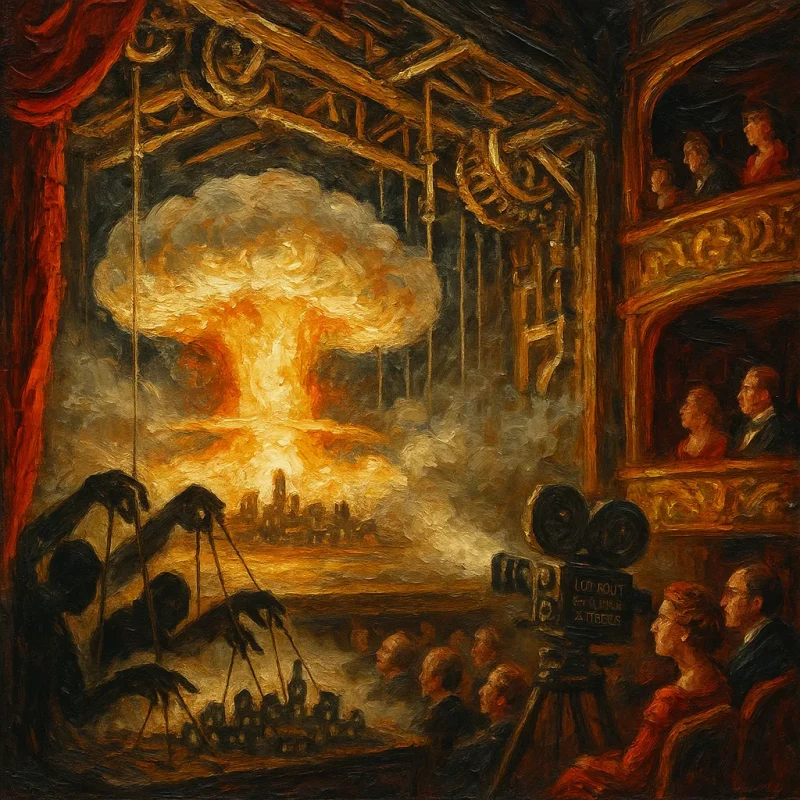
The mechanics of this proposed deception center on a critical moment in 1944 that Nakatani identifies as the birth of the hoax: when Manhattan Project scientists discovered during the “implosion crisis” that the gun-type bomb design wouldn’t work – not just for plutonium as officially claimed, but for any fissile material. Faced with admitting failure after spending billions in wartime dollars, the leadership allegedly chose an audacious alternative: stage a conventional bombing disguised as an atomic attack. Lookout Mountain Studios, a secret facility in Laurel Canyon that produced 19,000 classified films with Hollywood professionals including John Ford and Marilyn Monroe, possessed all the special effects capabilities needed to fabricate the documentation. The timing was perfect – Japan needed an honorable exit after the Soviet Union’s August 8th invasion of Manchuria made defeat inevitable, America wanted to claim technological supremacy without actually possessing doomsday weapons, and the military-industrial complex secured eternal funding. The “born secret” doctrine, which automatically classifies all nuclear weapons information from the moment of creation, ensures that any scientific challenge to the narrative becomes illegal to publish – including, Nakatani claims, his own mathematical proof that explosive nuclear chain reactions are impossible because neutrons simply cannot hit enough nuclei quickly enough to create the nanosecond explosion required.
If Nakatani’s thesis proves correct, we stand at the edge of a revelation that would fundamentally rewrite not just history but our understanding of human nature, power, and the stories we tell ourselves about existential threat. The implications cascade outward like the false shock waves of a phantom bomb: seventy-five years of foreign policy based on illusion, trillions of dollars spent on weapons that don’t exist, generations living under the shadow of potential annihilation that was never possible. Yet this book offers something beyond conspiracy theory – it presents a systematic examination of physical evidence, technical analysis, and historical documentation that challenges readers to confront uncomfortable questions. Whether you emerge convinced that humanity’s most feared weapon is indeed what the author calls “history’s most consequential lie,” or find yourself defending the orthodox narrative with renewed conviction, the journey through this evidence will forever change how you view the relationship between scientific authority, state power, and the stories that shape our world. In an age where we question so many accepted truths, perhaps it’s time to question the ultimate truth of our time: the reality of the weapon that has defined the modern world.
With thanks to Akio Nakatani.
Death Object: Exploding The Nuclear Weapons Hoax by Akio Nakatani
Watch also: Dr. Michael Palmer | NARRATIVE #185 by Robert Cibis