The Infrastructure of Impunity
An Essay On How Sexual Blackmail Became Infrastructure
UNBEKOMING
A Note on Sources
Jeffrey Epstein is back in the news. Names are circulating, documents are being released, and the public is once again asking questions that were never adequately answered. This essay exists because Whitney Webb already answered many of them—but her two-volume work One Nation Under Blackmail (Trine Day, 2022), totaling over 900 pages of densely documented investigation, is long enough that few will ever read it. What follows is intended as a surgical extraction of the essence of both volumes: the core argument, the key evidence, and the framework that makes sense of what would otherwise appear to be isolated scandals.
Webb’s research relies on court documents, congressional testimony, declassified files, and contemporaneous reporting from outlets including the New York Times, Washington Post, Washington Times, and Wall Street Journal. Readers seeking full documentation are directed to her work.
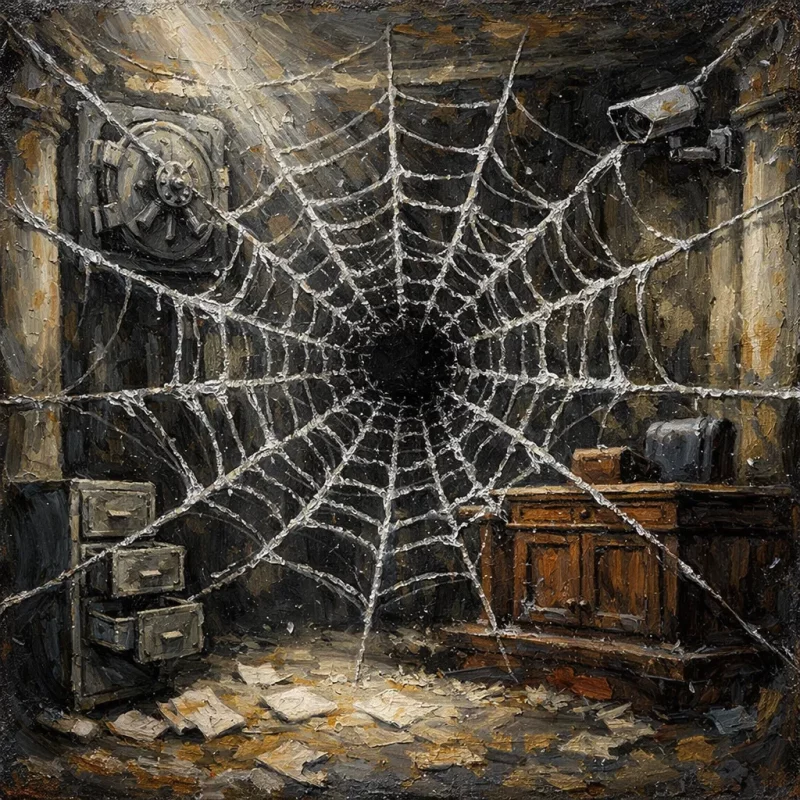
Webb does not identify a singular “they” controlling these operations. Her framework documents intersecting networks—intelligence agencies, organized crime syndicates, financial institutions, billionaire philanthropic circles—that converge around specific operations and individuals. The structure she describes is not a pyramid with a hidden apex but a web of mutual interests, where different nodes serve different functions and no single actor exercises total control. This analytical approach distinguishes her work from cruder conspiracy narratives that posit a unified secret group. The infrastructure persists not because someone commands it but because all participants benefit from its continuation.
This essay synthesizes her documented evidence into a narrative argument about sexual blackmail as a technology of political control—one that has operated continuously, adapted technologically, and survived repeated partial exposure.
The Visible Surface
In 2019, when Jeffrey Epstein’s lenient 2008 plea deal resurfaced as a scandal, the US Attorney who had approved it—Alexander Acosta—was serving as Secretary of Labor in the Trump administration. Questioned about why he had allowed a serial child abuser to serve just thirteen months in a county jail with work-release privileges, Acosta offered an explanation to the Trump transition team that has never been adequately addressed: he had been told to back off, that Epstein “belonged to intelligence” and that the matter was “above his pay grade.”
Acosta was not speculating. He was describing what he had been told by figures whose identities remain undisclosed. When later asked directly whether Epstein was an intelligence asset, Acosta declined to confirm or deny.
What does it mean for someone like Epstein to “belong to intelligence”? Mainstream coverage has largely declined to pursue this. The preferred narrative frames Epstein as an anomaly—a uniquely skilled con artist who manipulated his way into elite circles through charm and money. This framing contains the scandal. If Epstein was a lone operator, his death ends the story.
The evidence suggests otherwise. Webb’s research documents a pattern that stretches back decades before Epstein’s birth: sexual blackmail operations, often involving minors, conducted with documented connections to intelligence agencies, organized crime networks, and financial institutions. These are not separate scandals. They are glimpses of a persistent infrastructure—one in which Epstein was the most visible recent operator, not an inventor.
The subject matter has been marginalized as conspiracy theory. The evidence has not. The operations documented in what follows were reported by outlets including the Washington Times, the New York Times, and the Wall Street Journal; investigated by congressional committees; and confirmed by participants on the record. The pattern they describe is consistent across seven decades: sexual compromise of powerful figures, protection of operators by intelligence agencies, and the quiet dissolution of investigations that threaten to expose the network.
Such operations existed. The remaining questions are what purpose they serve, and whether the infrastructure that sustained them continues to function.
The Method: Roy Cohn and the Origins of the System
In the early 1980s, a former New York City detective named James Rothstein sat down with Roy Cohn. Rothstein specialized in sex crimes investigations. Cohn was the infamous attorney who had served as Senator Joseph McCarthy’s chief counsel during the anti-communist hearings of the 1950s and later became a power broker whose clients ranged from mob bosses to presidents.
Cohn, according to Rothstein’s account—which he confirmed in a 2020 interview with Webb—admitted to running a sexual blackmail operation that targeted politicians using minors. Rothstein’s summary of Cohn’s admission is direct: “Cohn’s job was to run the little boys. Say you had an admiral, a general, a congressman, who did not want to go along with the program. Cohn’s job was to set them up, then they would go along.”
This operation, Cohn said, was “part of the anti-communist crusade”—not a freelance criminal enterprise, but an activity integrated with state objectives.
Rothstein also told Webb that Cohn had indicated his own recruitment into this work had come about because he himself had been entrapped and blackmailed. The system perpetuated itself by creating new operators from former targets.
Cohn’s involvement in these activities predated his admission to Rothstein by decades. Testimony from Susan Kaufman, who worked as a legal assistant to Lewis Rosenstiel—a liquor magnate with deep mob ties—described events at the Plaza Hotel in New York during the late 1950s and early 1960s. At what Kaufman called “blue suite” parties, she witnessed young males, some appearing to be in their teens, engaging in sexual activity with adult men. Among those she identified as present were Cohn, FBI Director J. Edgar Hoover, and Cardinal Francis Spellman, the Archbishop of New York.
These gatherings were not merely sordid. Hoover’s presence at events that could be used for blackmail may explain his otherwise puzzling decades-long denial that organized crime existed in America—a denial that benefited the very crime figures who would have possessed compromising material. Cardinal Spellman’s presence suggests why the Catholic Church hierarchy in New York maintained such close relationships with figures like Cohn despite his known associations. Rosenstiel’s role as host points to the collaboration between organized crime and intelligence operations that recurs throughout this history.
Rosenstiel himself exemplified this merger. His Schenley Industries was the largest liquor distributor in North America, a position achieved in part through mob connections dating to Prohibition. He was also connected to the Anti-Defamation League’s intelligence operations and maintained relationships with Israeli intelligence figures. His apparent protégé was Cohn himself.
Cohn’s power derived from this positioning at the intersection of worlds that officially had no intersection. He represented major organized crime figures including Tony Salerno of the Genovese family and Carmine Galante of the Bonannos. He was simultaneously a close friend of media mogul Rupert Murdoch—”whenever Roy wanted a story stopped, item put in, or story exploited, Roy called Murdoch,” according to New York Magazine. He maintained close relationships with Si Newhouse Jr., whose media empire included Vanity Fair, Vogue, GQ, and The New Yorker. He was close to Barbara Walters, whom he introduced to Reagan administration officials. And he served as a mentor to a young real estate developer named Donald Trump.
Through these connections, Cohn could make problems appear and disappear. As one of his law partners told journalist Marie Brenner in 1980: “Roy could fix anyone in the city.”
The “fix” often involved leverage. Cohn’s possession of compromising material on powerful figures—whether gathered through the operations Rothstein described or through other means—gave him currency that transcended legal or financial power. In the political economy of secrets, Cohn was wealthy.
The logic is simple. Sexual blackmail, particularly involving minors, creates permanent leverage. Unlike financial crimes, which can be rationalized, or ordinary adultery, which can be survived, the sexual abuse of children ends careers and destroys legacies absolutely. A figure compromised in this way can never be fully trusted by the public again. They can, however, be trusted by those holding the evidence—trusted to comply, to vote correctly, to appoint the right people, to look the other way.
The leverage is permanent because it can never be discharged. A blackmailed official who does one favor does not thereby escape; they have simply confirmed their susceptibility and added to the evidence of their corruption. Each act of compliance deepens the trap.
Cohn died in 1986. The method did not.
The Government Connection: Craig Spence and the White House
On June 29, 1989, the Washington Times published an investigation that should have ended careers and prompted congressional inquiry. Under the headline “Homosexual Prostitution Inquiry Ensnares VIPs with Reagan, Bush,” the paper documented a sexual blackmail operation targeting officials at the highest levels of the US government.
At the center was Craig Spence, a Republican lobbyist who had been profiled glowingly by the New York Times just seven years earlier as a man who hosted “ichiban”—first-class—parties for “ichiban” guests including “ichiban” journalists and ambassadors. That profile had noted his “mysterious, even lurid side,” but framed it as colorful eccentricity.
The 1989 investigation revealed what that lurid side entailed. Spence’s home, according to sources including a Reagan White House official and an Air Force sergeant who had attended his parties, was equipped with recording equipment and two-way mirrors. He offered guests cocaine. And he provided access to what the Washington Times delicately termed “call boys”—young male prostitutes, some of them minors.
John DeCamp, a former Nebraska state senator who investigated related allegations, stated that Spence was known to offer his guests young children for sex.
The operation had reach. The Washington Times reported that Spence’s blackmail parties attracted “government officials, locally based US military officers, businessmen, lawyers, bankers, congressional aides, media representatives, and other professionals.” Credit card records reviewed by investigators listed clients who included “several former White House colleagues” of the US Attorney whose office was supposedly investigating.
Most remarkably, Spence had managed to take young men on late-night tours of the White House during the George H.W. Bush administration. When his operation began to unravel, Spence stated that his contacts enabling this access were “top level” officials, specifically naming Donald Gregg, Bush’s National Security Advisor. Gregg, a career CIA officer who had worked under William Casey, denied the allegations.
Spence himself claimed CIA connections. According to the Washington Times, he “often boasted that he was working for the CIA and on one occasion said he was going to disappear for awhile ‘because he had an important CIA assignment.’” He also expressed paranoia that the agency might “double-cross him” and “kill him instead and then make it look like a suicide.”
The investigation offered a possible motive for intelligence interest in Spence: sources told the paper he had spoken of smuggling cocaine into the US from El Salvador, an operation he claimed involved US military personnel. Given the timing—the Iran-Contra affair had recently revealed CIA involvement in exactly such activities—his comments may have been more than boasts.
The scandal’s resolution followed a pattern that would repeat with Epstein. The US Attorney managing the inquiry, Jay Stephens, had been deputy White House counsel under Reagan. Several of his former colleagues appeared in the credit card records of the prostitution ring. When the Washington Times asked whether Stephens would recuse himself due to conflict of interest, his office first offered cooperation, then withdrew the offer and declined to comment.
Spence fell from grace rapidly after the story broke. Within months, the man who had hosted ambassadors was found sleeping in parks and begging for money. In November 1989, he was found dead at the Boston Ritz Carlton. His death was ruled a suicide.
The investigation ended. The clients were never named. The infrastructure continued.
The Technology: PROMIS, Robert Maxwell, and the Surveillance Architecture
The blackmail operations documented in the careers of Roy Cohn and Craig Spence relied on human networks—parties, introductions, witnesses, photographs. By the 1980s, a technological dimension vastly expanded both the reach and the permanence of surveillance.
A clarification: the operations documented in this section involve Israeli intelligence alongside the CIA and organized crime. These are the actions of a state apparatus pursuing state interests, as states do. Documenting them implies nothing about Jewish people broadly, any more than documenting CIA activities implies something about Americans broadly. The distinction between a government’s intelligence operations and an ethnic or religious population should be obvious, but given how often this material is misrepresented, the point bears stating directly.
In 1982, a software program called PROMIS—Prosecutor’s Management Information System—was developed by a company called Inslaw Inc., founded by former NSA official Bill Hamilton and his wife Nancy. The software was revolutionary: it allowed the integration of separate databases and information analysis on a scale previously impossible. The Department of Justice, then headed by Reagan’s close advisor Edwin Meese, leased the software.
The program’s capabilities attracted attention beyond the Justice Department. Rafi Eitan, a legendary Israeli spymaster who had orchestrated the capture of Adolf Eichmann and who later ran the most damaging spy in American history—Jonathan Pollard—learned of PROMIS in 1982. Eitan headed Lekem, an Israeli intelligence unit focused on scientific and technical espionage. He recognized immediately what PROMIS could become if modified.
Using the alias “Dr. Ben Orr,” Eitan entered the United States and eventually obtained a demonstration of the software from Bill Hamilton himself. What happened next became the subject of years of litigation and congressional investigation. Israeli intelligence, with apparent assistance from elements within the US Justice Department, obtained PROMIS and modified it—inserting a hidden backdoor that would allow Israeli intelligence to access any system running the software.
The distribution vehicle for this modified PROMIS was Robert Maxwell.
Maxwell was a British media baron whose empire eventually included the Daily Mirror, Macmillan Publishing, and the New York Daily News. He was also, according to multiple sources including his biographers Gordon Thomas and Martin Dillon, an asset of Israeli intelligence. The connection was not subtle: following Maxwell’s 1991 death, he received a state funeral in Israel attended by the Prime Minister, the President, and heads of intelligence services. Israeli Prime Minister Yitzhak Shamir eulogized him as a man who had “done more for Israel than can today be said.”
What could not then be said included Maxwell’s role marketing the bugged PROMIS software to governments, intelligence agencies, banks, and corporations worldwide. Money “borrowed” from Maxwell-owned companies allegedly financed Mossad operations in Europe and elsewhere, with funds restored before their absence was noticed by employees not privy to these arrangements.
The PROMIS operation gave Israeli intelligence potential access to law enforcement databases, banking systems, and government communications across dozens of countries. It was, in effect, a master key to the information systems of the Western world.
Maxwell’s utility extended beyond software distribution. According to reports, he orchestrated the entry of Semion Mogilevich—sometimes called the “boss of bosses” of Russian organized crime—into Western financial systems by lobbying Israel to grant Mogilevich and his associates Israeli passports.
Maxwell’s relationship with Israeli intelligence had a personal dimension that would prove significant. His favorite daughter, the one he had named after his mother, was Ghislaine.
In November 1991, Robert Maxwell was found dead, floating in the Atlantic near his yacht. The death was ruled accidental drowning, though suicide and murder have both been seriously proposed. His business empire collapsed within weeks, revealing massive fraud including the theft of hundreds of millions from employee pension funds.
Ghislaine Maxwell moved to New York. Within months, she had partnered with a financial advisor named Jeffrey Epstein, who had been managing money for Ohio billionaire Leslie Wexner since 1987. The operation they would build together combined the methods Cohn had pioneered—sexual compromise using minors—with access to networks her father had cultivated and, potentially, to surveillance capabilities his technology dealings had created.
The Operation: Jeffrey Epstein and the Visible Surface
Jeffrey Epstein’s origins are murky by design. He claimed to have worked at Bear Stearns before leaving to manage money privately, but the details of his rise from college dropout to billionaire financial advisor have never been satisfactorily explained. His documented relationship with Leslie Wexner, founder of The Limited and the dominant shareholder in Victoria’s Secret, raises more questions than it answers.
Wexner’s own history includes connections that rarely feature in profiles of the Ohio retail magnate. His mentor Max Fisher maintained ties to both US and Israeli governments and intelligence agencies and helped relaunch the Jewish Agency in 1970. The Columbus, Ohio business community in which Wexner rose included documented organized crime connections through figures associated with the “Supermob”—the network of organized crime-linked businessmen documented by journalist Gus Russo.
By 1991, Wexner had granted Epstein extraordinary power over his finances, including power of attorney. That same year, Wexner co-founded the “Mega Group” with Charles Bronfman—an exclusive club of approximately twenty of “the nation’s wealthiest and most influential Jewish businessmen,” according to a 1998 Wall Street Journal report. The group’s existence was not publicly revealed until seven years after its founding.
Also in 1991, Ghislaine Maxwell arrived in New York following her father’s death. She and Epstein began what would become a decades-long partnership in sexual exploitation and, evidence suggests, intelligence gathering.
The operation’s mechanics have been extensively documented through victim testimony and court proceedings. Young women, often from economically disadvantaged backgrounds, were recruited with promises of money and career advancement. They were brought to Epstein’s properties in Manhattan, Palm Beach, New Mexico, and the US Virgin Islands. They were subjected to sexual abuse by Epstein and, according to testimony, coerced into sexual encounters with his guests. The encounters were documented.
The documentation is the point. An operation intended merely to satisfy Epstein’s personal proclivities would not require the elaborate infrastructure he maintained—the multiple properties, the flight logs, the hidden cameras that witnesses and investigators have described. This was an operation designed to produce leverage.
The guest lists and flight logs that have emerged include figures across political spectrums and sectors. Bill Clinton flew on Epstein’s private jet at least twenty-six times according to flight records, and Epstein visited the Clinton White House seventeen times in less than two years, meeting with numerous administration officials. A 1995 letter from Lynn Forester (now Lynn Forester de Rothschild) to Clinton explicitly mentions using her access to discuss “Jeffrey Epstein and currency stabilization.”
Donald Trump, whose mentor Roy Cohn had pioneered these methods, was photographed with Epstein and Maxwell repeatedly during the 1990s and early 2000s. Trump described Epstein in 2002 as a “terrific guy” who “likes beautiful women as much as I do, and many of them are on the younger side.” After Epstein’s arrest, Trump claimed they had fallen out.
Prince Andrew’s involvement is documented in photographs, flight logs, and the testimony of Virginia Giuffre, who stated under oath that she was trafficked to the prince three times while a minor. Andrew has denied the allegations but paid a settlement reportedly exceeding £12 million to avoid trial.
Ehud Barak, former Prime Minister of Israel, was photographed entering Epstein’s New York residence as recently as 2016 and admitted to visiting Epstein’s island. He invested in a company alongside Epstein and received $2.5 million from Wexner’s foundation for unspecified “consulting services.”
When Palm Beach police investigated Epstein in 2005-2006, they built a substantial case. The FBI became involved. Then the case was effectively shut down through a plea deal that allowed Epstein to serve just thirteen months in county jail with work-release privileges that let him leave for twelve hours a day, six days a week.
The US Attorney who approved this deal was Alexander Acosta. His explanation, given years later to the Trump transition team: Epstein “belonged to intelligence.”
The plea agreement contained a clause unusual for sex crime cases: it granted immunity not just to Epstein but to any “potential co-conspirators,” named or unnamed. The clients were protected.
The Infrastructure Today: Palantir, Carbyne, and the Surveillance Present
Jeffrey Epstein’s death in August 2019—ruled a suicide despite circumstances that strained credulity—did not end the infrastructure his operation represented. That infrastructure had already evolved beyond any single operator.
In May 2003, as the Pentagon’s Total Information Awareness program was being shut down amid public outrage over its ambition to create a comprehensive surveillance system targeting Americans, Peter Thiel incorporated a company called Palantir. The timing mattered.
TIA, run by John Poindexter—the same National Security Advisor convicted for his role in Iran-Contra, though the conviction was later overturned on technical grounds—had proposed using data mining to identify terrorists before they acted. Critics recognized it as a blueprint for mass surveillance of the American population. Congress defunded the program.
Richard Perle, the defense advisor with documented proximity to Israeli intelligence interests, arranged a meeting between Poindexter and two Silicon Valley entrepreneurs: Peter Thiel and Alex Karp. According to New York Magazine, Poindexter was told he was “precisely the person” the pair wanted to meet because “their new company was similar in ambition to what Poindexter had tried to create at the Pentagon.” Thiel and Karp wanted to “pick the brain of the man now widely viewed as the godfather of modern surveillance.”
Shortly after incorporation, Palantir received investment from In-Q-Tel, the CIA’s venture capital arm. The CIA remained Palantir’s only client until 2008. During this period, Palantir’s engineers traveled to CIA headquarters at Langley every two weeks—over two hundred trips—to develop and refine the software with the agency’s analysts.
The parallels between TIA and Palantir extended to their public relations strategies. Poindexter had sold TIA with language about “selective revelation” and “built-in privacy protections.” Thiel and Karp sold Palantir with nearly identical language, describing “privacy safeguards” where “users are able to access only information they are authorized to view.”
The public program had been killed. The private company implementing the same vision received government contracts worth billions.
Epstein’s own involvement in surveillance technology continued after his first conviction. He invested in Carbyne, an Israeli company providing call-handling technology for emergency services. Carbyne’s co-founders, with one exception, served in Unit 8200—Israel’s signals intelligence unit, frequently compared to the NSA and known to collaborate with it on operations including the Stuxnet virus. Unit 8200 is also documented as gathering information on Palestinian civilians for “coercion purposes”—the intelligence community’s term for blackmail.
Carbyne’s other investors included Ehud Barak and Peter Thiel. Its board featured former Trump administration officials including Kirstjen Nielsen, former Secretary of Homeland Security. The company’s technology, which takes control of users’ smartphone cameras, microphones, and location data during emergency calls, has been adopted by emergency services across the United States.
The connection between Epstein and Silicon Valley extended beyond Carbyne. In 2019, journalist James Stewart reported that Epstein claimed to be advising Tesla and that he possessed “potentially damaging or embarrassing” information on Silicon Valley’s elite, including details about “their supposed sexual proclivities.” Epstein told Stewart that top tech figures “were hedonistic and regular users of recreational drugs” and that he had “witnessed prominent tech figures taking drugs and arranging for sex.”
Elon Musk was photographed with Ghislaine Maxwell. Epstein reportedly attended a dinner hosted by LinkedIn’s Reid Hoffman where Musk allegedly introduced Epstein to Mark Zuckerberg. A woman from Epstein’s entourage dated Musk’s brother Kimbal from 2011 to 2012, a relationship that “brought Epstein into contact with the Musk family and its businesses.”
Whether Epstein obtained compromising material on tech executives remains unknown. What is documented is that he cultivated relationships with the people building the surveillance architecture of the twenty-first century—and that some of those same people were simultaneously investing in Israeli intelligence-linked surveillance companies.
The System
Cohn’s admission to Rothstein, Spence’s Washington operation, the PROMIS surveillance architecture, Epstein’s network and its Silicon Valley offshoots—these are not separate scandals. They describe a continuous infrastructure with consistent features.
Sexual compromise, preferably involving minors. Targets with power or potential power—politicians, military officers, businessmen, academics who advise governments. Operators with documented connections to intelligence agencies and organized crime, which often prove indistinguishable. Protection, because the people who would investigate are either compromised themselves or understand that the system serves interests more powerful than any individual case.
When components of this infrastructure are exposed, the pattern repeats: the operator is discredited or dies, the investigation terminates before reaching clients, and the system continues.
Roy Cohn died of “AIDS” in 1986, disbarred but never imprisoned for his role in blackmail operations he personally admitted to running. Craig Spence was found dead in a hotel room in 1989, his client list never released. Jeffrey Epstein was found dead in his cell in 2019 under circumstances that the New York City medical examiner ruled suicide but that a forensic pathologist hired by his family deemed more consistent with homicide. Ghislaine Maxwell was convicted of sex trafficking, but her trial saw information about third parties redacted. The clients remain protected.
The protection persists because the infrastructure serves too many interests to dismantle.
Intelligence agencies gain leverage over the politicians who set their budgets and oversee their operations. Politicians gain the destruction of rivals and the protection that comes from being inside the system rather than outside it. Financial institutions gain from the money laundering that accompanies these operations—the UN Office on Drugs and Crime estimates that laundering comprises two to five percent of global GDP, roughly $800 billion to $2 trillion annually. Organized crime gains protection and access to legitimate systems.
No single actor controls this infrastructure. It persists because all parties benefit from its continuation and because exposing it would implicate too many powerful interests. The prosecutors, the judges, the journalists, the politicians who might investigate are either compromised or constrained by the knowledge that pursuing these cases too vigorously ends careers.
“Belonging to intelligence” means operating within a system of mutual leverage where accountability becomes impossible because everyone with the power to impose it is exposed to the same system.
The infrastructure that began with photographed parties at the Plaza Hotel now runs on software. The surveillance capabilities that Robert Maxwell distributed through backdoored PROMIS have evolved into Palantir’s government contracts and Carbyne’s access to emergency communications. The blackmail material that Cohn accumulated in file cabinets now potentially exists as data accessible to those with the right tools and clearances.
This system exists. The documentation is extensive, the admissions are on record, the pattern is consistent across seven decades. Whether knowing this changes anything is a different matter.
Scandals surface every few years—Spence, Franklin, Epstein—and the public glimpses the system. Shock, investigation, termination of inquiry, continued operation. The system survives exposure because exposure without accountability is spectacle.
None of this is hidden. It exists in court documents, congressional testimony, newspaper archives, published investigations. The people named held or hold positions of enormous power. The pattern connecting them is visible to anyone who looks.
The infrastructure continues. The technology improves. The leverage accumulates.
What changes this is not a question journalism can answer.
Source: Unbekoming