The Tower in Basel
The Tower in Basel: Central Banking and the Machinery of Empire
An Essay
I. August 1982
In August 1982, Mexico’s finance minister informed the United States government that his country could no longer service its foreign debt. Within weeks, Brazil, Argentina, Venezuela, and more than forty other nations across Latin America, Africa, and Asia found themselves in the same position. The international banking system faced its gravest crisis since 1929.
The numbers were staggering. Mexico alone owed foreign creditors more than $80 billion. Across the developing world, governments that had borrowed heavily throughout the 1970s now confronted interest payments that exceeded their total export earnings. The loans that were supposed to fund modernization—power plants, highways, ports—had become instruments of national asphyxiation.
The crisis appeared to strike without warning. In the financial press, it was framed as a story of reckless borrowing by corrupt Third World governments, of profligate spending finally meeting reality. The solution, accordingly, would require discipline: austerity, structural adjustment, adult supervision by the International Monetary Fund.
This framing was misleading in its essential elements. The debt crisis was not an accident. It was not the result of poor decisions by individual governments. It was the predictable—and predicted—consequence of a system designed to produce exactly this outcome. The trap had been set years earlier, baited with petrodollars, and sprung by deliberate policy decisions in Washington and London. What appeared to be a crisis was, for those who understood the architecture of international finance, the system producing its predictable result.
To understand how dozens of nations found themselves simultaneously insolvent, it is necessary to examine three interlocking mechanisms: the recycling of oil revenues through Western banks in the 1970s, the interest rate shock administered by the Federal Reserve beginning in 1979, and the underlying structure of money creation that makes such traps possible. Behind all three stands an institution that most people have never heard of—the Bank for International Settlements in Basel, Switzerland—which coordinates the central banks that operate these mechanisms across borders.
The story of the 1982 debt crisis is, at its core, a story about the nature of money: who creates it, on what terms, and to whose benefit. It is also a story about empire—not the empire of armies and colonial administrators, but an empire of debt, operated through institutions that present themselves as technical and apolitical while exercising power that no colonial viceroy ever possessed.
Support Independent Research
This work remains free because paid subscribers make it possible. If you find value here, consider joining them.
What paid subscribers get: Access to the Deep Dive Audio Library — 170+ in-depth discussions (30-50 min each) exploring the books behind these essays. New discussions added weekly. That’s 100+ hours of content for less than the price of a single audiobook.
[Upgrade to Paid – $5/month or $50/year]
Get in touch Essay ideas, stories, or expertise to share: unbekoming@outlook.com
II. The Trap Is Set
The trap was baited with oil.
In October 1973, the Organization of Petroleum Exporting Countries announced an embargo against nations that had supported Israel in the Yom Kippur War. Oil prices quadrupled within months, from roughly $3 per barrel to $12. A second shock followed the Iranian Revolution in 1979, pushing prices above $30. The industrial economies of the West plunged into recession. Inflation and unemployment rose simultaneously, producing the novel misery that economists would call “stagflation.”
For the oil-producing nations, the price shocks generated revenues beyond anything they could absorb domestically. Saudi Arabia, Kuwait, the Gulf states, Venezuela, Nigeria—suddenly these governments commanded vast dollar surpluses with nowhere to invest them. The money flowed, almost automatically, into the only financial institutions capable of handling such volumes: the major commercial banks of New York and London.
Citibank, Chase Manhattan, Bank of America, Manufacturers Hanover, J.P. Morgan—these institutions found themselves awash in deposits. The petrodollars had to be put to work. Deposits sitting idle earn nothing; banks profit by lending. And so the bankers went looking for borrowers.
They found them in the developing world. Latin American governments were eager to finance industrialization, infrastructure, and the rising expectations of their populations. African nations sought to build the institutions of newly independent states. Asian countries wanted to climb the ladder that Japan had ascended. The banks were eager to oblige. Loan officers fanned out across the globe, offering credit on terms that appeared generous.
The key word is “appeared.” The loans carried variable interest rates, typically pegged to the London Interbank Offered Rate—LIBOR. When a government borrowed $1 billion at LIBOR plus two percent, it was not agreeing to a fixed payment schedule. It was agreeing to pay whatever interest rate the market demanded in the future, plus a premium. If LIBOR stood at seven percent, the effective rate was nine percent. If LIBOR rose to fifteen percent, the rate became seventeen percent. The borrower bore all the risk.
Throughout the mid-1970s, this arrangement appeared manageable. LIBOR hovered in the single digits. Commodity prices—the earnings that debtor nations relied upon to service their loans—remained relatively stable. The loans seemed almost free. Between 1975 and 1982, total Third World debt more than doubled, from roughly $400 billion to over $800 billion. The banks booked enormous profits. Their executives collected bonuses and their shareholders collected dividends. Citicorp and Chase Manhattan reported record earnings even as the debts of their borrowers compounded.
What the borrowing governments did not understand—what many of them could not have understood, because the information was not made available to them—was that the interest rates on their loans could be raised at will by policy decisions made in Washington and London. The terms of the loans made the debtor nations hostages to monetary policy set on another continent, by institutions accountable to different interests entirely.
The trap had been set. It awaited only a trigger.
III. The Architecture
The trap that closed on the Third World in 1982 was not improvised. The variable-rate loans, the petrodollar recycling, the coordinated interest rate shock—these were the latest refinements of an architecture developed over more than a century, through techniques pioneered in European finance and transplanted to American soil.
Niall Ferguson, in his authorized history of the Rothschild banking dynasty, identifies the governing principle: “It is better to deal with a government in difficulties than with one that has luck on its side.” A country in financial distress was, he writes, “a natural target for Rothschild financial penetration.” The corollary followed logically: “A government that did not borrow money was a government the Rothschilds could advise, but not pressurise.” Debt transformed the relationship from advisory to coercive.
The application of this principle required institutional vehicles. In Europe, the Rothschilds had long maintained relationships with central banks and finance ministries. The United States, with its tradition of hostility to centralized banking, presented a different challenge. The political obstacle required a political solution.
The solution began in 1837, when an agent trained at Rothschild banks in Frankfurt and Naples arrived in New York. Born Aaron Schönberg, he presented himself in America as August Belmont—no longer German, no longer Jewish, but as contemporaries noted, “some sort of Frenchman.” The timing was strategic: a financial panic had left American banks desperate for capital. Belmont organized large Rothschild loans to shore up debtor institutions. He later served for years as Chairman of the Democratic National Committee, positioning European capital at the center of American political finance. His son helped bail out the U.S. government when it approached default in 1895.
The Morgan banking house served a complementary function. Historians Gerry Docherty and Jim Macgregor trace its relationship with Rothschild interests to 1857, when the original Morgan firm faced ruin and was rescued by a loan from the Bank of England—where, they document, the Rothschilds held “immense sway.” Ron Chernow’s research establishes that J.P. Morgan became “the main conduit for British capital and a personal friend of the Rothschilds.” The arrangement served a specific purpose. Morgan, who could trace his family to pre-Revolutionary America and who presented as an upright Protestant guardian of capitalism, provided what Docherty and Macgregor call “the perfect front”—a native face for capital flows that might otherwise attract scrutiny.
By the turn of the twentieth century, Morgan’s reach was substantial. He spread control across the First National Bank, National City Bank, Chase National Bank, and the nation’s major insurance companies. He controlled at least one-fifth of all corporations trading on the New York Stock Exchange. The supposed rivalry between Morgan and Rockefeller interests obscured a more cooperative reality. Carroll Quigley confirms that “the Rockefeller group… functioned as a financial capitalist unit in close co-operation with Morgan.”
The creation of the Federal Reserve in 1913 represented the major institutional victory of this network. Unlike the central banks of Europe, which had long operated under Rothschild influence, America had resisted centralized banking since Andrew Jackson destroyed the Second Bank of the United States in the 1830s. The banking crisis of 1907 provided the necessary pretext. A manufactured panic demonstrated the “need” for a central banking authority; Morgan stepped forward to provide both the crisis management and the proposed remedy.
The Federal Reserve that emerged was not a government institution in any meaningful sense. It was, and remains, a consortium of private banks operating with government sanction. The power to create money—to conjure currency from ledger entries and charge interest on money that did not previously exist—was now institutionalized at the national level, controlled by private interests, and insulated from democratic accountability.
The First World War demonstrated the system’s capacity. By 1917, the British War Office had placed purchase orders totaling more than $20 billion through the House of Morgan. By war’s end, Britain and its allies owed Wall Street banks $12.5 billion at five percent interest. The difficulty was that Britain and France had been virtually bankrupted by the war and were struggling to pay.
The solution created additional extraction opportunities. The Treaty of Versailles made Germany responsible for everyone’s debts through war reparations. Germany would pay enormous sums to Britain and France, who would use them to service their debts to Wall Street. Germany, in turn, was enabled to meet these obligations by borrowing from the same Wall Street banks through bond sales. The Dawes Plan of 1924 and Young Plan of 1929 formalized this circular arrangement. Both plans bore the names of men connected to the Morgan network. Owen D. Young was deputy chairman of the Federal Reserve Bank of New York.
The Bank for International Settlements, established in Basel in 1930 ostensibly to manage German reparations, would internationalize this architecture—creating a coordination mechanism for central banks that operated beyond the reach of any government.
The connections between Wall Street, the Federal Reserve system, and subsequent geopolitical developments are documented in Antony Sutton’s research. He identifies American companies associated with “the Morgan-Rockefeller international investment bankers” as intimately involved with financing that would have significant consequences—”those firms controlled through the handful of financial houses, the Federal Reserve Bank system, the Bank for International Settlements, and their continuing international cooperative arrangements and cartels which attempt to control the course of world politics and economics.”
Ferguson’s research on the Rothschilds’ earlier operations confirms the underlying logic. During the Crimean War of 1853–1856, they lent £26 million to Britain while simultaneously lending to France and Turkey. Between 1859 and 1870, they “found themselves repeatedly on both sides of decisive conflicts.” Their internal communications reveal they “were calculating carefully to ensure that both sides in the conflict paid them for their financial services.” Ferguson explicitly rejects any suggestion that war damaged their interests: “Far from weakening the Rothschilds’ position, the Crimean War had precisely the opposite effect in that it emphatically reasserted the Rothschild houses’ primacy in the field of public finance.”
War creates debt. Debt creates dependency. Dependency creates control. The principle articulated by Amschel Rothschild—seek out governments in difficulties—scaled through Morgan’s American network, institutionalized through the Federal Reserve, and internationalized through the BIS, would find its fullest application in the developing world after 1945. The Third World debt crisis of 1982 was not an aberration. It was the same architecture, applied to new targets, with the same results.
IV. The Trigger
The trigger was pulled in October 1979, when Paul Volcker, the newly appointed chairman of the Federal Reserve, announced that the Fed would henceforth target the money supply rather than interest rates. The technical details of this policy shift mattered less than its practical consequence: interest rates would be allowed to rise as high as necessary to break inflation.
And rise they did. The federal funds rate, which had averaged around seven percent in early 1978, climbed past ten percent by the end of 1979. By June 1981, it exceeded twenty percent. LIBOR followed in lockstep. In the space of two years, the cost of servicing variable-rate debt approximately tripled.
For Mexico, Brazil, Argentina, and dozens of other nations, the mathematics became impossible. A government that had borrowed $10 billion at nine percent interest owed $900 million annually in interest payments alone. When the rate rose to eighteen percent, that obligation doubled to $1.8 billion—without a single additional dollar being borrowed. The principal remained untouched. The debtor had paid enormous sums and owed more than ever.
At the same time, the Volcker shock plunged the industrial economies into severe recession. Demand for the commodities that debtor nations exported—copper, coffee, cotton, sugar, tin—collapsed. Prices fell by a third, in some cases by half. The governments caught in the debt trap now faced a vicious scissors: the cost of servicing their debt had doubled while their earnings to pay it had been cut in half.
This was not an unforeseeable consequence of anti-inflation policy. It was a predictable and predicted outcome. The major banks had lent recklessly throughout the 1970s, booking fees and interest payments on loans that any sober analysis would have flagged as risky. When the risks materialized, the banks did not suffer the losses that a genuine market would have imposed. Instead, the losses were transferred—to the debtor nations first, and ultimately to their populations.
The Volcker shock has been praised in mainstream economic histories as the “tough medicine” that cured inflation. The standard narrative emphasizes oil shocks, reckless borrowing by developing nations, and the Federal Reserve’s necessary response to runaway prices. In this telling, the debt crisis was an unintended consequence—painful but unavoidable, the result of mistakes on all sides.
This narrative is incomplete. It omits the variable-rate structure that transferred all interest rate risk to borrowers. It ignores the coordinated nature of monetary tightening across central banks. It fails to ask who designed the loan terms, who set the rates, and who profited when the trap closed. The borrowers made mistakes; the lenders made fortunes. The “unintended consequences” fell entirely on one side of the ledger.
What this framing also omits is the distribution of costs. Inflation was cured primarily by destroying demand—by throwing millions of people out of work in both the developed and developing worlds. In the United States, unemployment reached levels not seen since the Great Depression. In the Third World, the consequences were measured not in unemployment statistics but in infant mortality rates, collapsing school enrollments, and hospitals without medicine.
Margaret Thatcher’s government in Britain pursued parallel policies. The coordination was not accidental. The governors of the Federal Reserve and the Bank of England consulted regularly, as they had for decades. They shared assumptions, analytical frameworks, and institutional interests. They also shared a venue for those consultations: the Bank for International Settlements in Basel, where central bankers gathered every two months, away from public scrutiny, to coordinate their policies.
V. The Mechanism
The debt crisis exposed a mechanism that operates beneath the surface of ordinary economic life. To understand why nations can be trapped by debt—why they can pay more than they borrowed and still owe more than they started with—it is necessary to understand how money comes into existence.
The conventional understanding holds that banks function as intermediaries. Depositors place their savings in banks; banks lend those savings to borrowers; interest compensates the depositors for deferring their consumption. In this model, banks are passive conduits, matching savers with borrowers.
This model is false. Banks do not lend existing money. They create new money at the moment of lending.
The Federal Reserve’s own publications acknowledge this. A document titled Modern Money Mechanics, published by the Federal Reserve Bank of Chicago, explains the process: “In the United States neither paper currency nor deposits have value as commodities. Intrinsically, a dollar bill is just a piece of paper. Deposits are merely book entries.” The document continues: “Banks are creating money based on a borrower’s promise to pay. Banks create money by ‘monetizing’ the private debts of businesses and individuals.”
When a bank approves a loan, it does not transfer existing funds from a vault. It creates a deposit in the borrower’s account—a number in a ledger. That number did not exist before the loan was made. The borrower now has money to spend, and the bank has an asset (the loan contract) on its books. Money has been conjured into existence.
This might seem like a technicality. It is not. The consequences are profound.
First, nearly all money in circulation originates as debt. Someone must borrow for money to exist. If all debts were repaid, the money supply would virtually disappear. The system requires perpetual borrowing to function.
Second, the money to pay interest is never created. The bank creates the principal—the amount lent—but not the interest that will be owed on it. If a bank lends $1,000 at ten percent interest, it creates $1,000. The borrower owes $1,100. The additional $100 must come from somewhere else in the economy—from money created by other loans, which carry their own interest obligations. The arithmetic guarantees that the total debt in the system will always exceed the total money available to pay it.
Third, this structure ensures a continuous transfer of wealth from borrowers to lenders. Because money is created as interest-bearing debt, the financial sector extracts a perpetual toll from the productive economy. The toll compounds over time. What begins as a small skim becomes, over decades, a dominant share.
The Federal Reserve Bank of St. Louis acknowledged the nature of the system in a technical footnote: “Modern monetary systems have a fiat base—literally money by decree—with depository institutions, acting as fiduciaries, creating obligations against themselves with the fiat base acting in part as reserves.”
Translated from banker’s language: private banks create the money supply, and the reserves that supposedly back it are themselves just government promises—entries in ledgers, backed by nothing more tangible than the state’s power to tax and compel.
This is the mechanism that was deployed against the Third World in 1982. Money was created by Western banks, lent to developing nations at variable interest rates, and then the cost of that money was tripled by policy decisions made at the Federal Reserve. The debtor nations did not merely owe money. They owed money that had been created for the purpose of indebting them, on terms that could be altered unilaterally, with interest charges that mathematically could not be paid without further borrowing.
The trap was not a bug in the system. It was the system’s basic architecture.
VI. The Distinction
A reader might object at this point: is this argument simply against interest? Against lending itself? If so, it would be naive—a medieval superstition dressed in modern language.
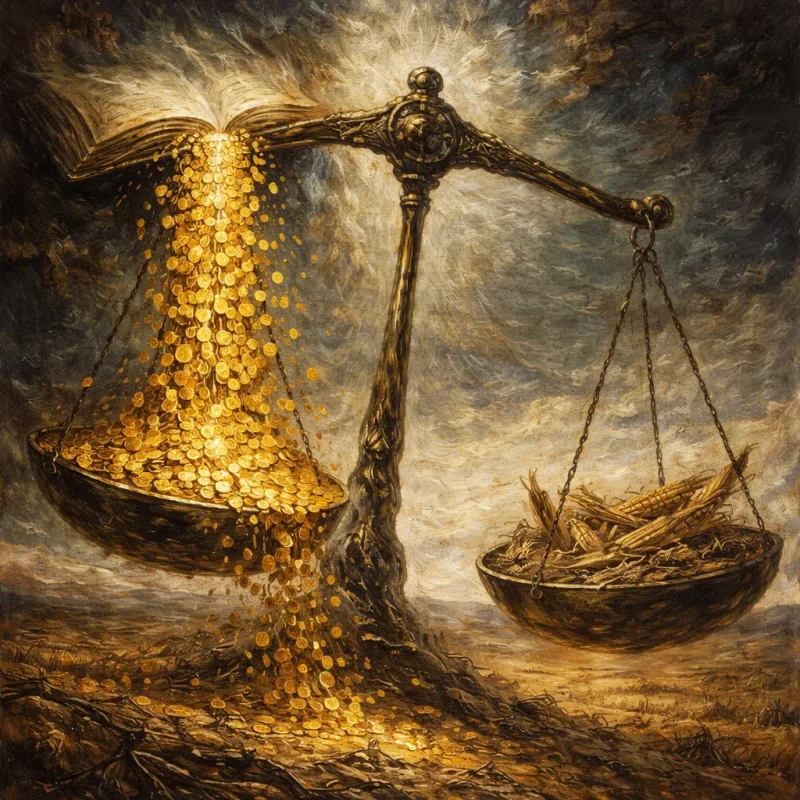
The objection misses a crucial distinction. Interest on legitimately accumulated capital serves rational economic purposes. When an individual or institution lends funds they have actually saved—capital representing past labor, production, or foregone consumption—compensation for that loan reflects real costs. The lender cannot deploy that capital for their own purposes during the loan period. The lender bears genuine risk of default. Present goods are valued more highly than future goods; the lender is owed something for waiting.
A farmer who lends his neighbor seed corn for planting, expecting return of the seed plus additional corn at harvest, engages in a transaction beneficial to both parties. The borrower gains productive capacity he otherwise lacked. The lender receives compensation for risk and delayed gratification. Nothing in this arrangement transfers wealth unjustly or creates systemic instability. This is not usury. This is the ordinary function of credit in a productive economy.
The system described in this essay operates differently.
When Elizabethan goldsmiths accepted deposits of gold for safekeeping and then issued ten times the amount as gold receipts—lending claims on wealth that did not exist—they were not lending their capital. They were manufacturing claims through ledger entries and charging interest on those fictional claims. The goldsmith who receives 100 ounces of gold and issues receipts for 1,000 ounces has lent nothing he possessed. He has created money from an accounting entry and demanded payment for it as if real capital had changed hands.
William Paterson, architect of the Bank of England, understood this precisely. He boasted that the Bank “hath the benefit of interest on all moneys which it creates out of nothing.” The Bank’s early operations demonstrated the principle starkly: within two years of its establishment in 1694, it had £1,750,000 worth of banknotes circulating against gold reserves of only £36,000—a ratio of nearly fifty to one. The interest charged on the unbacked £1,714,000 represented payment for nothing. No saved capital was lent. No opportunity cost was borne. No genuine risk of losing one’s own accumulated wealth was undertaken. The “loan” was an accounting fiction; the interest was nonetheless extracted as if real wealth had been transferred.
This is usury in its economically destructive sense: not the charging of interest per se, but the charging of interest on credit created ex nihilo—money manufactured through accounting entries rather than accumulated through production, saving, or genuine capital formation.
The consequences of these two forms of lending differ categorically.
Interest on saved capital redistributes existing wealth between parties who have voluntarily agreed to terms. The total monetary base remains stable. If the borrower defaults, the lender suffers real loss of real savings. The system contains natural self-correcting mechanisms: lenders cannot lend more than they possess.
Interest on created credit operates without these constraints. Credit conjured from nothing can be expanded or contracted at will by those controlling the creation mechanism. This produces the boom-bust cycles that devastate populations—not because interest itself is harmful, but because the money supply can be manipulated independently of actual productive capacity. The Federal Reserve’s decision to tighten credit in 1929, or to raise rates in 1979, affected not merely existing loans but the entire money supply, because that money supply existed only as debt to the institutions making the policy.
Congressman Louis McFadden, chairman of the House Banking Committee, identified this mechanism in 1932: “Those twelve private credit monopolies were deceitfully and disloyally foisted upon this country by bankers who came here from Europe… The sack of the United States by the Federal Reserve Board and Federal Reserve Banks is the greatest crime in history.” The crime he identified was not that interest existed, but that private entities had acquired the power to create the nation’s money supply as interest-bearing debt—extracting perpetual tribute on wealth they never possessed and never risked.
The historical record confirms that societies can have interest without having this system. Republican Rome used state-issued bronze coinage; interest existed, but the money itself was not created as debt. The English tally stick system financed major infrastructure without borrowing money into existence from private creators. The Russian State Bank under the Tsars provided low-interest loans to commerce and industry, but the state controlled money creation, and interest on state-issued money returned to public coffers rather than private banking syndicates.
These systems were not utopias. But they shared a common feature: money creation remained a public function. The distinction matters because it identifies the precise mechanism of extraction. The farmer lending seed corn at interest performs a social good. The institution that creates monetary claims from nothing, lends them at interest, and demands repayment in money that must be borrowed from the same source at further interest, constructs a system of mathematical impossibility. Aggregate debts must always exceed aggregate money supply. The system requires perpetual expansion or eventual collapse. Those who control the creation mechanism hold the economy itself as hostage.
This is what the trap was built from. Not interest. Not lending. Not credit. But interest charged on money created from nothing, by private institutions, as the sole mechanism through which currency enters circulation.
VII. The Apex
The question that arises once the mechanism is understood: how is it coordinated? Central banks are national institutions. The Federal Reserve serves the United States; the Bank of England serves Britain; the Bundesbank served Germany. Each answers, in theory, to its own government. Yet the debt crisis demonstrated that these institutions act in concert, pursuing synchronized policies across borders with consequences for nations that have no voice in their deliberations.
The answer lies in Basel, Switzerland, in an eighteen-story tower that overlooks the central railway station. This is the headquarters of the Bank for International Settlements—the BIS—an institution that describes itself as “a bank for central banks.” Sixty-three central banks hold membership. Its board of directors has included the governors of the Federal Reserve, the Bank of England, the European Central Bank, the Bank of Japan, and the People’s Bank of China. It is, by its own account, the oldest international financial institution in the world.
It is also among the least known and least accountable.
The BIS was established in 1930, ostensibly to manage German reparations payments under the Young Plan. Its founders were Montagu Norman, Governor of the Bank of England, and Hjalmar Schacht, who would soon become Hitler’s Minister of Economics. From the beginning, the bank was designed to operate beyond the reach of governments. The Hague Convention of 1930 granted it extraordinary protections: its assets cannot be seized, its archives are inviolable, its staff enjoy diplomatic immunity. The Swiss government has confirmed that its premises are beyond Swiss legal jurisdiction. It maintains its own security force. Its meetings are closed, its deliberations secret, its minutes never published.
Carroll Quigley, a professor of history at Georgetown University who had access to the archives of the groups that shaped Anglo-American policy, described the purpose of this architecture in 1966:
“The powers of financial capitalism had another far-reaching aim, nothing less than to create a world system of financial control in private hands able to dominate the political system of each country and the economy of the world as a whole. This system was to be controlled in a feudalist fashion by the central banks of the world acting in concert, by secret agreements arrived at in frequent private meetings and conferences. The apex of the system was to be the Bank for International Settlements in Basle, Switzerland, a private bank owned and controlled by the world’s central banks which were themselves private corporations.”
Quigley was not a critic of this system. He was an insider who believed in its aims. His description was not an exposé but a scholarly account of how power was actually organized.
The BIS functions as the coordinating node for central banks worldwide. Its power operates not through secret commands but through subtler mechanisms: norm-setting, shared analytical frameworks, and the definition of what constitutes “sound” monetary policy. When Paul Volcker raised interest rates in 1979, the consequences rippled across the globe not only because of market forces but because other central banks followed suit—coordinating through the regular meetings in Basel. The governors who gather there share assumptions, models, and professional incentives. Peer pressure among central bankers is as effective as any directive. The bank’s committees set standards for international banking: the Basel Committee on Banking Supervision, the Committee on the Global Financial System, the Committee on Payment and Settlement Systems. What appear to be technical decisions about capital reserves and risk management are, in practice, policy choices that determine which nations can access credit and on what terms. A country whose banks fail to meet Basel capital requirements finds itself frozen out of international finance—not by conspiracy but by the quiet operation of standards set in that tower.
The institution’s secrecy is striking. As one former BIS official told a journalist: “There is no written agenda unless one of the statutes of the bank requires revision, and minutes are not kept.” The central bankers who gather there trust each other absolutely. In the words of a former Federal Reserve foreign exchange chief who attended for fifteen years: “However much money was involved, no agreements were ever signed nor memoranda of understanding ever initialled. The word of each official was sufficient, and there were never any disappointments.”
The bank is accountable to no electorate, no legislature, no public. The policies formulated within its walls affect billions of people who have never heard its name. It holds more gold than most countries. It earns substantial profits, pays no taxes, and distributes dividends to its shareholders—the central banks themselves.
The debt crisis of 1982 was managed from Basel. The BIS provided the venue for coordinating the response. The central bankers who had allowed—encouraged—the reckless lending of the 1970s gathered to ensure that the costs would be borne by the borrowers rather than the lenders. The mechanism was called “structural adjustment.”
VIII. The Enforcer
The enforcement mechanism operated at multiple levels. At the institutional level, the International Monetary Fund imposed conditionalities on debtor nations. At the ground level, a different kind of operative prepared the trap.
John Perkins, who worked as what he calls an “economic hit man” for the consulting firm Chas. T. Main from 1971 to 1980, described the methodology in a 2004 confession. The process began with infrastructure loans—for power plants, highways, ports, industrial parks. A condition of such loans was that American engineering and construction companies must build all projects. “In essence,” Perkins writes, “most of the money never leaves the United States; it is simply transferred from banking offices in Washington to engineering offices in New York, Houston, or San Francisco.” Despite the fact that the money returned almost immediately to American corporations, the recipient country was required to pay it all back, principal plus interest.
The loans were designed to be larger than the country could service. “If an EHM is completely successful,” Perkins explains, “the loans are so large that the debtor is forced to default on its payments after a few years. When this happens, then like the Mafia we demand our pound of flesh. This often includes one or more of the following: control over United Nations votes, the installation of military bases, or access to precious resources such as oil.”
Perkins documents the results in Ecuador, where he worked extensively. During what was called the “Oil Boom” from 1970 onward, the official poverty level grew from fifty percent to seventy percent. Unemployment increased from fifteen percent to seventy percent. Public debt increased from $240 million to $16 billion. The share of national resources allocated to the poorest segments of the population declined from twenty percent to six percent. For every $100 of crude oil extracted from Ecuadorian rainforests, the oil companies received $75. Of the remaining $25, three-quarters went to paying foreign debt. Less than $3 reached the people whose land had been destroyed.
But what happened when a leader refused to cooperate?
Perkins describes a clear escalation sequence. Economic hit men were the first line. If they failed to secure cooperation through loans, bribes, or threats, “an even more sinister breed steps in, ones we EHMs refer to as the jackals.” The jackals were covert operatives. “When they emerge, heads of state are overthrown or die in violent ‘accidents.’” And if the jackals failed, “then the old models resurface. When the jackals fail, young Americans are sent in to kill and to die.”
Jaime Roldós, elected president of Ecuador in 1979, refused to cooperate. He launched an attack on the oil companies, presented a hydrocarbons law that would reform his country’s relationship with foreign extractors, and expelled the Summer Institute of Linguistics, which he accused of colluding with corporate interests. In May 1981, weeks after presenting his legislation to Congress, he delivered a speech warning all foreign interests that unless they helped Ecuador’s people, they would be forced to leave. He then boarded an airplane for a small community in southern Ecuador. The plane exploded. He was dead at forty.
Omar Torrijos of Panama had negotiated the Canal Treaty with Jimmy Carter. He refused to renegotiate under Reagan. He, too, expelled the Summer Institute of Linguistics. Two months after Roldós died, Torrijos boarded a small plane. It crashed into a Panamanian mountain. His security guard later told the novelist Graham Greene: “There was a bomb in that plane. I know there was a bomb in the plane.”
Perkins notes that Torrijos had confessed to nightmares about his own assassination—”he saw himself dropping from the sky in a gigantic fireball.” It was prophetic.
Once such examples had been made, the IMF’s work became easier. A nation that defaulted on its debts—or even sought to renegotiate terms—found itself frozen out of international credit markets. No government would lend to it; no bank would clear its transactions. The only path back to creditworthiness ran through the Fund and its “conditionalities.”
The pattern was consistent from country to country. The Fund would dispatch a team to assess the situation. The team would produce a report diagnosing the problem as excessive government spending, overvalued currency, and insufficient openness to foreign investment. The prescription was always the same: slash public expenditures, eliminate subsidies on food and fuel, devalue the currency, privatize state assets, remove barriers to foreign capital.
Irving Friedman, the American official who designed the conditionality system, later explained the philosophy: “My thought was that we would sort of hold out the use of the Fund resources as a kind of carrot to countries. You first have a very serious review of the country’s economic situation. You identify the source of the difficulties, you point out what things have to be changed.”
The conditionalities were not designed to restore economic health. They were designed to ensure debt repayment. A nation that slashed spending on health and education could redirect those funds to foreign creditors. A nation that devalued its currency made its exports cheaper for foreign buyers while making imports—including medicine, machinery, and food—prohibitively expensive for its own population. A nation that privatized its assets transferred ownership of resources built with public investment to foreign corporations at fire-sale prices.
Mexico, under IMF supervision, was forced to cut subsidies on basic necessities. The peso, which had traded at 12 to the dollar in early 1982, fell to 862 by 1986 and to 2,300 by 1989. Despite these sacrifices, Mexico’s total foreign debt grew from $82 billion to nearly $100 billion. The debt increased even as the nation’s wealth was stripped away.
The same process was repeated across Latin America, Africa, and Asia. Between 1980 and 1986, a group of 109 debtor countries paid $326 billion in interest alone on their foreign debts. They paid another $332 billion in principal repayments. The combined debt service totaled $658 billion—on debts that had originally amounted to $430 billion.
Despite this massive transfer, those 109 countries still owed $882 billion at the end of the period. They had paid more than one and a half times what they originally borrowed and owed more than twice the original amount.
The mathematics were not a malfunction. They were the intended operation of compound interest on debts that could never be repaid, enforced by institutions that served creditor interests while claiming to help debtor nations.
One study by Danish UNICEF estimated that during the 1980s alone, debtor nations transferred approximately $400 billion to the United States. This was the largest movement of wealth from poor nations to rich in human history. It dwarfed the extractions of the colonial era. It was accomplished not through military occupation but through financial instruments, conditionality agreements, and the coordinated policies of central banks.
The consequences were measured in human lives. In Africa, health spending per capita fell by fifty percent during the adjustment decade. Infant mortality rates that had been declining began to rise. School enrollment dropped as families could no longer afford fees. In Latin America, real wages fell by forty percent in some countries. The “lost decade” set back development by a generation.
The creditor banks, meanwhile, were protected from the consequences of their own reckless lending. The debts were not forgiven but restructured—meaning that unpaid interest was added to principal, increasing future obligations. When restructuring proved insufficient, public institutions like the World Bank provided new loans so that debtor nations could continue servicing their obligations to private banks. The risk had been privatized; the rescue was socialized.
IX. The Precedent
The 1982 debt crisis was not an innovation. It was the refinement of a technique perfected a century earlier on another target: the Ottoman Empire.
In the middle of the nineteenth century, the Ottoman Empire still appeared formidable—stretching from the Balkans across Anatolia to the holy cities of Arabia and the coasts of North Africa. But beneath the imperial surface, the treasury was chronically empty. The tax system was archaic. The economy remained agrarian while Britain and France industrialized.
In 1854, the Crimean War forced the Sultan’s hand. The empire needed funds to fight Russia. For the first time, the Ottomans accepted foreign loans from British and French banks. The terms were predatory: for every £100 of debt the Sultan signed, he received only £80 in cash. The bankers kept the difference. But interest was charged on the full amount.
The cash felt like a miracle. The war was won. And the borrowing continued. The Sultan wanted Istanbul to rival Paris. He built the Dolmabahçe Palace—14 tons of gold leaf, the world’s largest crystal chandelier, Baccarat crystal staircases—entirely with borrowed money. The cost equaled one-quarter of the empire’s annual tax revenue.
By the 1860s, the Ottoman finances had become a Ponzi scheme. New loans were taken to pay interest on old loans. By 1870, debt service consumed over fifty percent of government revenue. Half of every tax dollar collected from fishermen in Greece or farmers in Syria left the country immediately to pay bondholders in London.
The collapse came in 1875. A financial panic in Vienna dried up European credit markets. Drought struck Anatolia. The crops failed. The tax base starved. In October, the Grand Vizier announced the empire could not pay. The Decree of Ramadan cut debt payments in half. In financial terms, the Ottoman Empire had defaulted.
The reaction was swift. European investors who had bought Ottoman bonds saw their savings evaporate. Diplomatic support vanished. Russia, sensing weakness, invaded in 1877. The Ottoman army, unpaid and undersupplied, was routed. The Russians marched to the outskirts of Istanbul. The subsequent peace treaty imposed massive war indemnities on top of the existing unpayable debt.
What followed was not military occupation but something more efficient. In 1881, the representatives of European bondholders arrived in Istanbul—not generals but bankers, carrying briefcases rather than swords. They dictated terms. The result was the Decree of Muharram, which established the Ottoman Public Debt Administration.
The OPDA was a foreign corporation, governed by a board representing the banks of Britain, France, Germany, Italy, and Austria. It was headquartered in a fortress-like building in Istanbul. The decree transferred the empire’s most lucrative revenue streams directly to this body: taxes on silk, salt, tobacco, fishing, spirits, and stamp duties. The OPDA hired 5,000 of its own tax collectors who answered not to the Sultan but to the board of directors.
For the next three decades, the OPDA collected roughly one-third of all Ottoman government revenue. The Sultan ruled in name; the bondholders ruled in fact. If the empire wanted to build a school or a road, it required permission from the bankers. Usually, there was no money left.
The empire became a German economic satellite by 1910—new debts to Deutsche Bank replacing old debts to London and Paris—and entered World War I in a desperate gamble to break free. The gamble failed. The empire was destroyed.
But the debt survived.
When Mustafa Kemal Atatürk founded the Turkish Republic in 1923, the European powers returned with their ledgers. At the Treaty of Lausanne, they demanded the new nation pay the debts of the dead empire. Turkey, devastated by war, agreed. The final payment on Ottoman debt was made on May 25, 1954—exactly one hundred years after the first loan.
The structural parallel to 1982 is striking. Variable-rate loans designed to transfer risk to borrowers. Defaults triggered by external shocks. Creditor institutions seizing revenue streams. National sovereignty reduced to a formality while foreign bodies dictate policy. The mathematics of compound interest ensuring that more is always owed than can ever be paid.
The technique did not need to be invented in the twentieth century. It only needed to be scaled.
X. The Expansion
The Ottoman case illustrates how the system captures nations that accept its terms. But what of nations that refuse—that reject the loans, resist the conditionalities, or attempt to operate outside the dollar-denominated order?
The evidence suggests they are brought in by other means.
In September 2000, one year before the attacks of September 11, a Washington think tank called the Project for the New American Century published a ninety-page report titled “Rebuilding America’s Defenses.” The document outlined a vision for expanded American military dominance and identified nations that posed obstacles to U.S. interests: Iraq and Iran as primary adversaries in the Gulf, Syria and Libya as proliferation threats, China and North Korea as longer-term challenges. Many of the report’s authors—Paul Wolfowitz, I. Lewis Libby, Dov Zakheim—would assume senior positions in the Bush administration within months.
The document contained a passage that would later attract attention: “The process of transformation, even if it brings revolutionary change, is likely to be a long one, absent some catastrophic and catalyzing event—like a new Pearl Harbor.” One year later, that event arrived.
In 2007, retired General Wesley Clark—former NATO Supreme Allied Commander—publicly described a conversation he claimed to have had at the Pentagon shortly after September 11, 2001. According to Clark, a senior officer showed him a memo from the Secretary of Defense’s office outlining plans to “attack and destroy the governments” of seven countries in five years: Iraq, Syria, Lebanon, Libya, Somalia, Sudan, and Iran. Clark’s account has never been independently verified, and the memo itself has not been produced. But Clark is a credible witness—a four-star general and former presidential candidate—and his list overlaps substantially with the PNAC document’s identified adversaries.
What can be verified is what happened next. Iraq was invaded in 2003. Libya’s government was overthrown in 2011. Syria has been subject to sustained military and economic pressure since 2011. Somalia has experienced continuous U.S. drone strikes and special operations. Sudan was sanctioned and eventually partitioned. Iran remains under comprehensive sanctions, and its senior military commander was assassinated by U.S. drone strike in 2020.
The pattern becomes more suggestive when examined through the lens of central banking. The Bank for International Settlements maintains sixty-three member central banks. Membership is by invitation. The following data reflects current status:
Iraq’s central bank is not a BIS member. In September 2025, Iraq’s Central Bank Governor met with the Bank of England Governor to pursue integration into the international banking system. Libya’s central bank was not a member under Gaddafi. In June 2024, following years of civil war and the collapse of the old regime, Libya was approved for BIS membership—an invitation extended by General Manager Augustin Carstens himself. Syria, Lebanon, Somalia, Sudan, and Iran remain outside.
The nations on Clark’s list—whether or not his memo existed—share a common feature: at the time of their targeting, their central banks stood outside the BIS coordination network. The military and financial patterns align.
China presents an apparent exception. It joined the BIS in 1996 and is discussed extensively in the PNAC document as a “rising great-power competitor.” But China’s case may illustrate not an alternative to the system but its completion. The People’s Bank of China has attended the bimonthly Basel meetings for nearly three decades. China’s reserves remain overwhelmingly dollar-denominated. The same Wall Street institutions—Goldman Sachs, Morgan Stanley, BlackRock—that dominate Western finance have been instrumental in building Chinese capital markets. At the level that matters—central bank coordination—China has been inside the system for a generation.
The multipolar rhetoric serves a different function. BRICS summits generate headlines about de-dollarization and alternative currencies, but after more than a decade of discussion, no concrete system has emerged. The yuan’s share of global reserves remains marginal. The appearance of rivalry provides pressure relief: populations in both East and West can believe that alternatives exist, that the contest remains open, while the central banks of all major economies coordinate in the same tower, under the same immunity, following the same logic. Quigley’s description of “central banks of the world acting in concert” made no exception for ideological rivals. The Cold War’s financial architecture suggests he understood something that surface geopolitics obscures: the competition is real at some levels, but at the apex, coordination prevails.
The system expands by two methods. For nations that accept debt, the trap closes through compound interest and structural adjustment. For nations that refuse, other instruments exist. The outcome is the same: central banks coordinated through Basel, currencies dependent on the dollar, sovereignty reduced to administration of the debt.
XI. The Ledger
The architecture revealed by the 1982 debt crisis remains operational. The mechanisms have been refined, extended, and applied to new targets—including, after 2008, the populations of the creditor nations themselves. But the basic structure persists: private creation of money as interest-bearing debt, coordination of monetary policy through the BIS, enforcement through conditional lending.
The privilege of creating money—of conjuring purchasing power from ledger entries—has been delegated to private institutions that operate beyond democratic accountability. The interest charged on that money flows perpetually from borrowers to lenders, from the productive economy to the financial sector, from the periphery to the center. Nations that attempt to escape this arrangement discover that the system has enforcement mechanisms: credit denial, currency attack, and, when necessary, more direct interventions.
The men who designed this system understood what they were building. Montagu Norman and Hjalmar Schacht, creating the BIS in 1930, knew they were establishing an institution beyond governmental reach. The bankers who gathered at Jekyll Island in 1910 to draft the Federal Reserve Act knew they were privatizing the power to create money. The creditor committees that managed the 1982 crisis knew they were extracting more than had been lent.
The Ottoman bondholders knew it too. The technique is old. Only the scale has changed.
The numbers from 1982 stand as an indictment that requires no elaboration.
Original debt: $430 billion.
Amount paid: $658 billion.
Amount still owed: $882 billion.
These figures describe a system that takes more than it gives and leaves its subjects more burdened than before. The language of economics—restructuring, adjustment, conditionality—obscures what older and plainer words would call extraction, control, and dominion.
The tower in Basel still stands. The central bankers still gather there, every two months, behind doors that no journalist may enter, producing no minutes, accountable to no public. The debts of nations are still denominated in currencies that the debtors do not control and cannot create. The interest still compounds.
The system continues to function as designed.
References
Birmingham, Stephen. Our Crowd: The Great Jewish Families of New York. Harper & Row, 1967.
Chernow, Ron. The House of Morgan: An American Banking Dynasty and the Rise of Modern Finance. Grove Press, 1990.
Clark, Wesley. Interview on Democracy Now!, March 2, 2007. https://www.democracynow.org/2007/3/2/gen_wesley_clark_weighs_presidential_bid
Cinematic History Tales. “The Ottoman Empire ‘Debt Trap’: How Britain Bought The Middle East.” YouTube, December 10, 2025.
Cudenec, Paul. Enemies of the People: The Rothschilds and Their Corrupt Global Empire. Winter Oak, 2022.
Cudenec, Paul. The Great Racket: The Ongoing Development of the Criminal Global System. Winter Oak, 2023.
Cudenec, Paul. The Single Global Mafia. Winter Oak, 2024.
Cudenec, Paul. The Global Gang. Winter Oak, 2024.
Cudenec, Paul. ZIM Unzipped. Winter Oak, 2024.
Docherty, Gerry, and Jim Macgregor. Hidden History: The Secret Origins of the First World War. Mainstream Publishing, 2013.
Engdahl, F. William. A Century of War: Anglo-American Oil Politics and the New World Order. Pluto Press, 2004.
Engdahl, F. William. Gods of Money: Wall Street and the Death of the American Century. Edition Engdahl, 2009.
Federal Reserve Bank of Chicago. Modern Money Mechanics: A Workbook on Bank Reserves and Deposit Expansion. 1961, revised 1992.
Ferguson, Niall. The House of Rothschild: Money’s Prophets, 1798–1848. Viking, 1998.
Ferguson, Niall. The House of Rothschild: The World’s Banker, 1849–1999. Viking, 1999.
Goodman, Stephen. A History of Central Banking and the Enslavement of Mankind. Black House Publishing, 2014.
Greene, Graham. Getting to Know the General: The Story of an Involvement. Simon & Schuster, 1984.
Griffin, G. Edward. The Creature from Jekyll Island: A Second Look at the Federal Reserve. American Media, 2010.
Higham, Charles. Trading with the Enemy: An Exposé of the Nazi-American Money Plot, 1933–1949. Delacorte Press, 1983.
Hudson, Michael. Killing the Host: How Financial Parasites and Debt Destroy the Global Economy. ISLET, 2015.
LeBor, Adam. Tower of Basel: The Shadowy History of the Secret Bank That Runs the World. PublicAffairs, 2013.
Macgregor, Jim, and Gerry Docherty. Prolonging the Agony: How the Anglo-American Establishment Deliberately Extended WWI by Three-and-a-Half Years. TrineDay, 2018.
Macgregor, Jim, and Kerry O’Dowd. The Illusion of Democracy: A More Accurate History of the Modern World. 2024.
Perkins, John. Confessions of an Economic Hit Man. Berrett-Koehler Publishers, 2004.
Prins, Nomi. All the Presidents’ Bankers: The Hidden Alliances That Drive American Power. Nation Books, 2014.
Project for the New American Century. “Rebuilding America’s Defenses: Strategy, Forces and Resources For a New Century.” September 2000.
Quigley, Carroll. The Anglo-American Establishment: From Rhodes to Cliveden. Books in Focus, 1981.
Quigley, Carroll. Tragedy and Hope: A History of the World in Our Time. Macmillan, 1966.
Rancourt, Denis G. “Geo-Economics and Geo-Politics Drive Successive Eras of Predatory Globalization and Social Engineering.” Ontario Civil Liberties Association, OCLA Report 2019-1, April 2019.
Sutton, Antony C. Wall Street and the Rise of Hitler. GSG & Associates, 1976.
Never miss a show
New films, shows and articles by email – free, unsubscribe anytime.